


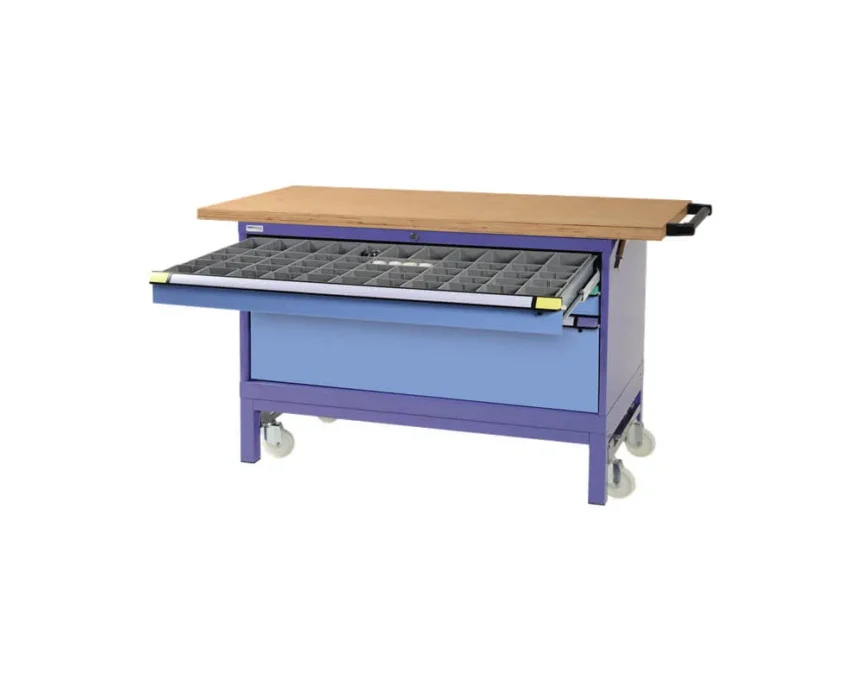
In a production facility, workshop or machine shop, lost time is rarely caused by one major failure. It is usually the accumulation of small delays: searching for a torque wrench, walking to a remote cabinet for fasteners, moving heavy equipment from an unsuitable surface or correcting avoidable handling errors.
A workbench with drawers addresses these problems by combining a stable working surface with organised, point-of-use storage. The result is more than a tidy bench. It is a practical workstation that supports productivity, safety, ergonomics and inventory control.
For UK production facility managers, workshop owners, engineers and manufacturing teams, choosing the right workstation is a strategic decision. The best solution should match the task, the operator, the stored items and the wider workflow. It should also be robust enough for daily industrial use.
This guide explains seven business benefits and provides practical steps for selecting and implementing the right system.
Why a Workbench with Drawers Is a Strategic Asset
A disorganised workstation creates motion waste. In lean manufacturing, this is a non-value-adding activity because it consumes labour without improving the product. Poor storage can also increase damage, stock inaccuracies and manual handling risks.
A properly specified workbench with drawers creates a defined home for tools, components and documentation. It supports 5S principles: Sort, Set in Order, Shine, Standardise and Sustain: while connecting physical organisation with digital inventory systems.
Software can tell a team where an SKU should be located, but the physical workstation must make that location obvious and accessible. Physical organisation is the bedrock of digital efficiency.
1. A Workbench with Drawers Improves Tool and Parts Organisation
The Problem
Open shelves and loose toolboxes make it difficult to maintain consistent locations. Items become stacked, mixed or returned to the nearest available space. This leads to duplicated purchases, misplaced tools and longer retrieval times.
How It Works
Drawers divide the workstation into controlled storage zones. Adjustable partitions, bins, foam inserts and labels allow teams to organise tools and components by:
- Function
- Frequency of use
- Size or weight
- Production line
- Maintenance activity
- Stock Keeping Unit (SKU)
A shallow drawer may be suitable for fasteners or cutting inserts, while a deeper drawer can accommodate power tools, fixtures or larger components. Full-extension drawer runners are particularly useful because they allow operators to see and reach the entire contents.
Practical Implementation Tips
- Apply the Pareto Principle: position the 20 per cent of tools used most often in the easiest-to-reach drawers.
- Store heavy items around waist height where practical, following HSE manual handling guidance.
- Use consistent labels and drawer numbering across multiple workstations.
- Introduce foam shadowing or dedicated compartments for high-value tools.
- Review drawer contents during regular 5S audits.
The outcome is a more reliable tool-control process, with less time spent searching and fewer opportunities for inventory shrinkage.
2. A Workbench with Drawers Reduces Search Time and Supports Productivity
The Problem
Technicians lose productive time when they must leave the workstation to retrieve tools, gauges or consumables. These interruptions are especially costly in maintenance, assembly and quality-control environments where tasks depend on a repeatable sequence.
How It Works
A drawer-equipped workstation acts as a local storage hub. Frequently required equipment remains within the operator’s primary reach zone, reducing unnecessary walking, bending and interruptions.
This supports Just-In-Time (JIT) working by placing the right items at the point of use without overloading the work surface. It also improves workflow standardisation: operators can follow the same sequence because tools are stored in predictable positions.
An organised workbench cannot eliminate every delay, but it can significantly reduce avoidable motion. The time saved on individual retrievals becomes meaningful when multiplied across operators, shifts and working days.
Practical Implementation Tips
- Record how often operators leave their stations during a typical task.
- Measure retrieval time for the most frequently used tools before and after reorganisation.
- Keep inspection equipment separate from general hand tools to prevent damage or misplacement.
- Use mobile drawer units where maintenance teams work across several production areas.
- Link drawer labels to your digital inventory or maintenance-management system.
A workbench with drawers is therefore not simply a furniture purchase. It is an infrastructure improvement that can support higher throughput and better Overall Equipment Effectiveness (OEE).

3. A Workbench with Drawers Supports Better Ergonomics
The Problem
Fixed-height benches and poorly positioned storage force operators to work with raised shoulders, bent backs or extended arms. Repetitive awkward postures can increase fatigue and contribute to musculoskeletal disorders.
How It Works
An adjustable height workbench allows the working surface to be set according to the operator and task. Precision assembly may require a different height from heavy mechanical work, where the operator applies downward force.
A height-adjustable system can also support both seated and standing work. This is valuable in shared work areas where operators of different heights use the same station.
The drawer layout matters as much as the worktop. Frequently accessed drawers should remain within the operator’s comfortable reach. Heavy items should not be stored above shoulder height or at floor level unless they are infrequently handled and suitable for that location.
Practical Implementation Tips
- Set the surface just below elbow height for many manipulative tasks, then validate the position with operators.
- Keep frequently used tools within the primary reach area.
- Position heavier drawers lower in the unit, while avoiding floor-level storage for regularly handled items.
- Provide an adjustable chair or sit-stand option where the process allows it.
- Consult operators before finalising the workstation layout.
Ergonomics is not an optional comfort feature. It is a critical foundation for sustained productivity and safer working practices.
4. Heavy-Duty Construction Provides Stability and Long-Term Value
The Problem
A lightweight bench can flex, wobble or deteriorate when exposed to heavy tools, impact, vibration, oils and continuous use. Drawer runners may become difficult to operate when overloaded, while weak frames can create a safety risk.
How It Works
A heavy duty workbench uses robust steel construction, reinforced frames and worktops selected for the operating environment. Depending on the application, suitable surfaces may include solid beech, multiplex, laminate, stainless steel or a steel-covered top.
The correct specification depends on the load and task. A machine shop may need a highly stable surface for vices, fixtures and tooling. An electronics area may prioritise a static-dissipative surface. An automotive workshop may need impact resistance and easy cleaning.
Never select a bench based only on appearance. Check the manufacturer’s load ratings for the worktop, drawers, shelves and castors. The rating should reflect the maximum intended working load, not merely the average daily load.
Practical Implementation Tips
- List the heaviest items that will be placed on the surface and in each drawer.
- Allow capacity margin rather than operating continuously at the limit.
- Specify lockable castors for mobile units and levelling feet for fixed stations.
- Inspect drawer runners, fasteners and worktop condition as part of planned maintenance.
- Choose established systems with documented quality standards and warranty support.
TEMA supplies robust LISTA and Thurmetall systems for demanding industrial environments. Thurmetall products purchased through TEMA carry a five-year warranty, while workbench tops and electronic parts carry a one-year warranty.
5. An ESD Workbench Protects Sensitive Electronics
The Problem
Electrostatic discharge may be invisible and imperceptible, yet it can damage sensitive electronic components. The result may be immediate failure or a latent defect that appears later in the product lifecycle.
This is particularly important in electronics assembly, testing, repair, e-mobility and high-voltage vehicle systems.
How It Works
An ESD workbench uses a static-dissipative worksurface, grounding connections and compatible accessories to control electrostatic charge. It should form part of a wider ESD Protected Area (EPA) rather than being treated as an isolated piece of equipment.
A compliant ESD setup may also require wrist straps, ESD footwear, suitable flooring, grounded tools, signage, training and periodic verification. The precise requirements should be established through the organisation’s ESD control programme and relevant standards, such as IEC 61340-5-1.

Practical Implementation Tips
- Specify a worksurface designed for ESD control rather than relying on a conventional metal bench.
- Provide a common point ground and verify connections regularly.
- Keep unnecessary insulators, packaging and plastics away from the handling area.
- Mark EPA boundaries clearly and restrict access to trained personnel.
- Document testing, cleaning and compliance checks.
TEMA’s ESD workspace and storage solutions can be configured for specialist electronics and e-mobility applications.
6. Integrated Drawers Improve Safety and Housekeeping
The Problem
Tools left on the worktop or floor can create trip hazards, dropped-object risks and contamination problems. Sharp tooling and heavy components are particularly hazardous when stored without defined locations.
How It Works
A workbench with drawers gives operators a controlled place to put tools away when they are not in use. Lockable drawers can restrict access to high-value or hazardous equipment, while internal dividers prevent items from moving during use.
A clean, uncluttered worktop also makes defects and spillages easier to identify. This supports visual management and helps supervisors confirm whether a workstation is being maintained to the required standard.
Drawer systems should still be used correctly. Overloading, opening several heavy drawers at once or failing to secure a mobile unit can create risks. Follow the manufacturer’s instructions and complete a site-specific risk assessment.
Practical Implementation Tips
- Keep the working surface clear except for items required for the current task.
- Place sharp and heavy tools in dedicated, labelled compartments.
- Use central locking where equipment requires controlled access.
- Include drawer inspection in daily or weekly housekeeping checks.
- Ensure walkways and drawer-opening zones remain unobstructed.
Good storage is a practical safety control, not merely a visual improvement.
7. Modular Configuration Makes the Workstation Adaptable
The Problem
Production requirements change. New SKUs, revised processes, additional equipment and different operator needs can make a fixed workstation obsolete.
How It Works
Modular systems allow teams to combine drawer units, worktops, tool panels, lighting, shelves, electrical accessories and mobile elements. This makes it possible to configure an industrial workbench for a particular task while retaining the ability to expand or reconfigure it later.
LISTA is well suited to configurable industrial workstations and high-density drawer storage. Thurmetall provides durable modular cabinets and workshop equipment for demanding applications. The best choice depends on the required dimensions, load ratings, security, mobility and specialist features.

Practical Implementation Tips
- Begin with a process map rather than a catalogue.
- Identify the tools, components and documents required at each stage.
- Plan for future capacity instead of filling every drawer immediately.
- Use vertical panels or pegboards for tools that need rapid visual access.
- Consider mobile units for changing production cells and fixed stations for repeatable assembly.
For additional ideas, see TEMA’s guide to workshop storage systems and our comparison of industrial drawer cabinets versus shelving.
How to Choose the Right Workbench with Drawers
Use the following checklist before requesting a quotation:
| Requirement | Questions to ask | Suitable specification |
|---|---|---|
| Task type | Is the work mechanical, electronic, assembly or inspection-based? | Select the correct worktop and accessories |
| Load | What are the heaviest tools, fixtures and components? | Confirm surface and drawer load ratings |
| Operator | Will one person or several people use the station? | Consider an adjustable height workbench |
| Storage | Are items small, bulky, sensitive or high-value? | Specify partitions, trays, foam or locking |
| Mobility | Does the station need to move between bays? | Choose castors, brakes and suitable stability |
| ESD | Are electronic components handled outside protective packaging? | Specify a complete ESD workstation and EPA |
| Growth | Will the process or SKU range change? | Choose a modular, expandable system |
The most effective workbench with drawers is the one designed around the work: not the one with the longest feature list.
Implementation Roadmap
A practical rollout can be completed in five stages:
- Audit the current process: Measure search time, walking distance, damaged items and recurring safety issues.
- Classify the inventory: Separate frequently used, heavy, sensitive, hazardous and low-frequency items.
- Design the workstation: Map worktop height, drawer positions, reach zones, lighting and access clearances.
- Pilot one station: Test the configuration with operators and record measurable improvements.
- Standardise and review: Apply successful layouts elsewhere, then review them through 5S audits and operator feedback.
This approach reduces the risk of buying unsuitable equipment and gives decision-makers a clearer business case.
Key Takeaways
- A workbench with drawers reduces search time by placing tools and parts at the point of use.
- Drawer dividers and labels improve SKU control, visual management and stock accuracy.
- A heavy duty workbench provides the stability and durability needed for industrial tasks.
- An adjustable height workbench supports different operators and task-specific working heights.
- An ESD workbench is essential when handling sensitive electronic components, but it must form part of a wider ESD control programme.
- LISTA and Thurmetall systems provide configurable solutions for workshops, manufacturing areas, automotive facilities and e-mobility operations.
- The right workstation should be selected through a workflow audit, not by price or appearance alone.
Conclusion: Build a More Productive Industrial Workstation
The right workbench with drawers becomes a cornerstone of workshop control. It brings tools closer to the operator, reduces unnecessary movement, supports safer working practices and creates a dependable connection between physical storage and digital inventory management.
For general industrial work, LISTA and Thurmetall systems can be configured with robust worktops, drawer units, partitions, tool panels and locking options. For electronics and e-mobility applications, specialist ESD features should be incorporated from the beginning.
TEMA Solutions can help you assess your current layout, identify workflow constraints and specify a workstation around your actual tools, processes and future requirements. Explore the available ranges in the TEMA shop or review our LISTA storage solutions and Thurmetall products.
The next step is simple: audit one workstation, measure the wasted motion and design a storage solution that makes efficient working the default.


