


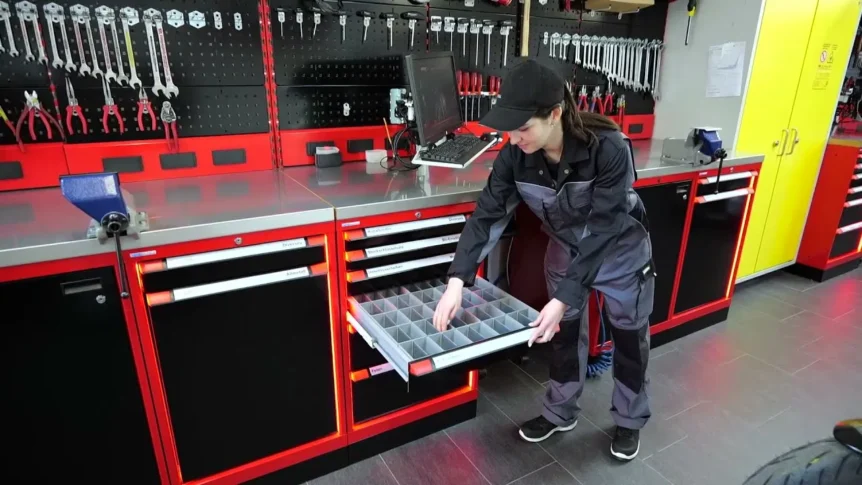
In a production facility, workshop or automotive maintenance area, storage directly affects productivity. Operators lose valuable time when tools are difficult to find, poorly protected or stored too far from the point of use. The resulting motion waste affects throughput, housekeeping, safety and inventory accuracy.
A well-specified tool storage cabinet turns these problems into an operational advantage. It gives every tool, component or SKU a defined location while supporting 5S, ergonomic working and reliable stock control. The right tool storage cabinet also provides a physical foundation for digital systems such as an ERP, CMMS or barcode inventory programme.
This guide examines seven practical tool storage cabinet options, with a focus on LISTA’s modular drawer cabinets, workstations and storage systems. It also explains the specification details that production managers, engineers and workshop owners should confirm before purchasing. If you are comparing solutions for a growing workshop, choosing the right tool storage cabinet is a practical step towards faster retrieval, better stock accuracy and stronger day-to-day control.
1. High-Density Drawer Tool Storage Cabinet
The problem
Open shelving uses valuable floor space inefficiently. Small tools, fasteners and components can become mixed together, while stacked items obstruct access to everything behind them. This increases search time and makes stock discrepancies more likely.
How it works
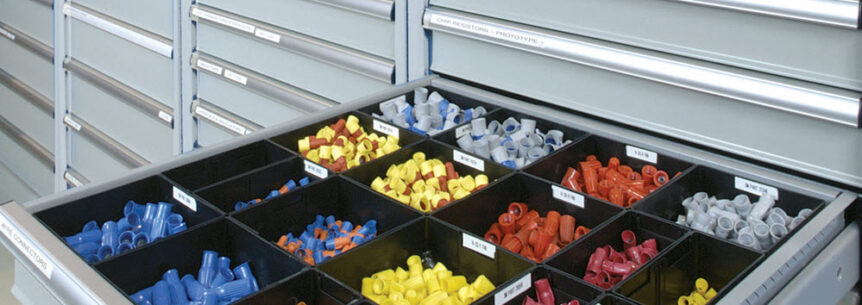
A high-density drawer tool storage cabinet uses vertical space to store a large number of tools and components within a compact footprint. Each drawer can be divided with trays, adjustable partitions, labels or foam inserts.
LISTA drawer cabinets are particularly suitable for facilities that need configurable storage for tools, maintenance parts and production supplies. Different drawer heights allow shallow spaces for small components and deeper drawers for heavier equipment.
Practical implementation tips
- Apply the Pareto Principle: place the most frequently used 20% of items in the easiest-to-reach drawers.
- Keep heavy contents in lower drawers to improve stability and handling.
- Specify full-extension drawers where operators need visibility of the entire drawer.
- Confirm the rated load per drawer rather than relying only on the cabinet’s total capacity.
- Leave spare capacity for new SKUs and future production changes.
For a wider overview of the business case, see TEMA’s guide to industrial storage solutions. If your priority is machining efficiency, also review TEMA’s dedicated tooling storage guide for a broader strategy covering layout, access and control.
2. Mobile Tool Storage Cabinet and Trolley

The problem
A central tool store may be organised, but it can still create unnecessary walking. Maintenance technicians and production teams often travel repeatedly between a fixed cabinet and the machine, assembly cell or repair area.
How it works
A mobile tool storage cabinet brings tools and parts directly to the point of use. LISTA mobile cabinets and workbench units can combine drawers, a worktop, a handle and heavy-duty castors, creating a flexible workstation for maintenance, changeovers and kitting.
Mobility should support the workflow rather than create uncontrolled satellite storage. Less frequently used items should remain in the main store, while high-use items can travel with the technician.
Practical implementation tips
- Calculate the fully loaded weight before selecting castors.
- Choose lockable castors and use brakes whenever the unit is stationary.
- Specify drawers with suitable retention to prevent movement during transport.
- Define a parking location so the trolley is returned after each task.
- Avoid using mobile units as a substitute for a properly controlled tool crib.
TEMA’s guide to tool cabinets on wheels provides further considerations for mobile workshop storage.
3. Roller-Shutter Door Cabinets
The problem
Conventional hinged doors can obstruct aisles and working areas. They are also inconvenient where operators need frequent access to shelves, bins or tools in a narrow workshop layout.
How it works
A roller-shutter tool storage cabinet opens vertically, keeping the door within the cabinet footprint. This makes the format useful beside benches, in tool cribs and along busy walkways. Internal shelves, drawers and bins can be configured for different item sizes.
Roller-shutter cabinets are a practical middle ground between open shelving and fully drawer-based storage. They provide a degree of protection from dust and unauthorised access while accommodating larger or irregularly shaped items.
Practical implementation tips
- Measure the available clearance above the cabinet before installation.
- Use adjustable shelves for bulky items that do not suit drawers.
- Store frequently accessed items between waist and shoulder height.
- Consider a lock where tools, gauges or controlled components are stored.
- Check the cabinet’s shelf load rating using the stated uniformly distributed load (UDL).
4. Wall-Mounted and Storage-Wall Systems
The problem
Small workshops and production cells often have limited floor area. Adding more low-level furniture can reduce aisle width, restrict access and interfere with material flow.
How it works
A wall-mounted tool storage cabinet or modular storage wall uses vertical space while keeping the floor available for people, vehicles and production equipment. LISTA storage systems can combine wall cabinets, drawers, panels, shelving and workstations into one coordinated installation.
This option is valuable where hand tools, consumables and documentation need to remain close to a workbench without occupying additional floor space.
Practical implementation tips
- Confirm the wall construction and fixing method before specifying the system.
- Do not place heavy items overhead unless the installation is designed for them.
- Use wall panels for frequently used hand tools and enclosed cabinets for higher-value equipment.
- Keep emergency equipment, electrical panels and access routes unobstructed.
- Plan the installation around the operator’s normal reach zone.
A wall system works particularly well alongside a workbench with drawers, creating a compact and consistent workstation.
5. Open Shelving Versus Closed Tool Storage Cabinet Systems
The problem
Open shelving provides quick visual access, but it leaves tools exposed to dust, swarf, coolant mist and accidental impact. It can also encourage overstacking and make ownership of individual items unclear.
How it works
Closed tool cabinets provide greater protection, security and visual discipline. Open shelving remains useful for bulky, low-value or frequently replenished items that do not need enclosure. In practice, the most effective workshop often uses both formats.
Use closed drawers for hand tools, calibrated equipment, small parts and high-value assets. Use open shelves for larger containers, packaging materials and items that are too large or irregular for drawers.
Practical implementation tips
- Assess the value, sensitivity and frequency of use for each item category.
- Use one defined location per SKU wherever possible.
- Avoid storing precision tools directly on open shelves.
- Add labels to both open shelving and closed drawers.
- Review slow-moving stock during regular 5S audits.
The choice should be based on workflow and risk, not simply the lowest purchase price. TEMA’s comparison of industrial drawer cabinets and shelving explains the space, access and protection considerations in greater detail.
6. NC and CNC Tooling Cabinets
The problem
CNC holders, cutting tools and related accessories need more protection and control than general-purpose workshop storage. Stacking them loosely can damage interfaces, expose cutting edges and slow down machine preparation.
How it works
An NC or CNC tool storage cabinet uses dedicated holders, cradles or inserts to keep tooling separated and accessible. The configuration can support job kitting, machine-family organisation and controlled returns.
Because NC tooling needs dedicated holders and reliable protection against damage, the cabinet layout should be planned around the exact tooling formats you use. For detailed guidance on machine-shop processes, tool classification and specialised metalworking storage, read TEMA’s dedicated tooling storage guide. You can also pair a specialist tool storage cabinet layout with the company’s article on tool inventory management strategies to improve stock visibility and replenishment discipline.
Practical implementation tips
- Measure the longest complete tool assembly before choosing drawer depth.
- Store each holder in an individual pocket or cradle.
- Separate new, in-use, inspected and damaged tooling.
- Place high-use tooling close to the relevant machine group.
- Link physical drawer locations to your digital inventory codes.
A dedicated cabinet is a strategic asset when the cost of damaged holders, lost tools and delayed changeovers is higher than the storage investment.
7. ESD-Safe Tool Storage Cabinets

The problem
Electrostatic discharge can damage electronic components without visible signs. Standard painted steel cabinets and ordinary foam inserts should not automatically be treated as ESD-safe.
How it works
An ESD-safe tool storage cabinet forms part of a wider electrostatic protected area (EPA). Suitable conductive materials, grounding, ESD-compatible drawer liners, correct handling procedures and regular checks must work together.
LISTA offers storage and workstation solutions for environments handling electronics, sensors, control systems and e-mobility components. Storage must be specified alongside the site’s ESD control programme rather than as an isolated item of furniture.
Practical implementation tips
- Confirm that drawers, inserts and containers are suitable for the required ESD environment.
- Connect cabinets and workstations to the approved grounding system.
- Keep uncontrolled plastics and other insulators outside the EPA.
- Train operators in correct handling and storage procedures.
- Review TEMA’s guide to ESD workbench benefits before planning an electronics workstation.
What to Check Before Buying a Tool Storage Cabinet
For many buyers, the decision is not simply about capacity. The correct tool storage cabinet should support retrieval speed, asset protection, stock accuracy and future flexibility without creating unnecessary motion waste.
A tool storage cabinet should be specified against the work, the contents and the environment. Use the following checklist during supplier discussions.
| Requirement | What to confirm | Why it matters |
|---|---|---|
| Drawer configuration | Number, height, depth and internal clear dimensions | Prevents wasted capacity and unsuitable storage |
| Drawer extension | Full-extension capability and safe operating load | Improves visibility and reduces reaching |
| Load rating | Per-drawer, cabinet and shelf capacity | Protects users and prevents premature failure |
| Security | Central locking, key control or electronic access control | Supports accountability for high-value tools |
| Mobility | Castor rating, brakes, handles and floor conditions | Prevents instability and unsafe movement |
| Layout | Aisle width, reach zones and point-of-use position | Reduces motion waste and ergonomic strain |
| ESD requirements | Conductive materials, grounding and compatible inserts | Protects sensitive electronic components |
| Future capacity | Spare drawers, partitions and modular expansion | Supports changing SKUs and production demands |
Electronic access control is appropriate where the business needs an audit trail showing who accessed a cabinet and when. For lower-risk storage, a central key lock may be sufficient. The correct choice depends on asset value, operational risk and the company’s control procedures.
How to Implement the Right Tool Cabinets
Begin with a short audit rather than ordering furniture immediately. Record search time, walking distance, damaged tools, stock discrepancies and recurring housekeeping problems. Then classify items according to frequency, size, weight, sensitivity and security requirement.
Next, map the workflow from receipt and inspection to storage, use, return and replenishment. A tool storage cabinet should be positioned where it reduces movement without blocking production routes or emergency access. Where possible, connect each tool storage cabinet layout to your wider tooling process so physical organisation supports consistent digital records.
Pilot one workstation, maintenance area or tool crib. Measure retrieval time and stock accuracy before and after installation. Involve operators in drawer layouts because practical acceptance is essential to sustaining 5S.
LISTA is well suited to configurable storage walls, drawer cabinets, mobile units and ergonomic workstations. Thurmetall also provides durable industrial cabinets and workshop systems, with a five-year warranty on Thurmetall products purchased through TEMA Solutions. Workbench tops and electronic components carry a one-year warranty.
Storage installations should also support the wider safety programme. The Health and Safety Executive’s PUWER guidance is a useful external reference for the safe provision and use of work equipment.
Conclusion: Make Storage a Productivity Asset
The best tool storage cabinet does more than hold equipment. It reduces search time, protects valuable assets, supports safer handling and makes the correct 5S behaviour easier to sustain.
For most industrial workshops, the strongest solution is a coordinated combination of high-density LISTA drawer cabinets, mobile units, wall storage, enclosed cabinets and specialist ESD or NC configurations. The selection should reflect actual tool usage, load requirements, workflow and future capacity.
TEMA Solutions provides consultative support to help businesses plan layouts and specify LISTA and Thurmetall systems around their facilities. Review the LISTA tool box range, explore the wider tooling storage guide, browse the tool inventory management strategies article and visit the TEMA Solutions shop to compare storage options before discussing your next tool storage cabinet project.
The right storage system is a critical foundation for an organised, safer and more productive workshop.


