


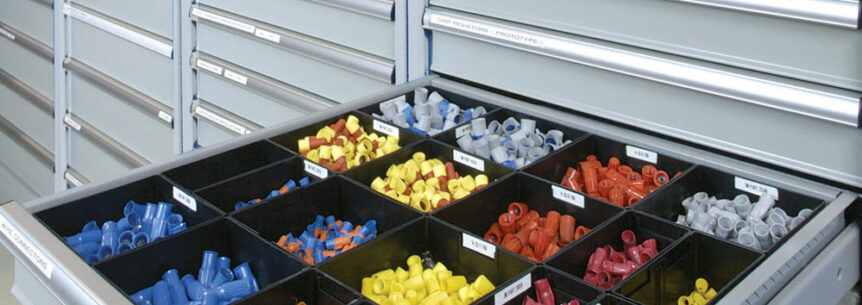
In a production facility, machine shop or automotive workshop, storage directly affects productivity.
Operators lose time when tools and components are difficult to locate, stored in unsuitable drawers or positioned too far from the point of use. Repeated across multiple shifts, these delays increase labour costs, extend changeover times and reduce inventory accuracy.
The right industrial drawer cabinets turn storage from a basic facilities requirement into a strategic business asset. They create defined locations for tools, parts and equipment while supporting 5S, JIT replenishment, ergonomic working and reliable digital stock control.
However, selecting the right cabinet requires more than comparing external dimensions or purchase prices. Drawer height, load rating, runner design, access control and environmental conditions all affect long-term performance.
This six-step guide explains how to specify the right solution for your facility. It focuses on selection and configuration rather than simply comparing cabinet types.
Step 1: Assess Your Inventory and Workflow
The problem
A cabinet selected without an inventory audit may have the wrong drawer depths, insufficient capacity or an unsuitable position within the workflow. Small components may be placed in deep drawers, while bulky tools are forced into shallow compartments. Both situations waste capacity and slow retrieval.
Poor positioning creates the same issue. Even a well-organised cabinet becomes inefficient if operators must walk across the workshop every time they need a frequently used tool or SKU.
How it works
Start by classifying what you need to store:
- Hand tools and power tools
- Fasteners, bearings and small components
- Jigs, fixtures and maintenance parts
- Gauges and calibrated equipment
- Electronics and ESD-sensitive components
- Heavy tooling or machine accessories
Then record the frequency of access, dimensions, weight, value and sensitivity of each category. The Pareto Principle is useful here: the most frequently used 20% of items should normally receive the most accessible locations.
Map the movement of each item from receipt and inspection through to storage, use, return and replenishment. This reveals whether a fixed cabinet, mobile unit or integrated workstation is the most appropriate solution.
Practical Tips
- Measure actual items rather than relying on assumptions.
- Record the maximum expected weight for each drawer.
- Assign high-use items between waist and shoulder height.
- Keep heavy items in lower drawers.
- Allow spare capacity for new SKUs and changing production requirements.
- Use the same location codes in the physical cabinet and your ERP, CMMS or inventory system.
TEMA’s guide to industrial storage solutions provides a broader overview of how storage can support workshop efficiency.
Step 2: Choose the Right Drawer Configuration and Heights
The problem
Using one drawer height for every item creates wasted space. Shallow components become difficult to organise in deep drawers, while larger tools may be stacked or left on nearby benches because the available drawers are too small.
This also undermines visual management. When items are piled together, operators cannot immediately see whether a tool or component is missing.
How it works
Select a combination of drawer heights based on the inventory audit. Shallow drawers are generally suitable for dividers, trays, fasteners and small electrical parts. Medium-height drawers can accommodate hand tools, fixtures and maintenance components. Deeper drawers are better suited to larger tools, boxed parts and heavier equipment.
The objective is usable cubic capacity, not simply the largest possible drawer volume. A well-configured cabinet allows every drawer to be divided into logical locations, reducing searching and preventing mixed SKUs.
LISTA is particularly strong in this area. Its engineering heritage, dating back to 1945, supports a broad range of configurable drawer cabinets, internal dividers and workstation combinations. This makes it suitable for facilities where the storage layout must be tailored to the actual contents.

Practical Tips
- Use adjustable partitions for changing component ranges.
- Give each SKU a defined compartment wherever practical.
- Avoid placing small parts in drawers that are deeper than necessary.
- Use foam inserts for precision tools or repeatable tool kits.
- Label drawers externally and compartments internally.
- Keep the most frequently accessed items in the operator’s primary reach zone.
For a wider discussion of the space and access benefits, see TEMA’s comparison of industrial drawer cabinets and shelving.
Step 3: Check Load Ratings and Construction Quality
The problem
A cabinet may appear robust but still be unsuitable for dense metal parts, power tools or fixtures. Overloaded drawers place excessive stress on runners, frames and handles. Partial-extension runners can also make heavy drawers difficult to operate and prevent safe access to the rear of the drawer.
It is critical to distinguish between the per-drawer rating, total cabinet rating and runner rating. These figures are not interchangeable.
How it works
When comparing industrial drawer cabinets, check the following specifications:
- Dynamic drawer load – the weight the drawer can safely support while opening and closing.
- Static load – the weight supported while the drawer remains closed.
- Runner type – full-extension ball-bearing runners generally provide better access than basic partial-extension slides.
- Frame construction – welded or reinforced steel construction is typically more appropriate for intensive industrial use than light sheet-metal furniture.
- Steel gauge or sheet thickness – ask for the actual specification, because gauge terminology can vary between manufacturers.
- Cycle-life testing – important in facilities where drawers are opened frequently throughout every shift.
- Cabinet stability – confirm anti-tip measures, levelling and fixing requirements.
Full-extension runners allow the operator to reach the rear of the drawer without leaning over the cabinet or removing front items. For heavy or wide drawers, ask whether the runner arrangement is designed for the stated load under normal operating conditions.
Do not design to 100% of the published capacity. A sensible operating margin accounts for uneven loading, repeated movement and future changes to the contents.
Practical Tips
- Calculate the maximum contents weight, not the average weight.
- Keep normal operating loads below the published maximum.
- Ask whether ratings are based on static or dynamic testing.
- Confirm whether mobile cabinets require a different load calculation.
- Inspect runner quality, locking mechanisms and handle construction.
- Request technical documentation before approving a purchase.
The specifications should be recorded as part of your facility’s risk assessment and maintenance programme.
Step 4: Plan Security and Access Control
The problem
Tools, gauges, electronic components and specialist equipment may be valuable, sensitive or subject to calibration controls. Unrestricted access can increase losses, unauthorised use and difficulty tracing damaged or missing items.
However, excessive security can also create operational friction. If operators cannot access essential tools quickly, they may bypass the system and leave equipment on benches or machines.
How it works
Match access control to the asset risk:
- Central key locking suits many general workshop applications.
- Separate locking zones can distinguish maintenance, production and quality equipment.
- Electronic access control can provide an audit trail showing who accessed a cabinet and when.
- Controlled key management can support lower-cost accountability where electronic systems are unnecessary.
- Individual drawer locks or interlocks may be appropriate for specialised or high-value equipment.
The correct approach depends on the value of the contents, the number of users and the level of traceability required. Access control should support the workflow rather than become a barrier to safe and efficient work.
Practical Tips
- Identify high-value and calibrated assets separately.
- Keep spare keys or access credentials under controlled ownership.
- Define what should happen when tools are lost, damaged or overdue.
- Link cabinet access rules to your tool-crib or maintenance procedure.
- Review access records if repeated discrepancies occur.
- Include security requirements in the initial specification, not as an afterthought.
Step 5: Consider Modularity and Expansion
The problem
Production environments change. New product lines, additional machines, revised layouts and increased SKU counts can make a fixed storage installation unsuitable within a few years.
Replacing an entire cabinet system is disruptive and creates unnecessary capital expenditure. A solution designed without future capacity can also force teams back towards loose boxes, temporary shelving and uncontrolled bench storage.
How it works
Modular industrial drawer cabinets allow businesses to expand or reconfigure storage as requirements develop. Modules may include drawer cabinets, worktops, wall panels, shelves, lighting, electrical accessories and mobile units.
LISTA is well suited to this approach because its cabinets and workstations can be configured around different tasks and combined into wider storage systems. A maintenance area may require deep drawers and a worktop, while an electronics cell may need ESD-compatible surfaces, component storage and controlled access.
Thurmetall provides heavy-duty industrial cabinets for demanding workshop and production environments. Thurmetall products purchased through TEMA Solutions carry a five-year warranty. Workbench tops and electronic parts carry a one-year warranty.

Practical Tips
- Leave physical space for future modules.
- Standardise cabinet widths and location codes across similar work areas.
- Pilot the layout in one production cell before wider deployment.
- Specify compatible dividers, inserts and accessories from the outset.
- Consider mobile units where production layouts change regularly.
- Review capacity every six or twelve months.
A modular system protects the value of the initial investment while allowing the storage programme to evolve with the business.
Step 6: Factor in the Working Environment
The problem
A cabinet suitable for a clean assembly area may perform poorly beside a CNC machine. Coolant mist, heavy swarf, dust, moisture, impact and static electricity all place different demands on storage equipment.
Choosing a general-purpose cabinet for a specialist environment can lead to corrosion, contamination, component damage or difficult cleaning.
How it works
Specify the cabinet around the conditions in which it will operate.
ESD environments: Electronics, sensors, battery-management components and control assemblies may require ESD-compatible drawers, liners, bins and grounding. An ESD cabinet must form part of the wider electrostatic protected area (EPA), alongside appropriate flooring, worktops, personnel controls and verification procedures.
Coolant and mist: Machine-shop storage should be easy to wipe down and positioned away from direct spray where possible. Closed drawers offer better protection than open shelving, but the cabinet should not be assumed to be liquid-tight without confirmation.
Heavy swarf: Choose robust construction and plan for regular cleaning. Consider drawer fronts, plinths and clearances that will not trap chips or interfere with floor maintenance.
Clean rooms and controlled assembly areas: Prioritise cleanability, low-particle operation and compatible surface finishes. Any required clean-room classification or validation must be confirmed with the supplier and site quality team.

Practical Tips
- Describe the environmental conditions during the enquiry.
- Specify ESD requirements by system standard and grounding method.
- Confirm coating and corrosion-resistance requirements.
- Keep cabinets away from direct coolant splash where possible.
- Establish cleaning and inspection intervals.
- Do not introduce ordinary insulating plastics into an EPA without approval.
TEMA can help match LISTA and Thurmetall equipment to workshop, automotive, electronics and production environments. The ranges are supported by certified manufacturing systems, including ISO 9001 quality management, ISO 14001 environmental management and ISO 45001 occupational health and safety management. You can also review the ISO 9001 quality management guidance for further context.
Industrial Drawer Cabinets Specification Checklist
Use this checklist when comparing quotations and technical proposals:
| Requirement | What to confirm | Why it matters |
|---|---|---|
| Inventory | Contents, dimensions, weight and access frequency | Prevents unsuitable capacity |
| Drawer layout | Number, height, depth and clear internal dimensions | Maximises usable space |
| Runners | Full-extension, ball-bearing design and load rating | Improves access and operating life |
| Construction | Steel gauge, reinforcement and welded or bolted assembly | Supports durability |
| Load capacity | Dynamic drawer, cabinet and accessory ratings | Prevents overloading |
| Security | Key, central, electronic or zoned access | Protects assets and supports traceability |
| Modularity | Compatible drawers, worktops, panels and future modules | Supports expansion |
| Environment | ESD, coolant, swarf, moisture or clean-room conditions | Protects contents and equipment |
| Installation | Floor loading, fixing, levelling and anti-tip requirements | Supports safe deployment |
| Warranty | Product-specific cover and exclusions | Clarifies long-term support |
How to Implement the Right Storage System
Begin with a focused audit of one high-friction area. Measure retrieval time, walking distance, stock discrepancies, damaged tools and recurring housekeeping issues. Then classify the inventory and map its movement through the facility.
Pilot the proposed layout with operators. Their feedback will identify practical issues that may not be visible on a floor plan. Once the pilot is working, standardise labels, location codes, replenishment rules and audit routines.
A workbench with drawers can provide an effective starting point for a production cell or maintenance station. For portable operations, review the LISTA tool box range. Where the project involves wider workshop planning, TEMA’s tool storage cabinet options guide provides additional context without replacing the detailed specification process set out here.
Storage should also form part of the wider workplace safety programme. The HSE’s PUWER guidance covers the provision, use, inspection, maintenance and training associated with work equipment.
Conclusion: Specify Storage Around the Work
The best industrial drawer cabinets are selected around the inventory, workflow and operating environment: not simply around price or external dimensions.
The six-step process is straightforward:
- Audit the inventory and workflow.
- Match drawer heights to the contents.
- Verify load ratings, runners and construction.
- Select proportionate security and access control.
- Plan for modular expansion.
- Specify for ESD, coolant, swarf, clean-room or other environmental conditions.
LISTA provides premium configurable storage with strong engineering heritage and extensive drawer and workstation options. Thurmetall provides durable heavy-duty cabinets backed by a five-year warranty through TEMA Solutions.
If you are reviewing your workshop layout, visit the TEMA Solutions shop or contact TEMA to discuss your inventory, floor plan and operational requirements. A consultative specification at the start is the critical foundation for a safer, more organised and more productive facility.


