


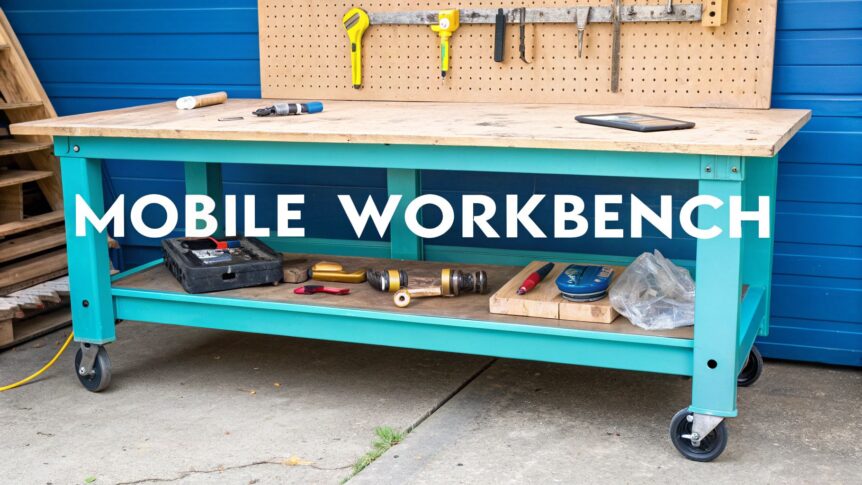
A good workbench with wheels is far more than just a table you can roll around. I’ve come to see it as the command centre of my workshop, a strategic piece of kit that lets me reconfigure my entire space in minutes to fit whatever project I’m tackling.
Why Mobile Workbenches Are a Workshop Game Changer
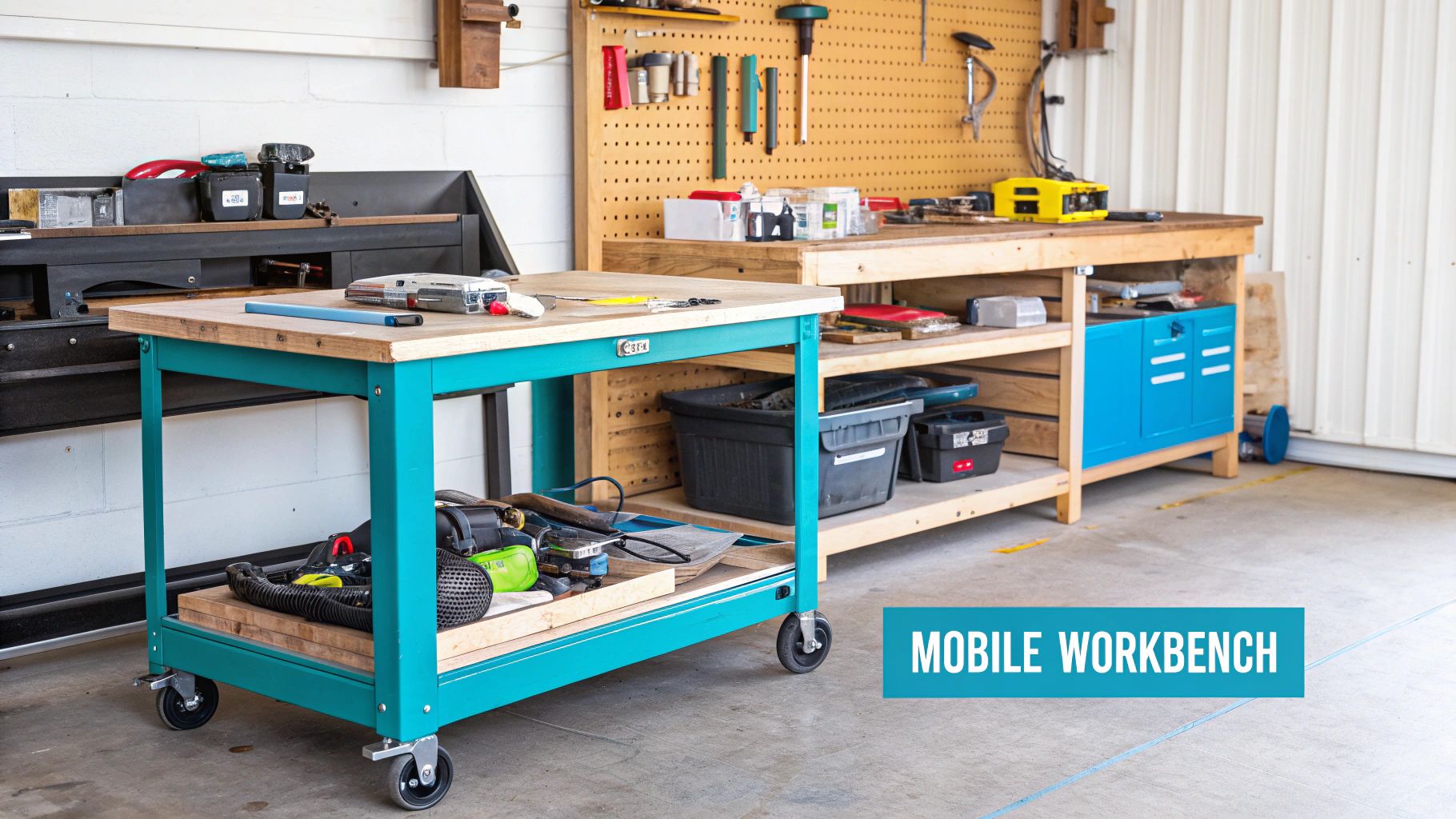
Let’s get past the obvious fact that it moves and talk about the real-world difference that makes. A traditional, fixed workbench anchors your whole process to one spot. I can’t count the hours I’ve wasted walking materials back and forth, not to mention the sketchy moments trying to lug something heavy and awkward across the floor.
A mobile workbench completely changes that dynamic. Instead of taking the project to the bench, you take the bench to the project. It sounds simple, but it has a massive impact on how you get things done.
Maximising Your Space and Workflow
If you’re working in a tight UK garage or a shared industrial unit, a workbench on wheels is a lifesaver. It gives you the power to set up temporary, specialised work zones whenever you need them.
- Project-Specific Layouts: Working on a car? Roll your bench right up next to the engine bay. Doing some detailed woodworking? Position it directly under the best light.
- Improved Safety: This is a big one. You can bring your sturdy work surface directly to heavy items like engine blocks or large timber sheets. This drastically reduces the risk of strains and accidents from carrying them.
- Easier Cleaning: Workshop cleanup is so much faster when you can just roll your main workstation out of the way to get at the sawdust, metal shavings, and other mess underneath.
There’s a reason the market for these is growing. The global workshop workbench market was valued at around $5.2 billion in 2023, and it’s expected to grow at about 6.1% annually through 2032. This boom is all about meeting modern workshop demands and putting a bigger focus on safety. For a deeper dive, you can explore the full workbench market report for more on these trends.
A mobile workbench isn’t just about saving space; it’s about reclaiming it. By allowing you to adapt your layout instantly, it makes your workshop feel larger and function more intelligently, ensuring every square metre is used to its full potential.
The Power of Integrated Organisation
Many modern mobile workbenches come with built-in storage like drawers and cabinets. This isn’t just a nice-to-have feature; it’s a massive efficiency boost. When your most-used tools are stored right at your workstation, you spend less time hunting for a 10mm socket and more time actually working.
Let’s look at a straight comparison. Here’s how a mobile workbench redefines your workspace compared to a traditional fixed setup.
Mobile vs Fixed Workbench: A Quick Comparison
| Feature | Impact on Your Workshop |
|---|---|
| Mobility | Creates dynamic work zones that adapt to any project you’re on. |
| Fixed Position | Restricts your workflow, forcing you to carry materials to a single spot. |
| Space Utilisation | Frees up floor space when not in use, which is ideal for smaller workshops. |
| Safety | Reduces the need for manual handling of heavy or awkward items. |
In the end, choosing a workbench with wheels is an investment in a more flexible, safer, and more productive way of working. It’s a foundational piece of equipment that adapts to you, not the other way around.
Choosing the Right Workbench With Wheels
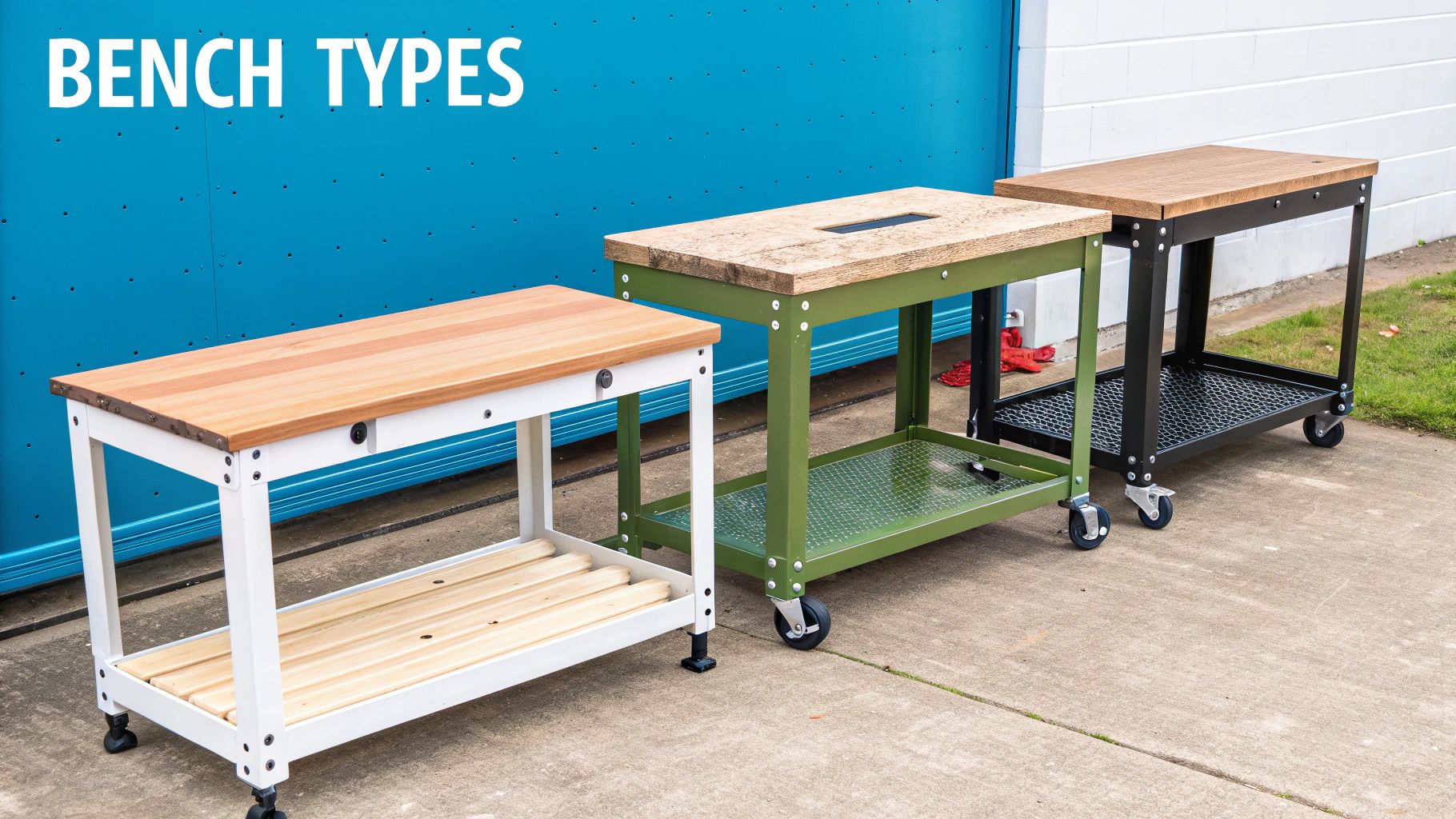
Picking out the perfect wheeled workbench isn’t about finding the one that looks the toughest; it’s about matching the bench to the jobs you actually do. It’s a surprisingly personal choice. The needs of someone assembling delicate electronic components are miles away from those of a mechanic wrestling with a heavy, oil-soaked gearbox.
The first big decision you’ll face is the material. For most engineering, fabrication, or heavy mechanical work, a robust steel frame is your best bet. It provides fantastic rigidity and won’t flinch at the knocks, scrapes, and spills that are part and parcel of that kind of work.
On the other hand, a solid wood or butcher block top gives you a much more forgiving surface. This is what you want for fine woodworking or electronics, as it’s far less likely to scratch or damage your project. Plus, let’s be honest, a wooden top has a classic workshop feel that many of us just prefer.
Getting to Grips With Load Capacity
One of the most critical specs to check is the load capacity. This number tells you exactly how much weight the bench can safely handle. It’s incredibly easy to underestimate this, so take a moment to think about your heaviest possible job. Don’t forget to include the weight of any tools you might clamp onto it, like a hefty bench vice or a grinder.
Don’t just plan for your average project; think about your most demanding one. A bench that sways or flexes under a heavy load isn’t just annoying—it’s a serious safety risk. Your workbench needs to feel absolutely rock-solid, even on wheels.
The demand for mobile workbenches is on the rise, especially in the UK’s manufacturing and automotive sectors. Industrial-grade metal workbenches with castors are often engineered to support up to 800 kilograms, built for intensive use where reconfiguring a space quickly is essential.
Picking the Right Worktop Surface
Beyond the frame, the worktop surface itself is a huge decision. Each material offers its own set of pros and cons depending on the kind of work you do.
- Stainless Steel: An excellent choice for automotive work or any job that gets messy. It’s non-porous, a breeze to clean, and stands up well against oil, grease, and most chemicals.
- Solid Wood/Butcher Block: As we’ve touched on, this is the go-to for woodworking and general craft. It’s tough but kinder to your projects. If it gets damaged over the years, you can always sand it down and refinish it.
- MDF (Medium-Density Fibreboard): This is a budget-friendly option that gives you a perfectly smooth, flat surface. It’s usually coated for extra durability, but be warned—if that coating gets chipped, it can be vulnerable to moisture damage.
It’s also worth looking outside your specific field for inspiration. For instance, exploring examples of large mobile work surfaces used in commercial kitchens can offer great insights into stability and functional design, even if they’re from a different industry.
Finally, get the tape measure out. A new workbench should make your life easier, not create a new obstacle course. Make sure you have enough room not only to park the bench but to move it around to different areas of your workshop. And don’t forget to account for the clearance needed for any drawers or cupboards to open fully.
For a truly flexible setup, pairing your bench with other mobile storage is a fantastic move. If that sounds interesting, you might want to read our guide on why https://tema-solutions.co.uk/tool-cabinets-on-wheels-the-ultimate-mobile-workshop-solution/.
Getting to Grips with Castors and Mobility
The whole point of a wheeled workbench is, of course, the wheels. But here’s where things can go wrong. The quality of those castors is what separates a nimble, helpful assistant from a wobbly, frustrating hazard. Let’s break down what you need to know.
At the end of the day, the castor system has to do two things perfectly. It needs to glide smoothly when you’re moving the bench across the workshop, but it absolutely must lock down solid when you’re putting your weight into a project. A flimsy castor isn’t just annoying; it’s a safety risk and kills your productivity.
This quick guide lays out the thought process for picking the right mobile workbench, from looking at your space to nailing down the features you need.
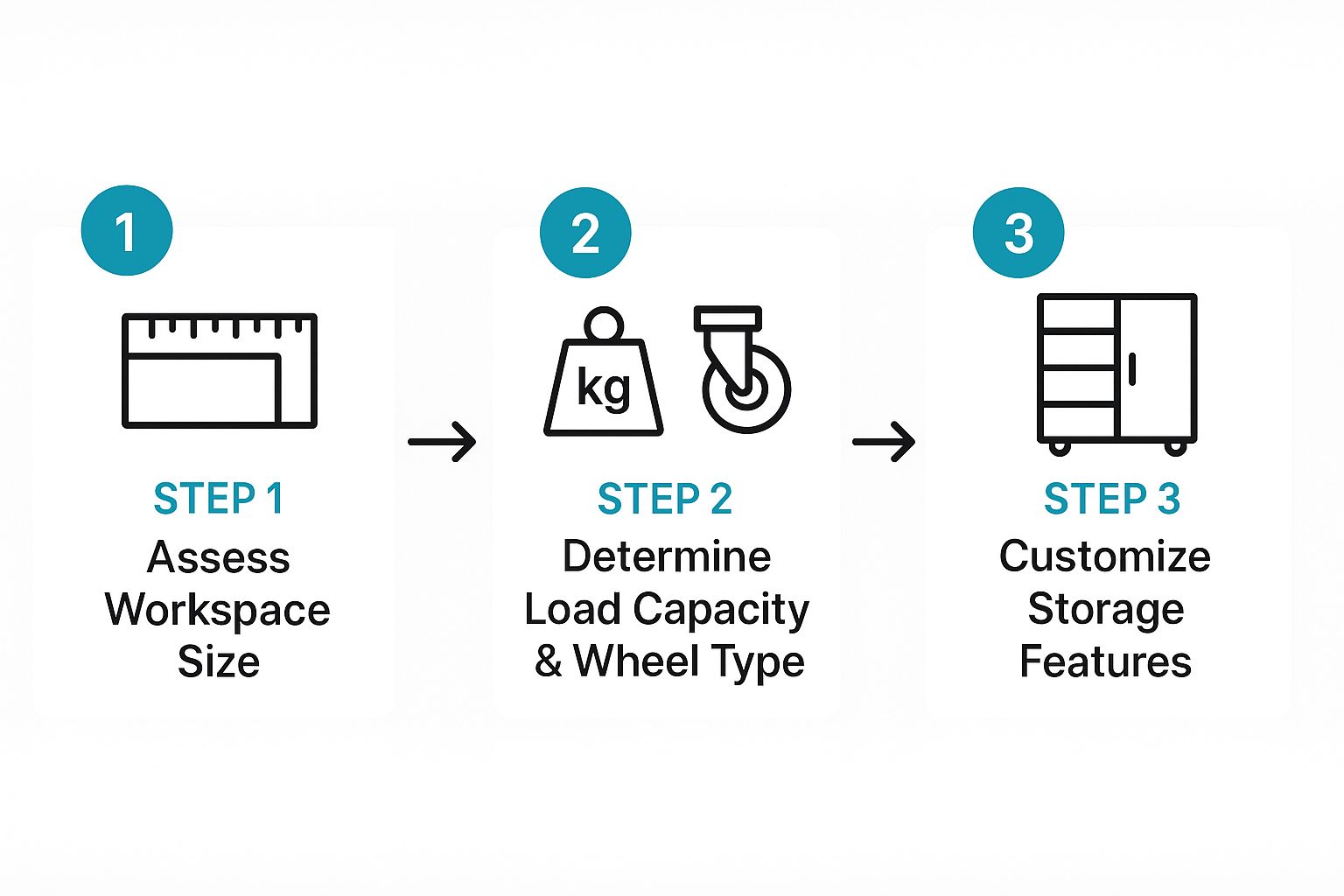
As you can see, once you’ve figured out your space and how much weight you’ll be loading, the next logical step is to dive into the mobility features like wheel types.
A Look at Castor Types
Not all castors are built the same. You’ll usually find a mix of three main types, combined to give you the best of both worlds—easy movement and sturdy stability.
- Swivel Castors: These are the ones that spin a full 360 degrees. Putting four of these on a bench makes it incredibly easy to manoeuvre, which is a lifesaver in a crowded garage or a workshop with tight corners.
- Rigid (or Fixed) Castors: Just as the name suggests, these only roll in a straight line, forwards and back. A very common and practical setup is two swivel castors at one end and two rigid ones at the other. This gives you great control for steering it in a straight line, a bit like pushing a shopping trolley.
- Locking Castors: Honestly, this is a non-negotiable feature. A good lock does more than just stop the wheel from rolling; it should also lock the swivel action in place. This dual-locking mechanism is what stops any drift or wobble, turning your mobile bench into a rock-solid workstation.
When you’re leaning into a saw or a drill, your mobile bench needs to feel like it’s bolted to the floor. The strongest frame means nothing if the castors can’t lock down tight. I always recommend testing the locks—they should completely freeze both the wheel and the swivel.
Choosing the Best Wheel Material
The actual material of the wheel makes a massive difference, too. What works best really comes down to your workshop floor and the kind of debris you expect.
For most people, polyurethane is a fantastic all-rounder. It’s tough, handles heavy loads without complaining, and won’t leave marks on sealed concrete or epoxy floors. It’s also got a bit of chemical resistance, a nice perk if you’re working on cars.
On the other hand, hard rubber wheels are brilliant at soaking up vibrations and keeping things quiet, which you’ll appreciate if you’re constantly rolling over rough concrete or tiled floors. The only downside is they can sometimes leave scuffs on lighter-coloured flooring. For truly heavy-duty industrial settings, you might even find cast iron or phenolic wheels, which are all about immense load capacity.
Setting Up Your Mobile Workbench for Peak Efficiency
Getting your new wheeled workbench out of the box is exciting, but that’s just the start. The real magic happens when you set it up thoughtfully, turning it from a simple rolling table into the true heart of your workshop. A smart setup is all about matching the bench to the way you work.
First things first, find its ‘home’. Even a mobile bench needs a primary parking spot. I always think in terms of a ‘work triangle’ – the path between your bench, your pillar drill, and maybe a big bandsaw. The fewer steps you take between these key stations, the more energy you’ll save throughout the day. You’d be amazed how much that adds up.
Turning Your Bench into a Command Centre
Once you’ve figured out its main location, it’s time to accessorise. This is where you really get to customise the bench for your specific jobs. Think about all those little repetitive tasks you do and find ways to make them faster.
Over the years, I’ve found a few simple additions make a massive difference:
- Magnetic Tool Holders: A magnetic strip bolted to the side of a steel bench is perfect. It keeps your go-to spanners, pliers, and screwdrivers right where you can grab them without thinking.
- Paper Towel Dispenser: If you’re doing any kind of mechanical work or finishing, having paper towels on hand for instant clean-ups is a lifesaver.
- Integrated Power: Securely mount a multi-socket extension lead to one of the legs. This little trick means you’re not constantly searching for a free wall socket every time you pick up a power tool.
It’s not just about adding things, either. How you organise the built-in storage is crucial. To get some solid ideas on that, our guide on maximising efficiency with workshop drawers is packed with practical tips.
Getting the Most from Key Features
A couple of features on any good mobile bench need special attention during setup. Getting these right is vital for both safety and performance.
The big one is mounting a vice. A vice is only as strong as its mounting. You absolutely must position it directly over a leg and castor. This channels all the force from clamping, hammering, and filing straight down to the floor, giving you a rock-solid platform and preventing the worktop from bending. Always bolt it right through the top, using large, load-spreading washers on the underside.
A vice mounted in the middle of an unsupported worktop is just asking for trouble. It’ll make the surface sag, ruin your accuracy, and could permanently damage the bench. Always, always mount it over a leg.
Finally, don’t forget about the height adjustment if your bench has it. This isn’t a one-and-done setting. Drop it down when you’re sitting for detailed work and raise it up for standing jobs like assembly. Taking a moment to get the ergonomics right will save your back and neck, making those long hours in the workshop much more comfortable and productive.
Looking After Your Workbench for the Long Haul
You’ve invested in a quality wheeled workbench, and it’s a genuine asset to your workshop. To make sure it stays that way for years to come, a bit of regular care is all it takes. Think of it less as a chore and more as a simple routine that protects your investment.
These aren’t time-consuming tasks. We’re talking about quick, targeted checks on the parts that matter most. A few minutes here and there will keep your bench rolling smoothly and standing strong, always ready for whatever project you throw at it.
Protecting the Worktop
The worktop takes the most punishment, and how you look after it depends entirely on what it’s made of. Get this wrong, and you could do some real damage.
- Butcher Block & Solid Wood: Beautiful, but thirsty. These surfaces can dry out, stain, or crack. A regular wipe-down is a given, but every few months, treat it to a coat of food-safe mineral oil or a proper worktop conditioner. This feeds the wood and helps it repel spills.
- Stainless Steel: Tough and resistant to most workshop chemicals. A simple wipe with soapy water is usually enough. For a streak-free finish, use a dedicated stainless steel cleaner and always wipe along the grain to avoid tiny scratches.
- Powder-Coated Steel or MDF: Generally the easiest to care for. Just use a damp cloth and a bit of mild detergent. Steer clear of abrasive pads or harsh chemicals that could scratch the finish or eat through the protective coating.
Keeping the Wheels Rolling Smoothly
The castors are what make your mobile bench mobile. If you neglect them, that smooth-gliding bench quickly becomes a stubborn, wobbly mess. A quick check every month or so will catch most problems before they start.
First, get in there and clear out any debris. It’s amazing how wood shavings, bits of wire, and other floor gunk can get tangled around the axles. Then, grab a spanner and check the bolts holding the castors to the frame—workshop vibrations can work them loose over time. A quick tighten keeps everything secure. A little squirt of spray lubricant into the swivel bearings will also keep them turning freely.
Your workbench should only move when you want it to. A castor that sticks when you’re pushing the bench or drifts when it’s locked isn’t just annoying; it kills your workflow and can even be a safety issue.
Checking the Frame and Drawers
The frame is the skeleton of your workbench. Every so often, just cast your eye over the main joints and bolts, especially where the legs meet the top. You’re looking for any signs of stress, like flaking paint or tiny cracks, which might suggest you’ve been overloading it.
If your bench has drawers, their smooth operation is crucial for an efficient workspace. A sticky drawer is often just a symptom of built-up dust in the runners. Pull it all the way out and give the slides a good clean. While you’re at it, have a think about how you’re using that space. Popping some divider storage boxes inside is a brilliant way to stop small parts from rattling around, protecting the drawer lining and making it much faster to find what you need.
Got Questions About Mobile Workbenches? We’ve Got Answers
https://www.youtube.com/embed/-K8MuKu7c34
Even after you’ve weighed up all the options, a few questions can pop up right before you commit. It makes sense—a good workbench is a real investment in your workshop’s flow, so you want to be completely sure you’re making the right call.
Over the years, we’ve heard just about every question in the book. Getting these common queries sorted is usually the final step people need to feel confident in their choice. Let’s dig into some of the things people ask us most often.
Are They Genuinely as Sturdy as a Fixed Bench?
This is the big one, and I get why people ask. The short answer is yes, absolutely—as long as you invest in a model with a solid frame and, crucially, high-quality locking castors. The stability of a well-made workbench with wheels today is night and day compared to some wobbly old trolley.
Modern locking systems don’t just stop the wheels from rolling; they stop them from swivelling, too. Engaging the locks on a quality bench creates a surprisingly rigid and secure work surface, more than stable enough for the vast majority of jobs you’ll throw at it.
For really heavy-duty work, like aggressive hammering or using a large bench vice, my advice is to find a bench where all four castors lock. A decent system effectively turns your mobile station into a fixed, rock-solid platform right when you need it most.
How Much Weight Capacity Do I Realistically Need?
This really boils down to what you’re building or fixing. It’s incredibly easy to underestimate the total weight once you add up a project, a stack of tools, and a heavy vice.
A good way to think about it is:
- For General DIY & Woodworking: A bench rated for 250–500 kg is usually the sweet spot. This will comfortably handle most hobbyist projects, power tools, and bench-mounted gear without breaking a sweat.
- For Heavy-Duty Use: If you’re doing things like car maintenance, engine rebuilds, or metal fabrication, you have to aim higher. Look for a heavy-duty workbench rated for 700 kg or more. You need that extra muscle to safely support the serious weight of things like engine blocks.
Always look for the Uniformly Distributed Load (UDL) rating and be realistic about the heaviest tasks you’ll ever perform. If you plan for your most demanding job, you’ll never have to second-guess your bench’s strength.
Is an Adjustable Height Feature Actually Worth the Extra Money?
For a lot of people, yes, it’s a game-changer. The ergonomic benefits are huge, particularly if you spend long stretches in the workshop or find yourself switching between very different tasks.
Think about it: you might be doing some fine, detailed work sitting down one minute, then standing up to do a larger assembly the next. An adjustable bench lets you bring the work surface to the perfect height for your posture, which does wonders for preventing back and neck ache. It’s not just about comfort; it helps you stay focused and productive. And if more than one person uses the bench, a height-adjustable feature is practically a must-have.
Ready to find a mobile workbench that will completely reorganise your workspace? The experts at TEMA Solutions Limited can guide you to the perfect, high-quality solution for your specific needs. Explore our industrial workstations and start building a more effective workshop today.


