


In a production facility, workshop or machine shop, small delays quickly become significant costs. Operators search for tools, walk to remote stores, move heavy components unnecessarily and work around cluttered benches. Repeated across shifts, these interruptions reduce throughput, increase fatigue and make accurate inventory control more difficult.
Well-planned industrial storage solutions turn these hidden losses into measurable operational improvements. They provide defined locations for tools, components and equipment while supporting 5S, lean manufacturing, ergonomics, safety and digital stock management.
This guide introduces ten practical categories for UK industrial businesses. It is designed as an overview: use it to identify priorities, then explore the specialist resources linked throughout the article.
Why Industrial Storage Solutions Are a Strategic Asset
Poor storage is not simply untidy. It creates motion waste, increases the risk of damaged equipment and makes stock records less reliable. When a commonly used tool cannot be found, the cost includes lost labour time, delayed production and potentially an unnecessary replacement purchase.
The right industrial storage solutions address these issues by combining:
- High-density capacity to make better use of vertical space
- Point-of-use access to reduce walking and searching
- Clear identification for improved traceability
- Ergonomic positioning to reduce unnecessary reaching and bending
- Controlled access for high-value, hazardous or calibrated items
- Modular design to accommodate future process changes
The Pareto Principle is useful when planning. In many workshops, a relatively small proportion of tools and SKUs accounts for most daily activity. Those items should be stored in the easiest-to-reach locations.
1. High-Density Industrial Drawer Cabinets
The problem
Open shelving and loose containers consume valuable floor space. Small parts become mixed, heavy items are stacked unsafely and operators must search through several boxes to find one SKU.
How it works
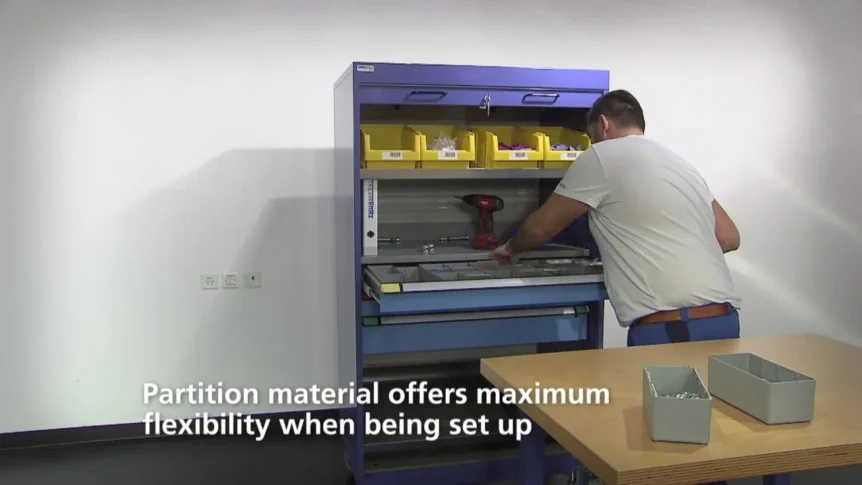
Industrial drawer cabinets use vertical space efficiently while presenting the contents at a practical working height. Drawers can be configured with dividers, trays, labels and foam inserts for tools, fasteners, fixtures and components.
These industrial storage solutions also improve visual control. A missing item is easier to identify when every drawer has a defined capacity and location.
Practical tips
- Store frequently used items between waist and chest height.
- Keep heavy contents in lower drawers.
- Label every drawer with a consistent location code.
- Leave spare capacity for new SKUs and seasonal demand.
- Check drawer and cabinet load ratings before specifying equipment.
TEMA supplies robust LISTA and Thurmetall systems for demanding industrial environments. Thurmetall products purchased through TEMA carry a five-year warranty.
2. Tool Cribs and Controlled Tool Stores
The problem
A tool crib without clear issue and return procedures becomes dependent on individual knowledge. Tools move between departments, duplicate purchases increase and high-value equipment may be difficult to trace.
How it works
A dedicated tool crib creates a controlled storage point for hand tools, power tools, gauges, calibration equipment and maintenance items. Cabinets can be organised by tool family, department, machine group or usage frequency.
Access control can range from a simple key system to central locking or electronic access management. The appropriate level depends on the value, risk and movement of the equipment.
For a more detailed guide to specialist machine-shop organisation, see TEMA’s article on tooling storage.
Practical tips
- Define “available”, “in use”, “inspection” and “quarantine” locations.
- Record check-out and return requirements for high-value tools.
- Use shadow boards or foam inlays for frequently used equipment.
- Audit the most active tool categories weekly.
- Link physical locations to your CMMS, ERP or inventory system.
These industrial storage solutions work best when the physical cabinet and digital record use the same location codes.
3. NC and Machine-Shop Tooling Storage
The problem
CNC tooling, holders and cutting tools require more protection than general-purpose shelving provides. Stacked holders can be damaged, cutting edges may be exposed and operators may waste time preparing jobs.
How it works
Purpose-designed NC storage keeps tooling upright, separated and accessible. Drawer cabinets, machine cabinets, transport trolleys and dedicated cradles can support tool preparation, machine-family organisation and controlled returns.
TEMA’s metalworking NC storage solutions are intended for machine shops handling specialist tooling and accessories.

Practical tips
- Match drawer depth to the longest tool assemblies in use.
- Separate new, used, damaged and regrinding tooling.
- Place high-frequency tools close to the relevant machine group.
- Use mobile transport units where tooling travels between the crib and machines.
- Clean and inspect holders before returning them to storage.
Good industrial storage solutions protect expensive tooling while supporting faster setups and more reliable changeovers.
4. ESD-Protected Storage Zones
The problem
Electrostatic discharge can damage electronic components without being visible or detectable by the operator. Poorly controlled storage may also expose PCBs, sensors and battery-management components to unsuitable surfaces or packaging.
How it works
An ESD-protected area combines a suitable work surface, grounding, compatible tools, personnel protection, signage and ESD-safe storage. Drawers, bins and cabinets must form part of the wider control programme rather than being treated as isolated furniture.
TEMA’s ESD workbench benefits guide explains how specialist workstations support electronics, e-mobility and repair teams.
Practical tips
- Define EPA boundaries clearly.
- Use ESD-safe bins and drawer linings.
- Keep unnecessary plastics and insulators outside the controlled area.
- Test grounding connections according to your internal programme.
- Train operators and record verification checks.
For further guidance, review TEMA’s ESD workspace and storage solutions. These industrial storage solutions help connect component protection with repeatable production quality.
5. Ergonomic Workstations and Benches
The problem
Operators lose time when tools, documentation and components are positioned outside the normal reach zone. Fixed-height benches can also encourage awkward postures, particularly where several people use the same station.
How it works
An ergonomic workstation combines a stable worktop with integrated drawers, shelves, lighting, power and accessories. Adjustable-height options support seated and standing work, while point-of-use storage reduces unnecessary motion.
A correctly specified bench should reflect the task. Mechanical assembly, electronics testing, inspection and maintenance may require different surfaces, heights and storage configurations.
See TEMA’s guide to the benefits of a workbench with drawers and the features to assess in a heavy-duty workbench.
Practical tips
- Ask operators to test proposed heights and drawer positions.
- Keep frequently used tools within the primary reach zone.
- Store heavy items where they can be handled safely.
- Confirm surface, drawer and castor load ratings.
- Use mobile benches only where mobility supports the workflow.
Ergonomic industrial storage solutions reduce avoidable movement and support sustained productivity.
6. Modular Workshop Furniture
The problem
Production requirements change. New SKUs, revised processes and additional equipment can quickly make fixed furniture unsuitable.
How it works
Modular workshop furniture allows cabinets, worktops, drawer units, shelves, tool panels, lighting and electrical accessories to be combined into a coherent system. It can be expanded or reconfigured without replacing the entire installation.
LISTA is well suited to configurable workstations and high-density storage. Thurmetall provides durable cabinets and workshop equipment for demanding applications.
Practical tips
- Start with a process map rather than a catalogue.
- Design around the tools and components actually used.
- Standardise workstation layouts across similar production cells.
- Allow for future capacity.
- Use mobile modules where product mix or line layout changes regularly.
This modular approach makes industrial storage solutions a long-term operational investment rather than a short-term furniture purchase.
7. Mobile Trolleys and Point-of-Use Storage
The problem
Central storage can be well organised yet still create excessive walking. Maintenance teams and production operators may repeatedly travel between a cabinet and the machine or assembly point.
How it works
Mobile drawer units, tooling trolleys and picking carts bring equipment directly to the work area. They are particularly useful for maintenance, changeovers, kitting and flexible production cells.
The trolley should complement, not replace, the main storage system. Frequently used items can be held locally, while less common or high-value equipment remains in a controlled central store.
Practical tips
- Select castors rated for the fully loaded trolley.
- Use brakes and secure drawers on sloping or busy floors.
- Create a standard trolley layout for repeatable tasks.
- Return mobile units to a defined parking location.
- Avoid overloading the trolley with rarely used items.
When planned around material flow, mobile industrial storage solutions reduce motion waste without creating uncontrolled satellite stores.
8. Small-Parts Bins, Dividers and Visual Management
The problem
Fasteners, electrical parts and consumables are easy to mix or miscount. Poor visibility leads to stock-outs, excess purchasing and avoidable assembly errors.
How it works
Compartmentalised drawers, bins and trays create a visual management system. Labels, colour coding, min/max markers and Kanban cards make shortages and incorrect returns easier to identify.
This is where physical organisation supports digital efficiency. An ERP system may identify an SKU, but the operator still needs a clear and accessible physical location.
Practical tips
- Use one location for each SKU wherever possible.
- Label both the front of the drawer and the internal compartments.
- Set minimum and maximum quantities based on consumption data.
- Position high-use parts close to the assembly process.
- Review obsolete and slow-moving stock during 5S audits.
These industrial storage solutions improve stock accuracy because the intended location and quantity are visible.
9. 5S and Lean Workshop Organisation
The problem
Storage projects often fail because equipment is installed without changing behaviours. Within weeks, tools return to benches, aisles become obstructed and locations lose their meaning.
How it works
Use the five 5S stages:
- Sort – remove obsolete, damaged and duplicate items.
- Set in order – assign a defined home to every tool and SKU.
- Shine – clean cabinets, drawers, benches and floors.
- Standardise – use consistent labels, layouts and replenishment rules.
- Sustain – audit, train and improve the process continuously.
Practical tips
- Photograph the agreed standard for each workstation.
- Use short end-of-shift checks.
- Measure search time, walking distance and stock discrepancies.
- Involve operators in layout decisions.
- Treat recurring audit failures as evidence of a design problem, not simply a discipline problem.
The most effective industrial storage solutions make the correct behaviour simple, visible and repeatable.
10. Safety, Security and Compliance
The problem
Overloaded drawers, unstable cabinets, blocked walkways and unsecured hazardous materials can create serious workplace risks. Storage must support the site’s risk assessments and operating procedures.
How it works
Specify cabinets and furniture according to load, stability, access, environment and contents. Lockable storage can protect high-value or hazardous equipment. Heavy items should be positioned to reduce manual-handling risk, while aisles and access routes must remain clear.
The HSE guidance on PUWER covers the provision, use, inspection, maintenance and training associated with work equipment. Storage systems should be incorporated into the wider workplace safety programme.
TEMA’s ranges are manufactured to recognised quality standards, including ISO 9001, ISO 14001 and ISO 45001.
Practical tips
- Confirm cabinet and drawer load ratings.
- Secure tall units where required by the manufacturer or risk assessment.
- Keep emergency routes and access zones clear.
- Separate hazardous materials using suitable controlled storage.
- Document inspections, maintenance and operator training.
Safety is a non-negotiable part of specifying industrial storage solutions.
Comparison Checklist for Workshop Managers
| Requirement | Questions to ask | Suitable approach |
|---|---|---|
| Tool access | What is used most frequently? | Point-of-use drawers or mobile units |
| Space | Is floor area restricted? | High-density vertical cabinets |
| Tool protection | Are items precision or contamination-sensitive? | NC cabinets and dedicated cradles |
| Electronics | Are ESD-sensitive parts handled? | EPA-compatible workstations and storage |
| Flexibility | Will the process change? | Modular furniture |
| Traceability | Do tools or SKUs require control? | Location codes, labels and digital records |
| Safety | Are items heavy, hazardous or high-value? | Lockable, rated and risk-assessed storage |
How to Implement Industrial Storage Solutions
Use a phased approach:
- Audit the current state: Measure search time, walking distance, damaged items and stock discrepancies.
- Classify the inventory: Separate high-use, heavy, sensitive, hazardous, obsolete and low-frequency items.
- Map the workflow: Follow materials from receipt and storage through to use, return and replenishment.
- Pilot one area: Test a cabinet, workstation or tool crib with operators.
- Measure the result: Track retrieval time, stock accuracy, housekeeping findings and setup delays.
- Standardise and expand: Apply successful layouts across comparable work areas.
TEMA Solutions takes a consultative approach, helping businesses match LISTA and Thurmetall equipment to their actual floor plan, tools, operators and production processes. Browse the LISTA tool box range or visit the TEMA Solutions shop to review available options.
Conclusion: Make Storage a Cornerstone of Workshop Performance
The right storage system improves more than appearance. It reduces wasted motion, protects tools and components, supports safer handling and provides the physical foundation for accurate digital inventory control.
From industrial drawer cabinets and NC tooling storage to ESD workstations, mobile trolleys and 5S visual management, the best industrial storage solutions are designed around the work. They create an organised environment in which efficient behaviour becomes the default.
Start with one high-friction area, measure the waste and build a practical improvement plan. TEMA Solutions can help you identify the right configuration and develop a storage programme that supports productivity, quality and long-term growth.


