


In an industrial workshop, mobility is a productivity decision: not simply a matter of convenience. A fixed workstation can force operators to carry tools, components and fixtures across the facility. A well-specified mobile workbench brings the working surface and essential tooling storage to the point of use.
That can reduce walking, support JIT production, improve housekeeping and make workshop layouts easier to reconfigure. It is particularly valuable in automotive maintenance, machine shops, assembly areas, MRO operations and changing production cells.
The right solution must still be stable, safe and durable. Castors, brakes, load capacity, worktop material, drawer configuration and ergonomics all require careful specification. This guide explains seven practical options and how to select the correct system for your operation.
Why choose a mobile workbench?
A mobile workbench is most effective where the operator, workpiece or process changes location regularly. It can reduce unnecessary movement while keeping high-use tools and parts organised.
This is not a substitute for every fixed bench. Fixed workstations remain appropriate for heavy, repetitive processes where equipment is permanently installed. Mobility becomes valuable when:
- Maintenance teams work across several machines.
- Production layouts change between product runs.
- Large or awkward components should not be carried to a remote bench.
- Shared tooling must move between work areas.
- A workstation needs to be cleared or repositioned for cleaning.
- Operators require immediate access to point-of-use tooling storage.
The physical layout also supports digital efficiency. An ERP, CMMS or barcode system may identify an SKU location, but that location must be clearly organised and accessible in the real workshop.

1. LISTA mobile workbench with drawers
The problem
Loose toolboxes and remote cabinets create search time, unnecessary walking and cluttered worktops. Small parts can also become mixed, damaged or difficult to count.
How it works
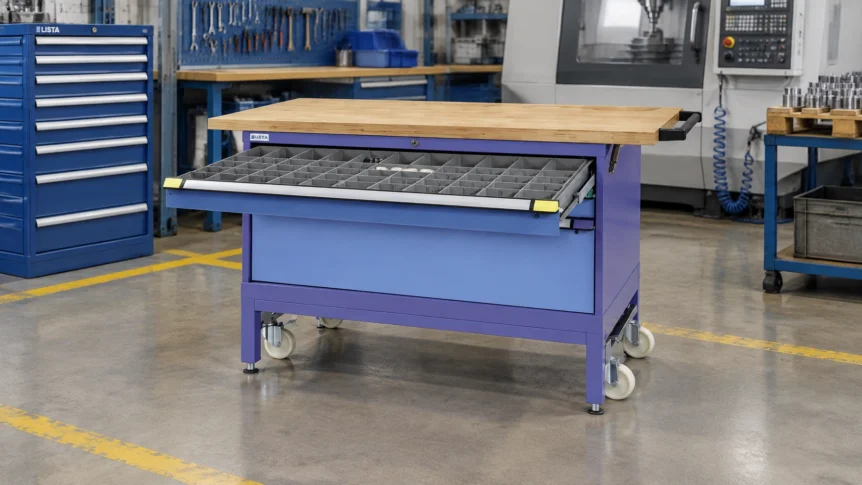
A LISTA mobile workbench with drawers combines a robust worktop with lockable, organised tooling storage. Drawers can be configured with dividers, trays, foam inserts and labels for tools, fasteners, components or maintenance equipment.
A genuine LISTA system workbench mobile configuration listed by TEMA measures 1,250 × 700 × 877 mm and includes a KEY Lock option. The exact drawer layout, worktop and accessories should be selected around the application.
Practical tips
- Apply the Pareto Principle: keep the 20% of tools used most frequently closest to the operator.
- Store heavy tools in lower drawers to improve stability.
- Use consistent drawer labels and SKU references.
- Confirm drawer load ratings as well as the total bench rating.
- Lock the castors before opening loaded drawers or applying force.
This is usually the strongest all-round option where the team needs both a workbench with wheels and dense point-of-use storage.
2. Mobile drawer cabinet with a worktop
The problem
Some workshops need more secure storage than an open bench can provide. High-value tooling, spare parts and controlled equipment should not remain exposed on shelves or temporary tables.
How it works
A mobile drawer cabinet supports secure tooling storage while its top provides a practical surface for inspection, kitting or light assembly. It is compact enough to move between bays but provides greater storage density than a basic trolley.
A mobile cabinet may be the right choice where the worktop is secondary and storage capacity is the priority. LISTA mobile drawer cabinets are available in several sizes and configurations through the TEMA Solutions shop.
Practical tips
- Separate frequently used tools from reserve stock.
- Use central or key locking where access must be controlled.
- Confirm that drawers have safety catches for movement.
- Check the turning space and route before selecting cabinet width.
- Avoid opening multiple heavily loaded drawers simultaneously unless the manufacturer permits it.
3. Rolling workstation for changing production cells
The problem
A fixed workstation can become a constraint when production lines change, new SKUs are introduced or teams work across several cells. Reinstalling fixed furniture for every layout change is disruptive and costly.
How it works
A rolling workbench combines a mobile frame, worktop, drawers and accessories such as lighting, power, tool panels or monitor arms. It can be positioned beside the current operation and moved when the process changes.
This configuration is suitable for assembly, inspection, maintenance and production support. It turns tooling storage into a flexible production asset rather than a fixed point in the building.
Practical tips
- Map the operator’s workflow before deciding the accessory arrangement.
- Leave clearance for drawers, handles, cables and turning movements.
- Define a standard parking position when the workstation is not in use.
- Keep the centre of gravity low when loading drawers or shelves.
- Use a pilot cell before standardising the layout across the facility.
4. Mobile ESD workbench
The problem
Electrostatic discharge can damage PCBs, sensors, power modules and battery-management components without visible evidence. A standard metal bench should not automatically be treated as ESD-safe.
How it works
A mobile ESD workstation combines a dissipative worktop with appropriate grounding, ESD-compatible tooling storage, personnel controls and verification procedures. The bench must remain part of the site’s ESD Protected Area, or EPA, after it has been moved.
The ESD Association standards resource provides authoritative information on ESD programme development. Requirements should also be considered alongside the relevant site standards and risk assessments.
Practical tips
- Specify measurable surface resistance and grounding requirements.
- Use ESD-compatible bins, drawer liners and component trays.
- Test the bench after relocation or modification.
- Keep ordinary plastics and unapproved packaging outside the EPA.
- Train operators and include checks in the maintenance programme.
Mobility is useful in electronics and e-mobility operations, but only when the complete ESD control system moves with the workstation.
5. Mobile assembly bench
The problem
Assembly work often changes between components, fixtures and product variants. A bench that is too small, too low or poorly organised creates reaching, waiting and repeated handling.
How it works
A mobile assembly bench provides a stable surface for kitting, sub-assembly, inspection or repair. It may include drawers, shelves, lighting, power and vertical panels for accessible tooling storage.
Worktop material should reflect the task. Beech or multiplex can suit general assembly, while steel, stainless steel or specialist surfaces may be more appropriate for heavier, cleaner or chemically demanding work.
Practical tips
- Position frequently used tools within the primary reach zone.
- Keep documentation, components and fixtures visible but controlled.
- Select height and accessories around the operator: not just the product.
- Confirm the worktop rating, including vices and mounted equipment.
- Consider an adjustable-height configuration where operators or tasks vary.
For wider selection criteria, see TEMA’s industrial workbench buying guide and adjustable-height workbench guidance.
6. Mobile tool trolley combined with a bench
The problem
A conventional trolley transports tools but may not provide a suitable working surface. Operators then move the trolley and search for a separate table or bench.
How it works
A tool trolley with an integrated top combines transport, storage and a compact work area. It is suitable for planned maintenance, inspection, service work and production changeovers.
This is a practical tool bench with wheels where the contents are task-specific. It should not become an uncontrolled satellite store. A defined contents list makes missing tools easier to identify and improves replenishment.
Practical tips
- Create a standard inventory for each trolley.
- Use foam shadowing, dividers or labelled compartments.
- Keep the heaviest items low.
- Specify castors for the fully loaded weight.
- Inspect the trolley at the end of each task or shift.
Where greater capacity or heavier work is required, upgrade to a full mobile workbench with industrial drawers and a rated worktop.
7. Mobile NC and CNC setup station
The problem
CNC holders, cutting tools and fixtures can be damaged or mixed when transported in unsuitable containers. Poor identification also increases setup time and the risk of selecting the wrong tool.
How it works
A mobile NC station provides dedicated tooling storage and a preparation surface for CNC tooling. Holders can be positioned according to standards such as ISO-SK, HSK, VDI or Capto, then moved between the tool crib, setup area and machine.
A dedicated NC transport unit is often more suitable than a general drawer cabinet where holders require locating positions and protection.
Practical tips
- Confirm the tooling standard before specifying inserts or holders.
- Separate clean, used, damaged and regrinding tools.
- Label locations by tool number, machine or job.
- Match drawer or holder depth to the longest assembly.
- Review TEMA’s specialist tooling storage solutions.
Mobile versus fixed workbenches
| Requirement | Mobile workbench | Fixed workbench |
|---|---|---|
| Layout flexibility | Can move between cells or bays | Remains in one defined location |
| Point-of-use access | Brings tools to the work | Requires the work to come to the bench |
| Stability | Depends on frame and castor brakes | Usually maximised through fixed feet or anchoring |
| Best application | Maintenance, changeovers and shared work | Repetitive, permanent production tasks |
| Floor planning | Requires routes and turning clearance | Requires a fixed footprint |
| Storage | Can combine drawers and mobility | Can support larger integrated systems |
| Reconfiguration | Fast and relatively low disruption | More difficult and costly |
The correct decision depends on the process. Mobility should be specified where it removes measurable movement or handling waste: not simply because the bench can roll.
Buying criteria for a mobile workbench
Before requesting a quotation, assess the complete system.
- Castor type and rating
Choose castors for the fully loaded bench, not the empty frame. Swivel castors improve manoeuvrability; fixed castors can provide more predictable straight-line travel. Follow the manufacturer’s rating and account for uneven loading and dynamic forces. - Braking and stability
Brakes should prevent unintended rolling. For demanding applications, specify a system that also restricts swivel movement. Operators must engage the brakes before assembly, inspection or force-intensive work. - Loaded weight
Add the frame, worktop, drawers, tools, fixtures, components and future capacity. Do not operate continuously at the absolute limit. - Frame and worktop
Select steel construction and a worktop suited to impact, oil, chemicals, heat, moisture or ESD requirements. Check whether a vice or press can be mounted safely. - Drawer configuration
Match drawer heights and depths to the tools and SKUs being stored. Full-extension runners, dividers and safety catches improve access and control. - Ergonomics
Position the worktop and storage around the task and operator. TEMA’s workbench with drawers guide explains how point-of-use storage supports productivity and safer working. - ESD requirements
If sensitive electronics are handled, specify the complete EPA: worktop, grounding, storage, flooring, personnel protection and verification.
The HSE manual-handling guidance states that hazardous manual handling should be avoided where reasonably practicable, with remaining risks assessed and reduced. That principle should inform route design, push-and-pull forces and the decision to bring a workstation to the load.
Implementation approach
A successful mobile workbench installation starts with the process rather than the catalogue.
- Audit the current state: Record walking distance, search time, setup delays and manual handling concerns.
- Classify the contents: Separate high-frequency tools, heavy items, sensitive components, reserve stock and controlled equipment.
- Design the workstation: Select the worktop, castors, drawers, accessories and tooling storage around the real task.
- Pilot one area: Involve operators and measure retrieval time, housekeeping and usability.
- Standardise the result: Create drawer labels, ownership rules, replenishment procedures and parking locations.
- Review after implementation: Adjust the layout when product mix, equipment or workflow changes.
TEMA supplies LISTA and Thurmetall systems for industrial workshops, production facilities, automotive businesses and e-mobility operations. Thurmetall products purchased through TEMA carry a five-year warranty. Workbench tops and electronic parts carry a one-year warranty, subject to the applicable product terms.
Thurmetall manufacturing references ISO 9001, ISO 14001 and ISO 45001, covering quality management, environmental management and occupational health and safety management.

Key takeaways
- Choose a mobile workbench when moving the workstation reduces walking, carrying or layout disruption.
- LISTA mobile benches can combine robust worktops, drawers, castors and organised tooling storage.
- Match castors and brakes to the fully loaded system.
- Specify worktop material according to the task and environment.
- Use ESD-compatible components as part of a complete EPA.
- Mobile NC stations can improve CNC setup control and protect tooling.
- Pilot one workstation before rolling the design out across the facility.
- Consider warranties, quality systems, maintenance and total cost of ownership: not only purchase price.
- Pair mobile benches with wider workshop storage systems and tool cabinets on wheels where appropriate.
Conclusion: make mobility work for the process
The right mobile workbench becomes a controlled productivity asset. It brings the working surface, tools and components closer to the job while allowing the workshop to adapt as processes change.
The best specification is not necessarily the largest or most mobile model. It is the one that matches the load, route, task, operator, storage requirement and future operating conditions.
TEMA Solutions can help you configure a LISTA or Thurmetall workstation for maintenance, assembly, CNC setup, electronics or automotive applications. Browse the TEMA Solutions shop or contact the team to discuss your workspace and tooling storage requirements.
Start with one high-friction workstation, measure the wasted movement and design mobility into the process.


