


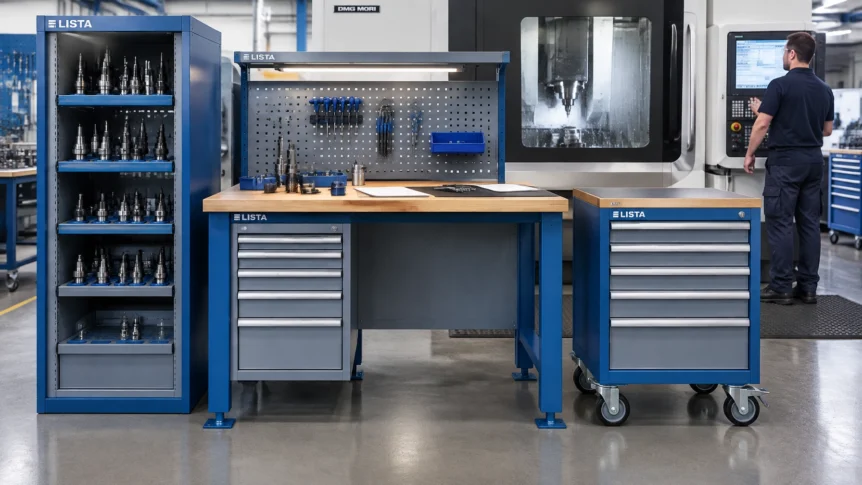
In an industrial workshop, storage is a productivity asset: not simply a housekeeping requirement. Time spent searching for tools, walking to remote cabinets or handling poorly protected components directly affects throughput, safety and operating cost.
The right workshop storage systems create defined locations, shorten retrieval times and support more reliable workflows across machine shops, automotive workshops and production facilities. TEMA Solutions supplies modular LISTA and Thurmetall solutions designed around heavy-duty use, ergonomic access and long-term durability.
This guide explains the nine principal system categories, how they work and what to assess before buying.
How workshop storage systems improve industrial performance
Disorganised storage creates motion waste, stock inaccuracies and avoidable manual handling. The Pareto Principle is useful when planning: a relatively small proportion of tools and SKUs typically accounts for most daily activity. Those high-frequency items should be positioned closest to the point of use.
Effective workshop storage systems connect physical organisation with digital inventory control. A CMMS, ERP or barcode system is only reliable when every tool and component has a defined physical home.

1. Heavy-duty drawer cabinets
Problem
Open shelving and loose containers waste floor space. Small components become mixed, heavy items are stacked unsafely and technicians spend time searching through multiple boxes.
How it works
Heavy-duty drawer cabinets use vertical space efficiently while presenting tools, parts and consumables at a practical working height. Drawers can be configured with dividers, trays, foam inserts and labels for controlled storage of multiple SKUs.
LISTA drawer cabinets are particularly suitable for high-density storage in maintenance areas, toolrooms and production facilities. Thurmetall cabinets provide robust steel construction for demanding workshop environments.
Practical tips
- Check the load capacity per drawer and per cabinet.
- Place heavy items in lower drawers.
- Keep frequently used tools between waist and chest height.
- Use central locking where valuable equipment is shared.
- Leave spare capacity for future stock growth.
For further guidance, see TEMA’s guide to tool storage cabinet options.
2. Workbenches with integrated storage
Problem
A bench without nearby storage forces operators to reach, bend or walk repeatedly for tools and components. This creates unnecessary motion and can encourage clutter on the work surface.
How it works
A workbench with integrated drawers, cabinets, shelving and accessories creates a complete point-of-use workstation. The layout can be configured around assembly, repair, inspection or testing tasks.
The worktop height, drawer position and accessory arrangement should reflect the operator and the task. Adjustable solutions are valuable where a workstation is shared between seated and standing users.
Practical tips
- Match worktop height to the main task and user group.
- Keep high-frequency tools within the primary reach zone.
- Confirm the worktop capacity, including vices or mounted equipment.
- Select a surface suitable for oils, impact, chemicals or ESD requirements.
- Review TEMA’s industrial workbench buying guide before specifying a complete workstation.
3. Mobile tool trolleys and rolling cabinets
Problem
A central tool store can remain organised while still causing excessive walking. Maintenance teams and operators may travel repeatedly between machines, benches and storage areas.
How it works
Mobile drawer units, tool trolleys and rolling cabinets bring equipment directly to the point of work. Locking castors provide stability when stationary, while secure drawers help prevent tools moving or falling during transport.
A mobile unit should support a defined task rather than become an uncontrolled satellite store.
Practical tips
- Calculate the fully loaded weight before selecting castors.
- Specify brakes that prevent both rolling and swivelling.
- Use lower drawers for heavy tools.
- Create a standard layout for repeatable maintenance or changeover tasks.
- Provide a defined parking location when the trolley is not in use.
Read TEMA’s guide to tool cabinets on wheels for a more detailed comparison of mobile options.
4. NC and CNC tooling storage
Problem
CNC holders, cutting tools, collets and accessories can be damaged when stored loose, stacked or in unsuitable shelving. Poor identification also increases setup time and the risk of selecting the wrong tool.
How it works
Dedicated NC storage uses tool-holder-specific inserts, cradles, drawers or transport units to keep tooling upright, separated and protected. This supports faster preparation, easier visual checks and more controlled movement between the tool crib and machines.
TEMA’s metalworking NC storage solutions are designed for machine shops requiring orderly storage and transport of metal-cutting tools.

Practical tips
- Specify the relevant holder standard, such as HSK, BT, CAT, ISO-SK or VDI.
- Separate new, used, damaged and regrinding tooling.
- Match drawer depth to the longest tool assemblies.
- Label locations by tool number, machine group or job.
- Use mobile NC transport units where tools regularly move between areas.
5. ESD-protected storage and workstations
Problem
Electrostatic discharge can damage sensitive electronics without visible evidence. Standard benches, packaging and storage may not provide the controlled environment required for PCBs, sensors or e-mobility components.
How it works
ESD storage forms part of a complete protected area, incorporating suitable worktops, grounding, compatible containers, personnel controls and operating procedures. LISTA ESD equipment uses specialist components intended to dissipate charges in a controlled manner.
These systems are relevant to electronics assembly, testing, repair and battery-related production.
Practical tips
- Define the electrostatic protected area clearly.
- Use suitable ESD drawers, bins and liners.
- Confirm grounding and continuity requirements.
- Test the workstation after relocation or modification.
- Use TEMA’s ESD workstation guide when planning electronics areas.

6. Shelving and rack systems
Problem
Low-level shelving can consume valuable floor space, while unsuitable shelves may sag, overload or make stock difficult to access.
How it works
Industrial shelving and rack systems provide flexible storage for containers, packaged components, maintenance stock and larger equipment. LISTA shelving can be configured for different levels, drawer units, pull-out shelves and vertical storage requirements.
The correct system depends on the dimensions, weight and access frequency of the items being stored.
Practical tips
- Confirm the load rating per shelf and complete bay.
- Keep heavier items at lower levels.
- Use bins and location labels for small parts.
- Maintain clear aisles and access routes.
- Consider vertical capacity before expanding the building footprint.
Together, these workshop storage systems can increase capacity without allowing stock to spread across benches and walkways.
7. Wall panels, rails and tool boards
Problem
Frequently used hand tools often occupy valuable bench space or are left on machinery. This slows visual checks and increases the chance of tools being misplaced.
How it works
Wall panels, rails, hooks and tool boards place frequently used equipment within immediate reach while releasing floor and worktop space. They also support 5S visual management because missing tools are easier to identify.
Wall storage is most effective for lightweight, high-frequency items: not as a substitute for rated cabinets where heavy tooling is involved.
Practical tips
- Position tools according to frequency of use.
- Use shadow outlines or clear labels.
- Keep heavier equipment in cabinets or lower-level storage.
- Define ownership for each panel.
- Include wall systems in routine 5S audits.
8. Modular workshop furniture
Problem
Fixed furniture quickly becomes unsuitable when production volumes, SKUs or processes change. Replacing an entire installation is expensive and disruptive.
How it works
Modular workshop furniture combines cabinets, worktops, drawer units, shelving, lighting, power and tool panels into a scalable arrangement. LISTA systems can be configured for individual workstations, production cells and wider facility layouts.
Modularity allows businesses to add, rearrange or relocate components as requirements develop.
Practical tips
- Start with the process and inventory audit: not the catalogue.
- Standardise layouts across similar work areas.
- Allow for future equipment and stock growth.
- Use mobile modules where layouts change frequently.
- Select compatible components from one coherent system where possible.
When specifying workshop storage systems, modularity is a critical foundation for long-term value.
9. Tool crib and presetting stations
Problem
A tool crib without controlled issue, return and inspection processes becomes dependent on individual knowledge. High-value tools go missing, duplicate purchases increase and CNC setups are delayed.
How it works
A tool crib provides a central, controlled location for hand tools, gauges, holders, fixtures and MRO supplies. Presetting stations extend this function by allowing CNC tooling to be assembled and measured away from the machine.
The result is a more structured flow from storage to preparation, production and return.
Practical tips
- Use defined locations for available, issued, inspection and quarantine items.
- Assign location codes to cabinets, drawers and transport units.
- Connect physical records to your CMMS or inventory system.
- Store high-value and calibrated items in lockable cabinets.
- Explore TEMA’s LISTA tool box for dense industrial drawer storage.
Comparison table
| System | Best suited to | Primary benefit | Important specification |
|---|---|---|---|
| Drawer cabinets | Tools, parts and MRO stock | High-density access | Drawer and cabinet load capacity |
| Integrated workbenches | Assembly, repair and testing | Storage at the point of use | Height, surface and drawer layout |
| Mobile trolleys | Maintenance and changeovers | Reduced walking | Castor rating and locking |
| NC storage | CNC holders and cutting tools | Tool protection and faster setup | Holder standard and insert type |
| ESD storage | Electronics and e-mobility | Static control | Grounding and dissipative components |
| Shelving and racks | Containers and bulk stock | Flexible capacity | Shelf loading and clearances |
| Wall systems | Frequently used hand tools | Visibility and access | Mounting and tool weight |
| Modular furniture | Changing production areas | Future flexibility | Compatibility and expansion |
| Tool cribs and presetting | Controlled tooling workflows | Traceability and preparation | Security and location control |
Selecting workshop storage systems: six buying criteria
The strongest workshop storage systems are selected around workflow, not appearance. Assess these six criteria before requesting quotations:
- Load capacity: Calculate actual working loads and retain a sensible safety margin.
- Drawer layout: Match drawer heights and depths to the tools, components or holders being stored.
- Ergonomics: Position frequent-use items within safe reach and reduce bending, twisting and carrying.
- Security: Use central locking, electronic access or controlled issue procedures where appropriate.
- Floor space: Consider vertical storage, aisle widths, open drawers and turning areas.
- Workflow: Map the route from receipt and inspection through storage, use, return and replenishment.
Review TEMA’s wider tool storage systems and industrial storage solutions for related planning guidance.
Specification checklist
Before placing an order, confirm:
- Cabinet, drawer, shelf or worktop load ratings
- Overall dimensions and available floor space
- Clearances for doors, drawers and maintenance access
- Castor type and braking arrangement for mobile units
- Locking and access-control requirements
- Surface finish and resistance to workshop contaminants
- ESD compatibility where sensitive electronics are handled
- Compatibility with existing labels, bins, dividers and software
- Installation, anchoring and operator training requirements
- Warranty, maintenance and replacement-part support
Implementation and maintenance
Treat workshop storage systems as a process improvement project rather than a furniture purchase.
- Audit search time, walking distance, stock discrepancies and damaged tools.
- Classify items by frequency, weight, value, sensitivity and condition.
- Map the physical workflow from storage to point of use.
- Pilot one high-friction area with operator involvement.
- Measure retrieval time, setup delays and housekeeping results.
- Standardise successful layouts across comparable workstations.
A pilot lets you validate workshop storage systems before investing across the entire facility. Make location labels, drawer layouts and replenishment rules part of the standard operating procedure.
Maintenance should include:
- Regular cleaning of drawers, shelves and castors
- Inspection of locks, handles, slides and fixings
- Checks for overloaded drawers or damaged components
- Verification that mobile brakes engage correctly
- Review of obsolete, duplicated or incorrectly located stock
- Periodic reassessment after machinery or process changes
Key takeaways
- Workshop storage systems should be designed around work, not simply available floor space.
- High-density drawers improve access to tools, components and SKUs.
- Integrated workbenches reduce movement and support ergonomic performance.
- NC, ESD and tool crib applications require specialist configurations.
- Mobility is valuable when matched with secure drawers, suitable castors and defined parking locations.
- Physical organisation is the bedrock of accurate digital inventory control.
- LISTA and Thurmetall offer durable, modular solutions for industrial environments.
- Thurmetall products purchased through TEMA include a five-year warranty.
- Workbench tops and electronic parts include a one-year warranty.
- TEMA’s solutions are supported by certified quality systems including ISO 9001, ISO 14001 and ISO 45001.
The best workshop storage systems turn storage into a cornerstone of productivity, safety and quality. TEMA Solutions can help you select LISTA and Thurmetall cabinets, workbenches, NC storage, ESD equipment, shelving and mobile units around your actual workflow.
Visit the TEMA shop or contact our team to discuss your workshop layout, storage requirements and next improvement project.


