


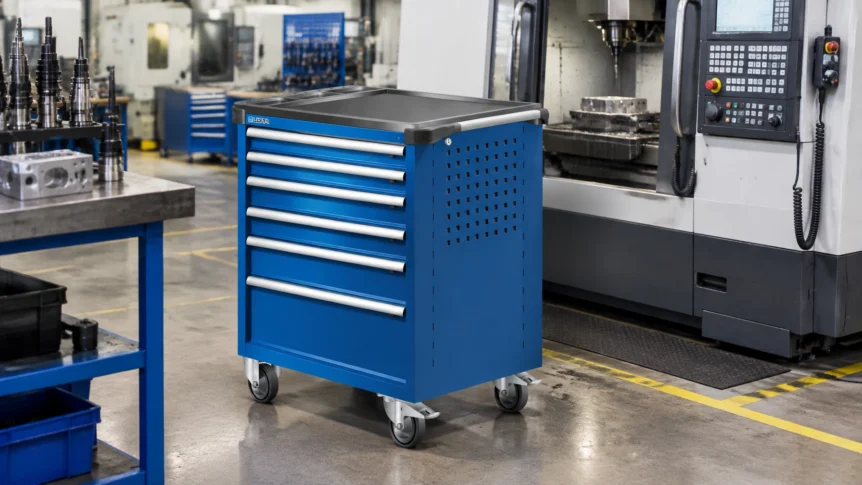
In a busy production facility, every unnecessary journey creates motion waste. Technicians walking across a workshop to collect tools, maintenance teams searching for missing parts and operators waiting for shared equipment all contribute to avoidable downtime.
The right tool cabinets on wheels bring frequently used tools, components and task equipment directly to the point of work. This improves access, supports 5S principles and helps teams reduce wasted movement without permanently fixing every workstation in place.
For industrial and automotive businesses, mobility must be balanced with stability, security and load capacity. A cabinet that rolls easily but cannot be locked safely is not a productive asset. The objective is controlled mobility: move the storage when the workflow changes, then secure it firmly when work begins.
Why tool cabinets on wheels are a strategic investment
A mobile storage unit can support several production strategies:
- Point-of-use storage: Keep high-frequency tools and consumables near the operator.
- JIT support: Deliver the right components to the right station at the right time.
- 5S implementation: Make ownership, location and replenishment easier to manage.
- Reduced motion waste: Shorten walking routes between storage and the work area.
- Flexible layouts: Reconfigure work zones during product changeovers or maintenance projects.
- Improved security: Lock valuable tooling and specialist equipment when not in use.
The Pareto Principle is useful here. In many workshops, a relatively small proportion of tools accounts for most daily usage. Storing those high-use items in a mobile unit can deliver a faster return than attempting to make every item mobile.
7 industrial tool cabinets on wheels for workshops
1. Mobile tool cabinet or rolling drawer cabinet
A mobile drawer cabinet is the most direct solution where teams need dense, organised storage that can be moved between workstations. LISTA mobile drawer cabinets are available in different widths, heights, drawer configurations and locking options, allowing the unit to be matched to the tools and SKUs being stored.
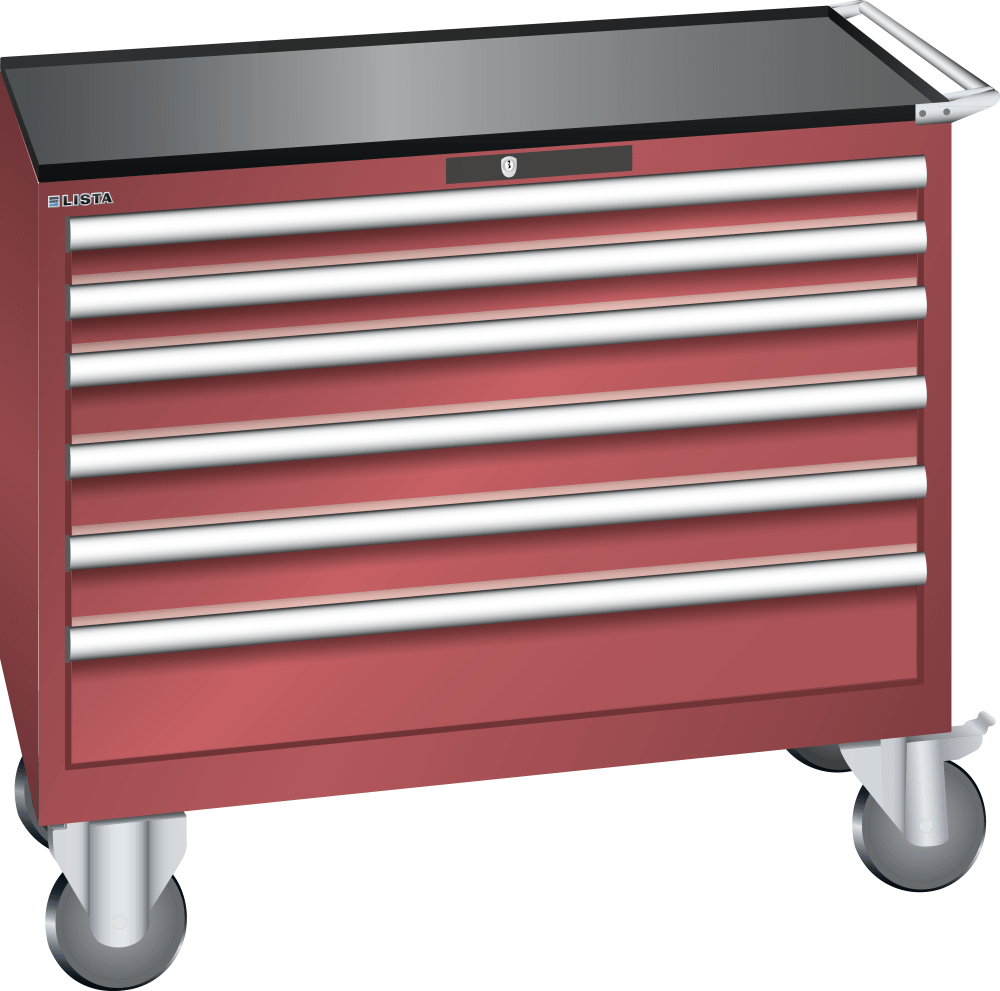
How it works: Full-extension drawers provide visibility and quick access. Dividers, trays and foam inserts separate tools and parts, reducing retrieval time and preventing damage. A central locking system secures the drawers when the cabinet is unattended.
Best for:
- Maintenance tool sets
- Automotive service equipment
- MRO parts and fasteners
- Production-line tooling
- Shared engineering departments
Practical tips:
- Place high-frequency items between waist and shoulder height.
- Label every drawer using a consistent naming convention.
- Keep heavy tools in lower drawers to improve stability.
- Specify drawer load ratings based on actual contents, not estimated averages.
A mobile tool cabinet of this type is usually the best starting point for a controlled point-of-use storage programme.
2. Task-specific tool trolleys
A workplace trolley is designed for a defined activity rather than general-purpose storage. Examples include an inspection trolley, changeover trolley, service trolley or replenishment trolley.
How it works: The trolley carries a preselected kit of tools, gauges, components and documentation to a particular task. This reduces repeated trips to a central tool crib and makes missing items easier to identify.
Best for:
- Planned preventive maintenance
- Quality inspection
- Assembly kits
- Product changeovers
- Mobile service teams
A mobile tool cabinet can hold a wider range of equipment, while a task trolley should remain deliberately limited. That distinction matters. Overloading a trolley turns it into an inefficient general store and makes it difficult to verify whether the correct kit is complete.
Practical tips:
- Create a standard contents list for each trolley.
- Use shadow boards, foam cut-outs or labelled compartments.
- Introduce a sign-off check at the end of each shift.
- Track replenishment using barcode labels or your existing CMMS.
3. Mobile workbenches with integrated storage
A mobile workbench combines a durable worktop with drawers, cabinets or shelving. It is appropriate when technicians need to transport both tools and the surface on which they will assemble, inspect or repair components.
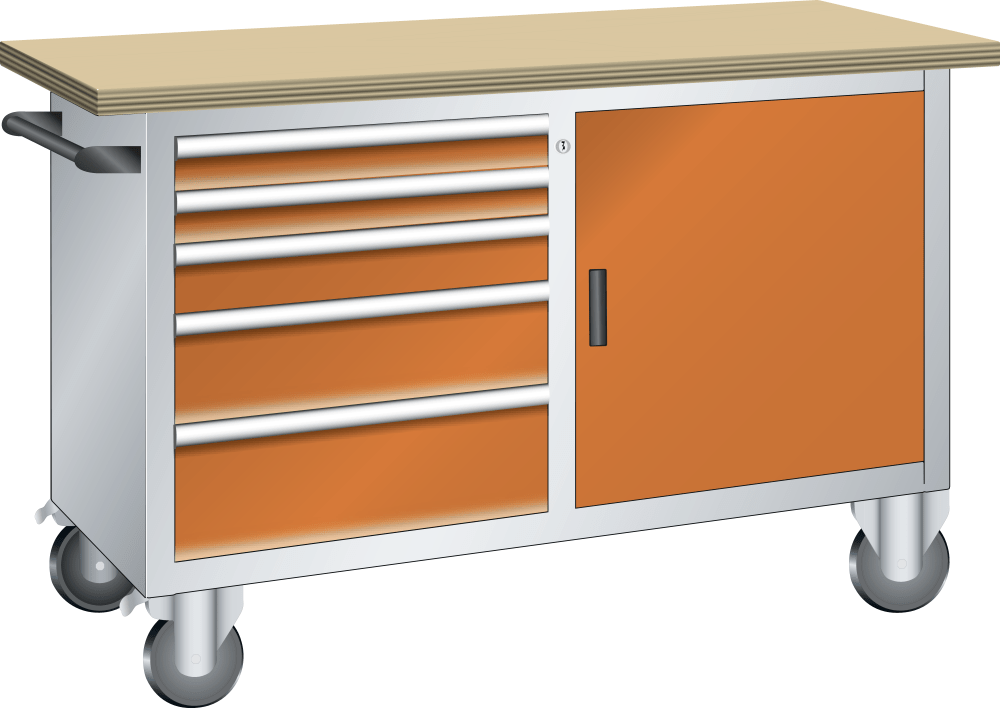
How it works: The workbench moves to the job, then locking castors create a stable platform. Integrated drawers keep tools within reach, while a robust worktop supports assembly and inspection activities.
A mobile workbench is not a substitute for every fixed workstation. It is most effective where work locations change regularly or where large components would otherwise need to be carried to a fixed bench.
See TEMA’s workbench with wheels and mobile workstations for solutions that combine mobility with ergonomic working height and integrated organisation.
Practical tips:
- Confirm the worktop load rating, including vices and mounted equipment.
- Choose locking castors that lock both the wheel and swivel action.
- Specify a surface appropriate to oil, chemicals, impact or ESD requirements.
- Keep the heaviest equipment low to maintain a safe centre of gravity.
4. Rolling cabinets for a dedicated work zone
Some areas need mobile storage that supports a complete work zone rather than a single technician. A larger rolling cabinet can serve a production cell, maintenance bay or assembly team.
How it works: The cabinet is configured around the zone’s process. It may include deep drawers for power tools, shallow drawers for small parts, cupboards for bulky equipment and a top surface for temporary staging.
This type of mobile tool cabinet works well in facilities that use cellular manufacturing or regularly change their layout. It provides more capacity than a trolley while remaining relocatable.
Practical tips:
- Map the process before deciding the cabinet configuration.
- Separate point-of-use tools from reserve stock.
- Use lockable storage for controlled or high-value equipment.
- Leave sufficient clearance for drawers to open fully without obstructing walkways.
For broader fixed and mobile combinations, review TEMA’s metal cabinets with drawers and industrial storage solutions.
5. NC and CNC tooling transport units
Machine shops have specific requirements. CNC holders, cutting tools and preset tooling need protection, identification and safe movement between the tool store, preparation area and machine.
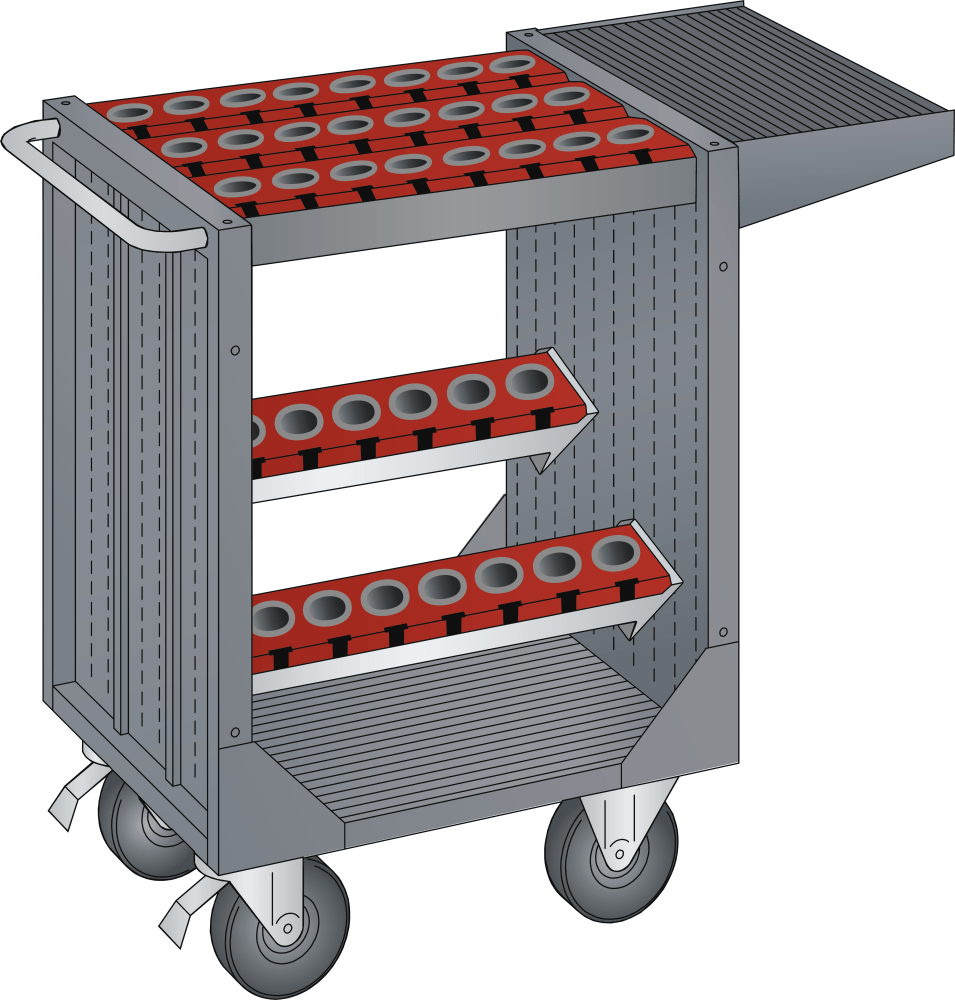
How it works: NC transport units hold tooling in defined positions, reducing the risk of impact and helping operators identify the correct holder quickly. A mobile unit can support JIT delivery to CNC machines without leaving tooling loose on benches or pallets.
A mobile tool cabinet is not always the right choice for CNC tooling. Where holders need dedicated locating positions, an NC transport unit is more appropriate than a conventional drawer layout.
Practical tips:
- Specify the tooling standard, such as ISO-SK, HSK, VDI or Capto.
- Keep clean and used tooling physically separated.
- Label locations by machine, job or tool number.
- Include covers or protection where coolant and swarf are present.
You can explore TEMA’s tooling storage and LISTA tool box solutions for more specialised options.
6. ESD-safe mobile cabinets
Electronics assembly, testing and e-mobility operations require control of electrostatic discharge. Standard metal storage may not provide the complete ESD system needed to protect sensitive devices.
How it works: ESD-compatible storage forms part of a wider protected area, alongside suitable worktops, earthing, flooring, wrist straps and operating procedures. Mobility can allow the protected work area to be repositioned, but the ESD controls must remain effective after movement.
A mobile tool cabinet used in an ESD environment should be selected as part of the site’s ESD control plan rather than treated as a standalone product.
Practical tips:
- Confirm continuity and earthing requirements with your ESD assessor.
- Use conductive or dissipative drawer liners where specified.
- Avoid mixing ordinary packaging materials with sensitive components.
- Test the system after relocation and record the result.
Read more about ESD workspace and storage solutions.
7. Modular mobile containers and shelving systems
Modular systems provide a flexible way to combine drawers, containers, shelving and work surfaces. They are useful where storage requirements will change as products, processes or team structures evolve.
How it works: Modules are configured around standard storage dimensions and can be expanded, rearranged or combined with fixed cabinets. This creates a scalable system rather than a collection of unrelated units.
Thurmetall systems are a strong option where durable construction and long service life are priorities. Thurmetall products purchased through TEMA Solutions are covered by a five-year warranty. Workbench tops and electronic parts carry a one-year warranty.

Practical tips:
- Standardise drawer and container dimensions across departments.
- Reserve expansion space in the original layout.
- Use modular labels so locations remain clear after changes.
- Maintain a digital record of cabinet contents and locations.
Comparison table
| Option | Main strength | Best application | Key specification |
|---|---|---|---|
| Mobile drawer cabinet | Dense, secure storage | MRO, maintenance and automotive tools | Drawer load rating and central locking |
| Task-specific trolley | Fast delivery of a defined kit | Inspection, changeover and service work | Contents checklist and manoeuvrability |
| Mobile workbench | Storage plus working surface | Assembly and repair | Worktop load rating and locking castors |
| Rolling zone cabinet | High-capacity point-of-use storage | Production cells and shared bays | Layout, drawer mix and clearances |
| NC transport unit | Protected tooling movement | CNC and machine shops | Tool-holder standard and locating positions |
| ESD mobile cabinet | Controlled storage for sensitive parts | Electronics and e-mobility | Earthing, dissipative surfaces and testing |
| Modular mobile system | Future flexibility | Changing production environments | Compatibility and expandability |
Specification checklist before you buy
When comparing tool cabinets on wheels, assess the complete system rather than focusing on price or drawer count.
- Caster load rating: Calculate the cabinet weight plus its maximum contents, then divide across the castors according to the manufacturer’s rating.
- Wheel material: Polyurethane is often suitable for sealed concrete and epoxy floors. Hard rubber may provide quieter movement. Specialist wheels may be required for chemicals, swarf or uneven floors.
- Locking castors: Specify brakes that prevent both rolling and swivelling where stability is critical.
- Steel gauge and construction: Heavier-gauge steel generally provides greater rigidity and durability under intensive use.
- Powder-coated finish: A quality finish supports resistance to abrasion and everyday workshop contamination.
- Ball-bearing slides: These support smooth, reliable drawer movement under load.
- Central locking: Important for shared areas and valuable tooling.
- Overall load capacity: Allow a minimum 25% safety margin above the calculated working load.
- Drawer safety catches: These help prevent drawers opening during movement.
- Handle and push points: The cabinet should be manoeuvred without unsafe pulling or twisting.
Floor conditions, routes and aisle widths
Mobility depends on the floor. Before selecting a cabinet, inspect thresholds, expansion joints, damaged concrete, ramps, gradients, swarf and areas where oil or coolant may collect.
A cabinet that performs well on smooth epoxy may be difficult to control on uneven concrete. Wheel diameter, tread material and swivel design all affect the force required to move it.
Aisle planning must account for the cabinet’s width, handle projection, open drawers and turning envelope. As an initial layout allowance, consider the cabinet width plus approximately 600 mm of total side clearance for a straight service route. This is a planning guide, not a universal legal minimum. Confirm the final arrangement through your site risk assessment, pedestrian segregation plan and fire-route requirements.
The HSE advises employers to avoid hazardous manual handling where reasonably practicable and to assess and reduce risks where it cannot be avoided. Read the HSE guidance on manual handling at work. Where mobile work equipment is involved, also review the HSE’s guidance on PUWER.
An implementation approach that works
Introducing tool cabinets on wheels should be treated as a process improvement project, not simply a purchasing exercise.
- Measure current motion waste: Record walking distances, search time, tool shortages and delays.
- Classify the contents: Separate high-frequency tools, reserve stock, controlled items and specialist tooling.
- Select the mobile format: Match the cabinet, trolley, workbench or NC unit to the task.
- Set a standard layout: Define drawer heights, labels, replenishment points and ownership.
- Pilot one work area: Measure retrieval time, usability and safety before a wider rollout.
- Connect physical and digital systems: Update the CMMS, inventory records or barcode system when tools move.
- Review after four weeks: Remove unused items, correct poor layouts and adjust stock levels.
Physical organisation is the bedrock of digital efficiency. A barcode system cannot locate a tool reliably if the tool has no defined home.
Maintenance routine
A short inspection programme protects both safety and investment.
Daily or weekly:
- Remove swarf, debris and packaging from wheels.
- Check that drawers close fully.
- Confirm castor brakes engage correctly.
- Return tools to their labelled locations.
- Report damaged handles, slides or locks.
Monthly:
- Check castor fixings and frame fasteners.
- Inspect wheel wear and swivel movement.
- Clean drawer slides according to the manufacturer’s instructions.
- Review overloaded drawers and unused stock.
- Verify labels remain legible.
Periodically:
- Inspect the powder-coated finish for chips or corrosion.
- Check central locking and spare keys.
- Reassess routes after layout changes.
- Review the cabinet against your PUWER and workplace inspection arrangements where applicable.
Key takeaways
- Tool cabinets on wheels reduce motion waste when positioned at the point of use.
- Select the format according to the task: drawer cabinet, trolley, workbench, NC unit, ESD cabinet or modular system.
- Mobility must be matched with locking castors, stable construction and appropriate load capacity.
- Plan routes around floor conditions, open drawers and turning space.
- Keep at least a 25% capacity margin above the expected working load.
- Integrate physical storage with labelling, CMMS and inventory controls.
- Use a pilot area to prove productivity and safety improvements before scaling.
TEMA Solutions supplies LISTA and Thurmetall storage systems for workshops, production facilities, automotive businesses and e-mobility operations. Our products are supported by certified quality systems including ISO 9001, ISO 14001 and ISO 45001.
For help selecting a mobile tool cabinet or designing a complete movable storage arrangement, visit the TEMA Solutions shop or contact our team to discuss your workspace, tooling and workflow requirements.


