


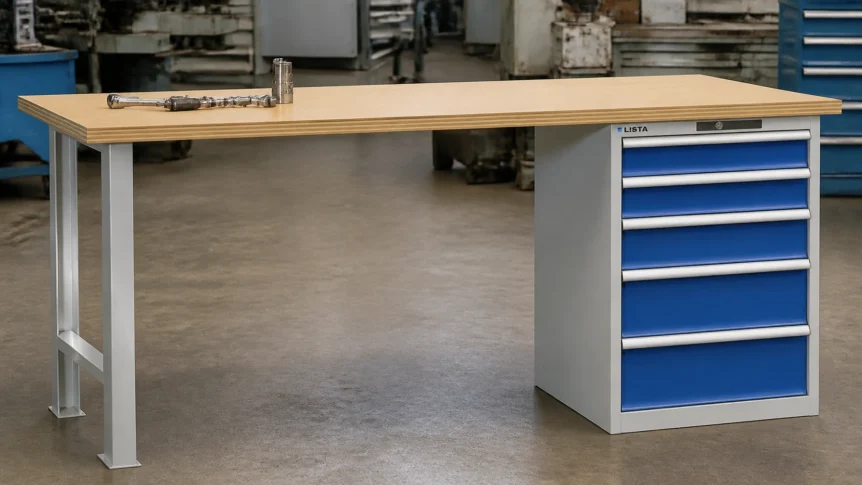
Choosing the right industrial workbench is a production decision, not simply a furniture purchase. The wrong specification can create wasted movement, poor posture, damaged tools, limited storage and unnecessary replacement costs. The right one supports productivity, safety, quality and reliable inventory control.
This seven-step buying guide is designed for production managers, workshop owners, engineers and manufacturing teams. It focuses on the criteria that should shape your purchase: worktop material, load capacity, height, storage, ESD protection, accessories, durability, certifications and warranty.
1. Define the Industrial Workbench Application
The problem
A bench designed for light assembly may fail in a machine shop. A steel surface suitable for fabrication may be inappropriate for electronics. Buying before defining the work creates compromises that affect both operators and equipment.
How it works
Start by documenting the work performed at the station. Identify whether the primary application is:
- Mechanical assembly or repair
- Automotive maintenance
- Inspection and quality control
- Electronics assembly and testing
- CNC tooling preparation
- Packing or kitting
- Maintenance and MRO activity
Then assess the operating environment. Consider oil, swarf, moisture, chemicals, heat, vibration, cleanroom requirements and ESD sensitivity.
The application should determine every later decision. For example, an electronics workstation may need a dissipative surface, grounding and ESD-safe storage, while an engine-repair station may prioritise impact resistance, stability and high load capacity.
Practical tips
- Observe the workstation during a normal shift rather than relying on assumptions.
- List the tools, fixtures, machines and components used at the point of work.
- Record whether the station is fixed, shared, mobile or used across multiple shifts.
- Measure available floor space and maintain clear access routes.
- Apply the Pareto Principle by identifying the 20% of tools and SKUs used most frequently.
Defining the application is the critical foundation for selecting a suitable industrial workbench.
2. Select the Industrial Workbench Worktop
The problem
The worktop receives the direct impact of daily operations. If the material is unsuitable, it may become damaged, difficult to clean or unsafe for the process.
How it works
Different worktop materials support different applications:
- Solid beech: Suitable for general assembly, maintenance and non-marring work.
- Multiplex: Offers strength and durability for demanding workshop use.
- Laminate: Provides a smooth, easy-to-clean surface for lighter industrial tasks.
- Steel: Suitable for heavy mechanical work, impact and fabrication.
- Stainless steel: Useful where hygiene and corrosion resistance are priorities.
- ESD laminate: Appropriate for electronics and other static-sensitive applications.
The worktop must also provide sufficient width and depth. A surface that appears large enough when empty may become congested once a vice, monitor, test instrument, documentation and component trays are installed.

A modular LISTA workstation can combine a durable worktop with point-of-use storage and accessories.
Practical tips
- Identify exposure to impact, oils, solvents, heat and moisture.
- Check whether the surface must be non-marring or chemically resistant.
- Allow space for fixtures, monitors and inspection equipment.
- Confirm that the worktop rating is compatible with the frame and drawers.
- Ask whether the surface can be replaced or upgraded in the future.
For a broader review of worktop materials and construction, see TEMA’s guide to heavy-duty workbench features.
3. Calculate Industrial Workbench Load Capacity
The problem
A load rating is meaningful only when you understand what it measures. Some manufacturers specify a uniformly distributed static load. Others provide separate ratings for the worktop, drawers, shelves or castors.
Ignoring those distinctions can lead to instability, premature wear or an unsafe working environment.
How it works
Calculate the complete working load, including:
- Maximum workpiece weight
- Tools and power equipment
- Vices, presses and fixtures
- Test instruments and monitors
- Materials and component batches
- Drawer and shelf contents
- Dynamic forces from impact, vibration or movement
A bench that supports a heavy component at rest may not be suitable for repeated hammering, pressing or force-intensive work. The frame, worktop, drawers and mobility equipment must be assessed as one system.
Do not specify a bench to operate continuously at its absolute limit. Include a sensible margin for uneven loading, future equipment and changes in production.
Practical tips
- Weigh the five heaviest items that will be used or stored.
- Confirm whether the stated rating is static, dynamic or uniformly distributed.
- Check individual drawer, shelf and castor capacities.
- Consider floor loading where heavy equipment is installed on mezzanines or raised floors.
- Record the required capacity in the procurement specification.
Load capacity is a non-negotiable requirement when selecting an industrial workbench for demanding production environments.
4. Choose Industrial Workbench Height and Ergonomics
The problem
A fixed height may suit one operator but force another to bend, reach or raise their shoulders. The risk increases when a station is shared between shifts or supports both seated precision work and standing assembly.
How it works
A fixed bench can be appropriate where one operator performs a consistent task. However, an adjustable-height workstation is often the better choice where:
- Several operators use the same station.
- Tasks vary between precision and force-intensive work.
- The workstation must support seated and standing operation.
- Product sizes change throughout the day.
- The organisation wants to reduce awkward postures.
The surface should be positioned according to the task, operator and equipment. Precision work may require a higher surface, while force-intensive work may need a lower and more stable position.
The HSE guidance on musculoskeletal disorders supports assessing workplace risks and reducing hazardous manual handling where reasonably practicable.
Practical tips
- Involve operators before approving the final specification.
- Trial the proposed height with the actual tools and workpieces.
- Keep frequently used items in the primary reach zone.
- Position heavy items where they can be handled safely.
- Check that drawers, cables and accessories do not restrict adjustment.
TEMA’s adjustable-height workbench guide covers the ergonomic and workflow considerations in greater detail.
5. Build Industrial Workbench Storage and Tool Access
The problem
A clear worktop does not happen by accident. Without integrated storage, tools, fasteners and documents are left on the surface or stored in remote cabinets. Operators then waste time searching or walking.
How it works
An integrated storage system creates a defined location for every tool, component and consumable. Options may include:
- Full-extension drawers
- Adjustable dividers
- Foam inserts
- Lockable cabinets
- Pegboards and tool panels
- Shelves and bin rails
- Mobile drawer units
- Lighting, power and monitor arms
Storage should reflect usage frequency. High-use tools should be closest to the operator, while low-frequency or controlled equipment can be stored elsewhere. This supports JIT activity and improves the accuracy of digital inventory records.
The physical layout is the bedrock of digital efficiency. An ERP, CMMS or inventory system may identify a SKU location, but the operator still needs a clearly organised physical location.

Mobile LISTA storage can bring tools and materials to the point of use without sacrificing organisation.
Practical tips
- Place the most frequently used tools between waist and chest height.
- Store heavy items in lower drawers where practical.
- Label every drawer, shelf and compartment.
- Separate available, issued, inspection and quarantine items.
- Link physical locations with SKU, job or maintenance references.
For more detail, read TEMA’s article on the benefits of a workbench with drawers.
6. Specify ESD for an Industrial Workbench
The problem
Electrostatic discharge can damage semiconductors, sensors, PCBs and battery-management components without producing a visible mark. Latent damage may not appear until the product is in service.
A standard metal bench should not automatically be treated as ESD-safe. ESD control depends on the surface, grounding, accessories, personnel protection and operating procedures.
How it works
An ESD workstation normally combines a static-dissipative surface, grounding point and compatible accessories. It should form part of an ESD Protected Area, or EPA, rather than being treated as an isolated item of furniture.
The ESD Association’s guidance on ESD fundamentals identifies IEC 61340-5-1 as an important framework for ESD control programmes.
Practical tips
- Identify the most sensitive devices handled at the station.
- Specify ESD-safe drawers, bins and mats alongside the worktop.
- Provide suitable personnel grounding and operator training.
- Keep unapproved plastics and packaging outside the EPA.
- Document grounding checks, inspections and maintenance.
TEMA’s ESD workbench guidance and ESD workspace and storage solutions provide further information for electronics, e-mobility and repair applications.
7. Check Industrial Workbench Durability, Compliance and Warranty
The problem
A low purchase price can become expensive if the frame flexes, the coating deteriorates, drawers fail or spare parts are unavailable. Industrial furniture must withstand sustained use, not simply look robust on delivery.
How it works
Review the construction, finish, technical documentation and support arrangements. Ask about:
- Frame design and reinforcement
- Worktop and drawer load ratings
- Corrosion and abrasion resistance
- Castor and levelling-foot quality
- Spare parts and replacement components
- Installation and delivery requirements
- Warranty coverage and exclusions
Thurmetall products supplied by TEMA carry a five-year warranty. Workbench tops and electronic parts carry a one-year warranty, subject to the relevant product terms.
Thurmetall states that its products are manufactured according to ISO 9001, ISO 14001 and ISO 45001 standards, covering quality management, environmental management and occupational health and safety management.

Thurmetall workstation and drawer systems provide a durable option for organised industrial environments.
Practical tips
- Request technical drawings and documented load ratings.
- Confirm whether certification applies to the product or manufacturing system.
- Check delivery access, installation and assembly requirements.
- Review warranty coverage for frames, tops, drawers and electronics separately.
- Assess total cost of ownership rather than purchase price alone.
A durable industrial workbench should support the operation for years, not require early replacement after a change in workflow.
Industrial Workbench Buying Checklist
| Requirement | Questions to ask | Specification to review |
|---|---|---|
| Application | What work is performed? | Mechanical, electronics, inspection or packing |
| Worktop | What will the surface encounter? | Beech, laminate, steel, stainless steel or ESD |
| Capacity | What are the heaviest loads and tools? | Worktop, drawer, shelf and castor ratings |
| Height | Who will use the station? | Fixed, manual or powered adjustment |
| Storage | Which tools need point-of-use access? | Drawers, dividers, cabinets and panels |
| ESD | Are sensitive components handled? | Surface, grounding and EPA controls |
| Integration | What equipment must connect? | Lighting, power, monitors and accessories |
| Support | How will the system be maintained? | Warranty, spares and technical assistance |
How to Implement Your Purchase
Use a phased approach before placing an order:
- Audit the current state: Measure search time, walking distance, damaged tools and workstation-related delays.
- Map the workflow: Follow materials from receipt through storage, use, return and replenishment.
- Classify equipment: Separate high-use, heavy, sensitive, hazardous and low-frequency items.
- Create a pilot station: Test one configuration with operators before standardising.
- Measure the result: Track retrieval time, quality issues, housekeeping and operator feedback.
- Expand intelligently: Use the successful layout across comparable work areas.
TEMA Solutions can help integrate LISTA workstations, drawer cabinets, ESD equipment and Thurmetall products into a wider industrial storage solution. Review the LISTA storage range, explore Thurmetall products or visit the TEMA Solutions shop.
Key Takeaways
- Define the process before selecting an industrial workbench.
- Match the worktop to impact, chemicals, heat, moisture and static requirements.
- Confirm complete-system load capacity rather than relying on one headline figure.
- Treat height, reach and storage position as part of the ergonomic design.
- Use integrated drawers and accessories to support tool access and inventory accuracy.
- Specify ESD protection as a complete EPA requirement.
- Review certifications, durability, warranty and total cost of ownership.
- Pilot the workstation and measure its effect before rolling it out across the facility.
Conclusion: Specify the Workbench Around the Work
The right industrial workbench supports far more than the task taking place on its surface. It improves access to tools, protects components, supports ergonomic working and provides the physical structure needed for reliable digital inventory control.
The strongest specification is the one built around your operators, materials, loads, workflows and future requirements. TEMA Solutions can help you assess the current layout and configure a LISTA or Thurmetall workstation that supports safer, more efficient production.
Start by auditing one high-friction workstation, measure the wasted motion and contact TEMA Solutions to plan the right industrial workbench for your operation.


