


An adjustable height workbench is exactly what it sounds like: a worksurface that you can raise or lower to fit the job at hand. Once seen as a bit of a luxury, they’re now becoming a cornerstone of any professional workshop that takes ergonomics and efficiency seriously.
The Foundation of a Modern Workshop
Ever tried to do delicate soldering work hunched over a low table? Or maybe you’ve had to assemble something heavy on a bench that was just a bit too high, making you strain your shoulders. That’s the daily reality with a fixed-height workbench—a single, static height that’s rarely perfect for every task, or for every person using it.
This “one-size-fits-none” setup is a recipe for discomfort, sloppy work, and even long-term physical strain. An adjustable height workbench tackles this problem head-on. Think of it as the ultimate adaptable partner in your workspace. It’s one bench that can be lowered for comfortable seated tasks, like fine electronics work, and then raised to standing height for jobs needing more leverage or freedom of movement, such as woodworking or automotive repair. This adaptability is its superpower.
More Than Just Comfort
The benefits go way beyond just feeling comfortable. By making it easy to switch between sitting and standing, an adjustable workbench genuinely improves your health. Moving around like this boosts circulation, takes the pressure off your lower back, and cuts down on the risk of musculoskeletal problems that come from being stuck in one position all day. This growing awareness is why they’re popping up in more and more workshops and factories across the UK and Europe.
In fact, the global market for these workstations is booming. Valued at roughly USD 5.1 billion in 2023, it’s expected to more than double, hitting USD 11.5 billion by 2032. This incredible growth shows a real shift in how businesses are thinking about staff well-being and productivity. You can dig deeper into this market trend on DataIntelo.com.
The core idea behind an adjustable height workbench is simple: the work should adapt to you, not the other way around. This principle is key to creating a safer, more productive, and more flexible workspace.
Before we dive deeper, let’s look at a quick comparison. It really highlights the practical advantages you gain by moving away from a traditional, static setup.
Fixed vs Adjustable Workbench at a Glance
| Feature | Fixed Workbench Limitation | Adjustable Workbench Advantage |
|---|---|---|
| Ergonomics | “One-size-fits-all” height forces awkward postures, leading to strain. | Adjusts to each user’s ideal height, whether sitting or standing. |
| Task Versatility | Poorly suited for tasks requiring different heights (e.g., detail vs. leverage). | Easily moves between heights for optimal precision, comfort, and safety. |
| Accessibility | Can be difficult for users of different heights or those with disabilities to use comfortably. | Provides an inclusive worksurface that accommodates a wider range of people. |
| Productivity | Discomfort and fatigue can lead to slower work and more errors. | Reduces fatigue and improves focus, helping to maintain high-quality output. |
As you can see, the switch is about more than just a new piece of kit. It’s about building a fundamentally better work environment.
Ultimately, investing in an adjustable height workbench is about creating a more efficient and healthier workshop from the ground up. It’s about setting up a space where every single task can be done at the perfect height for safety, precision, and getting the job done right.
The Real-World Benefits for Health and Productivity
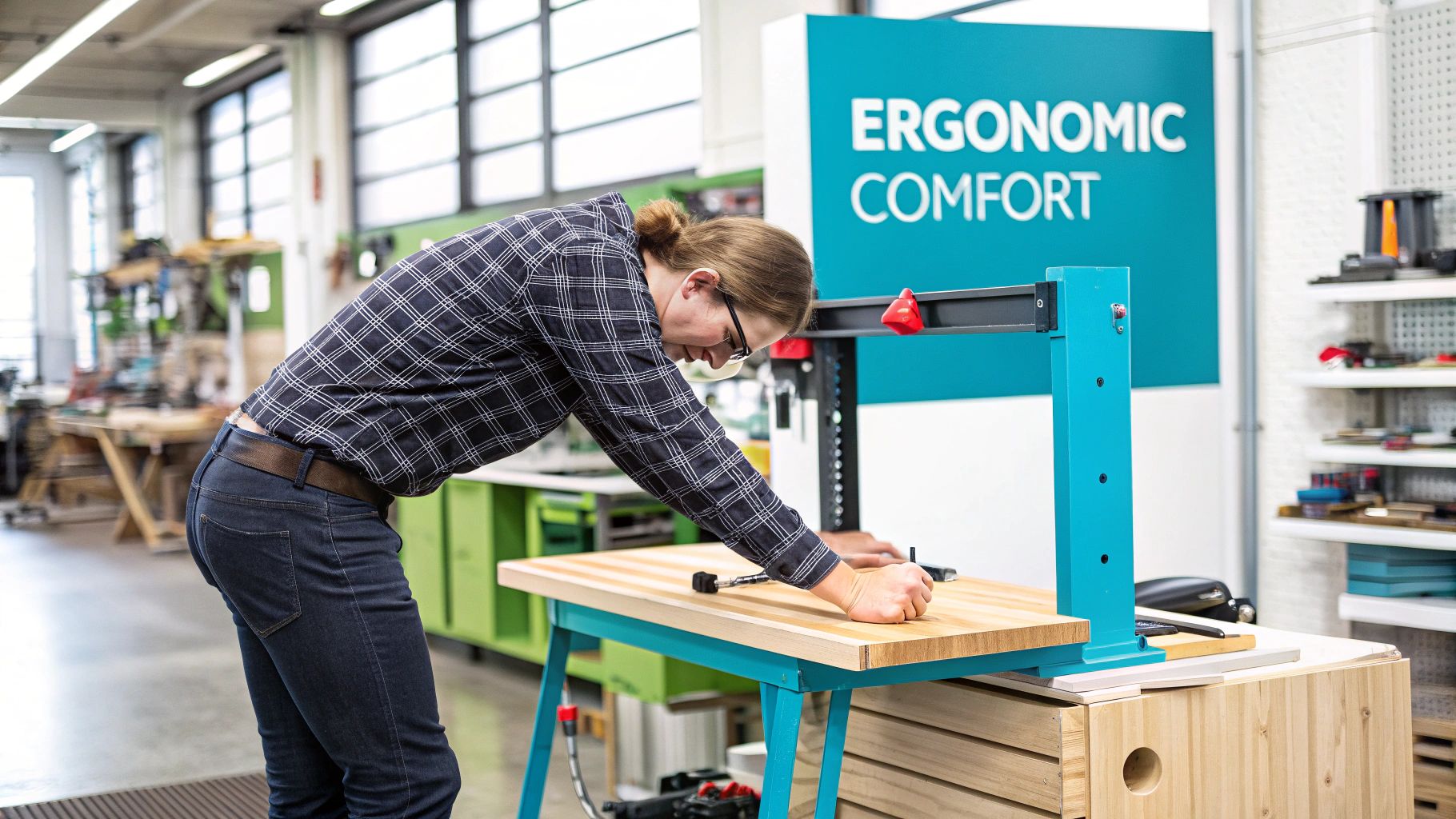
It’s one thing to talk about the concept of an adjustable workbench, but where it really proves its worth is in the day-to-day grind. This isn’t just another piece of workshop furniture; it’s a tool that actively looks after your well-being and improves the quality of your work. The biggest win? It helps you beat the dreaded static posture.
Think of your body like an engine. If you leave it in one position for too long—whether you’re sitting or standing—some parts start to seize up while others get overworked. An adjustable bench puts you back in control, letting you switch things up throughout the day. This simple change is a cornerstone of modern workplace ergonomics.
Just by alternating between sitting and standing, you get your blood flowing much more effectively. Better circulation means more oxygen to your brain and muscles, which helps you fight off that mental fog and physical fatigue that can derail a long project. It’s a key reason they’re increasingly recommended under UK workplace health guidelines.
Reducing Physical Strain and Injury
One of the first things you’ll notice is how much better your back feels. In fact, a study of office workers found that using a height-adjustable workstation cut upper back and neck pain by an incredible 54% in just a few weeks. That same logic applies perfectly to a workshop setting.
When you can set the bench to your ideal height, you naturally maintain a neutral spine. No more hunching over for detailed work or stretching awkwardly for heavy-duty tasks. This is a game-changer for any job that demands sustained focus.
An adjustable height workbench gives you the power to find the perfect ergonomic position for every task. This minimises the cumulative stress that leads to Repetitive Strain Injuries (RSIs), a common issue for anyone performing detailed, manual work.
Consider the different kinds of jobs you do:
- Precision Work: For delicate tasks like soldering or fine assembly, you can bring the bench right down to a comfortable seated height. This lets you brace your elbows, steady your hands, and get your eyes closer to the action without straining.
- Leverage-Based Tasks: When you need to put some muscle into it—like sanding a large plank or using a heavy-duty spanner—standing is far more efficient. A standing-height bench lets you engage your core and use your body weight for power, taking the strain off your arms and shoulders.
Of course, while the bench takes care of your back, standing for hours can be tough on your feet. It’s a good idea to look into tips to relieve tired feet and find lasting comfort to create a truly supportive workspace.
Boosting Focus and Work Quality
It’s no surprise that physical comfort is directly linked to mental performance. When you aren’t distracted by an aching back or a stiff neck, you can pour all that mental energy into the task at hand. An adjustable bench helps you stay in the zone for much longer.
A simple change in posture can feel like hitting a reset button. Feeling your energy start to dip? Just raise the bench and stand for a while. It re-engages your body and mind, helping you push through a tricky part of a project with fresh focus. This adaptability means fewer mistakes and a higher standard of finish.
This improved focus leads to real, measurable gains in productivity. A correctly positioned work surface cuts down on wasted time spent shifting around or taking unscheduled breaks because of discomfort. Everything is where it should be, your tools are within easy reach, and your workflow becomes seamless. On the topic of organisation, learning about maximising efficiency with workshop drawers is a great next step to complement your setup.
At the end of the day, an adjustable height workbench helps create an environment where you can do your best work, safely and consistently.
Understanding Your Adjustment Mechanism Options
The heart of any adjustable height workbench isn’t the tabletop—it’s the mechanism that makes it move. How your bench gets from a sitting to a standing position is what truly defines its usability day-to-day. This lifting system dictates the speed, convenience, and ultimately, whether the bench fits your actual workflow.
Getting to grips with the technology inside is the key to picking a bench you’ll genuinely love and use. There are really three main ways these workbenches operate, each with its own set of pros and cons. Your decision will likely come down to how often you’ll be changing heights, your budget, and the kind of work you do.
The Reliable Hand Crank Mechanism
The most traditional and straightforward option is the manual hand crank. It’s a beautifully simple piece of engineering that works a lot like a car jack: you turn a handle, and a set of gears smoothly lifts or lowers the entire workbench. It’s a time-tested, robust design that just works.
This type of mechanism is a fantastic fit for workshops where you aren’t adjusting the height all that often. If you tend to set your bench for standing and only lower it for specific, longer seated tasks, a hand crank offers incredible reliability and value. Plus, you don’t need a power socket nearby.
Key Takeaway: The manual hand crank is your go-to for budget-friendliness and sheer dependability. It’s slower and takes a bit of elbow grease, but its simplicity means fewer things can go wrong, making it a true workhorse.
The Effortless Electric Motor
Electric systems are where modern convenience really shines. At the push of a button, a quiet motor does all the work, gliding the workbench to your preferred height. Many models even come with programmable memory presets, so you can save your perfect sitting and standing heights for instant, one-touch adjustments.
This is the system for anyone in a dynamic environment who plans to switch postures frequently throughout the day. The ease of use removes any mental barrier to moving more, which is a huge win for better ergonomic habits. It’s this effortless operation that has made electric models so popular in professional settings.
In fact, the UK’s commercial sector has seen a major shift towards free-standing electrical tables, which operate on the exact same principles. This trend highlights a growing appreciation for push-button convenience, a topic you can dive into with market analysis on European adjustable table trends.
This image offers a quick visual comparison of how different workbench models stack up.
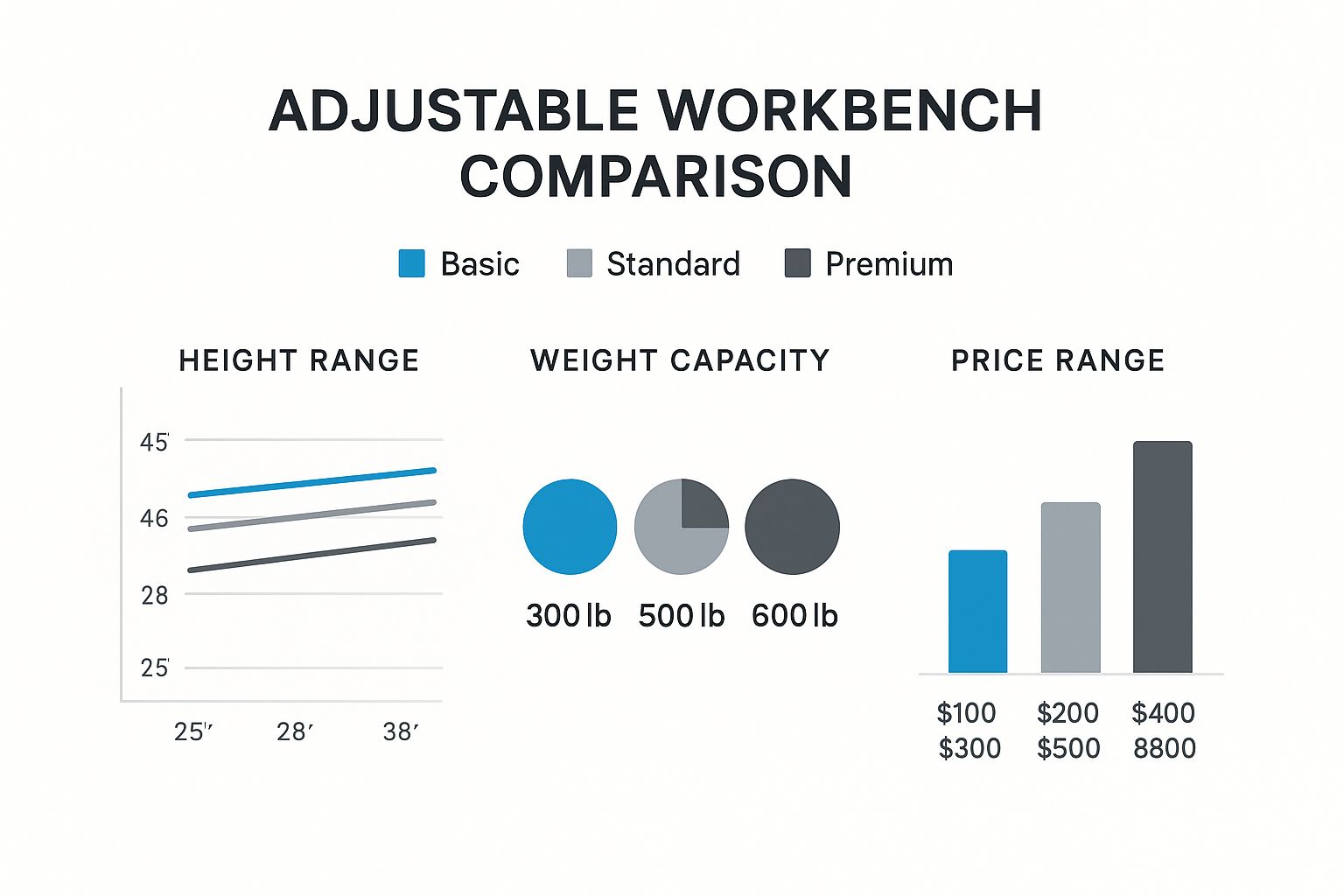
As you can see, as you move from a Basic to a Premium model, the features, weight capacity, and price all increase accordingly.
The Swift Pneumatic System
Sitting neatly between manual and electric is the pneumatic, or gas-spring, workbench. This design uses a pressurised gas cylinder to help with the lifting—think of the mechanism in a good office chair. You simply pull a lever and use a little bit of your own body weight to guide the surface up or down.
The big advantages here are speed and placement freedom. The adjustment is nearly silent and lightning-fast. And because it’s completely cordless, you can put your workbench anywhere you like, without being tethered to a wall socket. This makes it an excellent choice for quiet workshops or collaborative spaces where motor noise could be a distraction.
Choosing Your Workbench Adjustment System
To make the decision clearer, it helps to see the options side-by-side. This table breaks down what each mechanism is best for and the trade-offs involved.
| Mechanism Type | Best For | Pros | Cons |
|---|---|---|---|
| Manual Crank | Infrequent adjustments, budget-conscious users, no power access. | Very affordable, extremely reliable, no electricity needed. | Slow, requires physical effort, not ideal for frequent changes. |
| Electric Motor | Frequent sit-stand transitions, maximum convenience, heavy loads. | Effortless push-button control, memory presets, smooth lift. | Most expensive, requires a power outlet, more complex parts. |
| Pneumatic | Quick and quiet adjustments, workspaces without easy power access. | Cordless, fast and silent operation, simple to use. | May have lower weight capacity, requires some manual force. |
Ultimately, picking the right mechanism comes down to being honest about your daily routine and priorities. By balancing cost, convenience, and how you work, you’ll find the perfect system to support you.
How to Choose the Right Workbench for Your Needs
Choosing the right adjustable height workbench is about far more than just finding a model that fits your space. Think of it as an investment in your workshop’s flow and, just as importantly, in your own long-term health and comfort. To get it right, you need to create a personal checklist that balances your typical workload, the materials you handle, and your own physical needs.
It’s a bit like buying a new vehicle. You wouldn’t choose a small city car to haul building supplies, and you certainly wouldn’t commute in a massive lorry. The same logic applies here. Your workbench has to be a perfect match for the jobs you do every day.
This guide will walk you through the key factors to consider, making sure you end up with a workbench that will be a reliable foundation for your projects for years to come.
Assess Your Weight Capacity Needs
First things first, what are you actually going to put on it? The weight capacity you need can vary wildly depending on your work, so it’s vital to be realistic. Overloading a bench isn’t just a recipe for premature wear and tear; it’s a serious safety hazard that could lead to a collapse.
Generally, your needs will fall into one of three categories:
- Light-Duty Work: This covers things like electronics assembly, delicate craftwork, or PC repairs. A bench with a capacity of around 70-100 kg will usually be more than enough for this kind of detailed work.
- Standard Workshop Use: For general woodworking, assembling components, or light mechanical jobs, you’ll want something a bit more robust. Look for models that can support between 150-250 kg to handle most common projects and tools without breaking a sweat.
- Heavy-Duty Applications: If you’re wrestling with engine blocks, large fabrication projects, or industrial machinery, you need a true powerhouse. These heavy-duty workbenches are often rated for 500 kg or more, providing the brute strength and stability needed for extreme loads.
Always pick a weight capacity that comfortably exceeds what you think your heaviest project will be. This buffer is your safety margin, and it’s what protects the workbench frame and lifting mechanism over the long haul.
Select the Right Worksurface Material
The top of your workbench is where all the action happens, so the material you choose has a huge impact on its durability and how you work. Each surface has its own strengths, designed for different kinds of tasks.
Here are the most common options and where they really shine:
- Solid Wood or Butcher Block: A classic for a reason. Woodworkers love it for its traditional feel and its ability to absorb impacts. It’s also brilliant for tasks where you need to mount a vice, as it gives you a solid, secure base to work from.
- Laminate: A plastic laminate surface is a fantastic all-rounder. It’s affordable, a breeze to clean, and stands up well to scratches and stains. This makes it perfect for general assembly, packing stations, or craftwork.
- Steel: For the toughest environments, nothing beats a steel top. It’s incredibly strong, resistant to heat and chemicals, and simple to wipe down. This is the go-to choice for automotive garages, welding bays, and heavy industrial settings.
- ESD (Electrostatic Discharge) Laminate: If you work with sensitive electronics like circuit boards, an ESD-safe surface is non-negotiable. It’s specially designed to prevent the static build-up that can fry delicate components in an instant.
The demand for these specialised workstations is growing fast. The global market for height-adjustable desks was valued at around USD 5.5 billion in 2023 and is on track to nearly double by 2034. In the UK, this reflects a wider European trend towards convenient electric models in both offices and workshops. You can dig into these market insights from Transparency Market Research.
Consider Size and Essential Add-Ons
Finally, get the tape measure out. Check your available workspace and think about your own height to find the ideal dimensions and adjustment range. You want the bench’s lowest setting to be comfortable for sitting and its highest to let you stand tall without hunching over.
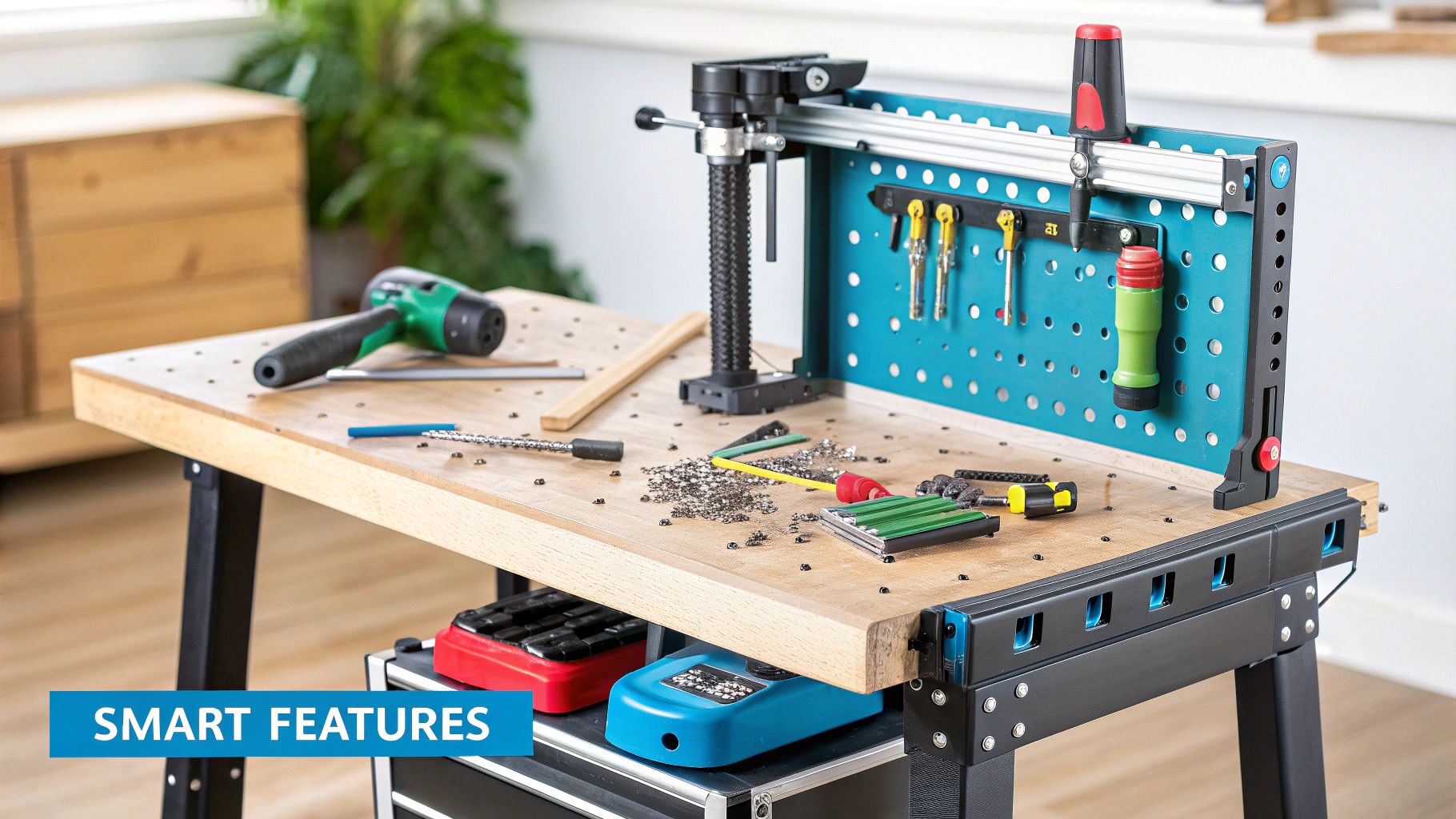
Beyond the basics, think about the extras that will make your life easier. The right accessories can transform a simple table into a fully integrated workstation tailored to your workflow.
Key features to look for include:
- Integrated Power Strips: Having sockets built right into the bench is a game-changer for keeping your space tidy and your tools powered up.
- Storage Drawers and Cabinets: Keeping your tools and parts organised and within easy reach is crucial for efficiency. For more ideas, check out our guide on innovative storage for tools.
- Lockable Casters: If you need to shift your workbench around, a good set of lockable wheels gives you both mobility when you need it and rock-solid stability when you don’t.
- Overhead Shelving and Lighting: These additions help keep your main worksurface clear while making sure your project is perfectly lit and your most-used items are close at hand.
Setting Up Your Workbench for Perfect Ergonomics and Workflow
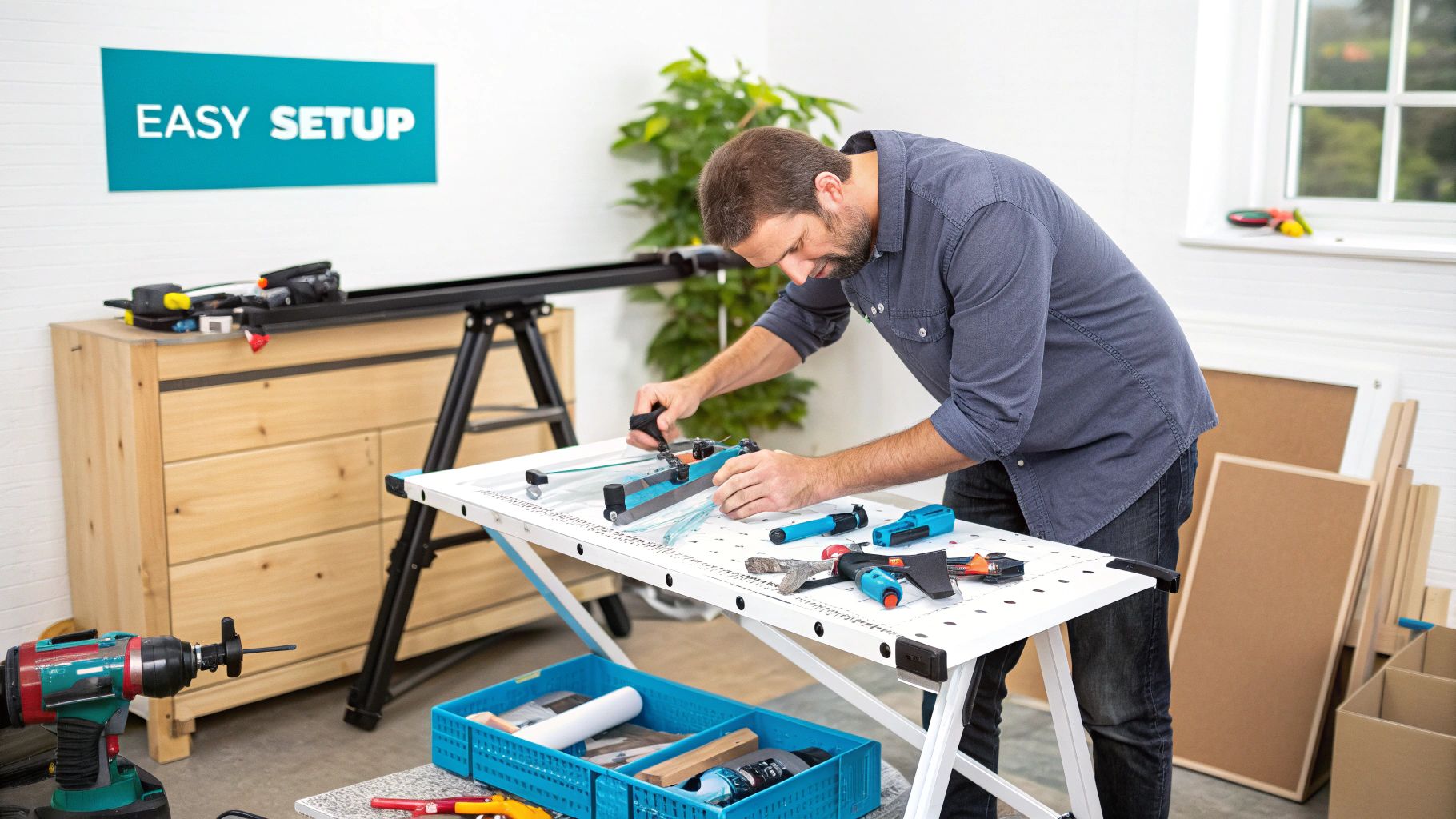
So, you’ve got your new adjustable height workbench. That’s a great first step, but the real magic happens when you dial it in for your body and the tasks you perform every day. A proper setup transforms it from just another bit of workshop furniture into a genuinely high-performance tool that works with you.
The aim is to create a seamless environment where the bench adapts to your movements, not the other way around. This starts with finding your ideal heights for both sitting and standing. After all, even the most advanced bench can cause strain if it’s not adjusted correctly. Luckily, getting it right is pretty straightforward.
Finding Your Ideal Ergonomic Heights
Honestly, the best way to find your perfect working height is to simply use your elbows as a guide. It’s a quick and reliable method that works whether you’re sitting or standing, helping you maintain a neutral posture that takes the pressure off your back, neck, and shoulders.
For your ideal standing height:
- Stand in front of the bench wearing your usual work shoes.
- Let your arms hang relaxed at your sides, then bend your elbows to a 90-degree angle, keeping your forearms parallel to the floor.
- Adjust the workbench so the surface is just a touch below your hands. This is your go-to standing height.
For your ideal sitting height:
- Sit down with your feet flat on the floor and your back properly supported by your chair.
- Tweak your chair height until your thighs are roughly parallel to the ground.
- Bend your elbows to 90 degrees, exactly as you did before.
- Lower the bench until the surface is, once again, just below your hands.
This “elbow rule” is the bedrock of good workshop ergonomics. Of course, you can fine-tune it. For detailed work like soldering or fine assembly, you might raise the bench a bit to bring the workpiece closer to your eyes. For tasks that need some muscle, like heavy wrenching, lowering it slightly lets you use your body weight to gain extra leverage.
Listen to your body—it’s the best gauge of a good setup. After finding your initial heights, pay attention to how you feel. If you notice any aches or strains, don’t be afraid to make tiny adjustments until it feels completely natural.
Creating an Efficient Sit-Stand Routine
Having an adjustable bench is one thing; actually using it to its full potential is another. The real health and productivity gains come from regularly switching between sitting and standing to avoid being stuck in one position for too long.
A good starting point is the 30-minute rule. Try to change your position at least every half an hour. Maybe work for 20 minutes sitting and then stand for 10 minutes—find a rhythm that works for you. This simple habit keeps your muscles active, boosts circulation, and helps you stay sharp throughout the day.
To make this transition feel effortless, you’ll need to organise your tools so they’re accessible from both positions. Think about creating an “active work zone” where your most-used tools are always within easy reach.
Here are a few tips for organising your space:
- Pegboards and Wall Racks: These are fantastic for keeping tools like spanners, screwdrivers, and pliers visible and grab-able from any height.
- Mobile Tool Trolleys: A small, wheeled trolley is your best friend here, ensuring your essential kit is always right where you need it.
- Tiered Shelving: Stash less-frequently used items on higher or lower shelves, leaving that prime, easy-to-reach area clear for the tools and parts you handle constantly.
By setting up a well-organised, dual-height workspace, switching between sitting and standing becomes a natural part of your routine instead of an interruption. This is how you truly get the most out of your investment in an adjustable height workbench.
Essential Maintenance to Protect Your Investment
Your adjustable height workbench is a serious piece of equipment, and like any valuable tool, it needs a bit of regular care. Looking after it properly will ensure it performs flawlessly for years, protecting your investment and preventing annoying downtime. A little proactive maintenance always beats a reactive repair.
This simple plan will help you keep both the worksurface and the lifting mechanism in top shape. Think of it as a quick health check for the backbone of your workspace. This same principle of proactive care applies to any valuable asset; it’s the same logic behind using a kitchen equipment maintenance checklist to keep a commercial kitchen running smoothly.
Caring for Your Worksurface
The worksurface is where all the action happens, so keeping it in good nick is vital. How you clean it really depends on the material—you wouldn’t treat a wooden top the same way as a steel one.
- Solid Wood / Butcher Block: Wipe up spills straight away to stop them from staining. For a general clean, a damp cloth with a mild soap solution works well, but always dry it thoroughly afterwards. Every so often, rub in some food-safe mineral oil or a good wood conditioner to stop it from drying out and cracking.
- Steel Tops: These are built to be tough. You can clean them with a standard all-purpose cleaner and a cloth. For stubborn grease or grime, a degreaser will do the trick. Just make sure you wipe the surface clean and dry afterwards to get rid of any residue.
- Laminate and ESD Surfaces: These are generally the easiest to look after. A quick wipe with a damp cloth and a mild, non-abrasive cleaner is usually all you need. Steer clear of harsh chemicals or scouring pads, as they can scratch the surface and ruin its finish.
A clean surface is a great start. For more ideas on keeping your entire area organised, our guide to effective workspace cleaning has some brilliant tips.
Mechanism Checks and Troubleshooting
The lifting mechanism is the heart of your adjustable workbench, but keeping it running smoothly is surprisingly straightforward.
Key Takeaway: Most problems with electric models aren’t mechanical failures—they’re usually down to power or calibration. Always check the simple things first before you assume the worst.
If your electric workbench suddenly stops responding, don’t panic. The first thing to do is check that all the cables are plugged in securely—at the wall socket, the control box, and the motor itself.
If the connections are solid, try a simple reset. Unplug the workbench from the power for at least 30 seconds, then plug it back in. On most models, you’ll then need to lower the desk all the way down to its minimum height. This recalibrates the controller and, more often than not, solves the problem completely.
Frequently Asked Questions
It’s natural to have a few questions swirling around as you get closer to choosing the right workbench. Let’s tackle some of the most common ones I hear from people, so you can feel completely confident in your decision.
We’ll cover the practical details that make all the difference.
What Is the Typical Weight Capacity?
This really depends on what you plan to throw at it. The weight capacity can vary dramatically from a light-duty craft bench to something designed for heavy industrial work, so it’s vital to match the bench to your tasks.
- Light-Duty Benches: Perfect for electronics assembly or detailed craftwork, these typically handle around 70-100 kg.
- Standard Workshop Benches: If you’re doing general woodworking or assembling components, you’ll want something in the 150-250 kg range.
- Heavy-Duty Benches: For serious industrial settings, engine work, or heavy fabrication, you’ll find models rated for 500 kg and well beyond.
Always double-check the manufacturer’s specifications. It’s the only way to be sure your bench can safely support your heaviest projects without a problem.
As a rule of thumb, I always advise choosing a bench with a capacity that’s comfortably higher than your heaviest expected load. Think of it as a safety margin—it prevents you from ever pushing the lifting mechanism to its absolute limit, which protects it from premature wear and ensures it works reliably for years to come.
Are Electric Adjustable Workbenches Noisy?
You’d be surprised. Modern electric workbenches are designed to be remarkably quiet. Most decent models hum along at under 50 decibels while in motion, which is actually quieter than a normal conversation. This makes them a great fit for home workshops, quiet labs, or even collaborative spaces where you can’t have a noisy motor disrupting everyone.
That said, some budget models can be a bit louder. If a peaceful environment is high on your list, it’s always a good idea to scan customer reviews for any mentions of motor noise.
Can I Add My Own Custom Top to a Frame?
Absolutely! This is a really popular route, especially for woodworkers who want a specific surface or anyone needing unusual dimensions. Many brands sell their adjustable frames as standalone units, giving you the freedom to create and attach a custom worksurface.
If you go this route, just keep two critical things in mind. First, make sure the top you build fits within the frame’s recommended size range. Second, you have to account for the weight of the top itself; its weight, plus the weight of your materials, must not exceed the frame’s total lifting capacity. Just be sure to follow the manufacturer’s guide for fastening it securely.
How Much Electricity Does a Motorised Workbench Use?
Honestly, very little. An electric workbench only draws a meaningful amount of power for the few seconds it takes to raise or lower the surface. The rest of the time, it’s in standby mode.
When it’s just sitting there, the standby power consumption is incredibly low—usually less than 0.5 watts. To put that in perspective, it’s a tiny fraction of what your other workshop tools use. The huge ergonomic and productivity gains you’ll get will far eclipse the tiny impact on your electricity bill.
Ready to build a more efficient and comfortable workspace? At TEMA Solutions Limited, we specialise in industry-leading adjustable height workbenches and storage solutions from trusted brands like Thurmetall and LISTA. Explore our robust, high-quality options designed to boost productivity and look after your team’s well-being. Visit us at https://tema-solutions.shop to find the perfect foundation for your workshop.


