


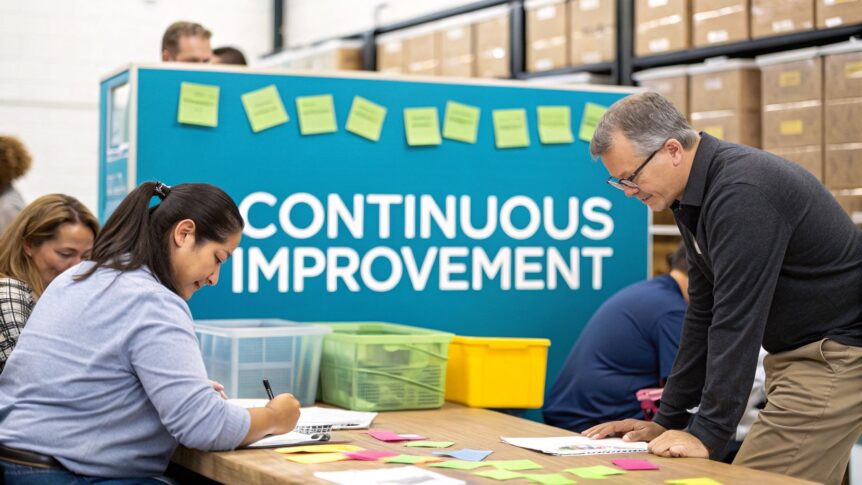
Picture this: a top-tier sports team that never stops analysing its performance. They don't just review the tapes after a loss; they're dissecting their game even after a championship win, always looking for that extra edge. That, in a nutshell, is the spirit of a continuous improvement culture. It’s about moving away from just fixing problems as they appear and actively asking, “how can we make this even better?”
Unpacking the Continuous Improvement Mindset
A continuous improvement culture, sometimes known by its Japanese name Kaizen, is about creating an environment where small, steady enhancements are everyone's daily responsibility. This isn't a one-off project or a directive from on high; it's woven right into the fabric of how a company works. Every single person, from the apprentice on their first day to the CEO, is encouraged and empowered to spot opportunities for improvement and do something about it.
This mindset takes you far beyond the dusty old suggestion box where good ideas go to die. Instead, it builds a living, breathing system where ideas are welcomed, talked about, and put into action. The aim is to make small, consistent gains that add up over time, creating major advantages in the long run.
The Two Pillars of Improvement
This whole culture really rests on two key pillars: a deep respect for people and an unwavering drive for improvement. You can't have one without the other; they're two sides of the same coin.
"A Lean leader looks at a mistake and asks: What in the system allowed that to happen? What can we do to prevent it in the future? We can be critical of broken systems without being critical of the people working in them."
Respect means trusting your employees. They know their jobs inside out, so you give them the freedom to make their work better. It’s about building systems that set people up for success, rather than pointing fingers when something goes wrong. In turn, the drive for improvement becomes a way to develop your team's skills and boost their engagement, not just a tool for hitting targets.
From Theory to Daily Practice
Putting this culture into practice means changing your focus. Instead of only chasing massive, game-changing innovations, leaders start to champion and celebrate the small, everyday tweaks. To see how this works on the ground, it helps to look at how companies handle things like business process optimization.
A few key traits you'll see in this kind of environment include:
- Empowered Teams: Staff have the authority and the tools they need to make changes in their own areas of work.
- Psychological Safety: People feel secure enough to try new things, point out when something isn’t working, and even fail without worrying about being blamed.
- Systemic Thinking: When a problem arises, the first question is "what's wrong with the process?", not "who messed up?".
- Shared Ownership: Everyone feels responsible for quality and efficiency, which helps to break down the walls between departments.
When you embed these elements into your organisation, it starts to transform. It becomes a true learning entity that doesn't just cope with change but actively thrives on it.
The Real-World Benefits of Embracing Improvement

It’s one thing to talk about concepts, but what does a continuous improvement culture actually look like on the ground? The reality is that the benefits ripple out through the entire business, touching everything from your bottom line to the buzz on the workshop floor. We're not just talking about shaving a few seconds off a task; this is about building a stronger, more resilient organisation from the inside out.
When getting better becomes a shared goal, it sparks a powerful drive for innovation. It creates a space where people feel safe to try new things and take calculated risks, knowing that failure is a learning opportunity, not a reason for blame. This unlocks a level of grassroots creativity that you can never achieve with top-down instructions alone.
This shift has a direct and meaningful impact on your team. When employees are given the tools and trust to fix problems and refine their own workflows, their sense of ownership and engagement naturally grows. They stop being just cogs in a machine and become genuinely invested partners in the company's success.
Boosting Morale and Productivity
A clear and immediate result of this empowerment is a visible lift in team morale. Instead of growing frustrated with clunky processes or recurring headaches, staff are given the power to actually fix them. It's no surprise that companies with a strong improvement culture often see much higher employee satisfaction and retention.
This proactive mindset gets to the heart of problems. Instead of simply papering over the cracks, teams learn to ask "why" and dig for the root cause, leading to solutions that stick. This results in:
- Superior Quality: By constantly fine-tuning how work gets done, defects and errors naturally decrease, leading to a much higher quality end product.
- Reduced Waste: Whether it's wasted time, materials, or movement, a focus on efficiency plugs costly leaks in your resources.
- Enhanced Safety: Encouraging everyone to spot and flag potential hazards makes the entire workplace safer for the whole team.
One study revealed that organisations with a mature improvement culture end up implementing around 80% of their employees' ideas. This shows a deep-seated trust and a real commitment to taking action, not just collecting suggestions in a box.
Creating a Competitive Advantage
In the end, all these internal gains add up to a serious competitive advantage. Better quality and greater efficiency translate directly into happier, more loyal customers. When people receive consistently excellent products and services, they come back, and they tell others.
Every small, daily tweak—a better-organised tool board, a simpler data-entry form, a slightly more ergonomic assembly step—compounds over time. These small wins accumulate, snowballing into a major long-term advantage that is incredibly difficult for competitors to copy. Your business becomes more agile and ready to adapt, setting you up for lasting success.
The Core Principles of Continuous Improvement

To build a culture of continuous improvement that actually sticks, you need more than just good intentions. It demands a solid foundation built on a few core principles. Think of them as the load-bearing walls of your operation. Get them right, and you can create a powerful, self-sustaining system for positive change.
These aren't complicated theories, but practical ways of thinking and acting that reshape how work gets done. They shift the focus away from top-down orders and towards bottom-up innovation, putting the power to improve directly into the hands of the people doing the work.
Unwavering Leadership Commitment
This is the big one. The single most critical element is genuine commitment from the very top. Leaders can't just sign off on the idea; they must actively champion it. Your team will look at what you do, not just what you say.
When leaders roll up their sleeves, ask thoughtful questions on the workshop floor, and celebrate the small wins, it sends a powerful message: this is how we do things here. That visible, hands-on involvement is the non-negotiable starting point.
Key Frameworks for Action
While culture is about a shared mindset, you need practical frameworks to turn great ideas into tangible results. Three of the most proven and effective are:
- Kaizen: This is a Japanese philosophy that literally means "change for the better." It’s all about making small, incremental improvements consistently. The belief is simple but profound: thousands of tiny tweaks add up to massive gains over time.
- Gemba: Meaning "the real place," this principle is about getting out of the office and going to where the work actually happens. A Gemba walk isn't about giving orders; it's about observing, listening to the team, and truly understanding a process or problem from the ground up.
- PDCA (Plan-Do-Check-Act): This is a beautifully simple, four-step scientific method for testing changes. You Plan an improvement, Do it on a small scale, Check to see if it worked as you expected, and then Act on what you learned—either adopting the change or trying a new approach.
Empowering Your Teams
A continuous improvement culture will wither on the vine if people aren't empowered. You have to give your teams the right training, the right tools, and, crucially, the right level of autonomy. This means trusting them with the authority to spot problems and implement fixes in their own areas.
True empowerment is about trusting your people to solve problems. It’s a move away from controlling every outcome and towards coaching for capability, building a system where your team is set up to succeed.
For instance, the NHS in England showed this by cutting red tape for some Primary Care Trusts, allowing staff to make their own recruitment decisions. This simple change demonstrated a deep trust in their teams' judgement, which is a cornerstone of genuine cultural change. This also highlights the importance of having solid quality assurance processes, as they give teams clear standards to work with and improve upon.
Finally, transparent communication ties it all together. You need open, honest channels for ideas to travel up the chain without fear of blame. When you pair this with a system that recognises and rewards effort—even a simple but sincere "thank you" from a manager—you create the positive feedback loop that keeps the whole culture running.
Running an Effective Improvement Workshop
Ideas are great, but it’s a structured process that turns them into real-world results. This is exactly what an improvement workshop, often called a Kaizen event, is for. Think of it as a focused, hands-on session designed to take a specific problem from a nagging frustration to a solved issue with a clear plan for moving forward.
A successful workshop is far more than just getting people together in a room. It's a carefully planned event, built to dig into root causes and get everyone on the same page. It’s a live demonstration of a continuous improvement culture in action, turning collaborative problem-solving into a skill your team can use again and again.
Preparing for Success
The groundwork you lay before anyone even enters the workshop is every bit as important as the event itself. If you rush this stage, you’ll likely end up with unfocused discussions and watered-down outcomes. Proper preparation really comes down to a few key steps:
- Define the Problem Clearly: You need to start with a sharp, specific problem statement. "The packing station is inefficient" is far too vague. A much better goal is something like, "Reduce the time to pack Order Type B from 7 minutes to 4 minutes." That’s a target you can actually measure.
- Select a Diverse Team: Make sure you bring together a cross-functional group. You absolutely need the operators who do the job every day, their supervisor, and maybe even someone from a completely different department who can offer a fresh set of eyes.
- Gather Initial Data: Don't go in blind. Before the workshop, collect some baseline data—things like process timings, error rates, or even just photos of the current setup. This objective information keeps the conversation grounded in facts, not just opinions.
This kind of disciplined prep work ensures your workshop kicks off with a clear sense of purpose.
The process flow below shows how these workshops fit into the bigger picture of improvement, taking you all the way from identifying an issue to standardising the solution.
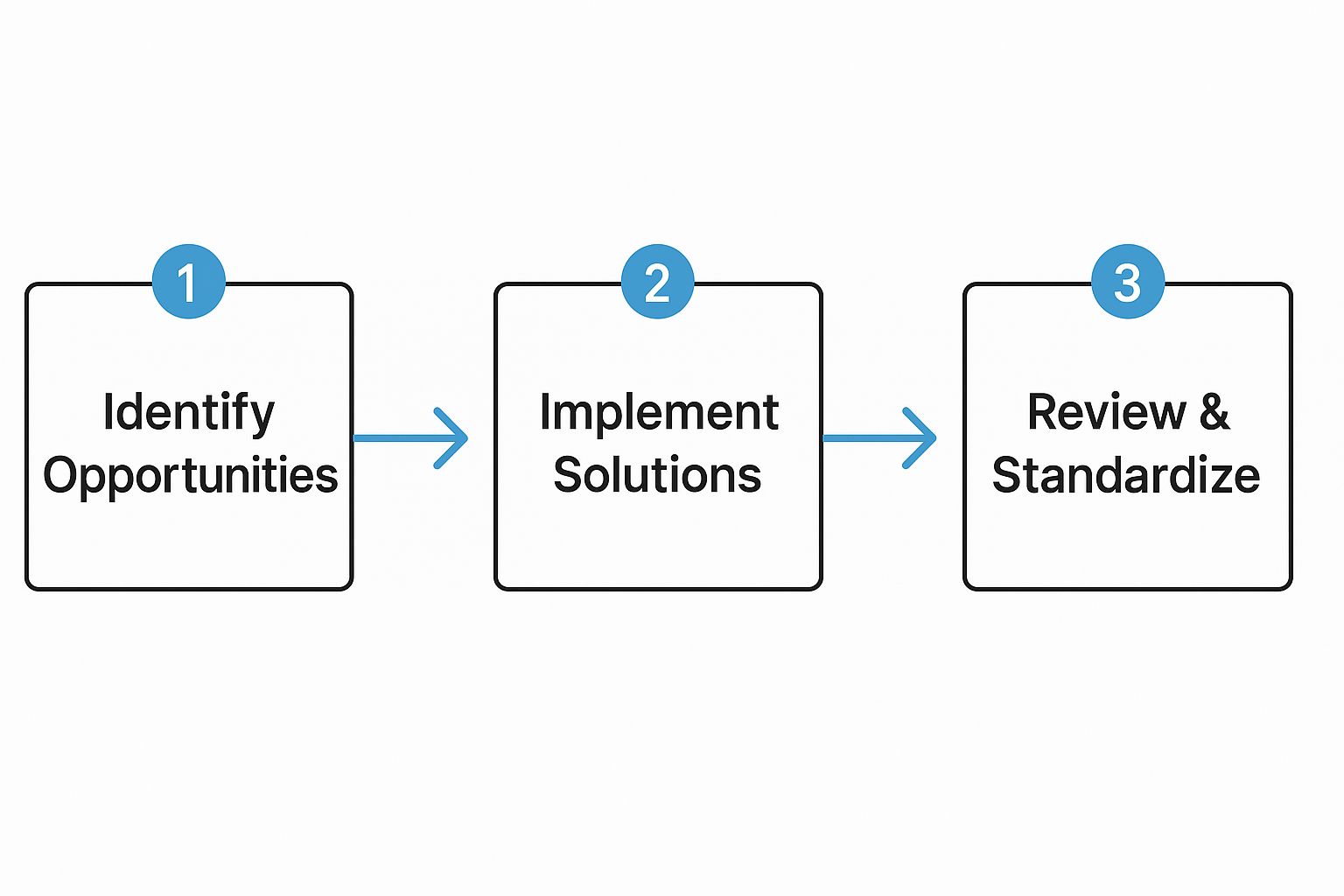
As you can see, the workshop is the engine that drives implementation. It’s the critical link between spotting a problem and locking in a new, better standard practice.
Facilitating the Workshop
Once the event is underway, your job as a facilitator is to guide the conversation, not dictate the outcome. It's crucial to create a judgement-free zone where every idea is heard and given respect. One of the most powerful, yet simple, tools for this is the ‘5 Whys’ technique. By asking "why" a problem is happening over and over, you can peel back the layers and get past the surface-level symptoms to find the real root cause.
The goal is to create an environment where the best ideas win, regardless of who they came from. It's about collaborative discovery, not top-down directives. Every voice has value in uncovering the path to a better way of working.
Once you’ve landed on a potential solution, the final piece of the puzzle is to build a concrete action plan. This plan has to be specific, with clear ownership and deadlines assigned for every single task. Without that accountability, even the most brilliant solutions can just fizzle out. The aim is always to implement, measure, and sustain the improvement, making sure it sticks and becomes the new standard.
Keeping the workspace organised is also vital for holding onto these gains. You can learn more about how the right equipment supports this by reading about maximising efficiency with workshop drawers.
How Improvement Culture Fuels Digital Transformation
Think of it this way: investing in new technology without the right company culture is like buying a high-performance race car but never learning how to drive it properly. The car has incredible potential, but without the skill to handle it, the results will always be disappointing. In the same vein, digital transformation isn't just about a technology upgrade; it's fundamentally a cultural one. A business that already embraces continuous improvement is perfectly positioned to get the maximum return from every new digital tool it adopts.
When a team is already used to analysing their workflows and seeking better ways of working, new technologies are welcomed as opportunities, not feared as disruptions. They don't just use a new system—they actively look for ways to adapt their processes to fully exploit its capabilities. This creates a powerful, positive loop of innovation.
Turning Data Into Action
One of the greatest gifts of modern digital tools is the sheer amount of data they generate. But data on its own is just noise. A company with a strong continuous improvement culture instinctively knows how to turn this data into fuel for the next improvement cycle. They see performance metrics not as a static report card, but as a treasure map pointing them toward the next big opportunity.
For UK firms, this connection is especially vital. The success of digital modernisation projects here often hinges on having this kind of culture baked in from the start. It's been shown time and again that companies with ingrained improvement practices reduce costs and boost productivity far more effectively when they adopt new technology. You can discover more insights about digital continuous improvement on kaizen.com.
Creating a Virtuous Cycle of Innovation
When culture and technology align, a powerful, self-sustaining cycle kicks into gear. New digital systems provide richer data, which fuels smarter improvement ideas, which in turn makes even better use of the technology. It’s this synergy that truly separates market leaders from the rest of the pack. Getting started often involves adopting smart digital tools; for example, reading up on leading accounting automation software can show how technology refines crucial financial processes.
An improvement culture ensures technology is not just implemented, but deeply integrated. It becomes part of a living system where teams continuously refine how digital tools serve them, ensuring the technology evolves with the business's real-world needs.
This proactive mindset maximises the return on every single tech investment. It also highlights the need for the physical workspace to keep pace with digital progress. As your processes become more data-driven and efficient, organised warehouse storage solutions become critical to maintaining that momentum. This prevents new, physical bottlenecks from undermining your digital gains, creating a holistic system where both digital and physical workflows are constantly improving together.
Right, let's get this done. Here is the rewritten section, designed to sound like it was written by an experienced hand.
Navigating the Sticking Points of Culture Change
Even with the best will in the world, trying to build a continuous improvement culture will always throw up a few common questions and challenges. The trick is to face these head-on. If you do, you’ll keep your momentum going and ensure everyone, from the workshop floor to the boardroom, is pulling in the same direction.
One of the first hurdles is nearly always getting genuine buy-in from senior leadership. It’s easy for them to see it as another initiative or a "nice-to-have" distraction. The key is to speak their language. Frame continuous improvement in terms of cold, hard strategic value. Show them the data—demonstrate how small, incremental changes directly improve efficiency, boost quality, and ultimately, fatten the bottom line.
Is This a Culture or Just Another Project?
Another point that needs clarifying early on is the difference between a CI culture and a one-off improvement project. A project is finite; it has a clear start and finish, and it’s designed to fix one specific problem.
A continuous improvement culture, on the other hand, is a fundamental shift in how everyone thinks. It’s a permanent, ongoing commitment to getting a little bit better every single day. It becomes part of the company's DNA.
Getting this distinction right from the outset is crucial for managing expectations and avoiding confusion.
How Do We Know if It’s Actually Working?
Finally, your teams will rightly ask how you're going to measure success. You can't just rely on gut feeling. A solid approach uses a mix of different signposts to track your progress.
- Hard Metrics: These are the numbers you can't argue with. Think reduced cycle times, lower defect rates, or a measurable increase in output.
- Softer Indicators: These are just as important because they show the culture is taking root. Look for things like higher scores in employee engagement surveys or a noticeable uptick in the number of improvement ideas being submitted by staff.
By tracking both, you get a much fuller, more honest picture of how you're doing.
Of course, sustaining these improvements is much easier when your workspace isn't fighting against you. A well-organised environment is foundational. TEMA Solutions provides industry-leading ergonomic storage and workstation systems that help you lock in those hard-won efficiency gains. Discover how our solutions can support your continuous improvement journey at https://tema-solutions.co.uk.


