


Think about what “quality” really means for a business. It’s not just a buzzword; it’s a promise to your customers. Quality assurance processes are the framework you build to make sure you deliver on that promise every single time. It’s about moving beyond simply finding mistakes at the end of the line and instead, preventing them from ever happening in the first place.
What Quality Assurance Processes Mean for Your Business
Let’s ditch the dry, textbook definitions for a moment. Picture this: you’re not just assembling a product, you’re building a high-performance car. Real quality assurance isn’t the final polish and inspection. It’s the meticulous work that happens long before that—ensuring the initial blueprints are perfect, sourcing only the best materials, and making sure every single step on the assembly line is followed with precision.
That’s the core of it. Quality assurance processes are the documented, repeatable steps your team follows to create a brilliant result, consistently. This proactive approach builds quality right into the DNA of your operations, which is the foundation of genuine customer trust and long-term success.
Quality Assurance (QA) vs Quality Control (QC)
People often use QA and Quality Control (QC) interchangeably, but they are fundamentally different. QA is proactive and process-oriented, focusing on preventing defects. QC is reactive and product-oriented, focused on identifying defects. Think of it like this: QA designs a great recipe and trains the chef, while QC tastes the final dish before it goes to the customer.
Here’s a clearer breakdown of the differences:
| Aspect | Quality Assurance (QA) | Quality Control (QC) |
|---|---|---|
| Focus | Proactive: Prevents defects by improving processes. | Reactive: Identifies and corrects defects in the finished product. |
| Goal | To build quality into the system from the start. | To ensure the final output meets quality standards. |
| Orientation | Process-oriented. | Product-oriented. |
| Timing | Happens throughout the entire development lifecycle. | Typically happens at the end of a phase or before delivery. |
| Responsibility | Everyone on the team is responsible for quality. | Usually a specific team or individual is responsible for testing. |
Understanding this distinction is crucial. A business that only relies on QC is always playing catch-up, whereas a business with strong QA builds an environment where mistakes are far less likely to happen in the first place.
Quality assurance is a systematic process of verifying and validating the accuracy and reliability of calculations, administrative processes and the member communications that go with them. It acts as a safeguard, ensuring that processes are precise, compliant, and transparent.
Many companies proudly display their commitment to these principles. For a solid example of how a business integrates this into its core identity, you can see their About – Quality page. This kind of transparency is quickly becoming a major competitive edge.
QA as a Driver of Growth
This focus on structured quality isn’t just about internal improvements; it’s a powerful economic force. The global market for formal quality assurance services is projected to leap from USD 4.7 billion in 2025 to a massive USD 15.5 billion by 2034.
The UK is a key player in this boom, largely thanks to its highly developed manufacturing and technology sectors. In Britain, quality assurance processes often involve stringent auditing and testing to comply with international standards like ISO 9001. This isn’t just about ticking boxes; it’s about proving excellence on a global stage. This growth underscores a simple truth: having robust quality assurance processes is no longer a “nice-to-have.” It’s essential for staying compliant and, more importantly, for leading the market.
The Core Stages of a Winning QA Framework
A truly effective QA framework isn’t some rigid checklist you tick off; it’s a living, breathing cycle that brings your quality goals to life. The best quality assurance processes are built on a solid structure that flows from big-picture strategy all the way down to a constant process of refinement.
We can break this lifecycle down into five essential, interconnected stages.
To make this real, let’s imagine we’re rolling out a new software feature. Each stage will build on the last, ensuring what we ship to customers is reliable, easy to use, and genuinely ready for the market.
This visual helps to show how quality assurance is a structured journey, moving from initial planning right through to continuous improvement, as mapped out by a team of QA engineers.
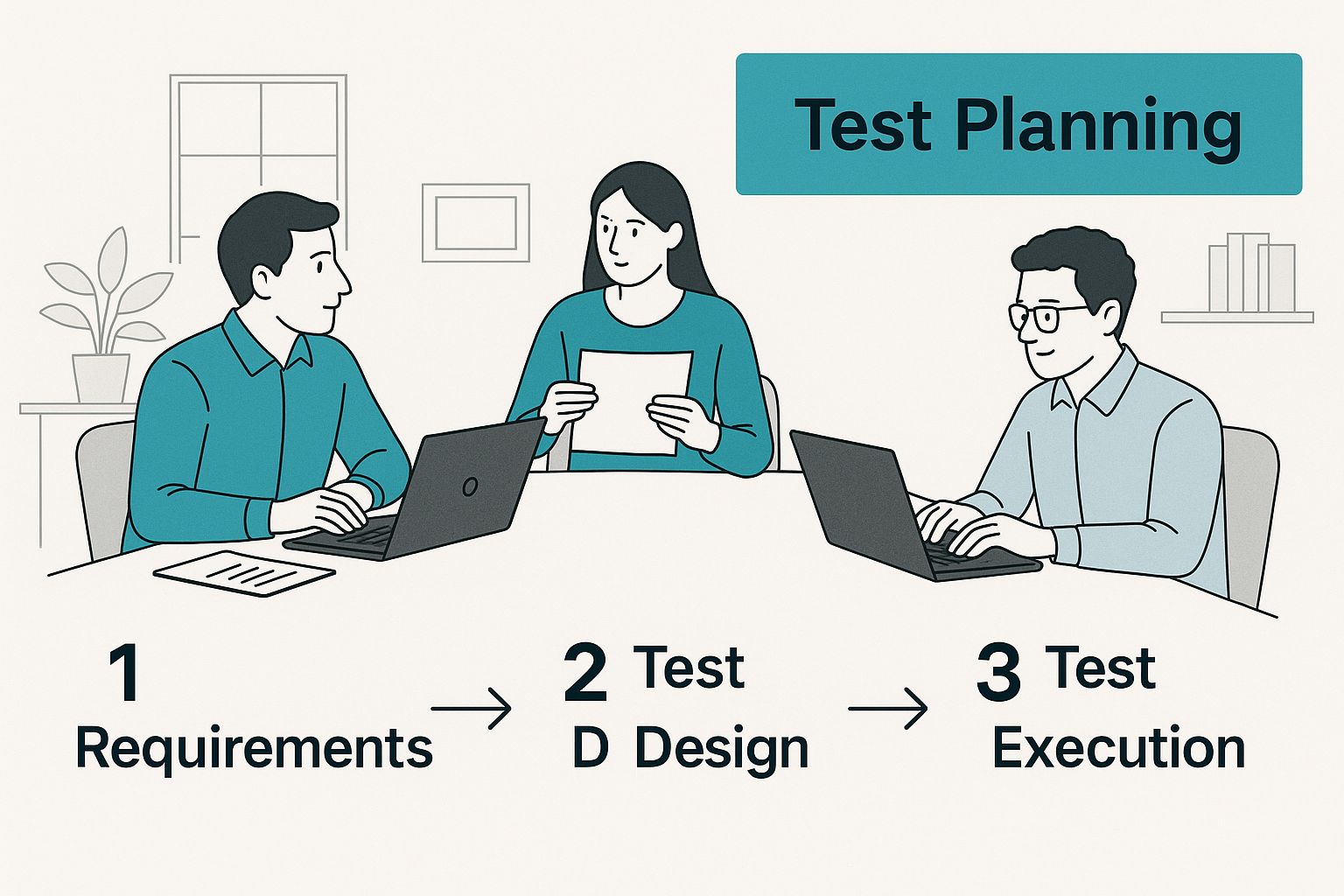
The flow here highlights something crucial: test planning isn’t just a starting point. It’s the foundation that supports every single action that follows.
Stage 1: Planning and Objective Setting
This is where it all begins—the strategic kickoff. Before a single test is run, you have to define what ‘quality’ actually means for this new software feature. Is the top priority lightning-fast performance? An incredibly intuitive user interface? Or is it launching with zero critical bugs?
This stage is all about setting clear, measurable objectives. For our new feature, that could mean locking in specific targets, such as:
- 99.9% uptime during the first month.
- A user satisfaction score of at least 8 out of 10.
- A maximum of five minor bugs reported in the first week.
Without these concrete goals, your QA efforts are just spinning wheels. You’ll have no direction and no real way to measure if you’ve succeeded.
Stage 2: Process Design and Documentation
Now that you know your destination, it’s time to draw the map. This is where you create the standard operating procedures (SOPs) your team will live by. You’re essentially documenting how you will hit the quality targets you’ve just set.
For our software feature, this means writing detailed test cases, deciding on the right testing environment, and outlining exactly how bugs should be reported. Documenting these steps ensures everyone on the team performs their tasks consistently, cutting down on confusion and human error. It’s a fundamental part of building reliable quality assurance processes.
Stage 3: Execution and Monitoring
Time to put the plan into action. Your QA team starts executing the test cases, running automated scripts, and performing manual checks, all according to the procedures you’ve documented. This is the most hands-on phase of the framework.
At the same time, you’re monitoring everything in real-time. Are tests getting finished on schedule? Are critical bugs being found and flagged correctly? This active monitoring makes sure the process is running smoothly and lets you make immediate adjustments if things start to go off track.
Quality assurance is not about ticking boxes; it is about safeguarding the future of scheme members and ensuring the integrity of the pension scheme.
Stage 4: Analysis and Reporting
Once the testing cycles are done, the work shifts from doing to understanding. This stage is all about analysing the data you’ve collected—bug reports, test results, performance metrics, and so on. You’re not just counting bugs; you’re digging deeper to find patterns and root causes.
The result is a clear report that turns all that raw data into insights that stakeholders can actually use. It answers the big questions: Is the feature ready to go live? What are the biggest risks we’re facing? Which areas need more work from the developers?
Stage 5: Improvement and Iteration
Finally, we close the loop. The insights you gained from your analysis feed directly back into making your process better for next time. You learn from both your mistakes and your wins to strengthen your quality assurance processes over time.
For more detail on specific parts of a QA framework, you can explore the best practices for quality control in labelling.
Maybe you found a type of bug that slipped through the cracks in your initial planning. Now you can update your process design to catch it much earlier in the next project. It’s this continuous feedback loop that turns a good QA framework into a great one.
Choosing the Right QA Methodology
Picking the right approach to quality isn’t a matter of simply grabbing one off the shelf. There’s no universal “best” method. The ideal quality assurance processes for a nimble software startup will look completely different from those needed in a high-precision manufacturing plant. The real skill is matching the methodology to your specific industry, your company’s culture, and what you’re trying to achieve with a particular project.
Think of it like picking the right tool for a job. You wouldn’t use a sledgehammer to hang a picture frame, would you? In the same way, forcing a highly complex, data-heavy methodology onto a small, creative project will only suffocate it. On the flip side, a simple framework just won’t provide the necessary rigour for a safety-critical system where failure is not an option.
Foundational and Philosophical Approaches
Some methodologies are less about a strict set of rules and more like guiding philosophies. They set the tone for your entire organisation’s attitude towards quality, creating a culture where excellence can thrive.
- The Deming Cycle (PDCA): This stands for Plan-Do-Check-Act, and it’s a beautifully simple but powerful framework for continuous improvement. It’s an iterative loop: you plan a change, you do it (often on a small scale first), you check the results to see if it worked, and then you act on what you’ve learned—either by rolling out the change or by starting the cycle over with a new plan. It’s perfect for any team aiming for steady, incremental progress.
- Total Quality Management (TQM): This is a much deeper, company-wide philosophy. The central idea of TQM is that absolutely everyone, from the CEO down to the newest intern, shares responsibility for quality. It’s about weaving quality into the very DNA of the company, focusing on long-term goals, delighting customers, and empowering employees to make a difference.
By championing and prioritising QA within our individual schemes we can continue to build robust, trustworthy, and efficient systems that stand the test of time and foster a culture of excellence across our industry.
Data-Driven and Specialised Methodologies
For industries where precision is everything, you need more specialised, data-centric approaches. These methods bring a level of mathematical certainty that’s essential for stamping out errors and optimising performance.
Take Six Sigma, for instance. This is a highly disciplined, statistics-based methodology. Its entire purpose is to find and eliminate the root causes of defects and reduce variability in any process, whether in manufacturing or business operations. The name itself signals its incredibly high bar: the goal is to reach a state of fewer than 3.4 defects per million opportunities. It’s the gold standard in sectors like automotive and aerospace, where even the smallest mistake can have catastrophic consequences.
Then you have the fast-moving world of technology, where quality assurance processes are now tightly woven into the fabric of development. Methodologies like Agile and DevOps champion continuous testing. Instead of a separate testing phase at the end, quality checks are performed constantly. This allows teams to spot and squash bugs early, adapt to changes on the fly, and deliver functional software at a much quicker pace.
Ultimately, choosing the right path means taking a hard look at your needs. Are you after a cultural transformation (TQM)? A simple cycle of improvement (PDCA)? Statistical perfection (Six Sigma)? Or integrated speed (Agile)? The right answer is the one that aligns your quality efforts directly with your most important business goals.
Here’s the rewritten section, crafted to sound like it was written by an experienced human expert.
The Real-World Business Impact of Great QA
So, what does investing in a solid quality assurance process really do for your business? It’s far more than a box-ticking exercise or an operational cost. Think of it as a direct investment in your company’s future, one that delivers clear, measurable returns that strengthen your bottom line and build a brand people trust.
When your products and services just work, you earn customer confidence. That reliability is the bedrock of loyalty. It’s what turns a one-time buyer into a repeat customer and, eventually, a vocal advocate for your brand. This isn’t just about good feelings; it translates directly into higher satisfaction scores, a better Net Promoter Score (NPS), and genuine, organic growth.
Slashing Costs and Accelerating Growth
One of the most immediate pay-offs you’ll see is a sharp drop in rework costs. Let’s be honest, finding a design flaw during the planning stage is a minor headache. Recalling a faulty product that’s already in the hands of customers? That’s a full-blown, expensive crisis.
By focusing on getting things right the first time, you naturally speed up your entire development cycle. It allows you to launch new products and services with confidence, often getting you to market much faster than the competition.
Quality assurance fundamentally shifts an organisation’s focus from costly, reactive ‘firefighting’ to proactive, value-driven operations. This isn’t just about avoiding problems; it’s about building a sustainable competitive advantage from the ground up.
Building an Ironclad Reputation
A strong QA framework is your best line of defence. It protects your reputation by ensuring you consistently meet regulatory standards, which minimises business risk and helps you sidestep hefty penalties.
You see this in action everywhere. The real-world impact of robust quality assurance in manufacturing and industrial settings is crystal clear—it’s absolutely essential for safety and reliability. But it’s not just for factories. Effective QA is just as crucial for methodical internal operations, like ensuring perfectly organised warehouse storage solutions run smoothly.
This commitment to quality isn’t just good practice; it’s driving serious market growth. The UK’s quality management software market—the very engine behind many quality assurance processes—is set to grow at a CAGR of 8.4% between 2025 and 2030. Interestingly, the biggest slice of that pie, 17.22%, belongs to complaint handling. This proves just how vital a systematic response to customer feedback is for maintaining quality. The data points to a clear, growing demand for tools that foster a culture of excellence, cementing QA as a true cornerstone of modern business strategy.
How to Implement Quality Assurance Processes
https://www.youtube.com/embed/pQieqWJQNjQ
Knowing the theory behind quality assurance is one thing, but actually putting it into practice is where the real work begins. Building an effective QA system isn’t a single event; it’s a deliberate journey that requires a clear plan, starting right at the top and weaving a commitment to quality into the very fabric of your operations.
The whole effort really depends on getting your leadership on board. When senior managers truly champion a culture of quality, it sets the tone for the entire organisation. They’re the ones who need to approve the budget, free up the necessary resources, and make it clear that quality isn’t just one team’s job—it’s everyone’s responsibility.
Building Your Foundation for Quality
With leadership backing you, the next logical step is to get the right people and tools in place. This doesn’t necessarily mean you have to go out and hire a brand-new department from scratch. You can start by looking for quality champions within your existing teams—those detail-oriented people who naturally drive for higher standards.
From there, you’ll need to choose the right tools for the job. This could be anything from dedicated Quality Management System (QMS) software to automation platforms that take care of repetitive checks. The trick is to find tools that solve your specific problems and can grow with you. Even something as fundamental as a well-kept environment is a tool for excellence; a professional workspace cleaning routine can contribute to more disciplined, quality-focused work.
Finally, a crucial part of this foundation is solid documentation. This is where you create and formalise your Standard Operating Procedures (SOPs). Think of these documents as your company’s playbook, ensuring that every task is done consistently and to the same high standard, no matter who is performing it.
Launching and Scaling Your QA Initiative
Once your team, tools, and procedures are ready, it’s time to bring your quality assurance processes to life. Instead of trying to overhaul the entire company all at once, the smarter approach is to start small.
- Run a Pilot Project: Pick one single, well-defined project or process to test your new QA framework. This gives you a safe, controlled space to work out the kinks and, hopefully, score an early win that builds momentum.
- Train Your Teams: Proper training is absolutely vital. Your people need to understand not just what they’re supposed to do, but why it matters. This helps nurture that quality-first mindset that is so critical for making this stick in the long run.
- Measure, Analyse, and Refine: Keep a close eye on the results of your pilot. Use data to see how you’re performing against your goals, spot what’s working well, and pinpoint where you can make improvements. This data-driven cycle is the engine of refinement.
The impact of a strict quality framework is clear even in massive undertakings like national data collection. By rigorously following its quality assurance protocols for the Index of Production, the UK’s Office for National Statistics achieved a 75.5% response rate, covering a massive 89.0% of total business turnover. You can read more about how these ONS quality frameworks enhance data reliability.
The ultimate aim is to create a system of continuous improvement. The lessons you learn from that first pilot project allow you to tweak and perfect your approach before you roll it out more widely, creating a ripple effect of quality and efficiency across the entire business.
Common Questions About Quality Assurance

Even with the best-laid plans, actually putting quality assurance processes into action can bring up a few tricky questions. Let’s walk through some of the most common sticking points to help you move forward with confidence.
Think of this as a practical guide to clear up any confusion you might have about the core ideas and the real-world hurdles you’re likely to face.
QA, Quality Control, and Testing Explained
It’s incredibly common for people to use these terms as if they mean the same thing, but they actually describe distinct, equally important layers of quality management. Getting the difference straight is the first step to building a truly effective strategy.
Let’s use a simple analogy: preparing a gourmet meal.
- Quality Assurance (QA) is your whole proactive approach. It’s about choosing a reliable recipe, sourcing the freshest ingredients from trusted suppliers, and making sure your kitchen team knows the proper cooking techniques inside and out. QA is all about preventing a bad dish from ever being made.
- Quality Control (QC) is the reactive check. This is when you taste the sauce just before serving to see if it needs a pinch more salt. QC is about finding a mistake in the finished product before it ever gets to the customer.
- Testing is just one specific action you take as part of QC. It’s like using a food thermometer to check the chicken has reached a safe internal temperature. It’s a tool you use to carry out quality control, not the whole process itself.
In a nutshell, QA looks at the process, QC looks at the product, and testing is a specific check to verify standards are met.
Can Small Businesses Implement QA On a Budget?
Absolutely. At its heart, quality assurance is a mindset, not a major expense. You don’t need a huge budget or a separate department to start making a real difference to your quality standards.
In fact, some of the most powerful strategies cost next to nothing. You can start by creating simple checklists for your most critical tasks, which helps enforce consistency and cut down on human error. Holding short, regular team meetings to talk about what went well and what could be done better next time is another fantastic, low-cost habit.
One of the most valuable—and free—QA tools you have is customer feedback. Actively gather it, review it, and let it steer your improvements. It tells you exactly where your quality hits the mark and where it falls short.
Free or low-cost digital tools can also provide a solid foundation for QA on a budget. Platforms like Trello are great for managing workflows, Google Forms can be used to collect customer opinions, and simple shared documents can house your standard operating procedures. The real investment is time and discipline, not cash.
How Is AI Changing Modern Quality Assurance?
Artificial Intelligence isn’t here to replace QA experts. Instead, it’s becoming a powerful partner that amplifies their speed, accuracy, and strategic insight. AI is fundamentally reshaping what’s possible within quality assurance processes.
For example, AI-powered tools can now run thousands of repetitive software tests in a few hours—a job that would take a human team weeks to finish. They can also carry out ‘visual testing’, spotting tiny user interface mistakes across different devices that the human eye would almost certainly miss.
On a more strategic level, AI can analyse past bug reports and project data to predict where new problems are most likely to appear. This allows teams to focus their valuable time and energy on the highest-risk parts of a project. AI also helps generate smarter test data and can even optimise test plans by flagging redundant checks.
It’s a misconception that AI is taking over. It’s actually freeing human experts from the repetitive, data-heavy work so they can focus on what they do best: creative problem-solving, understanding the customer experience, and making complex strategic judgements. This partnership between human and machine is making QA smarter and more efficient than ever. In the same way, well-organised physical systems for factory and workshop packing enable skilled workers to concentrate on higher-value tasks, boosting overall productivity.
At TEMA Solutions Limited, we believe that quality workspaces are the foundation of quality work. Our durable storage cabinets and ergonomic workbenches from leading brands like Thurmetall and LISTA are engineered to support the most rigorous quality assurance processes in any industrial setting. Explore our range of ISO-certified workstation solutions and build an environment where excellence comes as standard.


