


Moving materials is essential to production, but it can quietly consume valuable labour time. Operators pushing trolleys, searching for parts or waiting for deliveries are not adding value to the product. Across a shift, these small delays can interrupt production flow, extend lead times and make it harder to meet delivery targets.
Automated guided vehicles (AGVs) can take on repetitive internal transport, carrying materials between storage, workstations and production areas. Yet the vehicle is only one part of an effective solution. To deliver dependable results, AGVs need organised storage and clearly defined points where people, equipment and materials can hand over work.
Why material transport is a hidden production cost
Manual transport often becomes routine, which makes its true cost easy to overlook. A worker may spend only a few minutes walking to collect components, but repeated trips across a shift create substantial lost production time. Unplanned journeys also make replenishment less predictable and can leave workstations waiting for the next kit, tool or workpiece.
In aerospace, automotive and other production settings, the effect can be particularly significant. Materials may need to reach the correct process in a defined sequence, with clear identification and traceability. If parts are late, misplaced or delivered to the wrong point, the result can be avoidable waiting, excess work-in-progress or production disruption.
AGVs address the movement of materials, not the organisation of materials. That distinction matters. A well-planned system links transport to reliable storage, standardised handovers and clear production priorities.
What AGV systems actually do
An AGV system is more than an AGV robot following a route. It combines the vehicle with navigation, task management and the interfaces needed to connect transport requests to production. Depending on the configuration, orders may be entered by an operator or passed through a higher-level ERP or WMS.
Some modern systems offer dynamic route planning and the ability to prioritise transport orders. This helps match vehicle activity to changing production demand. Autonomous mobile robots (AMRs) are another term often used for mobile transport automation. The terminology can overlap, so assess the vehicle’s navigation, load handling and system integration against your actual use case.
The LISTA AGV product overview describes solutions for automated material flows across production, assembly and warehousing. The right setup depends on the load, route, handover method and workflow, not simply on the vehicle specification.
Seven ways AGVs automate material transport
-
Replenishing production lines
AGVs can deliver components or consumables from a central store to defined line-side locations. Regular, scheduled replenishment supports a JIT approach and reduces the need for operators to leave production to fetch materials. -
Moving work between production stages
A vehicle can carry workpieces between machining, assembly, inspection and other processes. This is particularly useful where work areas are separated or material movement happens repeatedly throughout the day. -
Transporting heavier loads
Moving heavy or awkward workpieces manually can put pressure on people and create operational risks. A suitable vehicle takes on the repeated journey, while staff focus on handling, checking or processing the load at each end. -
Connecting storage with the point of use
AGVs can transfer materials from stores to workstations and return empty carriers or completed items. This connects inventory locations with production demand rather than relying on ad hoc collections. -
Supporting order picking and kitting
AGV-supported picking can bring a carrier to the picking activity or help move completed kits to assembly. Pairing transport with a clear SKU-based pick sequence helps reduce unnecessary walking and makes kit status easier to manage. -
Prioritising transport tasks digitally
Where the AGV system integrates with ERP or WMS workflows, transport orders can be issued and prioritised digitally. This can improve visibility of requests and help teams respond to production needs in a consistent way. -
Reducing routine vehicle journeys by staff
Repeated trolley and vehicle trips take time away from skilled work. Assigning predictable routes to AGVs can help reduce this non-value-adding activity and create more consistent material movement.
These benefits depend on good process design. Automating an inefficient route can make an inefficient process happen automatically. Map the work first, then identify which journeys are repetitive, predictable and suitable for automation.
The LISTA AGV range: selecting a vehicle for the task
LISTA offers different vehicle types for different transport and picking requirements. Specifications below are provided as a starting point for planning; confirm the final configuration and application requirements with the supplier.
| LISTA system | Published dimensions (W × D × H) | Example application and stated features |
|---|---|---|
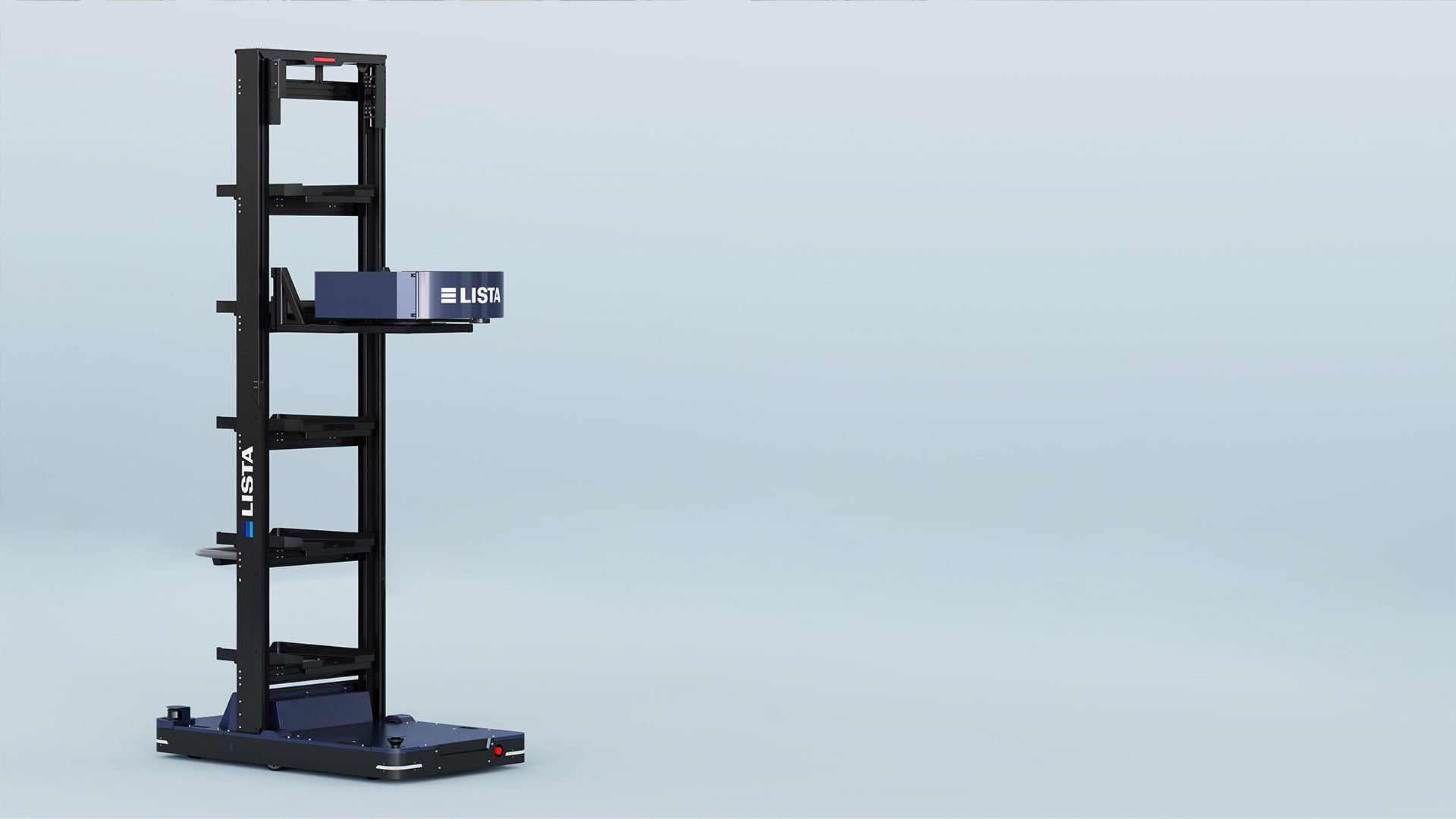
| Stacker | 1,800 × 890 × 2,220 mm | Compact stacker for narrow aisles and heavy workpieces, with intuitive controls, quiet operation and modern safety features. |
| ANT A3 | 795 × 590 × 285 mm | Compact ANT option for smaller-format material movement. |
| ANT A8 | 995 × 650 × 265 mm | 800 kg capacity and speed up to 1.5 m/s. Designed for digitally managed material logistics. |
| ANT A15 | 1,145 × 810 × 275 mm | Larger ANT model for applications requiring a higher-capacity vehicle format. |
| LISTA Picking | – | Ergonomic order-picking solution with 250 kg capacity and speeds up to 1.5 m/s, designed to reduce walking distances and physical strain. |
The Stacker suits applications where the aisle is tight and the workpiece is substantial. The ANT range focuses on digital material flow, including dynamic route planning, transport-order prioritisation and ERP/WMS integration. The Picking solution supports the picking process itself, helping make the movement of orders and materials more efficient.
Before selecting a vehicle, check load dimensions and weight, aisle clearances, floor conditions, turning space, route crossings and how loads will be transferred. For current product details, consult the LISTA AGV range.
Why organised storage is half the system
An AGV can deliver a load accurately and still leave production waiting if the receiving point is unclear. Materials need a designated location, a clear status and an agreed method of collection or replenishment. Defined handover points are a critical foundation for dependable automation.
Drawer cabinets can organise tools, small components and production consumables by SKU, job or process. Labelling and compartment layouts make it easier for staff to identify the correct items and prepare a kit for collection. TEMA’s LISTA storage systems include configurable solutions for industrial storage requirements.

Workbenches and picking stations also need to support repeatable handovers. A defined presentation area gives the vehicle a consistent drop-off or collection point, while the workstation provides an orderly place for the operator to check, prepare or use the materials. Explore workshop storage systems and the industrial drawer cabinets buying guide for ideas on organising tools and components.
This is where physical organisation meets digital efficiency. ERP and WMS software can create a task, but the operator still needs a well-defined location to pick from, and the AGV needs an accessible, consistent point to serve. Organised storage is not an optional extra: it is part of the material-handling system.
Plan the layout around people, vehicles and handovers
AGVs change how materials move through a facility. Routes, waiting areas and handover zones need to work alongside pedestrian access, machinery and existing transport. A layout that has grown around manual trolley movements may need adjustment before an automated route can operate reliably.
Consider how the vehicle will approach the workstation, where it will stop and how people will access the load. Ensure that staging areas do not obstruct walkways or emergency access. Identify crossings, pinch points and locations where a delivery could block another process. A suitable risk assessment and site-specific safety planning are essential.
Review workstation position as well as storage capacity. A mobile workbench may support flexible tasks in some settings, while fixed, clearly defined stations can suit repeatable automated routes. TEMA Solutions is a UK LISTA partner, supplying and installing LISTA workspace and storage systems. Its production solutions can help businesses consider storage, workstations and material flow as part of one layout.
Practical first steps for planning an AGV rollout
Start with a focused process rather than attempting to automate every journey at once.
- Record transport demand. Note what moves, how often, between which locations and at what times. Include load sizes, weights and any handling requirements.
- Identify the best pilot route. Look for repeated, predictable journeys with clear origin and destination points. Avoid starting with a route that depends on frequent exceptions.
- Define handover standards. Specify where materials are presented, how they are identified and what indicates that a load is ready or collected.
- Check the physical environment. Review aisle width, floor conditions, traffic, access and potential obstructions. Plan for people to work safely alongside automated transport.
- Confirm software and data needs. Establish whether tasks will be issued manually or integrated with ERP/WMS, and agree how priorities and status updates will be handled.
- Measure before and after. Track journey time, manual transport hours, waiting at workstations, replenishment reliability and picking performance. These measures show whether the change is improving the process.
- Plan for expansion. Use the pilot to improve routes, storage locations and operating rules before extending the system to other production areas.
Key takeaways
- Automated guided vehicles reduce repetitive manual material journeys and can support more consistent intralogistics.
- Match the LISTA vehicle to the load, route and task. Capacity, dimensions, speed and handover requirements all matter.
- Storage, kitting and workstation organisation are part of the automation design, not separate concerns.
- Start with a defined pilot, agree measurable outcomes and refine the layout before scaling.
- TEMA Solutions can help businesses plan LISTA storage and workspace as part of a joined-up production environment. Visit the TEMA Solutions shop to explore products.
SEO title: 7 Ways LISTA AGVs Automate Material Transport
Recommended URL: /lista-agvs-automated-material-transport/
Meta description: Discover how automated guided vehicles automate material transport, picking and replenishment, and why organised storage and defined handover points complete the system.


