


At its core, a storage racking system is the structural framework that holds all the inventory in a warehouse or industrial setting. It’s far more than just a set of heavy-duty shelves; it’s a meticulously engineered system built to organise goods, maximise your use of vertical space, and streamline the entire flow of operations, from receiving to dispatch.
The Indispensable Skeleton of Your Warehouse
Think of your racking system as the very skeleton of your warehouse. The building itself—the walls and the roof—provides shelter, but it’s the racking that gives the space its functional structure and holds everything together. Without it, you’re left with a cavernous, empty room of floor-stacked pallets, a recipe for chaos, product damage, and serious safety risks.
This framework is what turns empty air into valuable storage space. By building upwards, you can multiply your storage capacity without taking on the massive cost and headache of expanding your building’s footprint. While this is the most obvious benefit, a good racking system’s influence runs much deeper.
More Than Just Holding Stock
A well-designed storage racking system is the bedrock of your entire operational workflow. It determines how products move through your facility, how quickly your team can access them, and how safely everyone can work. The type of racking you choose and its layout directly impacts several key areas:
- Inventory Management: Proper racking makes systematic organisation possible. It’s what allows you to effectively implement crucial inventory control methods like First-In, First-Out (FIFO) or Last-In, First-Out (LIFO).
- Picking Efficiency: When stock is organised in dedicated slots with clear aisles, your team can find and retrieve items much faster. This slashes labour costs and speeds up order fulfilment. In fact, one study found that travel time can eat up 50% of picking hours—a number a smart racking layout can dramatically shrink.
- Workplace Safety: Professionally installed racking is designed and rated for specific load weights, which is critical for preventing catastrophic collapses. It also keeps inventory neatly off the floor, clearing pathways for forklifts and reducing trip hazards for staff.
Even understanding the basics of assembling storage shelves can provide a helpful foundation for appreciating how these much larger, more complex industrial systems work.
A storage racking system isn’t a cost; it’s an investment in productivity, safety, and scalability. It’s the critical element that turns a simple building into a high-performance logistics hub, defining the efficiency of every process within its walls.
Ultimately, choosing the right system is a major strategic decision that will affect your bottom line for years to come. It’s all about creating an environment where your goods are stored securely, handled efficiently, and shipped out accurately. This guide will walk you through everything you need to know to make the best choice for your unique operational needs.
Finding the Right Racking Type for Your Inventory
Choosing the right storage racking system isn’t something you can just pick from a catalogue. Think of it like a professional chef selecting the perfect knife; you wouldn’t use a bread knife to fillet a fish. In the same way, the racking you choose has to be the perfect match for your specific inventory and how your operation runs. Get this right, and you’ll maximise your efficiency.
If you make the wrong choice, you’ll end up with wasted space, painfully slow picking times, and even damaged stock. The goal here is to find a system that feels like a natural extension of your products and your workflow. So, let’s break down the most common and effective racking types to help you find that perfect fit for your warehouse.
The Versatile All-Rounder: Selective Racking
Standard selective racking is the most common type of pallet racking for a very good reason. It’s the absolute workhorse of the warehouse world, giving you direct, clear access to every single pallet you store. This makes it incredibly versatile and a brilliant choice for any operation handling a wide variety of products (SKUs) with different turnover rates.
If your inventory is diverse and you need the flexibility to grab any pallet at any time without fuss, selective racking is almost always the best place to start.
- Best For: Warehouses with many different product lines, fast-moving consumer goods (FMCG), and any operation where direct pallet access is a must.
- Key Advantage: You get 100% selectivity. Every pallet is immediately accessible without having to move other pallets out of the way first.
High-Density Solutions: When Space is at a Premium
When your main goal is to squeeze every last drop of value out of your floor space and you’re storing large amounts of the same product, high-density systems are what you need. These systems essentially trade a bit of that direct access for a huge boost in storage capacity.
Drive-In and Drive-Thru Racking
Picture a multi-storey car park, but for your pallets. With this system, a forklift physically drives into the racking structure to place or retrieve pallets, which sit neatly on supporting rails.
- Drive-In works on a Last-In, First-Out (LIFO) basis because it has only one point for entry and exit. It’s perfect for bulk goods that aren’t date-sensitive.
- Drive-Thru is set up with separate entry and exit points. This allows for a First-In, First-Out (FIFO) workflow, which is absolutely vital for perishable goods or anything with an expiry date.
Push Back Racking
This is another clever high-density LIFO system. Pallets are placed on a series of nested carts that sit on gently sloped rails. When you load a new pallet, it simply pushes the one behind it one position further into the rack. When you retrieve a pallet, the ones behind it automatically slide forward to the picking face.
Push Back racking can boost your storage density by up to 90% compared to standard selective racking. This makes it a powerful choice if you have limited floor space but still need to store several different product types.
Specialised Racking for Unique Inventory
Let’s face it, not all products fit nicely onto a standard pallet. For those long, bulky, or just plain awkwardly shaped items, you need a specialised storage racking system built to handle them safely and efficiently.
Cantilever Racking
This is the undisputed champion for storing things like timber, steel pipes, plastic extrusions, and furniture. Instead of using traditional shelves, it features a series of strong arms that extend from a central column. This design creates a completely open and easily accessible storage bay for long items of any length.
Pallet Flow Racking
For operations that demand strict FIFO control and a high volume of turnover, pallet flow racking is a fantastic solution. It uses inclined tracks fitted with rollers, allowing pallets to glide smoothly from the loading aisle down to the picking aisle. As soon as a pallet is removed, the next one in line automatically rolls into position. This guarantees constant stock rotation and keeps things moving at a very fast pace.
For even more advanced setups, you can explore a wide range of warehouse storage solutions that build on these core principles.
This image shows how these different racking types can be set up alongside each other in a real-world warehouse.
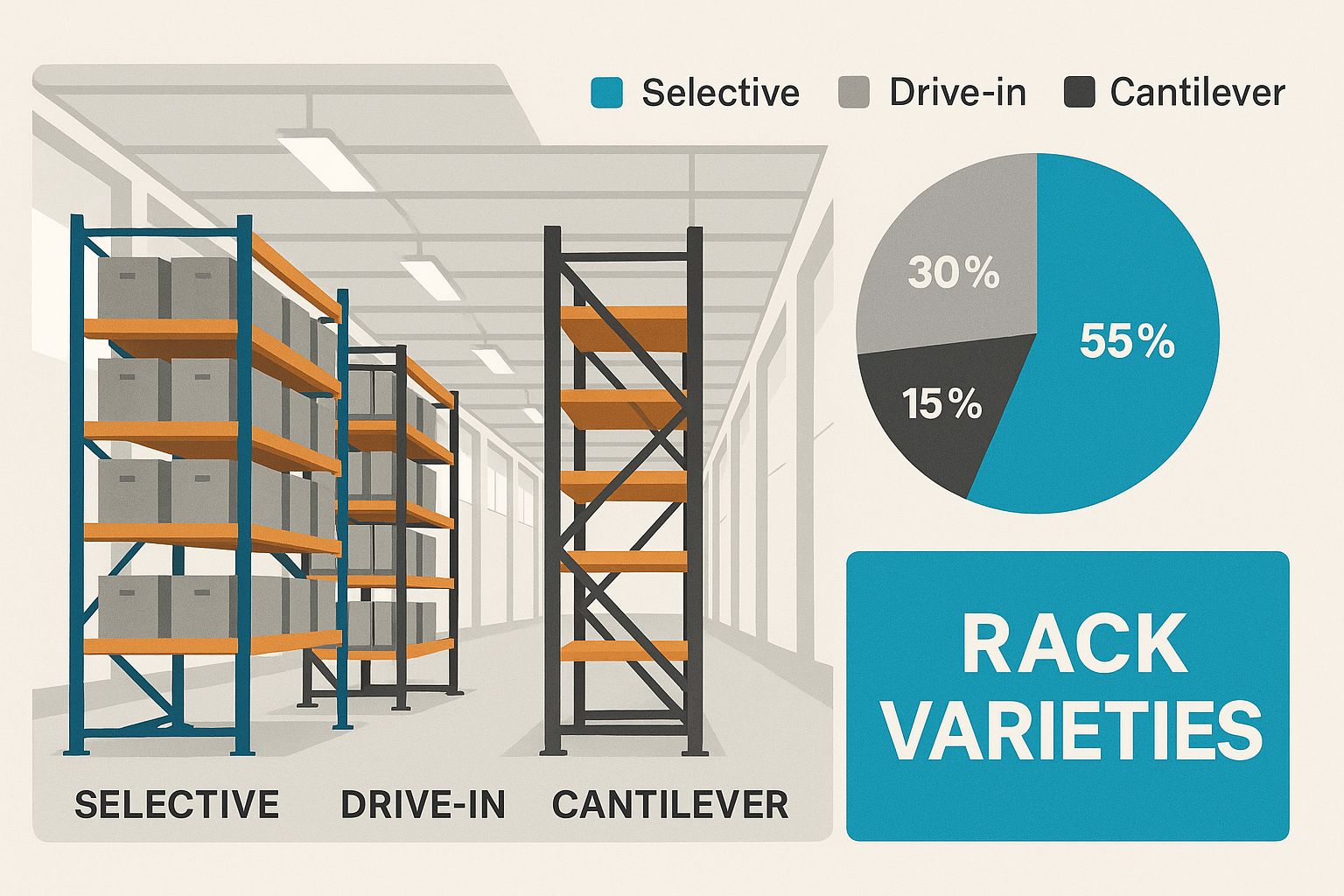
As you can see, different systems make use of floor space and vertical height in unique ways to suit various inventory types and operational needs. This kind of diversity in warehouse design is a direct response to market demands. In fact, the UK warehouse racking market is growing significantly, largely driven by the boom in e-commerce and logistics. Forecasts predict a compound annual growth rate (CAGR) of 3.9% through 2030—the fastest in Europe—fuelled by new warehouse construction to keep up with online shopping.
Comparing Common Storage Racking Systems
Sometimes, a simple side-by-side comparison is the best way to see how these systems stack up. This table gives a quick overview to help you weigh your options based on what matters most to your operation.
| Racking Type | Storage Density | Inventory Access | Best For |
|---|---|---|---|
| Selective | Low | Excellent (100%) | High SKU counts, varied inventory, direct access needs. |
| Drive-In | Very High | Low (LIFO) | Bulk storage of identical, non-perishable products. |
| Push Back | High | Medium (LIFO) | Limited space with moderate SKU variety. |
| Pallet Flow | High | Excellent (FIFO) | High-volume, perishable, or date-sensitive goods. |
| Cantilever | Varies | Excellent | Long, bulky, or awkwardly shaped items. |
Ultimately, the right choice combines your inventory profile with your operational goals. A system that offers high density is fantastic for bulk goods, but selective racking remains unbeatable for flexibility.
The Real Pay-Off: Why Optimised Racking is a Game-Changer
Investing in a proper storage racking system isn’t just about making your warehouse look tidier. It’s a strategic move that directly pumps efficiency, safety, and ultimately, profit into the heart of your operation. While the first thing you’ll notice is how much more space you have, the real value comes from connecting that smart layout to your bottom line.
Think about it this way: every square metre of your facility costs you money. An optimised racking system turns that empty, vertical air—which costs you just as much—into valuable, revenue-generating storage. By building upwards instead of outwards, you can often double or even triple your storage capacity without the massive expense and disruption of expanding your building. It’s not just about cramming more in; it’s about making your entire space work smarter and harder.
Putting Productivity into Overdrive
A logical racking layout is the backbone of a smooth-running warehouse. When your stock is organised and easy to get to, the time it takes for staff to find, pick, and pack an order plummets. This surge in operational speed pays you back in several ways.
For starters, faster picking times mean lower labour costs for every single order. It also leads to fewer picking errors, which cuts down on costly returns and keeps your customers happy. A well-designed system also means less travel time for your team and equipment like forklifts, resulting in less wear and tear and lower fuel or energy bills.
The right racking isn’t just a passive storage unit; it’s an active piece of equipment that sets the tempo for your entire operation. A chaotic layout creates bottlenecks and friction at every turn, while a logical one promotes a seamless flow from goods-in right through to dispatch.
Building a Foundation of Safety
Beyond pure productivity, a professionally engineered and installed racking system is absolutely essential for keeping your team safe. Every beam, frame, and brace is designed and rated for specific loads. Getting this right is critical for preventing damaged stock, and more importantly, for avoiding a catastrophic collapse that could cause serious injury.
Key safety benefits include:
- Load Stability: Properly specified racking keeps heavy pallets secure, stopping them from tipping or falling.
- Clear Aisles: By getting stock up off the floor and into its designated home, you maintain clear, safe pathways for people and vehicles, dramatically reducing trip hazards.
- Product Protection: Organised storage protects your goods from being accidentally crushed or hit by forklifts, safeguarding the value of your inventory.
This commitment to solid infrastructure is a huge part of the UK economy. The warehousing and storage services market in the UK was recently valued at approximately £35.9 billion, which gives you an idea of the sheer scale of the industry. This shows a continuous investment in building better, safer, and more efficient storage facilities.
Scaling Up for Tomorrow’s Growth
Finally, a well-thought-out storage racking system gives your business the flexibility it needs to expand. A good system supports your future plans, whether that means easily adjustable beams to handle new product sizes or a modular design that you can add to over time. For instance, lighter-duty needs can be handled with incredibly versatile options, and you can learn more about how wire racks and shelving provide scalable solutions for specific inventory. It ensures that as your business and order volumes grow, your operational efficiency doesn’t just keep up—it actually improves.
How to Design Your Ideal Warehouse Layout
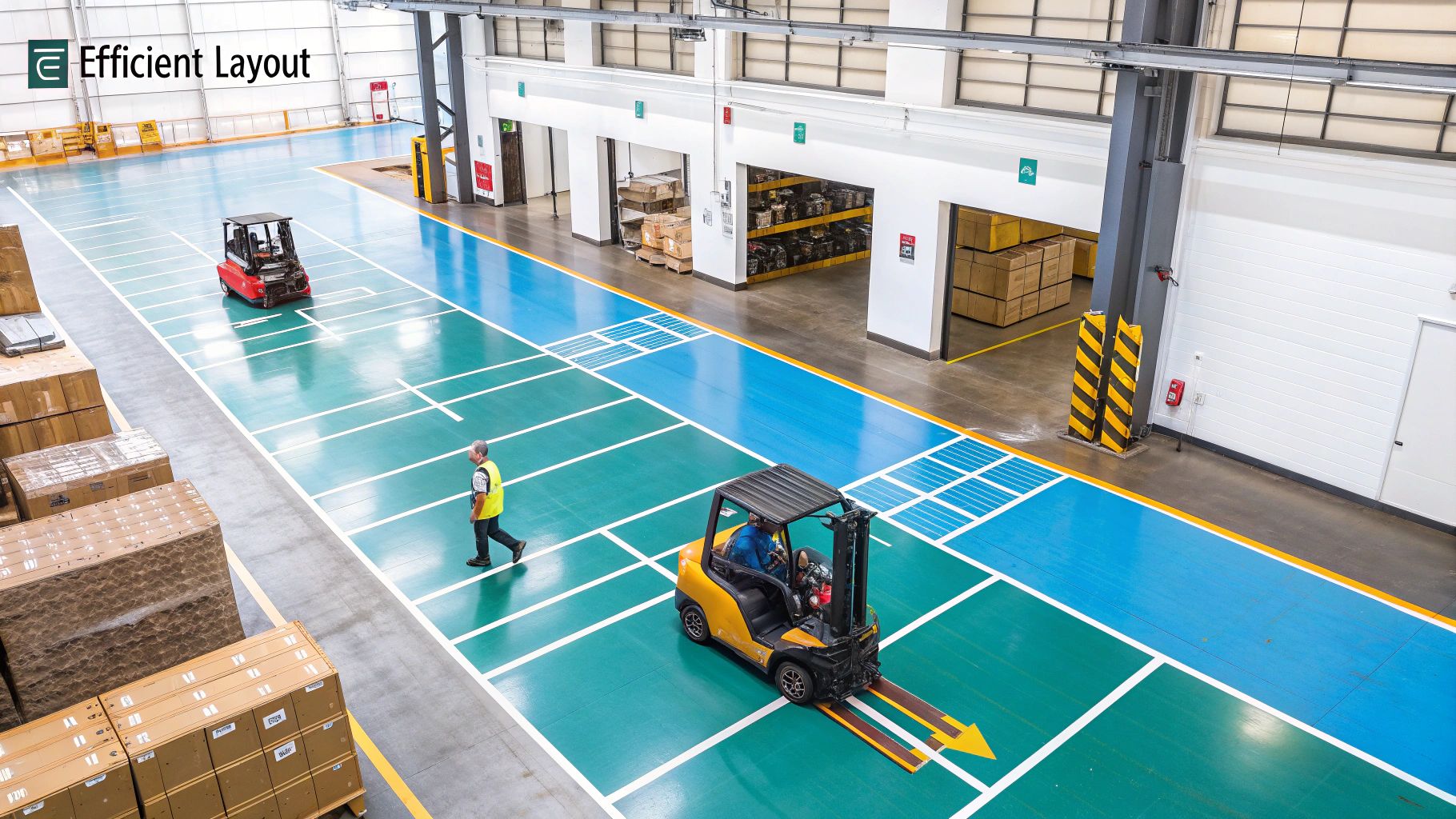
Designing a warehouse layout is much more than just figuring out where to put your shelves. Think of it as creating the master blueprint for your entire operation. A great layout turns your physical space into a high-performance engine, directly fuelling your business’s efficiency. It all comes down to a careful, considered analysis of your products, your building, and the way your team works.
When you plan a layout around the right storage racking system, you can wave goodbye to bottlenecks, cut down on wasted travel time, and truly make the most of every square metre. But here’s the key: the process doesn’t start with the racking. It starts with your inventory.
Start With a Deep Dive Into Your Inventory
Before you can even begin to sketch out a floor plan, you need to know your stock inside and out. Every item you store has its own set of characteristics, and these details are what dictate the type of storage it needs.
Get started by digging into these critical factors for your main product lines:
- Product Dimensions & Weight: It sounds basic, but you have to measure the length, width, height, and weight of your standard pallets or storage units. This data is the foundation for choosing the right beam length, depth, and load capacity for your racking. It’s non-negotiable.
- Inventory Turnover: Work out which products fly off the shelves and which ones hang around for a while. A simple ABC analysis (sorting items by value and movement) works wonders here. Your fastest-moving stock should be kept in the most accessible spots to make picking a breeze.
- Special Handling Needs: Do you store perishable goods that demand a First-In, First-Out (FIFO) system? Or perhaps you deal with bulky, awkward items that call for something like cantilever racking? These specific requirements will fundamentally shape your layout choices from the very beginning.
Assess Your Physical Space and Constraints
Once you’ve got a handle on your inventory, it’s time to turn your attention to the building itself. Your physical space comes with its own set of rules—limitations and opportunities that you have to work with.
Grab a tape measure and make a note of the precise locations of the following:
- Ceiling Height: What’s your clear usable height? That’s the distance from the floor to the lowest-hanging thing, be it a beam or a light fixture. This single measurement determines how high your racking can go, which directly impacts your storage density.
- Columns & Obstructions: Support columns, pipes, and doorways are permanent features. Your layout has to flow around them to ensure you have clear, safe pathways for people and equipment.
- Floor Load Limits: Your concrete floor can only take so much weight. It is absolutely critical to check that the combined weight of your racking, forklifts, and fully loaded pallets won’t exceed the floor’s load-bearing capacity.
A common mistake we see is people designing a perfect layout on paper, only to find it doesn’t work in the real world because of an unexpected pillar or low-hanging ductwork. Always, always do a thorough site survey first. It will save you a world of headaches and expense later.
Balance Aisle Width With Storage Density
The width of your aisles is one of the biggest decisions you’ll make. It’s a constant tug-of-war between storage capacity and operational ease.
Wider aisles give forklifts more room to manoeuvre, which can speed up handling times and reduce the chance of accidents. The downside? They eat up precious floor space that could be used for more racking. On the other hand, narrow aisles let you pack in more storage, but they often require specialised (and more expensive) forklifts and highly skilled operators. Finding the right balance for your unique operation and equipment is crucial. This detailed warehouse storage solutions guide can help you weigh up these important trade-offs.
Map the Entire Flow of Goods
Finally, think of your warehouse layout as a roadmap for your products. Your goal is to create the most direct and efficient route possible, from the moment a delivery arrives to the second it’s dispatched.
Trace the typical journey of your inventory: from the receiving dock, into the storage racking system, over to the picking and packing stations, and out through the shipping bay. This path should be as logical and straightforward as you can make it, eliminating any crisscrossing or backtracking that causes traffic jams and wasted steps. A simple but effective trick is to place your most frequently picked items closer to the shipping area. It’s a small change that can make a huge difference to productivity.
To get the most out of your setup, it’s always a good idea to see what new ideas are out there. Checking out the top warehouse storage solutions for maximizing space can provide some fresh inspiration for improving your own efficiency.
The Future of Storage with Automated Systems
When you picture a warehouse, you probably think of forklifts buzzing up and down long aisles, operated by busy staff. That picture is changing. The next big step forward in warehouse efficiency is happening right now, and it involves turning the storage racking system from a passive set of shelves into an active, intelligent part of the operation.
This isn’t some far-off concept. It’s the reality of Automated Storage and Retrieval Systems, or ASRS. These systems weave technology directly into the racking, completely changing how you move and manage inventory. Think of it this way: if your racking is the skeleton of your warehouse, ASRS is the brain and muscle, automating the slog of putting products away and picking them for orders with remarkable speed and accuracy.
Smart Racking in Action
So how does it work? Instead of relying purely on people to get the job done, an automated storage racking system uses robotic helpers to manage stock. This introduces a level of performance that human effort alone just can’t match.
A few key pieces of technology make this happen:
- Robotic Shuttles: These are small, incredibly fast devices that zoom along rails built into the racking. Their job is to grab a specific tote or carton and whisk it away to a picking station or put a new one back in its place.
- Vertical Lift Modules (VLMs): Picture a giant, high-tech vending machine for your most valuable parts or products. A VLM is a tall, enclosed unit filled with trays. A central inserter/extractor finds the right tray and brings it down to the operator at a comfortable, ergonomic height. It’s a brilliant way to achieve massive storage density on a tiny footprint.
These systems don’t just move things faster. They can run 24/7 with almost flawless precision, drastically cutting down on picking mistakes and reducing the need for people to do the most physically draining jobs.
The Tangible Benefits of Automation
Bringing automation into your racking isn’t just a minor upgrade; it fundamentally alters what your business can achieve. The most obvious win is a massive boost in storage density. Because ASRS robots can work in much tighter aisles and reach far higher than any forklift, you can store significantly more inventory in the exact same building.
This shift is already having a huge financial impact. The UK’s automated storage and retrieval systems market, for example, generated around USD 262.9 million in revenue and is projected to jump to USD 449.0 million by 2030. That kind of growth signals a clear move away from static shelving toward smart, dynamic solutions. You can find more details on the growth of the UK ASRS market in recent reports.
By automating the physical movement of goods, you free up your skilled workforce to focus on more value-added activities like quality control, packing complex orders, and customer service. It’s not about replacing people, but redeploying them more effectively.
Ultimately, an ASRS changes your racking from a simple cost centre into a high-performance strategic asset. It helps you build a fulfilment operation that is faster, denser, more accurate, and safer, giving you a powerful competitive edge for whatever comes next.
Ensuring Racking Safety and Installation Success
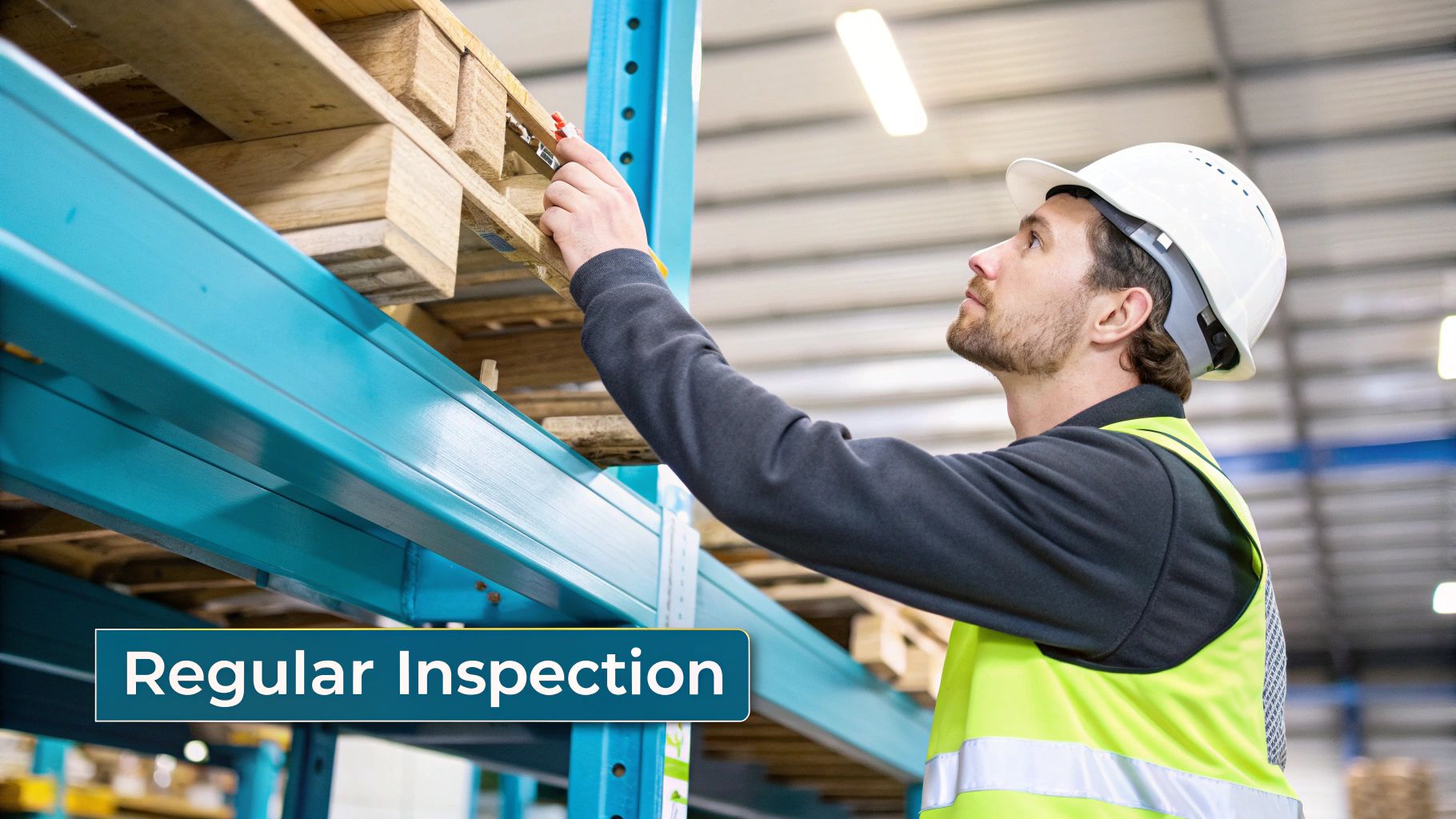
A powerful storage racking system is only an asset when it’s safe. Let’s be clear: an incorrectly installed or poorly maintained rack isn’t just inefficient; it’s a massive liability waiting to happen. The groundwork for structural integrity and long-term success is laid long before you load a single pallet, starting with a non-negotiable commitment to professional installation and ongoing safety checks.
Trying to save a few quid with a DIY installation is a classic false economy. Professional installers bring the experience needed to ensure every single component is assembled exactly to the manufacturer’s specifications. This isn’t just about bolting parts together; it starts from the ground up, demanding a properly prepared and level concrete floor to give the entire structure a stable foundation and avoid stress points that can lead to catastrophic failure.
Sticking rigidly to the manufacturer’s guidelines isn’t optional, it’s critical. Every beam, frame, and connector has been precisely engineered to work in harmony. If you start deviating from those plans, you immediately compromise the system’s load capacity and put your inventory and, more importantly, your team at serious risk.
Creating a Proactive Safety Culture
Once your racking is professionally installed, the focus has to shift to maintaining a safe working environment around it. This isn’t a “set it and forget it” job. It’s an ongoing cultural commitment that protects your people and your investment by catching small issues before they snowball into major incidents.
Key safety protocols should become second nature in your daily operations:
- Conduct Regular Visual Inspections: Your staff are your first line of defence. Train them to spot obvious signs of damage—a bent upright, a deflected beam, a missing safety pin—and empower them to report it immediately.
- Keep Load Capacity Plaques Visible: Every single racking bay must have a clearly visible plaque showing its maximum load capacity. This is a crucial legal and safety requirement that acts as a constant, visible reminder for forklift operators and pickers.
- Implement Protective Guarding: Let’s face it, forklift impacts are one of the most common causes of racking failure. Investing in the right protective equipment isn’t just a good idea; it’s essential.
A safe racking system is the backbone of a safe warehouse. A minor bump from a forklift might look like just a cosmetic dent, but that small amount of damage can reduce an upright’s load-bearing capacity by up to 50%. Ignoring it is a gamble you can’t afford to take.
Essential Protective Equipment Checklist
To shield your storage racking system from the inevitable knocks and bumps of a busy warehouse, consider these non-negotiable safety additions:
- Upright Guards: These are tough steel shields bolted to the floor right at the base of your uprights. They’re designed to take the hit from a forklift at the most vulnerable points.
- End-of-Aisle Barriers: Think of these as bullbars for your racking. These robust barriers protect the entire end of a racking run, an area highly exposed to damage from turning vehicles.
- Column Protectors: These wrap around individual uprights, giving them 360-degree protection. They are especially vital in high-traffic zones or tight corners.
Ensuring your racking is safe is a massive part of overall warehouse safety. For a wider view, consulting an essential warehouse safety checklist can help you build a truly robust safety programme. By pairing professional installation with a proactive, hands-on maintenance culture, you can make sure your racking system remains a productive and safe asset for years to come.
Your Racking Questions Answered
Even the most carefully planned warehouse project comes with questions. When it comes to something as fundamental as your storage racking, getting clear, straightforward answers isn’t just helpful—it’s essential for avoiding expensive mistakes down the line.
Let’s tackle some of the most common queries we hear from facility managers. We’ll break down the technical details into practical, easy-to-understand advice.
How Do I Figure Out the Right Load Capacity?
Getting this right is all about planning for your heaviest possible load.
First, identify the absolute maximum weight of a single, fully-loaded pallet you’ll ever need to store. Don’t estimate or use an average; use the heaviest-case scenario as your starting point.
Next, simply multiply that pallet weight by the number of pallets you intend to store on one beam level. This gives you the minimum required capacity for that beam. However, a good rule of thumb is to always add a safety buffer, choosing beams with a capacity that comfortably exceeds your calculation.
We always advise getting a racking professional to double-check your numbers. They can verify your calculations and make sure your design properly accounts for other factors like beam length and any local seismic codes.
What’s the Real Difference Between Roll Formed and Structural Racking?
The main distinction comes down to how they’re made and, ultimately, how much punishment they can take. You can think of it like the difference between a standard family car and a rugged, off-road truck—both get you from A to B, but they’re built for very different conditions.
- Roll Formed Racking: This is the most common type you’ll see. It’s made from cold-rolled steel, making it lighter and more cost-effective. The components typically clip together, which means installation and adjustments are quick and easy. It’s ideal for most standard warehouses, retail backrooms, and general storage needs.
- Structural Racking: This is the heavy-duty option. It’s made from hot-rolled steel channels that are bolted together during assembly. The result is a far tougher frame that can withstand significant impacts from forklifts. It’s the standard choice for harsh environments like cold storage and freezers, or in busy distribution centres where bumps and knocks are inevitable.
How Often Do I Need to Inspect My Racking?
A two-tiered approach to inspections is the best way to keep your system safe.
Your own trained staff should be doing regular visual checks—weekly or monthly is a good rhythm. They’re looking for obvious signs of damage: dented uprights, bent beams, or missing safety pins.
On top of that, a formal, detailed inspection by a qualified professional is critical at least once every 12 months. These experts are trained to spot subtle structural weaknesses that are easy to miss but could develop into serious hazards. In particularly demanding environments or high-traffic facilities, you should consider having these professional inspections more often.
At TEMA Solutions Limited, we specialise in providing the expert guidance and industry-trusted racking you need to build a safe, efficient, and successful operation. To see how we can help, explore our range of high-quality industrial storage options at https://tema-solutions.shop


