


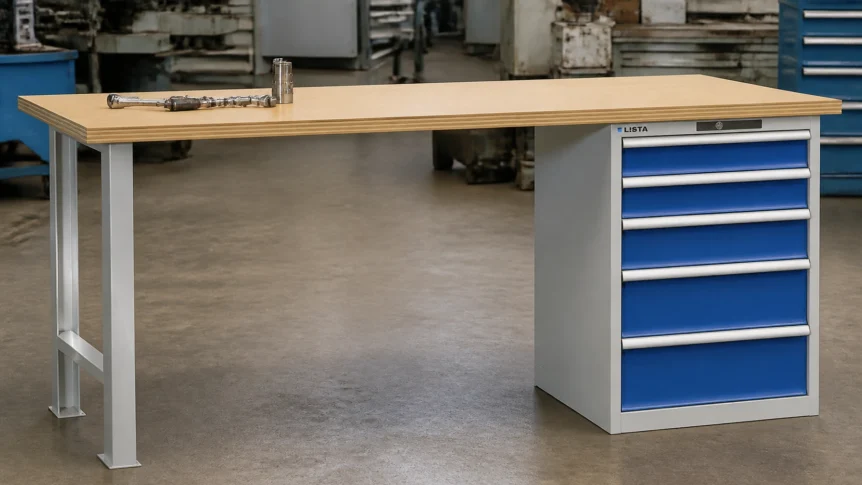
In an industrial workshop, small inefficiencies become significant costs when repeated across operators, shifts and production cells. Employees may bend over a fixed bench, reach across clutter, leave the workstation to retrieve tools or struggle to share one station with colleagues of different heights. These issues affect productivity, safety, quality and workforce wellbeing.
An adjustable height workbench addresses these challenges by allowing the working surface to suit the operator, task and production process. The result is not simply a more comfortable bench. An adjustable height workbench is a practical investment in ergonomic performance, lean workflow and long-term operational efficiency.
For production facility managers, workshop owners, engineers and manufacturing teams, an adjustable height workbench should be treated as a strategic specification rather than an optional feature. The following seven benefits explain why.
Why an Adjustable Height Workbench Matters in Industry
A fixed-height surface assumes that every operator, component and task is the same. Industrial work rarely follows that pattern. A machine shop may require force-intensive standing work, while electronics assembly may involve detailed seated inspection. Automotive maintenance can involve large components, varied working positions and frequent changes between tasks.
The right workstation supports the principle that the physical environment should reflect the work. This complements 5S, lean manufacturing, Just-In-Time (JIT) production and continuous improvement.
The HSE guidance on musculoskeletal disorders highlights the importance of assessing manual-handling risks and reducing them where reasonably practicable. Height adjustability cannot remove every workplace risk, but it can form part of a wider risk-reduction programme.
1. Adjustable Height Workbench Ergonomics for Different Industrial Tasks
The problem
A worktop that is too high can cause raised shoulders and excessive upper-arm movement. A surface that is too low may encourage forward bending and increased loading through the back and neck. These problems become more serious when operators repeat the same activity for several hours.
How it works
An adjustable height workbench allows the work surface to be positioned according to the task. Precision work may require the component to be raised closer to eye level, while tasks involving downward force may require a lower, more stable working position.
Height variation also supports the three broad task zones commonly considered in ergonomic planning:
- Precision work: a higher surface may help bring small components closer to the operator’s visual field.
- Light assembly: the surface should allow relaxed shoulders and approximately neutral wrists.
- Force-intensive work: a lower position may provide better leverage and stability.
The correct height depends on the operator, equipment and process. There is no universal setting that suits every application.
Practical implementation tips
- Trial the proposed height with the people who will use the station.
- Keep wrists as neutral as possible during repetitive hand work.
- Position monitors, inspection equipment and documentation within a comfortable visual range.
- Specify an adjustable chair or sit-stand support where seated work is required.
- Record the preferred settings for repeatable workstation layouts.
Ergonomic adjustment is a critical foundation for reducing avoidable physical strain while maintaining consistent work quality. In practice, an adjustable height workbench helps standardise better working positions without forcing every operator into the same setup.
2. How an Adjustable Height Workbench Reduces Physical Strain
The problem
Operators often compensate for unsuitable benches by bending, twisting, reaching or standing with their weight unevenly distributed. These awkward postures may appear minor during one task, but their effect accumulates through repetition.
How it works
An adjustable height workbench helps bring the working area into a more suitable position. This can reduce the need to lean over components or reach above shoulder height for frequently used tools. When combined with point-of-use storage, the workstation can support a more neutral posture throughout the task.
The benefit is greatest when height adjustment is combined with good layout design. A height-adjustable surface cannot compensate for drawers positioned too far away, excessive worktop clutter or heavy items stored at floor level.
Practical implementation tips
- Map the operator’s primary reach zone before positioning tools and parts.
- Store frequently used items between approximately waist and chest height, subject to the task and user.
- Avoid placing regularly handled heavy objects above shoulder height.
- Keep components close enough to prevent repeated trunk rotation.
- Use HSE manual-handling principles as part of the site’s risk assessment process.
The aim is not to prescribe one posture all day. The aim is to reduce extreme and repetitive positions while allowing controlled movement. A well-specified adjustable height workbench supports that balance more effectively than a fixed bench in most shared industrial environments.
3. Flexible Use Between Operators and Shifts
The problem
A fixed bench may suit one operator but force another to compromise. This is particularly common in shared workshops, multi-shift production and training environments where several people use the same workstation.
How it works
An adjustable height workbench can be reset for different operators without replacing the complete station. That makes one workstation more versatile and helps standardise the process across shifts.
This flexibility is also valuable when the same station supports several activities. For example, an automotive team may use it for inspection, light assembly and component preparation. A manufacturing team may alternate between seated testing and standing packing.
Practical implementation tips
- Create a simple procedure for setting the bench before work begins.
- Mark preferred height settings where the equipment allows it.
- Train all users to adjust the station rather than working around an unsuitable height.
- Consider access to controls for shorter operators and wheelchair users.
- Review the workstation whenever staffing, product mix or task sequence changes.
A flexible station supports better utilisation of floor space and reduces the need to purchase separate fixed benches for every operator or process. For many sites, that makes an adjustable height workbench a more efficient long-term choice.
4. Better Workflow and Productivity with an Adjustable Height Workbench
The problem
Poor workstation design creates unnecessary motion. Operators may leave the station to retrieve tools, lean repeatedly across the worktop or interrupt a task to reposition equipment. These actions are non-value-adding from a lean perspective.
How it works
An adjustable height workbench supports productivity by helping operators maintain a suitable working position while accessing tools and materials. When integrated with drawers, shelves, lighting and tool panels, it creates a defined point-of-use work cell.
This is where physical organisation supports digital efficiency. An ERP, CMMS or inventory platform may identify the correct SKU location, but the operator still needs a practical, accessible workstation. Clear physical locations are the bedrock of reliable digital records.
The effect should be measured rather than assumed. Track search time, walking distance, changeover delays, rework and operator feedback before and after implementation.
Practical implementation tips
- Apply the Pareto Principle: place the most frequently used tools closest to the operator.
- Use drawer dividers, labels and foam inserts to define locations.
- Position consumables according to actual usage data.
- Measure retrieval time for high-frequency tools.
- Link physical location codes with digital inventory or maintenance records.
The result is a workstation designed around flow rather than simply around available furniture. When specified correctly, an adjustable height workbench supports both lean layout planning and day-to-day operator efficiency.

A mobile LISTA workstation can support point-of-use access where tasks move between production areas.
5. Improved Accessibility and Inclusive Working
The problem
A workstation that cannot be adjusted may exclude capable employees or require them to adopt unsuitable working positions. Accessibility issues can also arise when controls, storage and equipment are difficult to reach.
How it works
An adjustable height workbench gives organisations greater scope to accommodate different physical requirements. The adjustment range can support seated and standing work, subject to the specific workstation design and clearances.
Accessibility should be considered as part of the complete work cell. The operator needs sufficient legroom, safe access to controls, suitable storage positions and an unobstructed approach to the bench. A narrow adjustment range or poorly positioned cabinet can undermine the benefit.
Practical implementation tips
- Consult the employees who will use the workstation before specification.
- Check access routes, knee clearance and control positions.
- Consider seated operation for inspection, testing and precision work.
- Keep essential tools within the user’s comfortable reach.
- Include accessibility in workstation risk assessments and layout reviews.
Inclusive design can widen the available talent pool while improving usability for the entire team. This is another reason an adjustable height workbench should be considered early in workstation planning rather than added later as an afterthought.
6. Integrating an Adjustable Height Workbench with Storage Systems
The problem
A height-adjustable surface can still perform poorly if tools, components, power supplies and documentation are scattered around it. Operators may gain a better working height but lose time searching for essential items.
How it works
The most effective workstation combines adjustability with integrated storage. LISTA systems can be configured with drawer units, worktops, tool panels, shelves, lighting and accessories. This allows the bench to become part of a complete production or maintenance cell.
TEMA’s article on the benefits of a workbench with drawers explains how point-of-use storage can improve organisation, safety and inventory control. For load ratings, worktop materials and robust construction, see the guide to heavy-duty workbench features.
For electronics and e-mobility applications, height adjustment should be specified alongside suitable ESD controls. TEMA’s ESD workspace and storage solutions provide further guidance.
Practical implementation tips
- Design the worktop, drawers and accessories as one system.
- Keep high-use items within the primary reach zone.
- Store heavy items where they can be handled safely.
- Confirm that storage modules do not restrict height adjustment.
- Specify ESD surfaces, grounding and accessories where sensitive electronics are handled.
A workstation should support the complete process, not just the operator’s position. The most effective adjustable height workbench is therefore one that is planned as part of the wider storage, tooling and workflow system.

ESD controls should be incorporated into the complete workstation and operating procedure.
7. Future-Proofing the Production Environment
The problem
Production requirements change. New products, additional SKUs, revised assembly sequences and changing staffing levels can make a fixed workstation unsuitable. Replacing furniture every time the process changes is expensive and disruptive.
How it works
An adjustable height workbench provides a degree of future flexibility. It can support different operators, tasks and production arrangements while remaining part of a modular system.
LISTA workstations and storage equipment can be specified with complementary drawer cabinets, shelves, panels and accessories. TEMA’s industrial storage solutions explain how modular equipment can support changing workshop and production requirements.
When selecting equipment, consider not only the current process but also the likely direction of the operation. A workstation that supports future adjustment and expansion protects the original investment.
Practical implementation tips
- Allow spare capacity for new tools, components and accessories.
- Confirm adjustment range, load capacity and service requirements.
- Select equipment with documented technical specifications.
- Standardise successful configurations across similar production cells.
- Review workstation performance during regular 5S and continuous-improvement audits.
Future-proofing is not about predicting every change. It is about avoiding unnecessary rigidity. A modular adjustable height workbench gives industrial teams more room to adapt without starting again.
How to Specify the Right Adjustable Height Workbench
Before requesting a quotation for an adjustable height workbench, assess the following:
| Requirement | Questions to ask |
|---|---|
| Task | Is the work precision, assembly, inspection, packing or force-intensive? |
| Operators | Will one person, several operators or multiple shifts use the station? |
| Height | What adjustment range is required for seated and standing work? |
| Load | What are the heaviest tools, fixtures, components and equipment? |
| Storage | Which items need drawers, dividers, shelves, tool panels or locking? |
| Environment | Are oil, moisture, impact, heat or ESD controls relevant? |
| Workflow | Where do materials arrive, where are they used and where are they returned? |
| Growth | Will the product range, staffing or process change? |
TEMA’s LISTA storage range and the LISTA workbench available through the TEMA shop provide starting points for reviewing materials, dimensions and configuration options for an adjustable height workbench. Always confirm the current technical specification before purchase.
Adjustable Height Workbench Implementation Checklist
Use this five-stage approach when introducing an adjustable height workbench:
- Audit the current station: Record awkward postures, unnecessary walking, search time and workstation-related delays.
- Consult operators: Ask users which tasks create the greatest discomfort or disruption.
- Map the work cell: Position the surface, storage, lighting, power and equipment around the actual process.
- Pilot one station: Measure retrieval time, output, quality issues and user feedback.
- Standardise the result: Apply the successful layout to similar work areas and review it through 5S audits.
Key Takeaways
- An adjustable height workbench supports better ergonomics across varied industrial tasks.
- An adjustable height workbench can reduce bending, reaching and other awkward postures when combined with sound layout planning.
- Shared workstations become more practical for different operators and shifts.
- Integrated storage reduces motion waste and supports reliable inventory control.
- Accessibility should be considered in the complete work-cell design of any adjustable height workbench.
- Modular equipment provides better protection against future process changes.
- ESD requirements, load capacity and adjustment range must be assessed before specifying an adjustable height workbench.
Conclusion: Make an Adjustable Height Workbench Part of Industrial Performance
An adjustable height workbench is more than a comfortable surface. It is a cornerstone of a productive, adaptable and inclusive industrial workspace. By aligning the worktop with the task and operator, businesses can reduce avoidable strain, improve workflow and make better use of shared production areas.
The best results come from treating an adjustable height workbench as part of a complete system. Combine height adjustment with organised drawers, point-of-use storage, suitable lighting, safe access and task-specific accessories. For specialist electronics, include ESD protection from the outset.
TEMA Solutions can help you review your current layout and specify LISTA or Thurmetall equipment around your operators, tools, loads and production processes. Explore the TEMA shop, review LISTA storage solutions or learn more about industrial storage solutions.
Start with one high-friction workstation, measure the wasted motion and create a practical improvement plan for the right adjustable height workbench. Contact TEMA Solutions to discuss your requirements.


