


In any industrial workspace, from bustling automotive repair shops to precise manufacturing facilities, efficiency is the engine of profitability. While high-quality tools and skilled technicians are crucial, the silent driver of success lies in how you manage your inventory. Poor stock control leads to costly delays, wasted capital, and frustrated teams searching for parts that aren’t there. Conversely, mastering your stock transforms operations, ensuring every component, tool, and consumable is exactly where it needs to be, when it’s needed.
This guide outlines 10 proven best practices for inventory management, offering a blueprint to streamline your processes, reduce waste, and build a more resilient and organised workspace. These strategies provide a strong foundation for resource organisation and complement broader operational frameworks. To further explore comprehensive strategies for setting up a strong foundation in resource organisation, consider reviewing essential asset management best practices.
By implementing the actionable techniques detailed in this article, you can shift from reactive problem-solving to proactive optimisation. We will move beyond theory and provide practical steps for implementing methods like JIT, ABC analysis, and EOQ. This will empower you to turn your stockroom from a cost centre into a strategic asset that fuels growth and operational excellence.
1. Just-in-Time (JIT) Inventory Management
Pioneered by Toyota, the Just-in-Time (JIT) inventory strategy represents a lean approach to stock control. The core principle is to receive goods from suppliers only as they are needed in the production process. This eliminates the need for large on-site stock holdings, drastically reducing storage costs, minimising waste, and freeing up capital that would otherwise be tied up in unsold inventory. It is a highly efficient model that relies on precise coordination and synchronisation across the entire supply chain.
How JIT Works
Rather than stockpiling parts, a JIT system uses pull signals, often called Kanban, to trigger orders. For instance, an automotive assembly line doesn’t order a new batch of windscreens until the current supply is nearly depleted. This demand-driven approach ensures materials arrive at the exact moment they are required, making it one of the most effective best practices for inventory management for reducing overheads and improving cash flow.
The infographic below illustrates the core principles that form the foundation of the JIT methodology.
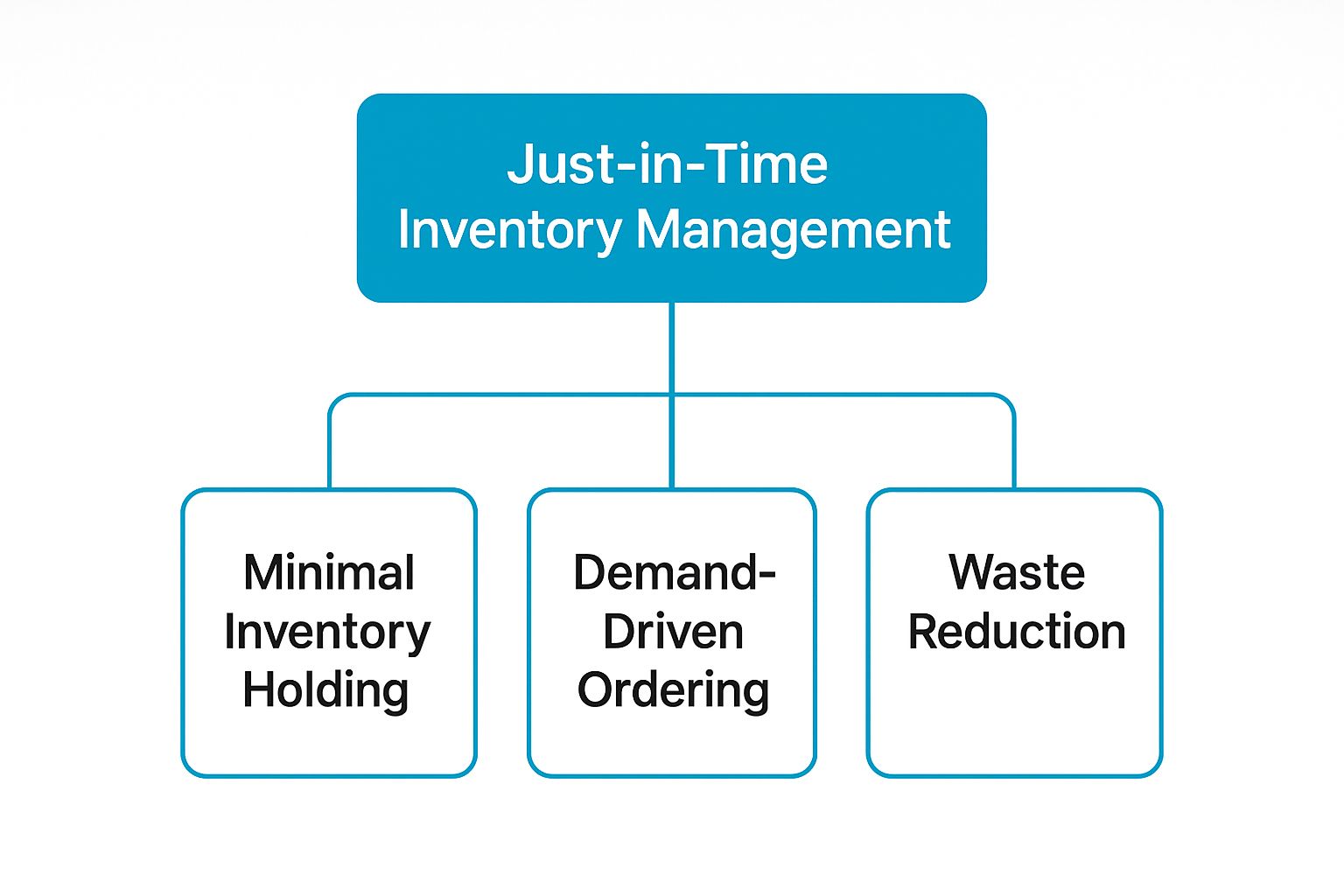
This hierarchy demonstrates how JIT’s primary goal of waste reduction is achieved through the interconnected strategies of holding minimal stock and ordering based on actual, immediate demand.
Practical Implementation Tips
- Build Strong Supplier Relationships: JIT is impossible without reliable suppliers who can deliver quality materials on a tight schedule. Start by forging partnerships with your most dependable vendors.
- Implement Robust Forecasting: Accurate demand forecasting is critical. Use historical sales data and market trends to predict needs precisely.
- Start Small: Test the JIT process with non-critical, high-turnover items first to refine your system before expanding.
2. ABC Analysis (Pareto Analysis for Inventory)
ABC analysis is an inventory categorisation technique that applies the Pareto Principle, which suggests that roughly 80% of effects come from 20% of causes. In inventory terms, this means a small percentage of items usually accounts for the majority of the inventory value. By classifying stock into A, B, and C categories, businesses can prioritise their management efforts where they will have the greatest impact. This method ensures that high-value assets receive the most rigorous attention.
How ABC Analysis Works
This approach segments inventory into three distinct groups. ‘A’ items are the most valuable products that contribute significantly to overall profit but are few in number. ‘B’ items are of moderate value and quantity, while ‘C’ items are the most numerous but have the lowest individual value. This segmentation is one of the most practical best practices for inventory management because it allows for differentiated control strategies, such as daily cycle counts for ‘A’ items and more relaxed controls for ‘C’ items, optimising labour and time.
For example, an automotive parts supplier would classify high-cost engine components as ‘A’ items, moderately priced brake pads as ‘B’ items, and low-cost nuts and bolts as ‘C’ items.
Practical Implementation Tips
- Establish Clear Criteria: Define your categories based on consumption value. A common split is A items (top 20%), B items (next 30%), and C items (remaining 50%).
- Regularly Review Categories: Market demand, pricing, and seasonality can change an item’s value. Re-evaluate and reclassify your inventory quarterly or semi-annually to ensure accuracy.
- Tailor Control Policies: Implement distinct management rules for each category. For instance, ‘A’ items might require stringent security and precise forecasting, while ‘C’ items can be managed with simpler, automated reordering systems.
3. Economic Order Quantity (EOQ) Optimisation
Developed by Ford W. Harris in 1913, the Economic Order Quantity (EOQ) model is a foundational formula in inventory management. Its primary purpose is to calculate the ideal quantity of stock a company should purchase to minimise its total inventory costs, which include both the expenses of ordering and holding stock. This mathematical approach helps businesses strike the perfect balance, avoiding the high ordering costs of frequent, small purchases and the high carrying costs of holding excessive inventory.
How EOQ Works
The EOQ model balances two opposing costs: the cost to order goods and the cost to hold them. Ordering more items at once reduces the frequency of orders and thus lowers ordering costs, but it increases the amount of stock held, raising carrying costs. Conversely, ordering smaller amounts more frequently increases ordering costs but reduces holding costs. This calculation provides a data-driven answer to the question of “how much to order,” making it one of the most reliable best practices for inventory management for achieving cost efficiency.
Practical Implementation Tips
- Regularly Update Parameters: The EOQ formula relies on accurate inputs for demand, ordering costs, and holding costs. Regularly review and update these figures to ensure your calculations remain relevant.
- Factor in Safety Stock: Combine EOQ calculations with safety stock levels to buffer against unexpected demand surges or supplier delays, ensuring you don’t run out of critical items.
- Consider Quantity Discounts: Use a modified EOQ model that accounts for price breaks on bulk purchases. This helps determine if the savings from a discount outweigh the increased holding costs.
4. Real-Time Inventory Tracking with Technology Integration
Integrating modern technology is a cornerstone of effective stock control, shifting businesses from periodic counts to continuous, real-time visibility. This approach utilises tools like RFID tags, barcode scanners, and inventory management software to track stock levels, locations, and movements automatically. By providing instant access to accurate data, companies can eliminate manual errors, prevent stockouts, and automate reordering processes, making it one of the most impactful best practices for inventory management today.

This method ensures that decision-making is based on up-to-the-minute information, not outdated reports. It’s the system that powers industry leaders like Amazon and Walmart, enabling them to manage vast inventories with unparalleled precision and efficiency.
How It Works
Real-time tracking systems assign a unique digital identity to each item, typically through a barcode or an RFID tag. Every time an item moves, from receiving to dispatch, it is scanned. This action instantly updates a central database, reflecting the change in stock levels and location. This continuous data flow provides a live, accurate picture of the entire inventory, a crucial factor when optimising how to use physical space, an important consideration for businesses searching for reliable warehouse racking companies. The system can be configured to trigger alerts for low stock or even place purchase orders automatically when levels fall below a predetermined threshold.
Practical Implementation Tips
- Start with a Pilot Programme: Test the technology in a single department or with a specific product line to identify challenges and refine processes before a full-scale rollout.
- Prioritise System Integration: Ensure the new tracking software can seamlessly integrate with your existing systems, such as your ERP or accounting software, to create a unified data ecosystem.
- Invest in Staff Training: Comprehensive training is vital for adoption. Your team must be comfortable using the new hardware and software to maximise its benefits and ensure data accuracy.
5. Safety Stock Optimization
Safety stock is the buffer inventory held by a company to protect against stockouts caused by demand variability and supply chain unpredictability. Optimising this buffer is a critical balancing act; holding too much ties up capital and increases storage costs, while holding too little risks lost sales and customer dissatisfaction. Effective safety stock management acts as a strategic insurance policy, ensuring operational continuity without excessive financial burden.
How Safety Stock Optimization Works
This practice involves using data-driven formulas to calculate the ideal amount of extra stock needed. Rather than relying on guesswork, this approach considers factors like historical sales volatility, supplier lead time variations, and desired customer service levels. By quantifying these risks, businesses can precisely determine a buffer that minimises the chances of a stockout.
For example, an electronics manufacturer might increase safety stock for a critical component with an unreliable supplier, while an e-commerce retailer would adjust levels for seasonal items ahead of peak demand. This strategic approach to inventory control is one of the most fundamental best practices for inventory management, safeguarding revenue and operational stability.
Practical Implementation Tips
- Use a Dynamic Formula: Calculate safety stock using a formula that accounts for both demand variability and lead time uncertainty, rather than a static number of units.
- Segment Your Inventory: Apply different safety stock rules for different product categories. High-value, high-demand (Class A) items may warrant a higher buffer than low-cost, slow-moving (Class C) items.
- Regularly Review and Adjust: Market conditions and supplier performance change. Re-evaluate and adjust your safety stock levels quarterly or semi-annually to reflect current realities.
6. Demand Forecasting and Planning
Demand forecasting and planning is the proactive process of predicting future customer demand for products. By analysing historical sales data, market trends, and economic indicators, businesses can make informed decisions about how much stock to order and hold. This strategic foresight helps to prevent both costly overstock situations and sales-losing stockouts, ensuring that inventory levels are optimised to meet consumer needs without tying up unnecessary capital.

This methodical approach is fundamental to achieving a state of operational excellence, forming a key pillar in the most effective best practices for inventory management. It moves a business from a reactive to a proactive stance, enabling better resource allocation and improving overall supply chain efficiency.
How Demand Forecasting Works
The process involves using both qualitative methods, like market research and expert opinions, and quantitative methods, such as statistical modelling and time series analysis. For example, a retailer preparing for the holiday season will analyse past years’ sales data for specific festive products while also factoring in current economic trends and planned marketing promotions. This creates a detailed prediction that guides purchasing and stocking decisions, ensuring shelves are filled appropriately to maximise sales opportunities during peak periods.
Practical Implementation Tips
- Combine Forecasting Methods: Do not rely on a single data model. Use a hybrid approach that blends historical sales data with insights from your sales and marketing teams for a more rounded and accurate prediction.
- Collaborate Across Departments: Ensure your forecasting process includes input from sales, marketing, and finance. Their combined knowledge on upcoming promotions and market shifts is invaluable.
- Regularly Review and Adjust: Forecasts are not static. Set a schedule to review forecast accuracy against actual sales and adjust your models accordingly to improve future predictions.
7. First-In-First-Out (FIFO) and Last-in-First-Out (LIFO) Methods
FIFO and LIFO are fundamental inventory valuation and rotation methods that dictate the order in which stock is used or sold. The First-In-First-Out (FIFO) principle ensures that the oldest inventory items are sold first. This is crucial for businesses dealing with perishable goods or products with a limited shelf life, as it prevents spoilage and obsolescence. Conversely, Last-In-First-Out (LIFO) assumes that the most recently acquired items are sold first, a method often used for accounting purposes, especially in environments with rising costs.
How FIFO and LIFO Work
FIFO operates like a queue; the first item that arrives is the first to leave. A grocery store rotating milk cartons is a classic example, placing new deliveries at the back of the shelf so customers buy the older ones first. This preserves product quality and minimises waste. LIFO works in reverse, selling the newest stock first. This approach is less common for physical stock flow but can offer tax advantages in certain economic climates by valuing cost of goods sold at more recent, often higher, prices.
Choosing the right method is a critical decision in establishing best practices for inventory management, as it directly impacts product integrity, financial reporting, and profitability.
Practical Implementation Tips
- Prioritise FIFO for Perishables: For industries like food service, pharmaceuticals, or electronics with date-sensitive components, always implement a strict FIFO system.
- Establish Clear Labelling: Use clear date codes, colour-coded labels, or batch numbers on all inventory to make it easy for staff to identify the oldest stock.
- Organise Your Storage: Arrange your storeroom or warehouse to support your chosen method. FIFO, for instance, benefits from shelving systems that can be loaded from one side and picked from the other.
- Train Your Team: Ensure all staff understand the importance of the chosen rotation method and are trained to follow the procedures consistently during stocking and picking.
8. Supplier Relationship Management and Diversification
Effective inventory management extends beyond your own four walls; it involves the strategic cultivation of strong, collaborative relationships with suppliers. This practice focuses on developing, maintaining, and optimising partnerships with vendors while simultaneously diversifying your supplier base to mitigate risks. By treating suppliers as partners rather than just transaction points, businesses can ensure supply security, negotiate better terms, and improve overall supply chain resilience.

How It Works
The core idea is to move from a purely price-driven, transactional relationship to a value-based partnership. This involves open communication, shared forecasts, and mutual investment in process improvements. For instance, Toyota is renowned for its supplier development programmes, where it actively helps its key suppliers improve their own production processes. This ensures Toyota receives high-quality parts on time while strengthening its entire supply chain.
This approach is one of the most crucial best practices for inventory management because it builds a reliable foundation for other strategies like Just-in-Time. A strong partnership ensures you can count on your suppliers during periods of high demand or unexpected disruption, preventing stockouts that could halt production or disappoint customers.
Practical Implementation Tips
- Establish Key Performance Indicators (KPIs): Track metrics like on-time delivery rates, quality acceptance rates, and price competitiveness to objectively measure supplier performance.
- Share Forecasts and Plans: Provide key suppliers with your demand forecasts and production schedules. This transparency allows them to plan their own operations more effectively, ensuring they can meet your needs.
- Diversify Strategically: Identify critical components and ensure you have at least one vetted backup supplier. This reduces your dependency on a single source and provides leverage during negotiations.
- Conduct Regular Reviews: Schedule regular meetings with key suppliers to discuss performance, address challenges, and explore opportunities for collaboration and improvement.
9. Regular Cycle Counting and Physical Audits
Moving away from the disruptive and often inaccurate annual stocktake, regular cycle counting is a systematic approach to inventory verification. This method involves counting small, designated portions of inventory on a continuous, rotating basis throughout the year. This ongoing process maintains a high degree of inventory accuracy, allows for the swift identification of discrepancies, and ensures the data within your inventory management system remains reliable and up-to-date.
How Cycle Counting Works
Instead of a massive, once-a-year effort, cycle counting breaks the task into manageable daily or weekly activities. For example, a distribution centre might count all items in a specific aisle one day and another the next. This methodical verification process is one of the best practices for inventory management because it catches errors like theft, damage, or receiving mistakes almost as they happen, preventing them from escalating into larger financial problems. It transforms inventory validation from a major annual headache into a routine, low-impact operational task.
This continuous auditing ensures that discrepancies are identified and resolved quickly, maintaining the integrity of stock records used for purchasing, production planning, and sales. It provides a consistently accurate picture of what you have on hand at any given moment.
Practical Implementation Tips
- Prioritise High-Value Items: Use an ABC analysis to categorise your stock. Count high-value ‘A’ items more frequently (e.g., monthly), ‘B’ items quarterly, and low-value ‘C’ items biannually.
- Utilise Technology: Equip staff with mobile devices and barcode scanners to accelerate the counting process and reduce manual entry errors.
- Investigate Discrepancies Immediately: Don’t let count variances linger. Create a clear process for investigating and resolving the root cause of any differences found.
- Schedule Counts Strategically: Conduct counts during periods of low activity, such as before the start of a shift, to minimise disruption to daily operations and improve accuracy. Properly organised workstations, like those provided by high-quality work storage benches, can make this process even more efficient.
10. Cross-Docking and Drop-Shipping Strategies
Cross-docking and drop-shipping are powerful logistics strategies that fundamentally minimise or eliminate inventory holding. Drop-shipping involves shipping goods directly from the supplier to the end customer, completely bypassing the retailer’s warehouse. Cross-docking, popularised by retail giants like Walmart, involves unloading inbound materials at a distribution centre and immediately loading them onto outbound vehicles with little to no storage time in between. Both approaches are designed to reduce warehousing costs, shorten delivery lead times, and free up capital.
How These Strategies Work
In a drop-shipping model, a customer’s order triggers a notification to the supplier, who then handles order fulfilment directly. This is common in e-commerce, where a retailer like Wayfair sells furniture without ever physically handling the stock. For cross-docking, incoming shipments are sorted and redirected to their next destination upon arrival. Logistics hubs operated by FedEx or UPS are prime examples, where parcels are constantly in motion rather than being stored. These methods represent some of the most agile best practices for inventory management for high-velocity supply chains.
Practical Implementation Tips
- Establish Clear Supplier Agreements: For drop-shipping, formal agreements are crucial. Define responsibilities for shipping, returns, and quality control to protect your brand reputation.
- Implement Strong Tracking Systems: Real-time visibility is non-negotiable. Use integrated software to track orders from the supplier to the customer, ensuring transparent communication.
- Focus on High-Velocity Items for Cross-Docking: Cross-docking is most effective for products with consistent, high demand that don’t need to be stored. Prioritise these items to maximise efficiency.
Inventory Management Best Practices Comparison
| Inventory Strategy | Implementation Complexity 🔄 | Resource Requirements ⚡ | Expected Outcomes 📊 | Ideal Use Cases | Key Advantages ⭐ / Tips 💡 |
|---|---|---|---|---|---|
| Just-in-Time (JIT) Inventory Management | High – requires strong coordination 🔄🔄 | Moderate – reliable suppliers needed ⚡ | Waste reduction, lower inventory costs 📊⭐ | Lean manufacturing, fast fashion, build-to-order | Reduces holding costs, improve cash flow ⭐; start with reliable suppliers 💡 |
| ABC Analysis (Pareto Analysis) | Moderate – data analysis and categorization 🔄 | Low to moderate – statistical tools ⚡ | Optimized resource allocation and control 📊 | Large inventories with diverse SKUs | Focuses on high-value items ⭐; update categories regularly 💡 |
| Economic Order Quantity (EOQ) Optimization | Moderate – mathematical modeling 🔄 | Low – depends on accurate cost data ⚡ | Cost minimization and order frequency optimization 📊 | Businesses with steady demand | Minimizes total cost ⭐; adjust for real-world constraints 💡 |
| Real-Time Inventory Tracking with Technology | High – technology integration & training 🔄🔄 | High – hardware, software, staff training ⚡ | Instant visibility and automated reordering 📊⭐ | Large warehouses, fast-moving goods | Eliminates manual errors, speeds decision-making ⚡; pilot programs recommended 💡 |
| Safety Stock Optimization | Moderate – statistical calculations & monitoring 🔄 | Moderate – additional inventory capacity ⚡ | Stockout prevention and service level stability 📊 | Demand variability, critical items | Balances risks and costs ⭐; regularly review safety levels 💡 |
| Demand Forecasting and Planning | High – data analysis, collaboration 🔄🔄 | Moderate to high – data, analytics tools ⚡ | Improved inventory accuracy and planning 📊⭐ | Dynamic markets, multiple SKUs | Combines methods for accuracy ⭐; involve sales/marketing 💡 |
| FIFO and LIFO Methods | Low – procedural implementation 🔄 | Low – organizational controls ⚡ | Inventory valuation, waste/spoilage reduction 📊 | Perishable goods (FIFO), accounting needs (LIFO) | FIFO prevents spoilage ⭐; train on rotation procedures 💡 |
| Supplier Relationship Management & Diversification | High – ongoing relationship management 🔄🔄 | Moderate – monitoring systems & audits ⚡ | Supply security and better terms 📊 | Companies needing supply risk mitigation | Enhances quality and negotiation power ⭐; maintain backup suppliers 💡 |
| Regular Cycle Counting and Physical Audits | Moderate – scheduling & execution 🔄 | Moderate – staff and tools required ⚡ | Inventory accuracy and discrepancy resolution 📊 | Retailers, distribution centers | Prioritize high-value items ⭐; use tech for efficiency 💡 |
| Cross-Docking and Drop-Shipping Strategies | High – logistics coordination 🔄🔄 | Moderate to high – tracking & communication ⚡ | Reduced inventory holding and faster fulfillment 📊 | E-commerce, high-velocity items | Cuts storage costs ⭐; strong supplier agreements needed 💡 |
From Theory to Action: Building Your High-Performance Inventory System
Navigating the landscape of inventory management can seem complex, but the journey from theoretical knowledge to practical mastery is a structured and achievable one. Throughout this guide, we have explored a comprehensive suite of strategies, from the lean efficiency of Just-in-Time (JIT) to the precise control offered by Economic Order Quantity (EOQ) and the analytical power of ABC analysis. Each of these represents a powerful tool in your operational arsenal, designed not as a one-size-fits-all solution, but as a customisable component for your unique business needs.
The core message is one of strategic integration. True operational excellence isn’t found by adopting a single method, but by carefully selecting and combining these best practices for inventory management to create a cohesive, responsive system. Perhaps your highest-value ‘A’ items require rigorous real-time tracking and safety stock optimisation, while your lower-value ‘C’ items can be managed more loosely. Maybe a hybrid approach, combining demand forecasting with a robust supplier relationship programme, is the key to unlocking new levels of efficiency and resilience against market volatility.
Key Takeaways for Immediate Action
To transition from reading to doing, focus on these critical takeaways:
- Visibility is Non-Negotiable: You cannot manage what you cannot see. Implementing real-time tracking technology and conducting regular cycle counts are foundational steps that provide the data needed for every other strategy to succeed.
- Data Drives Decisions: Move beyond guesswork. Use historical data for accurate demand forecasting and apply formulas like EOQ to make informed, cost-effective ordering decisions that balance holding costs and order costs perfectly.
- Relationships are a Strategic Asset: Your suppliers are partners in your success. Cultivating strong, transparent relationships and diversifying your supplier base creates a crucial buffer against supply chain disruptions.
Your Path to an Optimised System
Adopting these advanced best practices for inventory management begins with a critical foundational element: a well-organised physical workspace. An orderly, efficient environment is the bedrock upon which every successful strategy is built. When tools, parts, and components are housed in high-quality, durable storage solutions, the entire system functions more smoothly. Clearly labelled, ergonomic cabinets and workbenches make cycle counting faster and more accurate, simplify the implementation of FIFO principles, and empower your team to work with maximum efficiency.
By methodically integrating the right strategies with the right physical infrastructure, you transform your inventory from a passive cost centre into an active, competitive advantage. Begin by auditing your current processes. Identify your biggest pain points and select one or two of the strategies discussed to tackle them first. This incremental approach will build momentum and demonstrate tangible results, paving the way for a resilient, highly productive inventory system that fuels sustained growth and operational excellence.
Ready to build the physical foundation for your high-performance inventory system? TEMA Solutions Limited offers premium workshop storage solutions from industry-leading brands like Thurmetall and LISTA, designed to organise your space and maximise efficiency. Explore our range of durable cabinets, workbenches, and storage systems at TEMA Solutions Limited to take the first critical step in implementing these best practices for inventory management.


