


Let's be honest, a professional garage storage workbench is the heart and soul of any serious workshop. It’s the command centre where all the real work—assembly, repairs, and fabrication—gets done. We're not talking about just any old table here; these are integrated systems that combine heavy-duty work surfaces with smart, organised storage to make your workflow smoother and faster.
The Foundation of a Productive Workshop
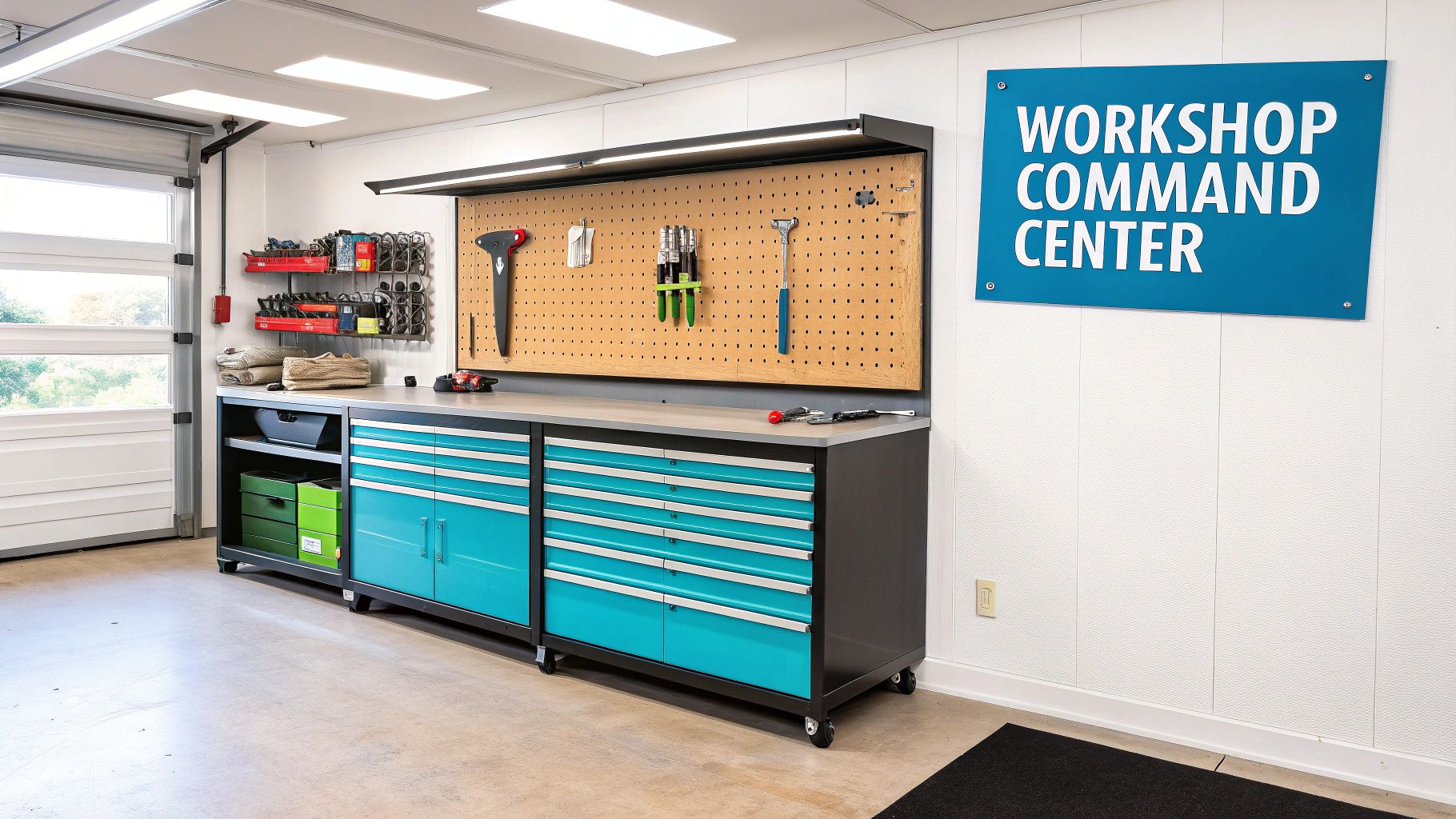
Think of your workshop like a high-performance engine. For it to run perfectly, every single part has to work in harmony. In that engine, your workbench is the block—it's the solid, central structure that everything else is built around. If that foundation is weak or chaotic, the whole operation sputters, becomes inefficient, and can even be dangerous.
A messy, disorganised workspace costs you money. It's that simple. Every minute spent digging for a lost tool, every component that gets buried under clutter, and every safety hazard from a messy floor—it all chips away at your productivity and your bottom line. This is precisely where a professional-grade system from respected brands like Thurmetall and LISTA really shows its worth.
More Than Just a Table
A properly designed workbench isn't just a passive surface; it's an active tool that completely changes how technicians work. By integrating drawers, cabinets, and back panels, it gives every single item a proper home. This kind of systematic approach has a proven track record.
For instance, workshops that switch to modular workbenches often report a 25% increase in technician efficiency. That's measured in real tasks completed per hour. How? By slashing the time spent searching for tools from an average of 45 seconds down to a mere 15. The numbers don't lie.
Investing in a well-designed system delivers clear, immediate advantages.
Key Benefits of Professional Workbench Systems
| Benefit | Impact on Workshop Operations |
|---|---|
| Increased Efficiency | Less time searching for tools and parts means more time spent on revenue-generating tasks. |
| Improved Organisation | A designated place for everything reduces clutter, prevents loss, and simplifies inventory management. |
| Enhanced Safety | Clear, organised surfaces minimise trip hazards and prevent accidents caused by misplaced equipment. |
| Professional Appearance | A clean, orderly workshop inspires confidence in clients and boosts team morale. |
Ultimately, a professional system establishes a standard of order and precision that lifts the quality of every job you do.
A professional workbench isn’t an expense; it’s an investment in workflow optimisation. It establishes a standard of order and precision that elevates the quality of every task performed.
Building a Smarter Workspace
At TEMA Solutions, we see ourselves as your partner in building this crucial foundation. We supply the essential equipment needed to transform a chaotic garage into a streamlined, high-performance workspace. Our goal is to create an environment where professionals can do their best work, both safely and efficiently.
Of course, having the right setup is only half the battle. To create a truly productive workshop, you also need the right skills. Knowing, for example, how to use a multimeter opens up a whole new world of electrical diagnostics and repair. When you combine a world-class workstation with expert skills, you've built a workshop that's ready for anything.
Getting to Grips with Workbench Types and Features
Picking the right garage storage workbench is a lot more than just finding a tough table. It's about investing in a piece of specialist equipment that's built around the way you work. No two benches are exactly alike, and figuring out the main types is the first real step towards creating a workshop that genuinely works for you. Think of it less like buying furniture and more like choosing a precision instrument for your craft.
Each design serves a distinct purpose, whether it's standing up to the relentless daily grind of an industrial setting or creating a safe zone for handling sensitive electronics. Let’s break down what makes each type tick, so you can find the perfect match for the jobs you tackle every day.
The Adaptable Modular Workbench
For ultimate flexibility, nothing beats a modular workbench. Think of it as a professional-grade Lego set for your workshop. You can add, remove, and reconfigure parts as your projects change or your business grows, which makes it a really smart long-term investment.
You start with a solid frame and your choice of worktop, then you build it out with exactly the storage you need. Fancy a bank of lockable drawers to keep expensive diagnostic tools safe? No problem. Need a few large cupboards for bulky equipment? Just add them in. This way, your workstation evolves with you, rather than holding you back.
The Unyielding Heavy-Duty Workbench
When you’re dealing with engine blocks, heavy fabrication, or serious machinery, you need a workbench that’s built like a tank. That's where heavy-duty industrial workbenches come in. These beasts are engineered for brute strength and stability, often rated to handle immense loads well over 1000 kg.
They’re typically built with reinforced steel frames and incredibly tough worktops like solid beech or thick steel plate. These are the immovable anchors of a workshop, designed to take a beating and absorb the impacts of demanding work without flinching. For jobs where you need absolute, rock-solid stability, nothing else will do. To see what makes them so tough, you can check out the specs on a professional heavy-duty workshop bench and see how they're built to industrial standards.
The Agile Mobile Workbench
Let's face it, not every job can be brought over to the bench. Sometimes, you need to take the bench to the job. Mobile workbenches give you that freedom, fitted with heavy-duty castors that let you roll your entire worksurface and toolset right up to a vehicle or a large piece of equipment.
Don't mistake these for flimsy trolleys. A proper mobile workbench marries a solid worktop with integrated drawer cabinets, giving you a complete, portable command centre. This is a game-changer for efficiency, slashing the time you waste walking back and forth for tools and keeping everything you need right where the action is.
"A workbench is no longer just a static object. Mobile and modular systems transform the entire workshop floor into a dynamic and responsive workspace, directly impacting technician productivity and turnaround times."
Specialised Workbenches for Modern Demands
Beyond the big three, you'll find specialised benches designed for very specific technical needs. In today's high-tech world, one of the most crucial is the ESD-safe workbench.
- ESD (Electrostatic Discharge) Protection: If you're working on modern vehicle electronics, e-mobility components, or any sensitive circuits, this is essential. These benches use dissipative materials to safely ground static electricity, stopping it from frying delicate and expensive components. A single accidental spark can cause hidden damage that leads to premature part failure, making proper ESD protection a non-negotiable for any serious tech work.
Features That Make a Workbench Truly Professional
The real difference between a basic table and a professional workstation is in the details. These are the features that transform it into a tool that actively boosts your efficiency.
- Integrated Drawer Cabinets: They provide secure, organised storage for hand tools, meters, and small parts, keeping them clean, safe, and always within easy reach.
- Perforated Back Panels: Perfect for hanging your most-used tools. You can see everything at a glance and keep your main worksurface completely clear for the task at hand.
- Built-in Power Supplies: Having integrated electrical sockets and USB ports right on the bench means no more tripping over messy extension leads. It’s safer, neater, and far more convenient.
How to Choose the Right Garage Storage Workbench
Picking the right garage storage workbench isn’t just about buying a product; it’s about finding the perfect partner for your workshop. This is a decision that will directly impact your efficiency, safety, and the quality of your work every single day. Get it right, and your workflow will feel seamless.
Think of it like choosing any other specialist tool. You wouldn't use a delicate screwdriver to break concrete, and you wouldn’t bring a sledgehammer to a job that requires precision. Your workbench needs to be just as precisely matched to its purpose, from the materials you handle to the space you have to work in. Let's walk through the essential points to make sure you're making a smart, long-term investment.
Assessing Your Load Capacity Needs
First things first: how much weight does this bench really need to hold? This isn't just about whether the bench will survive the load. It's about providing a completely stable, rock-solid platform for your most demanding tasks. Underestimate this, and you’re looking at a wobbly, unsafe surface or, in the worst-case scenario, a complete failure.
Start by thinking about the heaviest items you'll ever place on it. For an automotive workshop, that might be a full engine block or a transmission, which can easily top several hundred kilograms. In a manufacturing setting, you could be dealing with heavy dies, jigs, or stacks of raw materials.
Your workbench’s load capacity should comfortably exceed the weight of your heaviest jobs. Always look for the Uniformly Distributed Load (UDL) rating, which tells you the maximum weight the bench can safely support when spread evenly across the top.
For light assembly or general repairs, a bench rated for 500 kg might do the trick. But for serious industrial or automotive work, a heavy-duty model from a trusted brand like LISTA, rated for 1000 kg or more, is the professional standard. When it comes to load capacity, it's always smarter to over-spec than to risk under-specifying.
Selecting the Ideal Workbench Top
The worktop is where all the action happens, making its material one of the most critical choices you'll make. It determines the bench's durability, its resistance to damage, and what kind of work it's best suited for. The wrong surface will wear out quickly, look unprofessional, and need constant replacement.
This decision tree helps to map out your needs and point you toward the right kind of workbench.
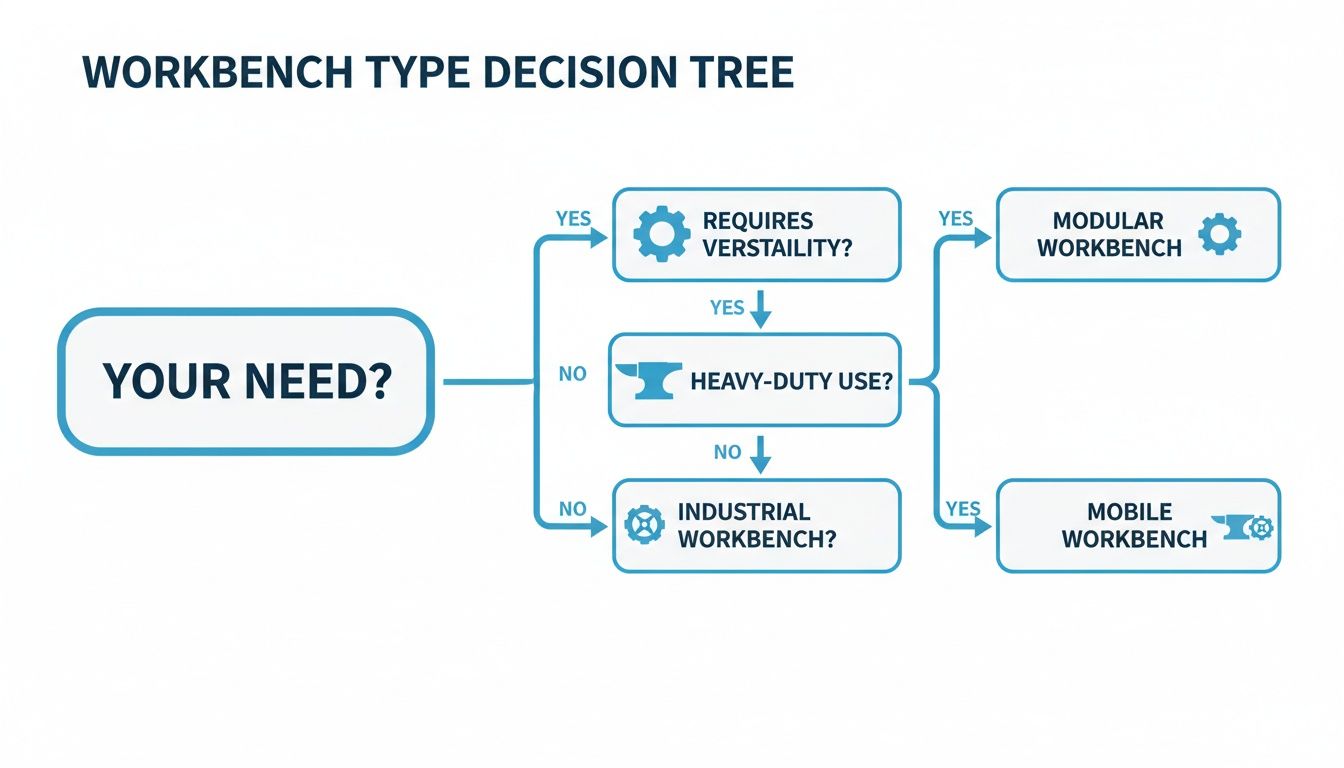
As you can see, specific demands like heavy-duty use or the need for mobility point directly to specialised designs like industrial or mobile workbenches.
Here's a closer look at the different worktop materials to help you decide.
Workbench Top Material Comparison
| Material Type | Best For | Key Properties |
|---|---|---|
| Solid Beech | General mechanical and assembly work | Extremely tough, absorbs impacts well, and can be sanded and refinished to extend its life. |
| Steel Plate | Heavy fabrication, welding, engine work | Maximum resistance to heavy impacts, oil, grease, and most chemicals. Built for the toughest jobs. |
| Linoleum / PVC | Electronics, delicate assembly | Good resistance to oils and grease with a slightly softer surface that won't scratch sensitive components. |
Each material has its place. Solid Beech is a timeless classic for a reason—it’s tough and forgiving. For the absolute harshest environments where you're dealing with heavy impacts and chemicals, a Steel Plate top is unbeatable. And if you’re working with more delicate parts, Linoleum or PVC offers a softer touch with decent chemical resistance.
Finalising Dimensions and Storage
It goes without saying, but your workbench has to fit your space and your workflow. Before you even think about buying, get the tape measure out. Carefully measure your available area, but don't forget to leave plenty of room around the bench for people to move safely and for drawers and cupboards to open fully without obstruction. A standard depth of around 750 mm usually gives you plenty of workspace without forcing you to overreach.
Next up is storage. A professional workbench isn't just a table; it's an organised hub. The right integrated storage keeps your tools secure and your worktop clear of clutter. The ideal setup depends entirely on what you need to store.
- Drawers: Perfect for hand tools, power tools, and small parts. Look for high-quality, full-extension drawer runners that can handle serious weight without sagging over time.
- Cupboards: Great for bigger, bulkier items like chemical containers, large power tools, or equipment you need to keep protected from dust and debris.
Often, a combination of drawers and cupboards is the most versatile solution. It lets you create a custom layout that keeps everything you need right where you need it, within easy reach.
The Critical Role of ESD Protection
In any modern workshop dealing with vehicle electronics, e-mobility components, or any sensitive circuit boards, electrostatic discharge (ESD) is a silent killer. That tiny, invisible spark of static electricity you can’t even feel is more than enough to permanently fry expensive electronic parts.
In these environments, an ESD-safe workbench isn’t a luxury—it’s an absolute necessity. These specialised benches are built with dissipative materials that safely channel any static charge away to a grounding point, neutralising the threat before it can cause any damage. Think of an ESD-safe workbench as essential insurance; it protects the integrity of your work and prevents incredibly costly component failures down the road.
Designing Your Workspace for Peak Performance
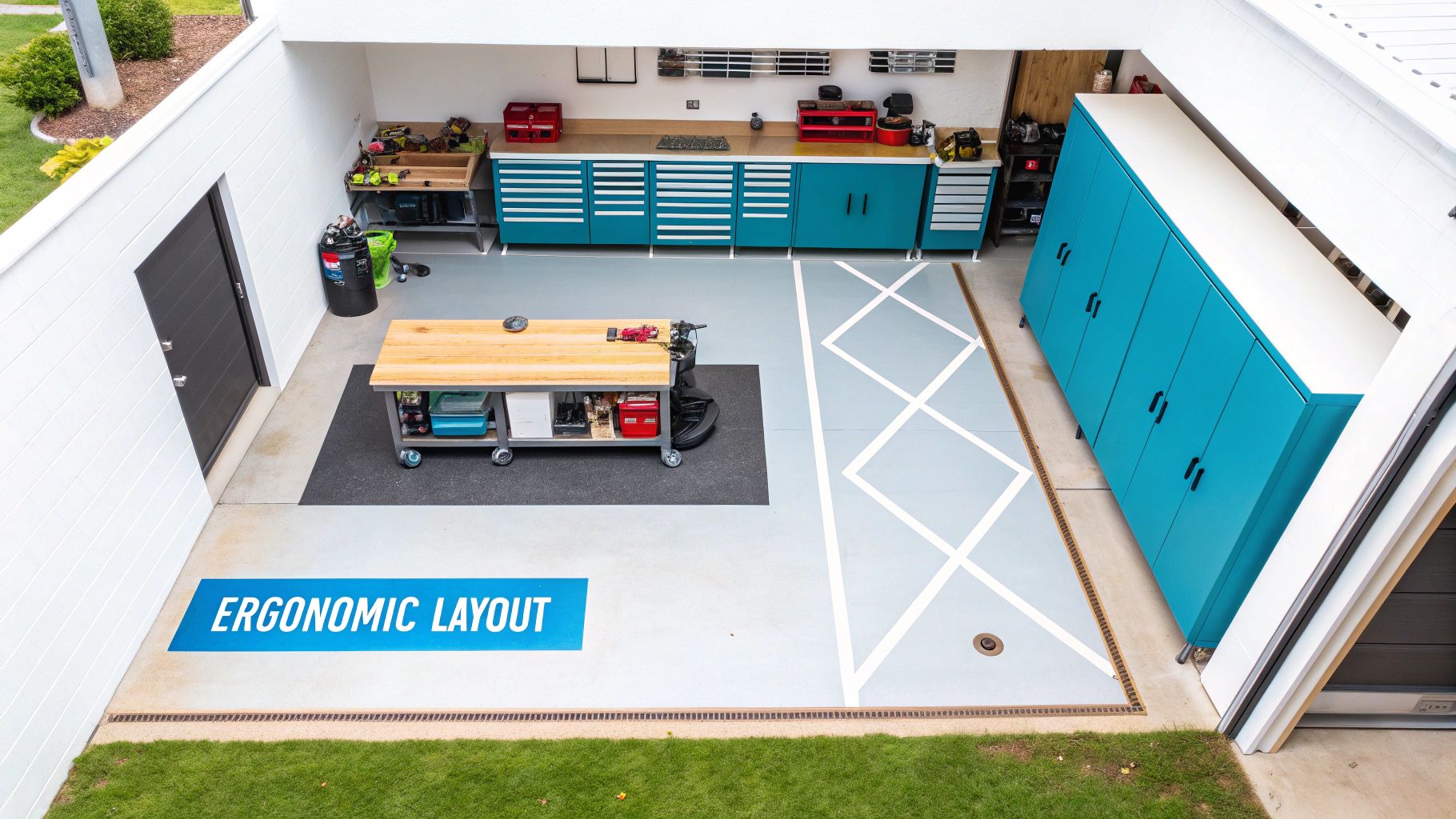
A first-class garage storage workbench is only as good as the space it sits in. You can’t just shove a quality bench against a wall and expect magic to happen. Real performance comes from creating an integrated ecosystem where every tool, cabinet, and pathway works together. It’s a shift in thinking from just buying equipment to engineering a complete operational environment.
The aim is to build a layout that feels second nature. One where your team isn't wasting time walking back and forth or straining to reach things. It's about designing efficiency directly into the floor plan, turning a simple garage into a high-performance hub that boosts both productivity and safety.
The Ergonomic Triangle for Workshops
You've probably heard of the "work triangle" that chefs use to arrange the cooker, sink, and fridge for ultimate efficiency. We can borrow that same brilliant logic for the workshop. Think of an ergonomic triangle connecting your three most critical zones.
- Zone 1: The Workbench. This is your mission control for assembly, repairs, and intricate jobs.
- Zone 2: Main Tool Storage. Whether it's a large rolling chest or wall-mounted storage, this is where your go-to tools live.
- Zone 3: Heavy Machinery/Equipment. This could be your vehicle lift, diagnostic station, or other fixed gear.
Keeping these three points in a tight, clear formation drastically cuts down on wasted steps. It might only save a few seconds on each task, but over a day, a week, or a year, those seconds add up to massive productivity gains. A smart layout makes the entire workflow feel natural and fluid.
Actionable Layout Strategies
Getting the layout right goes beyond just the triangle. You need to think about the smaller details that make a workshop not just efficient, but safe and comfortable enough for a full day's work.
Lighting is Your Most Important Tool
Bad lighting is a recipe for mistakes, eye strain, and sluggish work. If you can, position your main garage workbenches to catch natural light from a window, but don’t ever rely on it alone. You need bright, direct overhead lighting above every workstation to kill any shadows. It’s why TEMA Solutions’ systems can be fitted with integrated LED lighting—to make sure the work surface itself is perfectly lit.
Clearance and Flow
A cramped workshop isn't just inefficient; it's dangerous. As you map out your floor plan, leave plenty of room around each workbench. A good rule of thumb is at least one metre of clearance. This space lets drawers and cupboards open fully, gives people room to move safely, and stops technicians from bumping into each other. Think about the common pathways through the space and keep them completely clear.
A well-organised workspace is about more than just tidiness; it’s a fundamental component of workplace safety and operational excellence. An ergonomic layout directly reduces physical strain and streamlines every action.
Putting this level of thought into your workspace isn't just a "nice-to-have"—it delivers real results. HSE workplace ergonomics studies show that robust, correctly positioned workbenches can slash operational downtime by 18%. What's more, features like adjustable heights are a game-changer for safety, helping to reduce musculoskeletal injuries by as much as 30%. That’s a massive deal in physically demanding fields like e-mobility repair.
Harnessing Modularity for a Perfect Fit
This is where the modular design of the TEMA Solutions range really shines. Our systems aren't off-the-shelf, one-size-fits-all solutions. They are built to be configured to your workshop's exact dimensions and needs. You can mix and match workbench sizes, drawer units, and overhead cabinets to build a custom setup that flows perfectly with your work and your floor plan.
And don't forget the details. Effective cable management is essential for safety and order. Taking a few minutes for organizing cables for a clutter-free space keeps your workbench area tidy and free from trip hazards.
If you’re looking for more inspiration, have a look at our guide on https://tema-solutions.co.uk/storage-ideas-for-workshop/. This level of adaptability means you can finally transform that chaotic garage into a streamlined, professional operation truly built for peak performance.
Getting the Most Out of Your Workbench for Years to Come
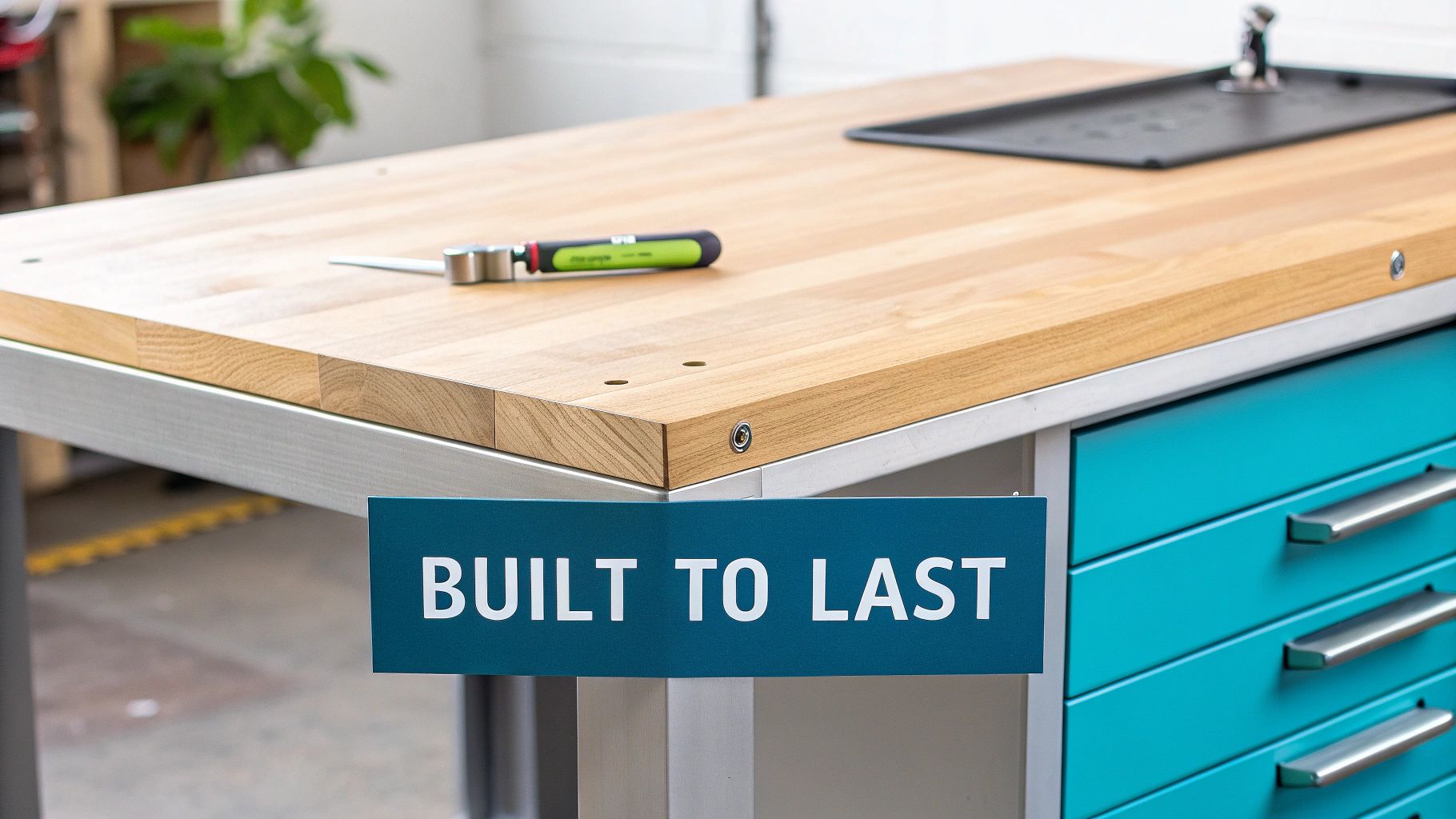
When you invest in a professional garage workbench, you're buying more than just a piece of furniture. You're getting a long-term asset for your workshop, something that should stand up to years of hard work, not something you'll need to replace every couple of seasons.
Protecting that investment is straightforward. It all starts with a solid installation and continues with a bit of simple, routine care. Think of it like any other quality tool in your arsenal – a little bit of attention ensures it performs reliably, day in and day out, providing a stable foundation for all your most important jobs.
Starting Off on the Right Foot
Proper installation is the first and most critical step towards a long service life. Most professional workshops have concrete floors, but let's be honest, they're rarely perfectly level. Taking the time to get your workbench properly levelled is non-negotiable for its structural integrity and your safety.
A wobbly or unlevel workbench puts constant, uneven stress on the frame and legs. Over time, this can lead to warped surfaces, or drawers that stick and refuse to align properly. Grab a spirit level and use the bench’s adjustable feet to get that worktop perfectly horizontal. It’s a small effort that guarantees stability under heavy loads and keeps everything from drawers to cupboards operating smoothly.
"A level workbench is a stable workbench. Skipping this crucial first step can compromise the frame's integrity and shorten the lifespan of your entire workstation, regardless of its quality."
Simple Upkeep for Lasting Performance
Once your workbench is perfectly installed, a simple maintenance routine is all it takes to keep it in prime condition. These quick checks don't take much time, but they pay off massively in durability.
- Daily Surface Wipe-Down: At the end of the day, give the worktop a quick clean. For a solid beech top, a dry cloth or a mild soap solution is perfect. If you’ve got a steel top, a good degreaser will cut through any oil and grime.
- Monthly Drawer Checks: Once a month, pull all the drawers out fully to make sure they're still running smoothly. A quick wipe of the runners to clear out any dust and debris is usually all that’s needed to keep them gliding.
- Six-Month Fastener Check: Every six months or so, give the main bolts and fasteners a quick once-over to make sure they’re still tight. Vibrations from heavy-duty work can sometimes cause them to loosen slightly.
This proactive approach is the best way to prevent the kind of gradual wear and tear that can slowly degrade even the toughest equipment. If you're looking for storage that's just as robust and easy to care for, take a look at our full range of metal cabinets with drawers to complete your setup.
The Real Return on Your Investment
The true value of a professional workbench isn't just its price tag. It’s measured in its longevity and the support that comes with it. This is where things like the warranty and the manufacturer's reputation really start to matter when you’re thinking about the return on investment (ROI). A long warranty is basically the manufacturer telling you they believe in their own product.
At TEMA Solutions, we stand firmly behind the quality of what we sell. That's why our Thurmetall products come with a five-year warranty, and the premium LISTA workbenches are backed by an impressive ten-year warranty. This kind of long-term assurance means you can invest with complete confidence, knowing your workbench is built to last and supported for the long haul.
Your Garage Workbench Questions Answered
When you're getting down to the final details of a workshop fit-out, a few specific questions always pop up. Here are some straightforward answers to the things we're most often asked by professionals looking to get their workbench setup just right.
What’s the Best Workbench Top for an Automotive Garage?
For busy automotive workshops, you can’t go wrong with either a solid beech or a steel plate top. Each has its own strengths.
A solid beech worktop is fantastic at soaking up impacts from dropped tools or heavy parts. It has a bit of 'give' that can protect both the bench and your components, and one of its best features is that you can sand it down and refinish it if it gets really chewed up over the years.
A steel plate top, on the other hand, is the undisputed champion for sheer toughness. It laughs off heavy impacts, oil, grease, and just about any chemical you can throw at it. This makes it a no-brainer for heavy-duty jobs like engine rebuilds or fabrication, where spills are part of the daily routine and you need a surface that will not quit. We offer both at TEMA Solutions, so you can pick the one that matches your workshop’s reality.
How Much Weight Can a Professional Workbench Actually Take?
This is a critical point, and the answer varies hugely from one model to the next. A standard workbench you might find in a DIY store could be rated for around 500 kg, but that’s not going to cut it for professional use. Heavy-duty benches from brands like LISTA are built for serious work, often rated to hold 1000 kg or even more.
Always check the uniformly distributed load (UDL) rating before you commit. A good rule of thumb is to choose a bench with a capacity that’s well above the weight of the heaviest things you work on—think big transmissions or engine blocks. It’s all about creating a safe and stable foundation for your work.
An ESD-safe workbench is no longer optional—it is essential insurance for any workshop servicing modern vehicles. It actively protects valuable electronic components from hidden damage that can lead to costly failures and comebacks.
Do I Really Need an ESD-Safe Workbench?
If you’re working on modern vehicle electronics, e-mobility parts like battery management systems, or any sensitive circuit boards, then yes, you absolutely do. An ESD (Electrostatic Discharge) safe workbench isn't a luxury; it's a necessity.
It's surprisingly easy for static electricity to build up on a person or a standard surface. A tiny, unseen spark can discharge into a sensitive component, causing microscopic damage that might not show up immediately but leads to a failure down the road. An ESD-safe workbench is designed to safely channel that static charge to the ground, protecting thousands of pounds worth of parts and safeguarding your reputation for reliable repairs.
Are Modular Workbench Systems a Pain to Put Together?
Not at all. In fact, professional modular systems from Thurmetall and LISTA are designed specifically for easy assembly. They use simple but incredibly strong bolting systems, so you can add, move, or reconfigure things like drawer cabinets and back panels with just a few basic hand tools.
This flexibility is precisely why they're such a smart investment. Your workbench setup can grow and change right along with your business, without you having to start from scratch every time your needs shift.
Ready to build a workshop that truly works for you? See our complete collection of durable, modular, and specialist garage storage workbenches at TEMA Solutions Limited.
Discover Your Perfect Workbench Solution at tema-solutions.co.uk


