


When you think about optimising a professional workspace, what comes to mind? High-tech machinery? A new layout? Often, the most significant improvements come from the basics, and a high-quality shelf wire rack is a perfect example. It's more than just a place to put things; it's the backbone that introduces order, visibility, and a smoother workflow to any busy environment.
Why a Shelf Wire Rack Is Your Workshop's Secret Weapon
Picture your workshop. Is it a chaotic jumble of tools, parts, and boxes? Now, imagine it as a finely tuned machine, where everything has a home and can be found in an instant. That’s the difference a good wire racking system makes. It transforms clutter into a streamlined, operational advantage.
Solid shelving has its place, but it often creates "dead zones" where items get lost at the back, hidden from view. The open-wire construction of a rack, on the other hand, gives you complete visibility. You can spot the exact component you need at a glance, saving precious time you'd otherwise spend digging through bins. This simple change can have a direct impact on your team's productivity and turnaround times.
Boost Efficiency with Superior Airflow
One of the most underrated features of wire shelving is the airflow it allows. Workshops are often dusty, and moisture can be a real issue. Solid shelves trap all of that, leading to grime, potential corrosion on metal parts, or even damage to sensitive electronics.
A shelf wire rack lets air circulate freely around everything you store. This simple design feature keeps dust from settling and helps prevent moisture from building up—a crucial benefit for protecting valuable equipment and inventory.
Enhancing Workplace Safety and Order
It’s a simple truth: an organised space is a safer space. By giving every tool and component a sturdy, designated spot, wire racks dramatically cut down the risk of accidents around the workshop.
Here’s how they make a difference:
- Reduced Trip Hazards: Getting clutter off the floor and workbenches creates clear, safe pathways for everyone.
- Stable Storage: It puts an end to the risky practice of stacking heavy boxes or parts on whatever surface is available.
- Improved Visibility: When your team can see their surroundings clearly, there's less chance of bumps, collisions, or other mishaps.
In the end, this straightforward storage solution becomes a powerful tool for making your entire operation run more smoothly. It’s a smart, foundational investment for any workshop or industrial facility serious about optimising its space and workflow.
What Makes a High-Performance Shelf Wire Rack Tick?
Let's be honest, not all wire racks are built the same. When you need shelving that can stand up to the daily grind of an industrial setting, you need to know what you’re looking for. A truly tough shelf wire rack is all about its core components, and once you understand them, you can spot a reliable workhorse from a flimsy pretender just by glancing at a spec sheet.
The heart of any high-performance rack is its material. For any serious industrial job, commercial-grade steel is the only real option. It gives you the raw strength needed to hold heavy tools, machine parts, or boxes of inventory without buckling or bending over time.
But that raw strength needs protection. That’s where a good finish comes in. Modern powder coatings create a rugged barrier against the kind of abuse that’s common in workshops, shielding the steel from scratches, chemical splashes, and everyday knocks. Unlike a simple coat of paint, a powder-coated finish is electrostatically applied and then baked on, forming a hard, durable surface that won’t easily chip or rust.
Getting to Grips with Load Capacity
One of the most important numbers you’ll see is the load capacity. This isn’t a vague guideline; it’s a critical benchmark for safety and performance. You'll usually see it listed as a 'uniformly distributed load' (UDL). All that means is the maximum weight a shelf can handle when the items are spread out evenly across its surface.
Think about it this way: if you’re storing a few heavy gearboxes, piling them all in the middle concentrates all that force in one spot. That could easily cause the shelf to fail, even if the total weight is under the limit. By spreading them out, you distribute the load and keep the structure sound.
A classic mistake is focusing only on the capacity of a single shelf. You absolutely have to check the maximum load for both the individual shelves and the entire unit to avoid dangerous overloading.
How This Plays Out in a Real-World Workshop
This obsession with solid construction isn't just for show—it has a real, measurable impact on your day-to-day work. In workshops across the UK, getting the right shelving in place has been a game-changer for efficiency. Automotive repair shops that have invested in properly specified wire racks are reporting 15-20% faster part retrieval, which gets technicians back to work quicker. Since 2023, as supply chains have tightened, warehouses have also turned to these systems to pack in up to 25% more stock without needing a bigger building.
This diagram perfectly illustrates how simply getting organised with the right shelving leads to a workshop that’s not just tidier, but safer and more productive.
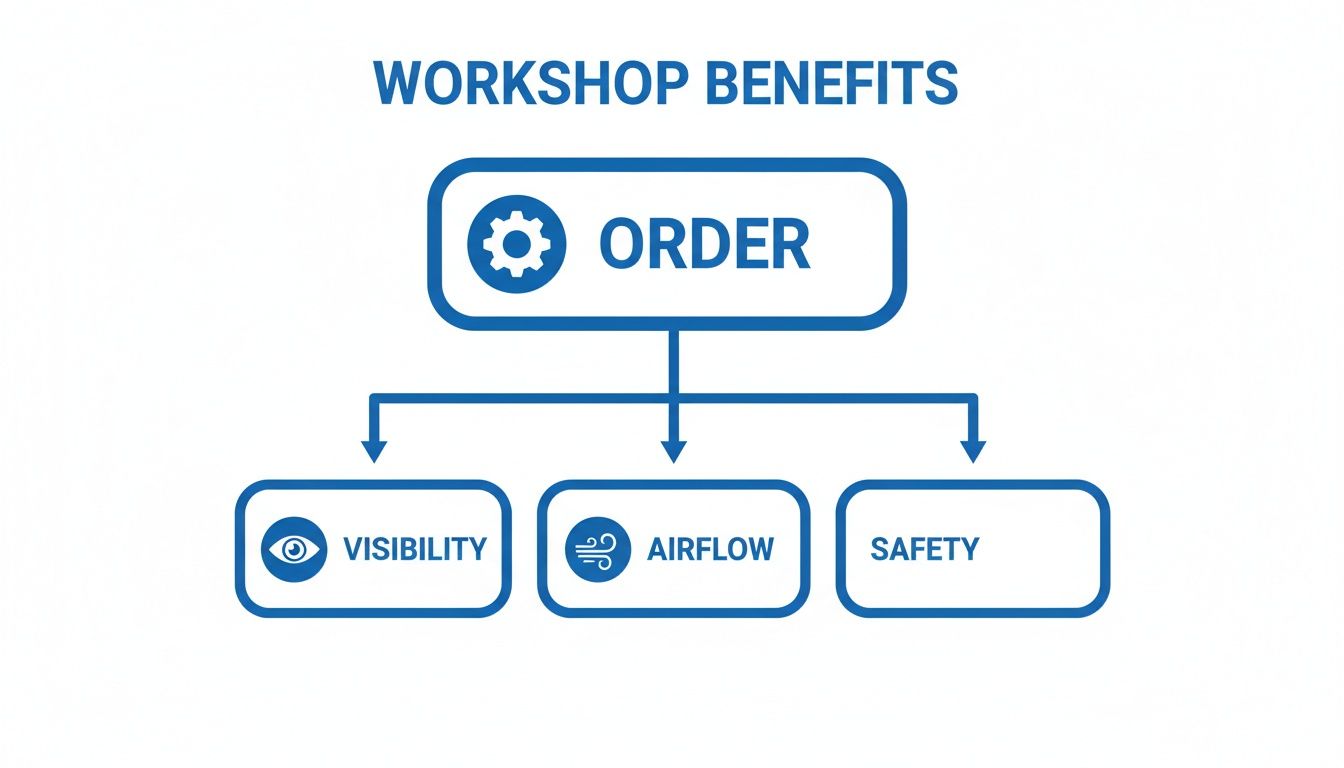
As you can see, good order is the foundation for everything else—better visibility, improved airflow, and a much safer environment for everyone.
Picking the Right Finish for the Job
While powder-coating is the go-to for most industrial spaces, different environments call for different finishes. To help you choose, here's a quick comparison of the options you'll typically find.
Shelf Wire Rack Feature Comparison
| Feature | Standard Option (e.g., Chrome-Plated) | Industrial Grade (e.g., TEMA Powder-Coated) | Best For |
|---|---|---|---|
| Durability | Prone to scratching and chipping under heavy use. | Highly resistant to scratches, impacts, and chemicals. | Industrial settings, workshops, high-traffic warehouses. |
| Corrosion Resistance | Good in dry environments; susceptible to rust if scratched or damp. | Excellent protection against moisture and corrosive spills. | Garages, storerooms, and areas with fluctuating humidity. |
| Appearance | Bright, reflective finish. | Professional, semi-gloss finish available in various colours. | Retail displays (chrome) or branded workspaces (powder-coat). |
| Maintenance | Requires careful cleaning to avoid damaging the plating. | Easy to wipe down; the tough surface resists staining. | Busy environments where cleaning needs to be quick and effective. |
Ultimately, chrome plating gives a clean, bright look that works well for dry storage, but it just doesn't have the resilience for harsh or damp conditions. For specialised needs, like food preparation or cleanroom applications where hygiene is non-negotiable, you might even explore options like stainless steel shelving racks.
The key takeaway is this: matching the material and finish to your specific environment is how you make sure your investment pays off for years to come.
How to Measure Your Space for a Perfect Fit
Choosing the right wire shelving is a bit like getting a bespoke suit made – a perfect fit makes all the difference. Get it right, and your storage feels like a natural extension of your workspace. Get it wrong, and you're stuck with awkward gaps, wasted corners, and daily frustration. The aim here is to make every square centimetre count.
This isn't just about measuring the footprint where the unit will stand. You need to think in three dimensions to avoid nasty surprises come assembly day. It’s about understanding the entire environment the shelving will live in.
Start with the Core Dimensions
First things first, grab your tape measure. Nailing these three fundamental measurements will prevent the most common – and most annoying – mistakes.
- Width: Measure the total horizontal space you’ve got, whether it’s along a wall or in the middle of a room.
- Depth: Measure from the wall outwards to see how far the unit can come into the room without getting in the way of walkways or other gear.
- Height: Measure from the floor right up to the lowest point of your ceiling. This one is absolutely critical for avoiding overhead clashes.
Once you have these numbers, it’s a smart move to knock a few centimetres off each one. This gives you a bit of "breathing room," which makes installation a whole lot easier and stops the rack from scuffing up your walls or ceiling.
Think Beyond the Tape Measure
A great installation plan accounts for the real-world chaos of a busy workshop. Just because the physical space is there doesn't mean it's practical. Look up, down, and all around the spot you’ve picked out.
One of the most common slip-ups is forgetting about what’s hanging from the ceiling. Things like low-slung light fittings, pipes, ventilation ducts, or even sprinkler systems can seriously reduce your usable height. Always measure to the lowest of these obstacles, not the ceiling itself.
You also need to think about clearance. Will the shelving block a doorway once it's loaded up? Will it prevent you from getting to a fire exit or an electrical panel? And crucially, make sure you leave enough room for aisles. A good rule of thumb is to allow at least 90-120cm for walkways so that people and small trolleys can get through safely and without a squeeze.
The Power of a Modular Approach
Try to think of your wire shelving system less like a single piece of furniture and more like a set of building blocks. This modular design is its biggest advantage, letting you build a storage solution that's truly tailored to your specific stuff. You can mix and match different shelf sizes, post heights, and all sorts of accessories to get the configuration just right.
Think about how this flexibility can solve everyday storage headaches:
- Varying Item Sizes: You could use deeper shelves at the bottom for bulky boxes and switch to shallower ones higher up for smaller components. For exceptionally large or heavy items, you might even need to look at options like long span shelves for industrial spaces.
- Dynamic Layouts: Pop a set of heavy-duty casters on the bottom and your static unit instantly becomes a mobile workstation. This is perfect for workshops where you need to reconfigure the layout for different projects.
- Specific Needs: You can add shelf dividers and ledges to stop small parts from getting jumbled up or to prevent things from accidentally being knocked off the sides.
By measuring carefully and embracing this modular mindset, you can make sure your new wire shelving doesn't just fit into your space – it makes it work better.
Assembling Your Shelf Wire Rack for Maximum Safety
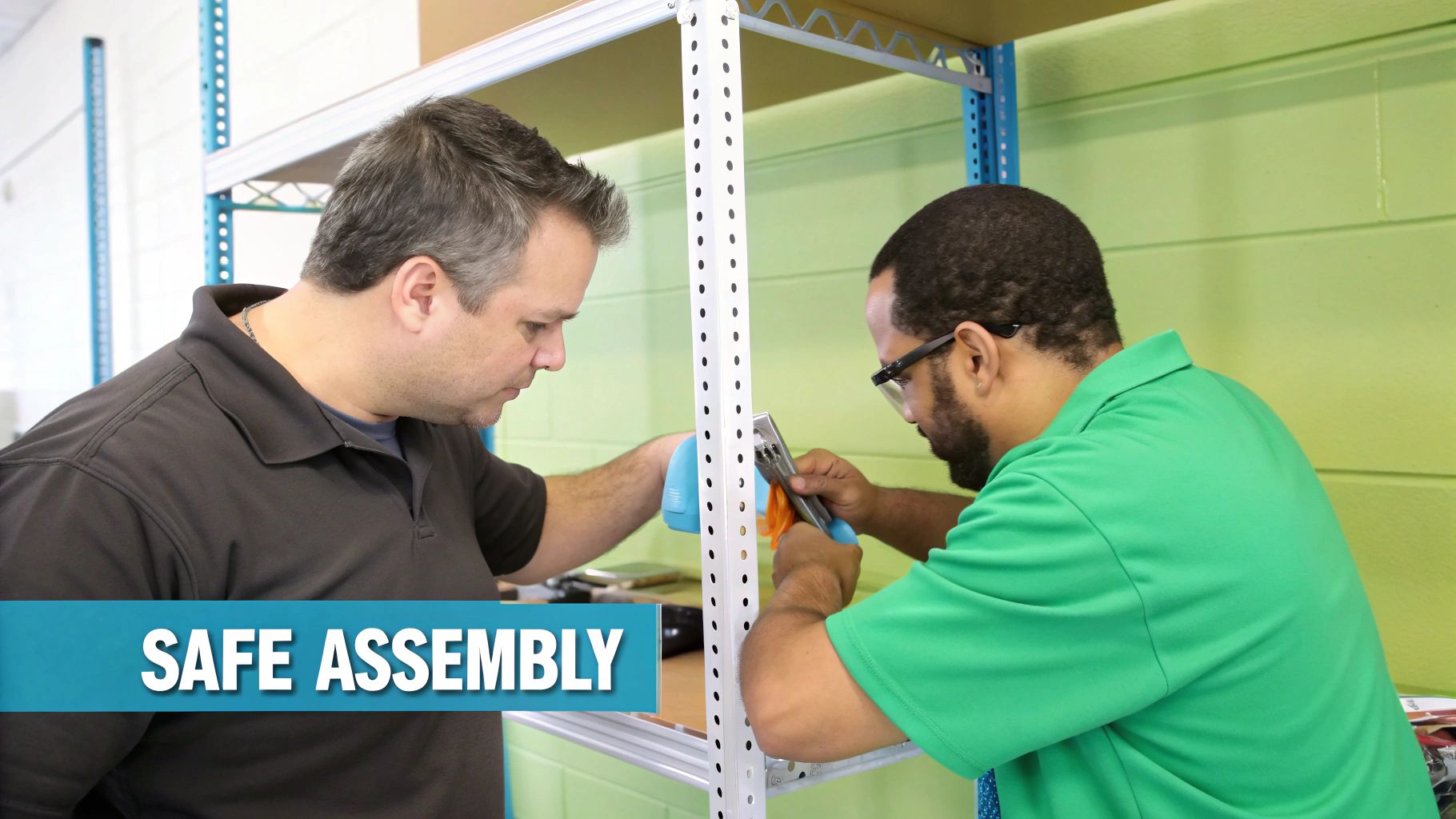
Proper assembly isn't just about following the instructions in the box; it's about building a safe, reliable asset for your workspace. A sturdy, correctly built wire rack protects your inventory, but more importantly, it protects your people. Don't rush it – a wobbly shelf is an accident waiting to happen.
First things first, pick your spot. You need a completely level surface, preferably away from busy walkways where a forklift or pallet truck might accidentally clip it. An uneven floor is a major red flag, as it can cause the whole unit to lean and put a dangerous amount of stress on the joints.
Securing the Foundation with Shelf Clips
Those little plastic pieces that clip around the posts – often called split sleeves or shelf clips – are the unsung heroes of the whole system. They're what create the clever friction fit that locks each shelf in place. Getting this part right is absolutely critical for a stable rack.
Make sure the clips on all four posts are set at the exact same height. If they're even one groove off, you'll end up with a wobbly shelf that can’t be trusted with any real weight.
Here's a pro tip: once you slide a shelf down over the clips, use a rubber mallet to give each corner a firm but gentle tap. You should feel it lock into place. That solid connection is your green light that the shelf is properly seated and ready for action.
With the rack built, loading it correctly is the next key to safety. Always, always put your heaviest and bulkiest items on the bottom shelves. This creates a low centre of gravity, making the entire structure far more stable and much less likely to tip.
Anchoring for Ultimate Stability
If you're using taller shelving units, or if you're in a workshop with vibrations from heavy machinery, anchoring the rack to a wall is a non-negotiable safety step. This completely removes the risk of the unit toppling over, which is especially important if it’s heavily loaded or in an area prone to bumps.
For a rock-solid installation, follow these best practices:
- Use the right hardware: Choose anchors and brackets that are properly rated for the total weight of your rack and its intended load.
- Check the wall: Make sure the wall itself (whether it's concrete, brick, or a timber stud) is strong enough to handle the strain.
- Secure it at multiple points: On tall racks, don't just anchor the top. Use brackets at several different heights to distribute the force evenly.
For anyone planning a wall-mounted setup, this practical guide to wall mounting brackets offers some excellent tips for a safe and secure installation. And for a broader look at keeping your entire facility safe, have a look at our resources on workplace safety compliance.
Real-World Applications for Your Workshop and Warehouse
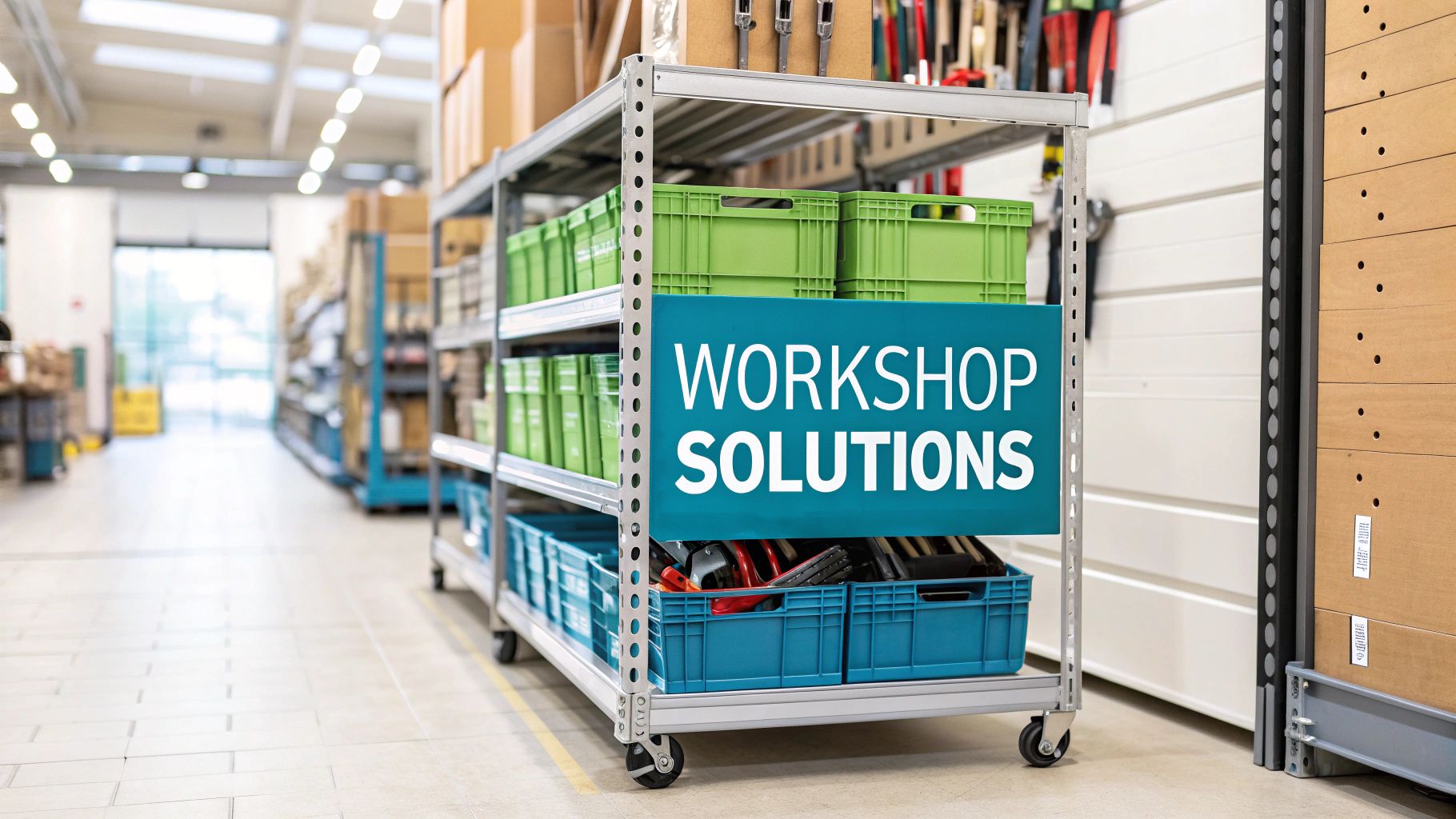
The technical specs are important, but where a wire shelf rack really proves its worth is on the workshop floor. This is where its versatility shines, turning cluttered, inefficient spaces into well-oiled machines.
Think of a busy vehicle repair shop. A heavy-duty wire rack can be set up with the strongest shelves near the floor, creating the perfect, easy-to-access spot for bulky items like brake discs or transmission parts. The shelves higher up can be organised with bins holding smaller components—filters, spark plugs, you name it—all clearly visible and ready for a technician to grab.
It’s a simple, logical change, but it means jobs get done faster. That’s a direct impact on productivity and your bottom line.
Boosting Workflow on the Manufacturing Line
Now, let's step onto a manufacturing line. Here, a mobile wire rack on heavy-duty castors isn't just for storage; it becomes an active part of the workflow. Instead of assemblers constantly walking back to a central stockroom, all the components for a specific task can be "kitted" onto a mobile rack and rolled right to their station.
This simple adjustment is a classic lean manufacturing principle in action, slashing wasted movement and time. It helps keep the production line flowing and cuts down on the frustrating delays caused by hunting for parts, which ultimately boosts output.
The real magic of a wire shelf rack is its ability to adapt. It’s not just a static piece of furniture, but a dynamic tool you can mould to the unique rhythm of your operations—whether that’s in assembly, repair, or order fulfilment.
This need for smarter, more agile storage is why these systems are becoming so common in the UK, especially in warehousing and manufacturing. In fact, UK facilities that have optimised their racking have seen efficiency gains of up to 30% through better inventory control. This trend has only been accelerated by the e-commerce boom. You can find more data on this industrial storage growth and its key drivers.
Specialised Applications for Sensitive Environments
Wire shelving is far more than just a general-purpose solution. In environments where a stray spark of static electricity could be catastrophic, like an electronics lab, there are purpose-built options.
ESD-Safe Racking: An Electrostatic Dissipative (ESD) wire rack is built using conductive materials. This design provides a safe path to ground for any static charge, protecting sensitive microchips and circuit boards from damage that might not be discovered until it's far too late.
Cleanroom Compatibility: For pharmaceutical labs or food processing areas, chrome-plated or stainless steel racks are the standard. Their open-wire design is brilliant for promoting laminar airflow and makes them exceptionally easy to clean and sanitise, which is essential for meeting the strict hygiene standards in these critical settings.
Selecting the Right TEMA Solutions Shelf Wire Rack
Right, you’ve got a solid grasp of what makes a wire rack tick. The final piece of the puzzle is putting all that insight to work and picking the TEMA Solutions system that’s a perfect match for your space. It’s actually a pretty straightforward process once you zero in on what you really need.
A few simple questions are all it takes. Think of your answers as a compass, pointing you directly to the ideal shelving unit in our range.
Your Decision-Making Checklist
What’s the heaviest thing you’ll put on it? This is the most important question. Your answer sets the baseline for the load capacity you need, both for individual shelves and the entire unit. As a rule of thumb, always pick a rating that’s comfortably above your heaviest item to build in a solid safety margin.
Will it get wet or be around chemicals? If there’s even a chance of moisture, humidity, or chemical exposure, a standard chrome finish just won’t cut it long-term. You’ll need the serious corrosion protection of TEMA’s industrial-grade powder coating to stop rust in its tracks.
Does your storage need to move? For busy workshops or labs where the layout needs to be flexible, a static rack can be a pain. Choosing a unit that works with our heavy-duty castors transforms it into a mobile workhorse you can roll wherever you need it.
Choosing TEMA Solutions isn’t just buying shelves; it's an investment in certainty. Our systems are built to demanding ISO-certified quality standards and backed by proper industry warranties, giving you the peace of mind that your storage will stand up to the job for years.
When you invest in a TEMA Solutions shelf wire rack, you're getting more than just steel. You're getting a partner committed to making your operations run smoother. From getting expert advice during the selection process to a system engineered for years of reliable performance, our goal is to provide a storage solution that boosts your efficiency from day one.
To see all the possibilities, take a look at our complete collection of industrial storage racks and find the perfect fit for your business.
Got Questions About Wire Shelf Racks? We've Got Answers
Even after you've done your homework, a few practical questions always pop up when it comes to putting wire racking into a real-world workshop. Here are some of the most common queries we get, along with some straight-talking answers.
How Should I Clean and Maintain My Racking?
Keeping these racks in good nick is refreshingly simple. For day-to-day dust and grime, a quick wipe-down is all it takes. If you're dealing with a greasier workshop environment, a cloth dampened with a mild degreaser will cut through it easily.
That open-wire design really is your best friend here—it means there are no hidden corners for dirt to build up, making the whole job much faster.
Can I Put Wheels on My Rack to Move It Around?
Absolutely. Adding castors is a brilliant way to create a mobile storage unit, perfect for workshops where layouts change or you need to bring tools closer to the job.
But there's a crucial point to remember: adding wheels will lower the rack's overall weight capacity. Make sure you choose a set of heavy-duty castors built for the job, and always check the revised load rating to keep things safe and stable once you start rolling it around.
Is a Powder-Coated Finish Really Better Than Chrome?
In a busy industrial setting? Without a doubt, yes. While chrome has a certain shine and works fine for dry, light-duty applications, its biggest weakness is that it can chip, and once that happens, rust isn't far behind.
A tough powder-coated finish, like the ones you'll find on TEMA Solutions units, is in a different league. It offers far better protection against the knocks, scrapes, chemicals, and corrosion that are part of daily life in a workshop. It’s simply the smarter choice for a long-term investment that will stand up to years of hard use.
Ready to build a storage system that works as hard as you do? Explore the durable, high-performance range from TEMA Solutions and find a shelf wire rack that's genuinely built to last. Visit https://tema-solutions.co.uk to see the options.


