


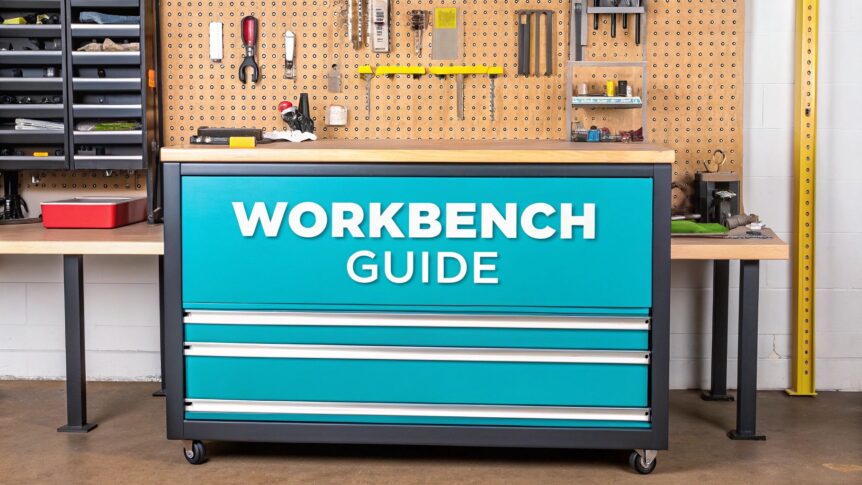
A work storage bench is so much more than just a sturdy table. It’s a clever, multi-functional piece of furniture that marries a durable worktop with built-in storage like drawers, cupboards, or shelves. Think of it as the central hub for any serious workshop, garage, or industrial space.
It gives you a dedicated spot to get jobs done while also providing organised storage for all your tools and materials. The real magic, though, is how it boosts your efficiency and safety simply by keeping everything you need within arm’s reach.
Your Workshop’s Command Centre
Don’t just picture a table; imagine a command centre for your entire workshop. For setting up a smooth and safe workflow, this is probably the single most important bit of kit you can own. It has the power to turn a chaotic, cluttered space into a genuinely productive environment.
It’s a bit like how a professional chef sets up their station, with every ingredient and utensil meticulously placed for quick access. A good work storage bench is designed with that same logic in mind, allowing for seamless building, repairing, and creating.
The concept behind it is simple but incredibly effective. By building storage directly into your main workspace, you cut out the wasted time and sheer frustration of hunting for tools. No more digging around for that one specific spanner or misplacing a box of essential screws. Everything has its place, right where you need it, exactly when you need it.
Why Integrated Storage Matters
The growing popularity of this kind of furniture isn’t just a hunch. The UK’s demand for shop stools and benches is part of a bigger global picture, with the total market size projected to climb from roughly USD 1.56 billion in 2024 to USD 1.85 billion by 2030. A major reason for this growth is that people increasingly want furniture that offers both function and built-in storage. You can discover more about these market insights on Businesswire.com.
This trend points to a real shift in how both professionals and hobbyists think about their workspaces. We’re moving away from cobbled-together, makeshift setups and embracing deliberate, organised systems that just work better.
A well-organised bench doesn’t just store your tools; it organises your thoughts. By reducing physical and mental clutter, it frees you up to focus entirely on the task at hand, leading to better results and fewer mistakes.
Let’s break down some of the core benefits of having a proper work storage bench.
| Core Benefits of a Work Storage Bench |
| :— | :— |
| Benefit | Impact on Your Workspace |
| Enhanced Efficiency | With tools at your fingertips, you spend more time working and less time searching. This is a massive boost to your overall productivity. |
| Improved Safety | A tidy bench means fewer trip hazards from tools left on the floor. It also ensures sharp or heavy items are stored away securely. |
| Optimised Space | It combines your work area and storage into a single footprint, which is perfect for smaller workshops or garages where every square metre counts. |
Ultimately, investing in the right work storage bench isn’t just about buying a piece of furniture. It’s a foundational step for any serious maker, laying the groundwork for a smoother, safer, and far more enjoyable creative process.
The Evolution of Modern Workbenches
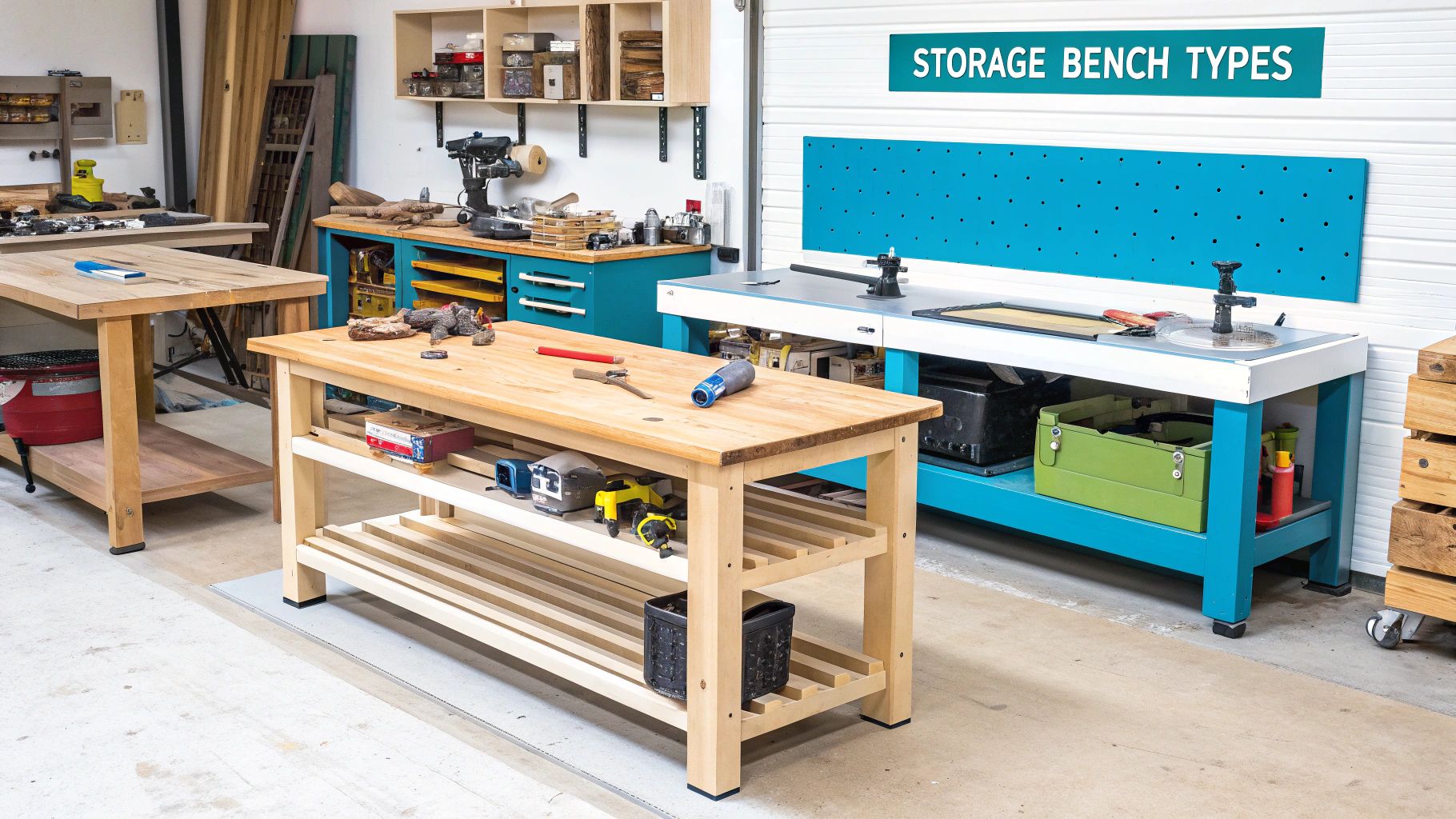
The humble workbench has come a long way. If you look back at post-war factories, you’d see little more than a sturdy plank of wood. Today, we have sophisticated, ergonomic powerhouses. This transformation wasn’t an accident; it was a direct result of huge shifts in British industry, technology, and, crucially, a deeper understanding of what makes a workplace safe.
In the beginning, workbenches were all about brute strength and durability. But as manufacturing grew more intricate, so did the need for speed and efficiency. A simple flat top just couldn’t cut it anymore when a worker needed a whole arsenal of specialised tools within arm’s reach.
This is where the idea of integrated storage began to take hold. At first, it was pretty basic stuff—a shelf bolted underneath or a couple of drawers tacked on the side. It might seem like a small step, but it was a massive turning point. It laid the foundation for the work storage benches we see as standard in every professional workshop today.
The Impact of Safety Regulations
A huge part of this evolution was driven by new safety laws. The UK’s industrial journey, particularly from the post-war years onwards, has had a profound effect on workbench design. As businesses started to take worker well-being more seriously in the early 2000s, spurred on by rules like the Health and Safety at Work Act 1974 and its updates, the demand for safer equipment shot up. Suddenly, there was a real commercial incentive to invest in workbenches that could cut down on clutter and reduce on-site hazards.
This new focus on safety transformed the workbench from a passive bit of furniture into an active tool for managing risk.
A cluttered workspace is an unsafe workspace. The rise of the work storage bench is a direct answer to the realisation that keeping tools organised is fundamental to preventing accidents, whether it’s a simple trip or a serious injury from misplaced gear.
From Basic Storage to Modular Systems
In recent years, the pace of change has quickened, with ergonomics and modular design leading the charge. Today’s workbenches are no longer a one-size-fits-all solution. They are highly adaptable systems, built to support specific jobs and make the user’s life easier and more comfortable.
Some of the key advances include:
- Adjustable Height Mechanisms: These allow you to set the bench at the perfect height for your body, which makes a world of difference in reducing back strain and fatigue over a long day.
- Durable, Specialised Worktops: The surface itself has become a specialised component, from traditional solid wood for woodworking to anti-static tops for handling sensitive electronics.
- Modular Storage Components: Modern systems are like building blocks. You can customise your setup with different drawer units, cupboards, and pegboards to create a workstation that’s perfectly tailored to your workflow.
When you understand how different manufacturing tools and aids work together to boost a workshop’s efficiency, you can really appreciate the role these advanced benches play. They aren’t just a luxury; they represent decades of learning how to work smarter and safer. That history is built into every single drawer and durable surface.
Choosing the Right Type of Work Storage Bench
Picking the right work storage bench is a lot like choosing a vehicle. You wouldn’t use a sports car to move house, and you wouldn’t take a lorry on a racetrack. The best choice always comes down to the job at hand, the space you’re working with, and the weight it needs to bear.
Not all workbenches are cut from the same cloth. Understanding the main types is your first step to finding the perfect fit for your workshop. A bench that’s perfect for a mechanic wrestling with heavy engines will be worlds apart from one designed for delicate electronics assembly.
The Heavy-Duty Contenders
When your work involves serious weight and impact—think engineering, welding, or automotive repair—a heavy-duty industrial bench is essential. These are the titans of the workshop, typically built from thick-gauge steel with fully welded frames for incredible strength and rigidity. Their worktops are just as tough, often made of solid wood, steel plate, or a composite designed to take a beating from hammers, grinders, and chemical spills.
Storage on these beasts usually means deep, rugged drawers with high load capacities, ideal for stashing heavy socket sets, power tools, and bulky components. They are the true workhorses of the industrial world, engineered for maximum durability, not portability.
Mobile and Flexible Solutions
On the other hand, if your workshop layout needs to change with each project, a mobile work storage bench on castors brings fantastic flexibility. These benches let you reconfigure your space on the fly, bringing your tools right to the job. This is a massive plus in larger workshops or on assembly lines where moving the project itself just isn’t an option.
While they’re still strong, mobile benches are generally lighter than their static industrial cousins. Their storage often features a mix of drawers, cupboards, and open shelving, striking a good balance between organisation and mobility. For smaller workshops, they can be a real game-changer, easily tucked away to free up floor space.
A key insight from workshops is that the most efficient layouts are often fluid. A mobile bench transforms your workspace from a fixed set of stations into an adaptable environment, directly improving workflow for varied tasks.
To help you visualise the options, here’s a quick comparison of the common types you’ll encounter.
Comparing Work Storage Bench Types
A comparative look at different work storage bench models to help you choose the right one for your application.
| Bench Type | Best For | Key Storage Features | Primary Material |
|---|---|---|---|
| Heavy-Duty Industrial | Engineering, welding, heavy mechanics | Deep, high-capacity drawers; reinforced shelving | Steel, Solid Wood |
| Mobile Workbench | Dynamic workshops, assembly lines, varied tasks | Mix of drawers, cupboards, open shelves | Steel, Aluminium |
| Woodworking Bench | Carpentry, joinery, detailed craft | Vices, dog holes, tool wells, drawers | Solid Wood (e.g., Maple, Beech) |
| ESD/Electronics Bench | Electronics assembly, repair, lab work | Grounding points, anti-static surfaces, small part drawers | Steel with ESD Laminate Top |
This table should give you a clearer idea of how each bench is tailored for specific jobs, helping you narrow down your search.
Considering Materials and Lifespan
The material of your bench really dictates its durability and what you can do on it. A woodworker will love a solid wood or butcher block top that’s kind to their tools and can be resurfaced. An electronics technician, however, will need an anti-static (ESD) surface to protect sensitive components from damage.
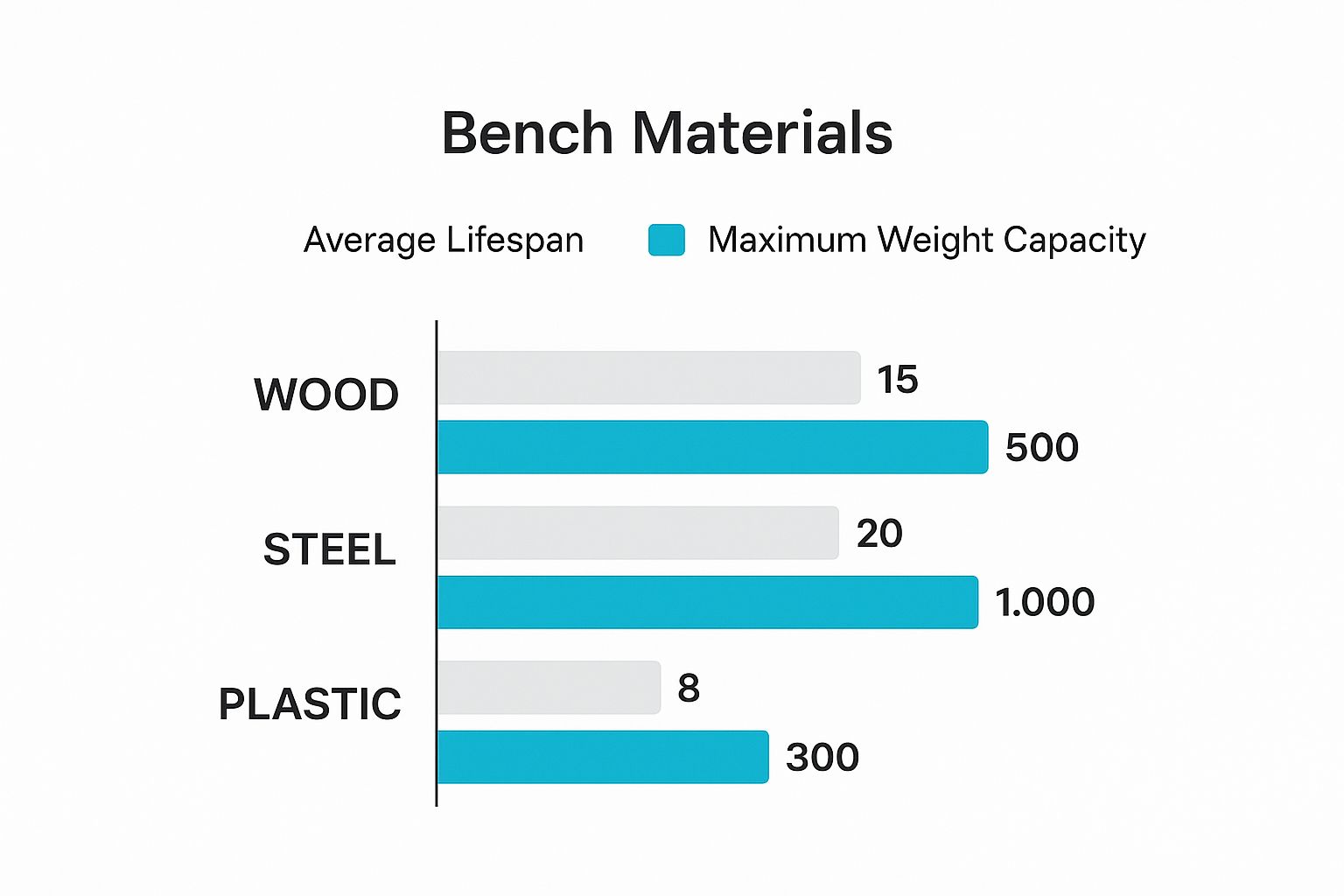
As you can see, steel provides the highest weight capacity, making it a must for heavy industrial use. Wood, in contrast, offers a brilliant balance of longevity and workability for more general tasks.
When it comes to keeping smaller items like fasteners or electronic parts tidy inside these benches, using well-designed divider storage boxes can make a huge difference to your efficiency. By matching the bench material and storage to your specific projects, you ensure your workspace is not just organised, but perfectly equipped for the work you do.
Key Features To Look For Before You Buy
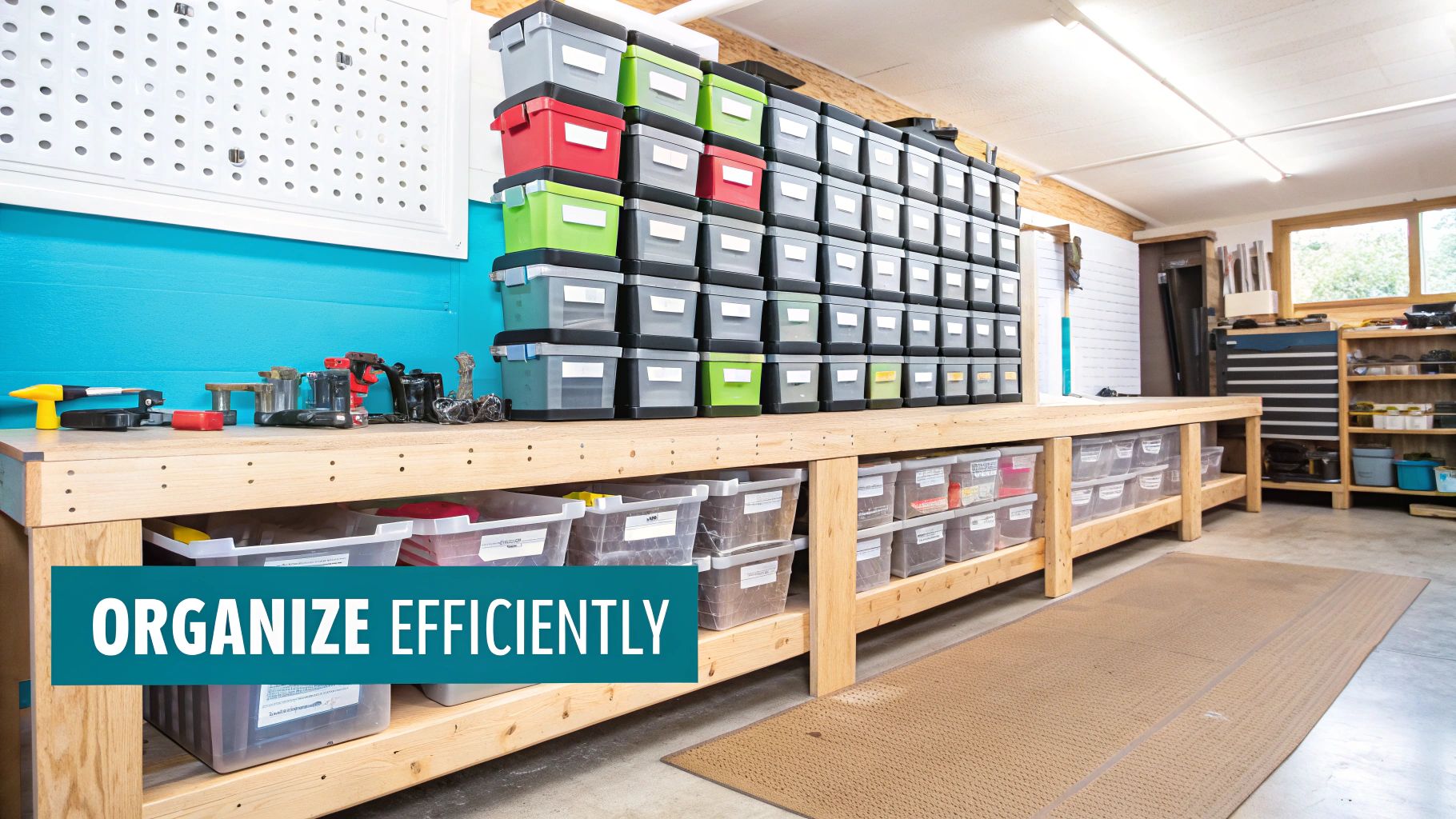
Picking out a new work storage bench is a big deal. It’s a decision that’s going to shape your daily workflow for years to come, so it’s worth getting right. It’s easy to just look at the price, but the real value is in the functional features that make your work easier. Think of this as your essential checklist for making a smart, long-lasting investment.
The first thing you absolutely must check is the load capacity. This isn’t just a suggestion; it’s a critical safety rating that tells you exactly how much weight the bench can handle. My advice? Always overestimate. A bench that can hold more than you think you need gives you a vital safety buffer and ensures it won’t let you down when a heavier project comes along.
Material And Worktop Surface
The worktop is where all the action happens, so its material is incredibly important. It determines how durable the bench is and what kind of work it’s best suited for. A cheap surface that scratches or dents easily will become a constant source of frustration.
Here are a few common worktop materials to consider:
- Solid Wood or Butcher Block: A fantastic all-rounder, especially for woodworking. It’s tough, forgiving on your tools, and you can often sand it down and refinish it if it gets damaged.
- Stainless Steel: The go-to choice for workshops, labs, or anywhere dealing with chemicals, heat, and hygiene. It’s incredibly tough and a breeze to clean.
- Laminate/Composite: A good budget-friendly option that often provides solid resistance to stains and scratches. If you’re working with sensitive electronics, make sure to look for an ESD (electrostatic discharge) safe version.
Storage Configuration And Hardware Quality
The storage is just as crucial as the worktop. The layout of drawers and cupboards will dictate just how organised and efficient your workspace can be. If the storage is poorly designed, it can easily get in your way more than it helps.
Don’t forget to look closely at the quality of the hardware. For drawers holding heavy tools, ball-bearing slides are non-negotiable; they ensure a smooth glide, even under serious weight. Cheaper slides will sag and stick, turning a simple task into a daily battle. For tools you grab all the time, a bench with a built-in pegboard back can be a lifesaver. Our guide to innovative storage for tools has plenty more ideas for getting your setup just right.
A work storage bench is a complete system. The quality of its drawers, hinges, and locks is just as important as the strength of its frame. Compromising on these small details can undermine the entire bench’s usefulness over time.
When you’re looking at these parts, having a basic grasp of choosing the right building hardware can give you a real advantage. It helps you spot quality construction and tell the difference between a bench built for the long haul and one that’s destined for an early retirement. By checking these features—load capacity, worktop material, and storage hardware—you can find a bench that will be a reliable cornerstone of your workshop for years.
How the Right Bench Boosts Safety and Efficiency
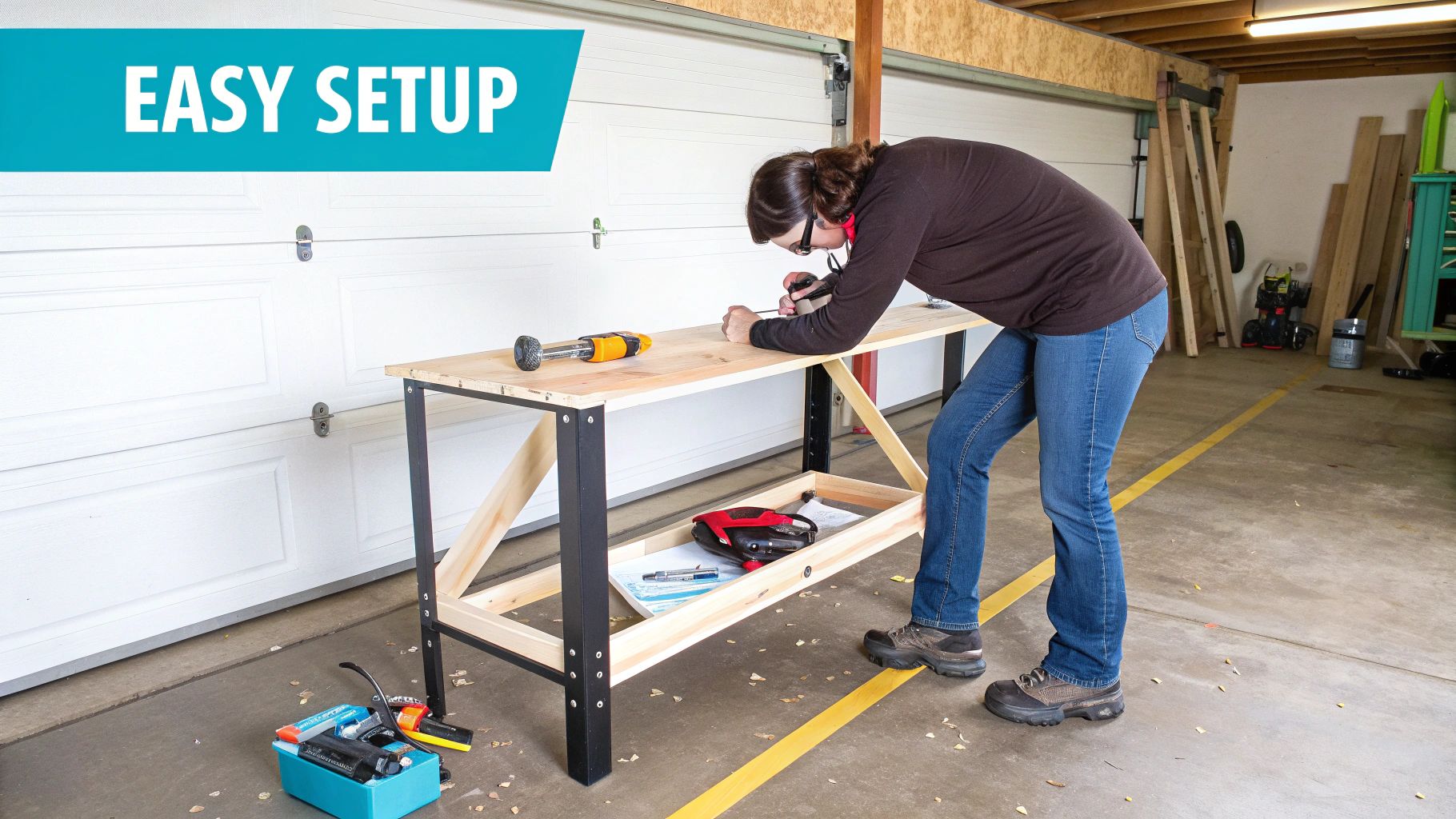
A quality work storage bench is much more than a simple surface for holding your tools. When you get the right one, it fundamentally changes how you work, turning your workshop into a genuinely safer and more productive space. It does this by taking on two of the biggest enemies of any productive environment: disorganisation and physical strain.
Think about all the time you’ve wasted hunting for a specific tool. A few minutes here, a few minutes there—it all adds up, stealing hours from your month. An organised bench with designated drawers and compartments puts a stop to the search party, letting you focus on the job at hand. This reduction in ‘mental clutter’ does wonders for preventing mistakes, too, as your full attention is on the quality of your work. For a deeper dive, our guide on maximising efficiency with workshop drawers has some great insights.
Creating a Safer Workspace
Efficiency is one thing, but safety is paramount. A well-designed bench is the bedrock of a secure workshop. By giving every tool a proper home, you dramatically cut down the risk of trip hazards from equipment left carelessly on the floor. It’s that simple.
On top of that, sharp or heavy items can be tucked away securely in lockable drawers, safe from accidental knocks or falls. This isn’t just good practice; it’s a vital part of meeting workplace safety standards and creating a professional atmosphere.
An organised bench is a safe bench. When tools are stored correctly, the risk of trips, falls, and injuries from misplaced equipment drops significantly, creating a more professional and secure working atmosphere for everyone.
This push for safer, better-equipped workshops isn’t just a local trend. The global demand for high-quality workbenches is on the rise, with a projected compound annual growth rate of around 6.1% between 2023 and 2032. Here in the UK, this is heavily influenced by bodies like the Health and Safety Executive (HSE), which consistently advocate for the use of ergonomic and durable equipment.
The Ergonomic Advantage
Beyond just storage, the physical design of the bench itself plays a massive part in your long-term health and wellbeing. Spending hours hunched over a bench that’s too low, or reaching up to one that’s too high, is a fast track to back pain, neck strain, and general fatigue.
An ergonomically sound work storage bench is designed to help you maintain a neutral, comfortable posture. This reduces physical stress, allowing you to work comfortably and effectively for longer stretches. It’s a critical factor in preventing the kind of chronic injuries that can sap your productivity day after day. While focused on offices, you can find valuable strategies in these essential office renovation tips that apply to optimising any workspace.
Ultimately, the right bench doesn’t just change your workshop; it can improve your entire working life.
Common Questions About Work Storage Benches
When you’re ready to invest in a new work storage bench, it’s completely normal to have a few practical questions. Getting the details right from the start means your new workspace hub will serve you perfectly from day one. Let’s tackle some of the most common queries with clear, straightforward answers.
How Do I Determine the Right Height for My Workbench?
Finding the correct height is absolutely crucial for both your comfort and safety. The right height prevents back strain during long sessions at the bench, but there’s no single “correct” height – it all comes down to you and the kind of work you do.
A simple, tried-and-true method is the elbow-height rule. Just stand up straight with your arms relaxed at your sides. The ideal height for your workbench surface should be about level with your wrists or the base of your palms. This posture gives you the best control and leverage without forcing you to hunch over or stretch uncomfortably.
Of course, the nature of your work matters too:
- Fine, detailed work: For tasks like assembling electronics or doing intricate carving, a slightly higher bench (a few inches above wrist height) is often better. It brings the workpiece closer to your eyes, reducing strain.
- Heavy-duty tasks: If you’re doing work that needs serious downward force, like hand planing wood or heavy mechanical jobs, a slightly lower bench gives you much better leverage and stability.
If your work is highly varied, an adjustable-height bench is a fantastic investment. It offers the flexibility to get the perfect setup for any task you throw at it.
What Is the Best Way to Maintain My Worktop Surface?
The lifespan of your work storage bench often depends on how well you look after its worktop. The best maintenance routine really depends on what your surface is made of.
For solid wood or butcher block tops, a regular wipe-down with a damp cloth is enough to handle dust and debris. If you’ve got tougher grime, a bit of mild soap and water will do the trick. To keep the wood in top condition, you’ll want to periodically apply a coat of food-safe mineral oil or a specialised workbench finish. This stops it from drying out and cracking.
For steel or laminate surfaces, cleaning is much simpler. A standard all-purpose cleaner will take care of most spills and stains. Just be sure to avoid abrasive scouring pads on laminate, as they can scratch the finish. For stainless steel, a dedicated steel cleaner will bring back its shine and get rid of fingerprints. The real key is consistency; a quick wipe at the end of each day prevents any serious buildup.
Think of your worktop like any other high-performance tool in your workshop. A small amount of regular maintenance ensures it remains reliable, safe, and ready for whatever project comes next.
Can I Add More Storage to My Bench Later On?
Absolutely. One of the best things about modern work storage benches is their modular design. Many systems are built specifically to grow and adapt right along with your needs.
You can often add components like:
- Overhead shelving or back panels: These are brilliant for adding storage without taking up any more of your precious floor space.
- Additional drawer or cupboard units: Many manufacturers sell standalone units that are designed to slide right under or sit neatly next to your existing bench.
- Pegboards and tool holders: These can be easily mounted to the wall behind the bench or attached directly to the bench’s own frame.
Before you buy, it’s a smart move to check if the manufacturer offers compatible add-ons. Sticking with a system from a single product family ensures that any new additions will fit perfectly, both in terms of function and looks.
How Much Weight Can a Standard Work Storage Bench Hold?
This is a big one. The weight capacity, or load rating, varies enormously between different models, so there really is no “standard” figure. A light-duty bench for hobbies might only support 150-200 kg, whereas a heavy-duty industrial bench can often hold well over 1,000 kg.
Always, always check the manufacturer’s specified load capacity before you make a purchase. This isn’t just a number; it’s a critical safety specification. A good rule of thumb is to choose a bench with a load rating that comfortably exceeds the weight of your heaviest projects and equipment. It’s always better to have more capacity than you need.
Ready to create a workspace that’s as organised as it is productive? The team at TEMA Solutions Limited are experts in fitting workshops with high-quality, durable work storage benches that stand the test of time. Explore our range of industrial workstations and storage solutions to find the perfect foundation for your efficiency.


