


So, what really makes a workshop bench heavy duty? Choosing Your Heavy Duty Workshop Bench, It’s not just about it looking tough. A true heavy-duty bench is all about its bones—the construction and the load it can handle. Think of it as the non-negotiable foundation for any serious workshop, built with a fully welded, thick-gauge steel frame and a worktop that can take a beating day in and day out.
What Sets a Real Heavy Duty Workshop Bench Apart?
When you’re ready to move beyond the flimsy, bolt-together tables you find in a DIY store, the term “heavy duty” starts to mean something specific. It signals a proper piece of industrial equipment, engineered to perform under serious stress.
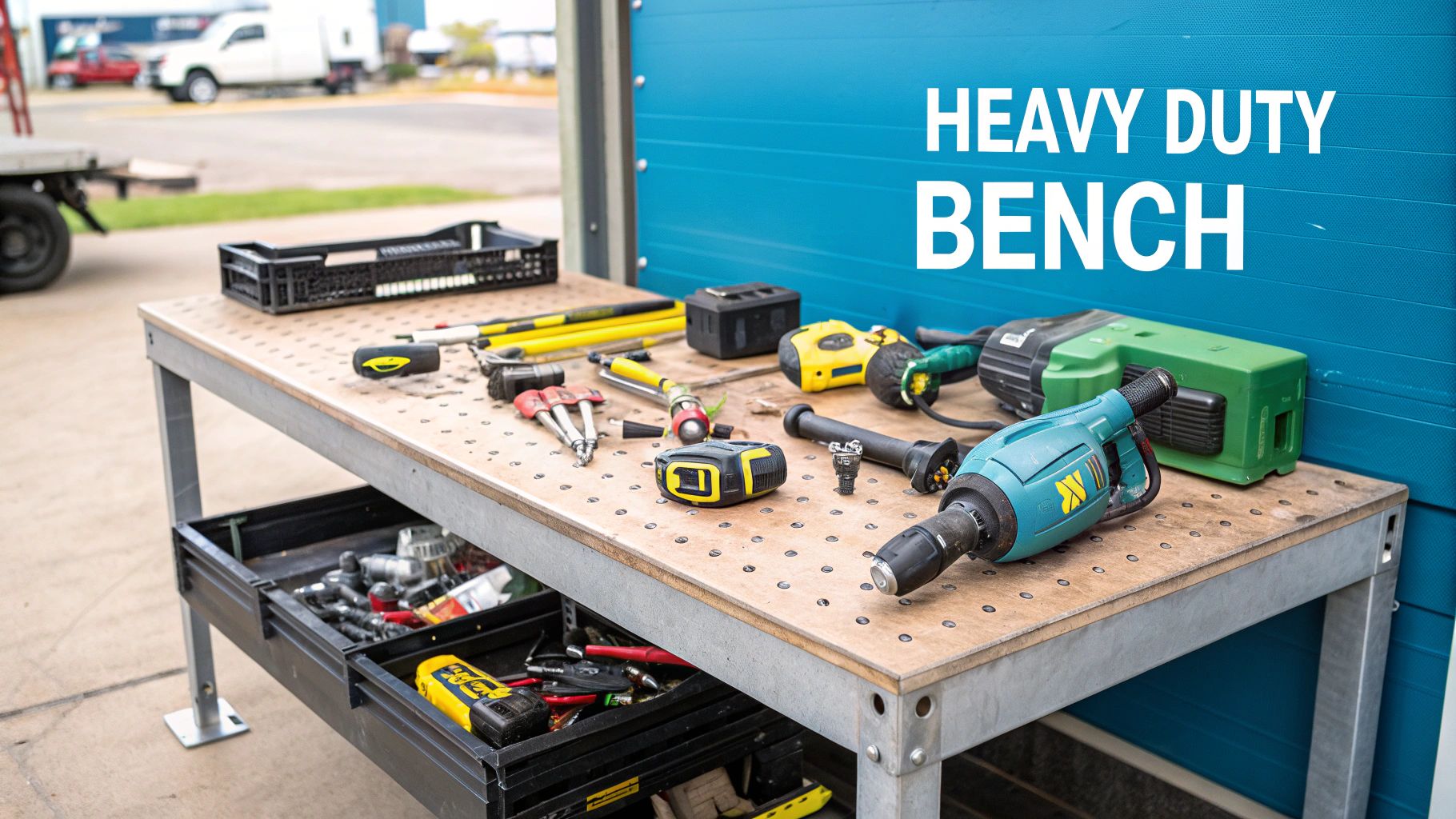
Let’s break down what separates a genuine heavy-duty workbench from the lightweights.
The heart and soul of the bench is its frame. A proper heavy-duty frame isn’t bolted together from a kit; it’s fully welded from thick-gauge steel. This single, crucial detail is what eliminates weak points. It stops the bench from flexing or wobbling when you put weight on it, ensuring it stays rigid and lasts for years. It’s this solid, unyielding structure that gives it such a high load capacity.
A welded frame is the skeleton of a high-performance bench. It provides the core stability needed for tasks like hammering, pressing bearings, or securing a vice, where any movement could compromise safety and precision.
Understanding Load Capacity
The true test of a heavy-duty bench is its Uniformly Distributed Load (UDL) capacity. This isn’t just a number for marketing fluff; it’s a structural guarantee. Here in the UK, these benches are vital pieces of kit in manufacturing and engineering workshops.
A standard heavy-duty model will typically support up to 1,000 kg, while the extra heavy-duty versions built for intense industrial use can handle loads up to 5,000 kg. You can dig deeper into these industry standards by checking out the Spaceguard buyer’s guide.
This is the kind of capacity that lets you confidently drop an engine block, a heavy die, or large assemblies onto the surface without a moment’s hesitation.
Choosing the Right Worktop for the Job
The worktop is where all the action happens, so the material you choose will directly impact how useful the bench is for your specific tasks.
To help you decide, here’s a quick look at the most common materials and what they’re best for.
Heavy Duty Workbench Material Comparison
| Material | Primary Use Case | Pros | Cons |
|---|---|---|---|
| Solid Wood | General assembly, joinery, mechanical work | Absorbs impacts, won’t damage parts, can be resurfaced | Can be damaged by heat, chemicals, and moisture |
| Steel Plate | Welding, heavy fabrication, grinding, engineering | Extremely durable, heat-resistant, easy to clean | Can damage delicate components, noisy, can rust |
| Laminate/ESD | Electronics assembly, labs, precision tasks | Smooth, non-conductive (ESD), chemical-resistant | Can chip or scratch under heavy impact |
Each surface has its place. A butcher block-style solid wood top is fantastic for general work because it can take a hit and is less likely to damage what you’re working on. For the really tough jobs like welding or grinding, nothing beats a steel plate top for its sheer durability and heat resistance. And if you’re working with electronics, an ESD laminate surface is essential to protect sensitive components.
Ultimately, a real heavy-duty workshop bench is a purpose-built tool. It’s a combination of that rigid, welded steel frame and a task-specific worktop, coming together to create a stable, reliable platform that’s the backbone of any productive and safe workshop.
Matching the Bench to Your Specific Workload
Picking the right heavy duty workshop bench isn’t a simple case of ‘that one looks sturdy’. The perfect bench for a mechanic grappling with a lorry engine is worlds apart from what a technician needs for intricate electronics work. The first, most crucial step is to honestly assess what you’ll be throwing at it, day in and day out.
Forget just static weight for a moment. Yes, you need to know how much your heaviest projects weigh, but the real test comes from dynamic forces. Think about the sudden downward pressure from using a press, the sharp shock of a hammer blow, or the twisting torque from a heavy-duty vice. These actions create momentary loads that can dwarf the actual weight of the workpiece. Your bench needs the guts to absorb these forces without a single wobble.
A classic mistake is buying a bench based purely on the weight of the items you’ll put on it. A bench rated for 500 kg might sound ample, but the dynamic load from a sharp impact or constant vibration can weaken its structure over time.
Assessing Your Space and Workflow
In most UK workshops, every square metre counts. The bench’s footprint is about more than just fitting it in; it’s about how it impacts your entire workflow. Before you even think about clicking ‘buy’, get the tape measure out. But don’t just measure the floor space. Consider your ‘working envelope’ – the area around the bench. You need enough room to move, manoeuvre large materials, and use tools without feeling boxed in.
A bigger bench isn’t automatically better, especially if it turns your workshop into an obstacle course. Sometimes, a more compact bench with smart, integrated storage is far more useful than a huge, cluttered surface. This is where you start thinking strategically about features.
- Integrated Storage: Having drawers and cabinets built-in keeps your worktop clear and your tools protected. It means less time hunting for that 10mm socket and less exposure to dust and damage.
- Built-in Power: Integrated sockets and USB ports are a game-changer. They get rid of dangerous extension leads snaking across the floor, making your workspace safer and tidier.
- Task Lighting: An overhead frame with good lighting is essential. It gives you bright, consistent light right where you need it, cutting down on shadows and mistakes.
Planning for these add-ons from the start helps you build a complete, self-contained workstation. When you’re thinking about storage, for example, consider how it fits with the rest of your setup. Check out our guide on heavy duty racks for storage to see how you can get your whole space working efficiently together.
Future-Proofing Your Decision
Finally, try to look beyond the jobs you have on right now. What will you be doing in a few years? It might be worth considering specialized workbenches like those with integrated pipe racks if you think you might take on more fabrication or plumbing work down the line.
Choosing a bench with a slightly higher load capacity or a modular design gives you room to grow. The demand for truly robust benches is on the rise across the UK’s industrial sector. In fact, benches that can handle over 454 kg (1000 lbs) are a major part of this market growth, showing a clear shift towards more durable, long-lasting workstations in engineering and manufacturing. By investing in a more capable bench now, you’re securing a core asset that will serve you well for years to come.
Why You Can’t Afford to Ignore Ergonomics and Safety
A heavy duty workshop bench isn’t just a slab of wood or steel; it’s the heart of your workspace. It’s where you’ll spend countless hours, and if you treat its setup as an afterthought, you’re setting yourself up for discomfort, poor work, and even long-term injury. Getting the ergonomics and safety right from day one isn’t just a box-ticking exercise—it’s absolutely vital for a productive and safe workshop.
Think about it. A bench that’s the wrong height is one of the biggest culprits behind workshop strain. Too low, and you’ll spend your days hunched over, leading to a sore back and neck. Too high, and your shoulders and elbows will be constantly raised, causing fatigue right up through your upper body. Over time, these awkward postures can lead to serious musculoskeletal problems, which is a major red flag under UK health and safety laws.
Getting the Height Just Right for the Job
The perfect bench height isn’t a one-size-fits-all number; it really depends on the task at hand. This is precisely why adjustable-height benches have become so popular—they’re a smart investment that lets you dial in your working position for the best possible comfort and control.
As a general rule, aim to set the worktop at or just below your elbow height when you’re standing comfortably. But you’ll want to tweak this for different jobs:
- For Precision Work: If you’re doing something detailed like soldering electronics or fine assembly, raise the bench a bit. This brings the workpiece closer to your eyes, so you aren’t craning your neck.
- For Heavy-Duty Tasks: When you need to apply some real force, like using a large spanner, lower the bench. This lets you put your body weight into the job, giving you more leverage safely.
Investing in a proper adjustable height workbench provides the flexibility to create an ergonomic setup for any task. It’s a game-changer, especially in workshops where different people might be using the same bench.
A well-organised, ergonomic workstation is the cornerstone of an efficient and safe workshop. It’s why the demand for these benches keeps growing, driven by a stronger focus on keeping workers safe and productive.
Creating a Safe Zone Around Your Bench
Beyond just the height, your entire bench area needs to be a designated safe zone. This means looking at both the bench itself and the space immediately around it. Little details on the bench, like rounded or chamfered edges, can make a big difference by preventing nasty cuts and bruises when you’re moving about. It’s also critical that the bench is rock-solid and won’t wobble or shift, even under a heavy load.
Your responsibility doesn’t end at the bench’s edge. Keep the floor clear of tools, offcuts, and trailing cables to get rid of trip hazards. Make sure you have enough room to move around the bench and handle materials without feeling cramped. And of course, your personal protection is just as important. Always have your essential safety workwear sorted from a supplier you trust. This focus on safety is a big reason the global heavy-duty workbench market is expected to grow at a 5% CAGR, hitting $3.8 billion by 2033, thanks in part to stricter health and safety rules.
Getting Your New Bench Assembled and Installed
So, your new heavy-duty workshop bench has arrived. Now for the final hurdle before you can get to work: the assembly. This is where you turn a pile of steel and wood into the solid, dependable heart of your workshop. Getting this part right isn’t just about following instructions; it’s about ensuring the stability and safety you paid for.
First things first, get your tools ready before you even open the box. You’ll likely need a decent set of spanners or a socket set, a spirit level, and maybe a rubber mallet for some gentle persuasion. I’d also recommend phoning a friend. Trust me, these parts are heavy, and an extra pair of hands makes the whole process smoother and safer.
Start on Solid, Level Ground
This is the golden rule: build your bench on a perfectly level surface. Most workshop floors, particularly in garages or older industrial units, have slopes you’d never notice until you try to build something square on them. If you assemble the frame on an uneven floor, you’ll build a permanent twist into it, resulting in a wobble that’s a nightmare to fix later.
Find the flattest area in your space and double-check it with a spirit level. If your floor is sloped, use some temporary shims under the legs to get the frame true during the build. You can fine-tune it later, but starting level from the get-go saves a world of frustration.
This image lays out the typical assembly process for most heavy-duty benches.
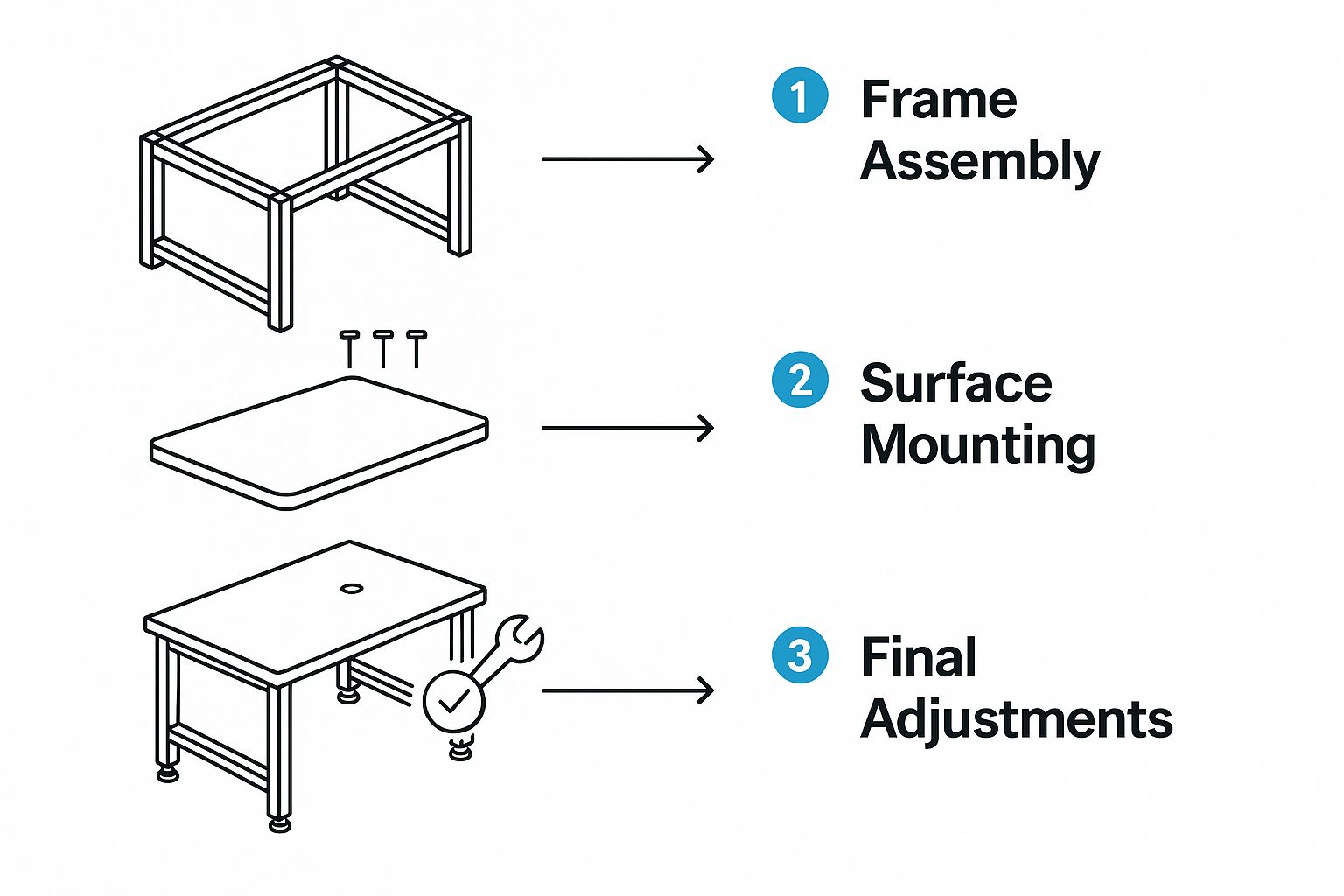
As you can see, a logical flow—building the frame, fitting the top, then making final adjustments—is the most reliable way to end up with a rock-solid bench.
To Anchor or Not to Anchor?
With your bench built and level, you have one last choice to make: should you fix it in place? For many applications, a heavy, freestanding bench loaded with gear won’t budge. However, for certain jobs, anchoring isn’t just a good idea—it’s a critical safety measure.
Think about it: you’ve clamped a large piece of steel in your vice and you’re about to put all your weight into a long breaker bar. That creates immense sideways force. An unanchored bench, no matter how heavy, can easily shift, tip, or ‘walk’ across the floor under that kind of strain.
You absolutely should anchor your bench if you plan to:
- Mount and frequently use a large bench vice.
- Do a lot of hammering, filing, or sawing that generates vibration and side-to-side forces.
- Use the bench for leverage when working on heavy components.
Fixing the bench to a solid concrete floor with anchor bolts is the gold standard for stability. If you don’t have a concrete floor, securing it to the wall studs is the next best thing.
Of course, sometimes you need flexibility. If your workspace demands mobility, our guide on choosing a workbench with wheels explains how to get the best of both worlds with heavy-duty locking castors. Ultimately, a securely installed bench is the foundation of a safe, productive workshop.
Looking After Your Bench for the Long Haul
You’ve invested in a heavy-duty workshop bench because you needed a solid, reliable foundation for your work. Think of it as the most important tool in your arsenal. And just like any quality tool, a little bit of regular care will ensure it performs flawlessly for years, maybe even decades.
Thankfully, keeping it in top nick is pretty straightforward.

Set aside a few minutes once a month for a quick inspection. I always start with the bolts and fasteners, particularly around the legs and where the top connects to the frame. In a busy workshop with constant vibration and heavy loads, things can gradually work themselves loose. A quick once-over with a spanner is all it takes to keep everything tight and rigid.
This is also the perfect opportunity to give the frame a good look. Keep an eye out for any subtle signs of stress, like tiny hairline cracks in the paint around the welds. It’s rare on a well-built bench, but catching something like that early makes all the difference.
Keeping Your Worktop in Prime Condition
The worktop takes the most abuse, and how you care for it depends entirely on the material. Using the wrong cleaner or technique can easily cause permanent damage, so it’s crucial to get it right.
Here’s a quick breakdown based on what I’ve seen work best:
- Solid Wood / Butcher Block: These can dry out and crack over time. The key is to regularly treat the surface with a good quality wood oil or conditioner. Always clean up spills as soon as they happen—especially oils or chemicals—and stick to a damp cloth with a bit of mild soap for general cleaning.
- Steel Tops: Steel benches are magnets for grease and grime. A decent degreaser and a soft cloth will handle most messes. Just be sure to avoid abrasive pads or scourers, as they’ll scratch up the surface. Always wipe it completely dry to keep any rust at bay.
- Laminate / ESD Surfaces: These are the easiest to look after. A wipe with a damp cloth and a mild detergent is usually all that’s needed. If you have an ESD (anti-static) bench, you must use specially formulated ESD-safe cleaners. Using anything else can strip its static-dissipative properties, making it useless for electronics work.
A big problem we see in damp UK workshops is rust creeping in on steel frames. A quick wipe with a dry cloth at the end of each day does wonders. If you do spot any surface rust, tackle it immediately with a wire brush and a touch-up of rust-inhibiting paint to stop it in its tracks.
This simple routine doesn’t take much time, but the payoff is huge. Consistent care ensures your workbench remains a safe, stable, and reliable partner for every project you throw at it, protecting your investment for the long term.
Your Heavy Duty Workbench Questions Answered
Even after you’ve weighed up all the options, a few questions always seem to pop up right before you pull the trigger on a new heavy-duty workshop bench. Getting straight answers to these common queries will give you the confidence that you’re making the right choice for your workshop.
Let’s dive into the most frequent questions we get from professionals and serious DIYers alike.
What Is the Real Difference Between Standard and Heavy-Duty?
The gap between a standard bench and a true heavy-duty one comes down to three things: material, construction, and load capacity. A standard bench might use thinner steel or timber, often bolted together, which is usually fine for a few hundred kilograms.
A genuine heavy-duty workshop bench, however, is a different beast entirely. We’re talking about a fully welded frame made from thick-gauge steel, built for absolute rigidity. These benches are designed to handle loads anywhere from 1,000 kg right up to a staggering 5,000 kg. The worktops are just as tough—thick solid wood, heavy steel plate, or specialised laminates that can take a beating from chemicals and impacts that would destroy a lesser surface.
Should I Choose a Mobile or Static Heavy-Duty Bench?
This really depends on your workflow and the layout of your space. A static bench, especially if you bolt it to the floor or wall, gives you rock-solid stability. It’s the only real choice for tasks like heavy hammering, grinding, or using a vice where even the slightest movement is a problem.
On the other hand, a mobile heavy-duty bench offers brilliant flexibility. Fitted with high-quality, lockable castors, it’s ideal for dynamic workshops where you need to change the layout on the fly or bring the workbench directly to a large project. Just be certain the castors are rated to handle the full weight of the bench plus whatever you plan to put on it.
How Important Is an Adjustable Height Feature?
Honestly? It’s critical for both ergonomics and sheer versatility. A fixed-height bench can easily force you into an awkward posture, which is a big red flag under UK health and safety regulations. An adjustable bench lets every user set the height perfectly for their body and the task at hand.
Think about it this way:
- Precision work, like assembling small components, is far more comfortable when the surface is higher.
- Tasks that need leverage, like using a big spanner, are safer and more effective when you can lower the bench.
If more than one person will use the bench, an adjustable height isn’t just a nice-to-have; it’s a practical investment in safety, comfort, and productivity.
What Accessories Are Truly Essential for a New Bench?
While you could accessorise a bench endlessly, a few items are genuinely essential right from the start.
First up, a high-quality engineer’s vice. For any mechanical or fabrication work, this is non-negotiable. You’ll need to be sure your bench is tough enough to withstand the powerful clamping forces it can generate. Next, integrated power outlets are a game-changer, letting you use power tools without having extension leads snaking across the floor creating trip hazards.
You also need to think about storage. Adding a set of drawers or a lower shelf is a simple way to keep your main work surface clear and organised. Finally, never underestimate good task lighting. Whether it’s mounted on an overhead frame or a separate lamp, proper lighting is crucial for both safety and the quality of your work.
At TEMA Solutions Limited, we specialise in providing robust, high-performance workstation solutions that form the backbone of an efficient workshop. Explore our range of heavy-duty workbenches and find the perfect foundation for your workspace by visiting us at https://tema-solutions.co.uk.


