


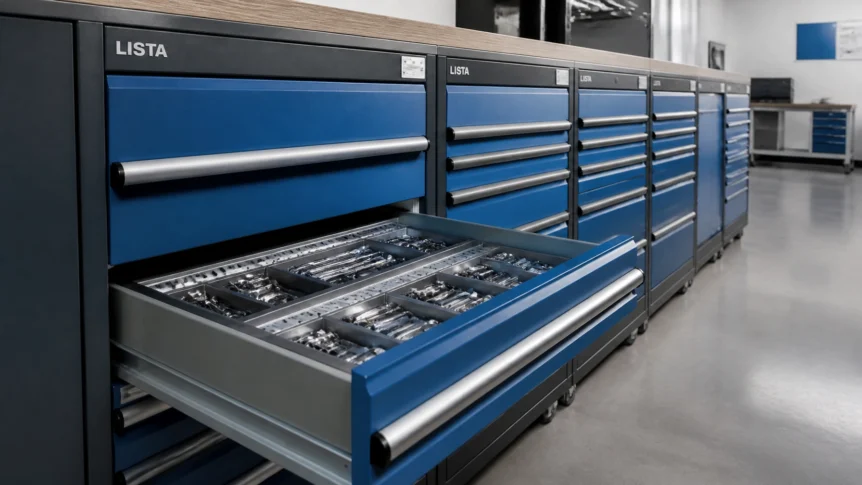
In the high-stakes environment of modern manufacturing and automotive engineering, the floor space of your workshop is more than just square footage: it is a critical driver of overhead costs and operational throughput. For production managers and workshop owners, the choice between industrial drawer cabinets and traditional open shelving is often framed as a simple matter of budget. However, this perspective overlooks the strategic impact that high-density storage has on labour efficiency, inventory accuracy, and long-term profitability.
Traditional shelving has been the “default” for decades due to its low initial acquisition cost. Yet, as workshops evolve into leaner, more data-driven spaces, the hidden costs of shelving: wasted vertical air, time lost searching for tools, and damaged inventory: are becoming impossible to ignore. This article provides a comprehensive comparison between these two storage philosophies, specifically focusing on how modular workshop furniture from industry leaders like Thurmetall and Lista can transform your operational efficiency.
1. Space Optimisation: Reclaiming the “Lost 80%”
The primary failure of traditional shelving in an industrial context is poor cubic volume utilisation. When you place small parts or hand tools on a shelf, you are effectively paying for the air above the item. In contrast, industrial drawer cabinets are designed to eliminate this “dead space” entirely.
The Problem: Footprint Bloat
In a workshop using open shelving, a significant portion of the floor area is consumed by rows of racking that are only 20-30% full by volume. This forces facilities to expand their footprint or lease larger premises, which is a significant strategic error when vertical space is available.
The Solution: High-Density Cubic Storage
Modular drawer systems allow you to tailor the height of each drawer to the exact dimensions of the contents. By using a mix of shallow drawers for fasteners and deeper drawers for power tools, you can store the same volume of inventory in roughly 20% of the floor space required by shelving.
Practical Tip: Conduct a “Cubic Audit.” Measure the total volume of your tools and compare it to the total volume of your current shelving. If more than 50% of your shelf volume is empty air, you are a prime candidate for a high-density metal cabinet with drawers.
2. Access Speed and Workflow Efficiency with Industrial Drawer Cabinets
In a “Just-In-Time” (JIT) production environment, every second spent searching for a specific socket or a calibrated gauge is a direct hit to your bottom line. Well-organised industrial drawer cabinets reduce motion waste and support faster retrieval at the point of use.
The Problem: The “Search and Rescue” Cycle
On open shelves, items are often stacked or hidden behind one another. This leads to the “Search and Rescue” cycle, where technicians move three boxes to find one tool, often forgetting to replace the original boxes correctly. This degrades the 5S methodology (Sort, Set in order, Shine, Standardize, Sustain) integrity of the workspace.
The Solution: 100% Visibility and Full Extension
Premium systems like Lista tool boxes and Thurmetall cabinets feature 100% full-extension drawers. When a drawer is opened, every single item is visible and accessible from above. There is no reaching into dark corners or moving secondary items. In practice, industrial drawer cabinets create a more disciplined picking process than shelving because each SKU can be assigned a fixed, visible location.
- Standardised Partitioning: Each tool has a dedicated “home” via plastic bins or slotted metal dividers.
- Visual Management: Labels and colour-coded handles allow for instant identification of contents.
Practical Tip: Implement a “Shadow Board” philosophy within your drawers. Use custom foam inserts or adjustable dividers to ensure that a missing tool is immediately obvious to the supervisor during end-of-shift audits.

3. Tool Protection and Asset Longevity
Your workshop’s tools: from CNC milling bits to high-torque impact wrenches: represent a massive capital investment. Exposing them to the workshop environment is a risk that most professional operations cannot afford.
The Problem: Contamination and Damage
Open shelving offers zero protection against the airborne dust, metallic chips, and coolant mist common in machine shops. Furthermore, tools stored loosely on shelves are prone to falling or being bumped, leading to nicks and calibration errors.
The Solution: The Sealed Cabinet Environment
Industrial drawer cabinets act as a protective vault. When closed, the drawers provide a dust-resistant seal that keeps precision instruments clean and ready for use. For workshops storing high-value cutters, gauges, and consumables, industrial drawer cabinets also make condition control and stock discipline far easier to maintain.
- Central Locking: Most systems come with high-security locking mechanisms, protecting high-value assets from shrinkage or unauthorised use.
- Smooth Glide Technology: High-quality slides (often rated for up to 200kg per drawer) ensure that heavy tools are moved smoothly, preventing internal collisions.
Practical Tip: For sensitive electronic components, always opt for ESD (Electrostatic Discharge) solutions. Many workshop storage systems can be fitted with conductive coatings and grounding points to protect your electronics.
4. Ergonomics: The Human Factor
A workshop is only as productive as its technicians. Forcing staff to bend down to the floor or climb ladders to reach high shelves is a recipe for fatigue and musculoskeletal injuries.
The Problem: Non-Ergonomic Reach Zones
Shelving units often extend from floor level to over two metres high. This forces workers into “red zone” postures: awkward reaches that increase the risk of injury and slow down task completion.
The Solution: The Golden Zone
Maximizing efficiency with workshop drawers allows you to keep 90% of your frequently used items in the “Golden Zone” (between waist and shoulder height). Because the drawers bring the contents to the worker, there is no need to lean into a dark shelf cavity. Well-specified industrial drawer cabinets therefore support both ergonomic best practice and higher daily throughput.

5. Comparison Matrix: Drawer Cabinets vs. Traditional Shelving
To help you make a data-driven decision, we have synthesised the key differences into the table below. For manufacturers following lean manufacturing principles, industrial drawer cabinets usually outperform shelving wherever retrieval speed, traceability, and space density are non-negotiable.
| Feature | Industrial Drawer Cabinets (Thurmetall/Lista) | Traditional Open Shelving |
|---|---|---|
| Storage Density | Extremely High (Up to 85% space saving) | Low (Wasted vertical/depth space) |
| Retrieval Speed | Fast (100% visibility, compartmentalised) | Slow (Items often hidden/stacked) |
| Protection | High (Dust-proof, lockable, secure) | Low (Exposed to debris and theft) |
| Ergonomics | Excellent (Items brought to the user) | Poor (Bending, reaching, climbing) |
| Initial Cost | Higher (Long-term ROI) | Lower (High hidden costs) |
| Durability | Heavy-duty steel (5-10 year warranties) | Varies (often prone to bowing) |
| Best Used For | Tools, small parts, high-value assets | Bulky items, large crates, palletised goods |
6. Implementation: Moving Toward a Modular Future
If you are currently relying on an outdated shelving system, the transition to modular workshop furniture does not have to happen overnight. A phased approach is often more manageable for large-scale production facilities.
Step-by-Step Transition Plan:
- Categorise Your Inventory: Separate your inventory into “Dense/High-Access” (hand tools, fasteners) and “Bulky/Low-Access” (spare motors, empty crates).
- Start with the Workstations: Replace your standard benches with a heavy-duty workshop bench featuring integrated drawer units. This puts the most essential tools right at the technician’s fingertips and introduces industrial drawer cabinets where they deliver the fastest ROI.
- Consolidate Central Storage: Replace your central shelving aisles with a few high-density cabinets. You will likely find that two cabinets can replace an entire row of shelving.
- Integrate Mobile Solutions: For maintenance teams, tool cabinets on wheels provide the benefits of high-density storage with the added advantage of point-of-use proximity.
- Standardise the Layout: Use principles from the Toyota Production System to assign logical locations, standard drawer labelling, and repeatable replenishment rules for your industrial drawer cabinets.

Conclusion: A Strategic Asset, Not Just Furniture
While the lower price tag of traditional shelving is tempting, it represents a false economy for any serious industrial operation. The cumulative cost of wasted space, lost time, and damaged tools far outweighs the initial investment in a high-quality Thurmetall or Lista system.
By choosing industrial drawer cabinets, you are not just buying “storage”: you are investing in a platform that supports higher throughput, better safety, and a more professional working environment. The right industrial drawer cabinets become a cornerstone of workshop control, helping teams manage SKUs, reduce search time, and maintain a cleaner, more accountable workspace. In the race for workshop efficiency, the most organised facility always wins.
Ready to reclaim your workshop floor space? Contact the team at TEMA Solutions today to discuss a bespoke layout audit and discover how our modular systems can transform your productivity.


