


You might think of a mobile safety step as a physical gadget, but it’s something far more important: it’s a habit. It’s that final, deliberate action you take before turning the key, where you secure your phone completely out of sight and reach. Think of it like fastening your seatbelt—a simple, non-negotiable step for a safe journey.
What Is the Mobile Safety Step?
The idea behind the mobile safety step goes beyond just not holding your phone. It’s about making a conscious decision to create a driving bubble free from digital distractions. By building this one simple habit, you tackle the root cause of distracted driving by removing the temptation altogether.
Current UK law is crystal clear: it’s illegal to hold and use a phone, sat nav, tablet, or any device that sends or receives data while driving. This isn’t just for when you’re moving; it applies when you’re stopped at traffic lights or stuck in a queue. The mobile safety step helps you stay on the right side of the law by making sure your device is tucked away properly—in the glovebox, a bag on the back seat, or even in the boot.
Understanding the Legal Boundaries
It’s surprising how many drivers aren’t entirely sure what ‘using’ a phone actually means in the eyes of the law. The rules are strict and go well beyond just making calls or sending texts.
Legally, ‘using’ your phone includes:
- Illuminating the screen
- Checking the time
- Looking at notifications
- Unlocking the device
- Making, receiving, or even rejecting a call
- Using the camera, video, or sound recorder
- Typing a text or email
- Looking at stored data like photos or documents
- Going online
The definition is deliberately broad, and it highlights a crucial point: pretty much any physical interaction with your phone while the engine is on is illegal.
It all boils down to a simple principle: if your phone is in your hand for any reason, you’re breaking the law and putting people at risk. Adopting the mobile safety step is your best line of defence.
A quick look at the rules can clear up any confusion about what you can and can’t do with your phone while driving in the UK.
UK Mobile Phone Driving Rules at a Glance
| Action | Is It Legal? | Key Consideration |
|---|---|---|
| Holding and using your phone for any reason | No | This is a blanket ban. It includes texting, calling, checking social media, etc. |
| Using a hands-free device (e.g., Bluetooth, voice command) | Yes | You must not be holding the device. Police can still prosecute you for careless driving if you are not in proper control of the vehicle. |
| Touching your phone to make a call (even if in a cradle) | No | You cannot touch your phone’s screen while driving, except in a genuine emergency to call 999 or 112. |
| Using your phone as a sat nav | Yes | Only if the phone is secured in a cradle and you do not touch it while driving. The route must be set before you start your journey. |
| Using your phone to pay at a drive-through | Yes | This is a specific exemption, provided the vehicle is stationary and the payment is contactless. |
Ultimately, while some hands-free use is technically permitted, the safest approach is to avoid all interaction with your device.
Stricter Enforcement on the Horizon
If you needed another reason to get this habit sorted, new enforcement technology is on its way. From 2025, the UK is rolling out AI-powered roadside cameras that can spot illegal phone use with unnerving accuracy, even when a car isn’t moving.
These new systems are designed to catch drivers touching their devices for any reason—from skipping a song on a playlist to checking the map. This tech effectively ends any grey areas about what’s allowed. For a deeper dive, you can read more on how these new cameras will change road enforcement in the UK. The bottom line is, the chances of getting caught are about to go way up.
It’s frighteningly easy to justify a quick glance at your phone while driving. A single notification pops up, and the temptation is immense. But that split-second decision isn’t just a brief distraction; it’s a high-stakes gamble where the true cost isn’t measured in seconds, but in shattered lives.
The most effective way to sidestep this risk is surprisingly simple: a mobile safety step. It’s the one tool every driver can use to stop a preventable tragedy before it ever has a chance to happen.
Think about it this way: when you look down at your phone, you’re driving blind. A car at 60 mph travels the length of a football pitch in just 4.6 seconds. A lot can change in that time. The car in front could slam on its brakes, or a child could step into the road. This isn’t about scare tactics; it’s just physics.
The Hard Numbers Behind the Heartbreak
The official data tells a stark and sobering story. In 2022 alone, using a mobile phone while driving was a contributing factor in 22 fatalities and 674 injuries on UK roads. Behind every one of those numbers is a family, a community, and a network of people whose lives have been turned upside down by a completely avoidable choice.
The real tragedy here is that none of these were truly “accidents”. They were the predictable, devastating outcomes of a dangerous habit.
And things aren’t getting any better. UK authorities prosecuted 15,300 drivers in 2023 for illegally using a handheld phone. Worryingly, this behaviour seems to be getting worse among younger, less experienced drivers. You can dig deeper into the stats on this alarming rise in distracted driving habits on RAC.co.uk.
A Story in Numbers: The Risk for Young Drivers
The rise of video calling has thrown another, even more distracting, behaviour into the mix. For drivers under 25, the number admitting to making video calls behind the wheel shot up from 17% in 2022 to a shocking 30% in 2023. That’s a huge leap in just one year.
This points to a massive gap between people knowing the risks and actually changing what they do. And the consequences aren’t just about causing harm. For a driver who has only recently passed their test, the penalties for being caught are severe:
- Six penalty points are immediately added to their licence.
- This triggers an automatic licence revocation, as new drivers are disqualified if they get six points within their first two years.
- They must then retake both their theory and practical driving tests from scratch.
This is more than a slap on the wrist. It’s a major setback that can affect job prospects, independence, and personal finances. A mobile safety step isn’t just about dodging a fine—it’s about protecting your licence, your future, and the lives of everyone else on the road. The evidence is clear, the risk is real, and the solution is simple.
Navigating UK Mobile Phone Driving Laws

The laws on using a mobile phone while driving in the UK are tough for a reason, but there’s still a lot of confusion out there. Many drivers aren’t entirely sure what they can and can’t do, often straying into a legal grey area. This section cuts through the noise, giving you a clear guide to stay on the right side of the law and understand why a mobile safety step is your best friend on the road.
At its heart, the law is simple: it’s illegal to hold and use a phone, sat nav, tablet, or any similar device while you’re driving. This rule applies even if you’re stationary, like when you’re stopped at a traffic light or stuck in a queue. The only time you’re allowed to make a handheld call is in a genuine emergency to 999 or 112.
What Does ‘Using’ a Device Actually Mean?
The law deliberately defines ‘using’ a device in very broad terms to prevent people from finding loopholes. Essentially, almost any physical interaction with your phone is off-limits.
This includes things like:
- Unlocking the screen, no matter the reason.
- Checking notifications, even for a split second.
- Rejecting a call by tapping the screen.
- Scrolling through your music or podcast library.
- Taking a photo or video, even when you’re not moving in traffic.
The message couldn’t be clearer: if the phone is in your hand, you’re breaking the law. This is precisely why making a mobile safety step—getting your device properly secured before you even turn the key—is such a crucial habit to build.
The law isn’t just about the physical act of holding a phone. It’s about tackling the mental distraction that any interaction creates. A quick glance away from the road is all it takes for something to go terribly wrong, which is why a strict, hands-off approach is the only safe one.
The Consequences of Being Caught
Ignoring these rules isn’t just a minor slip-up; it comes with serious legal and financial penalties that can disrupt your life and career. The consequences are designed to be a powerful deterrent.
If you’re caught using a handheld device behind the wheel, you can expect:
- An immediate £200 fine.
- Six penalty points on your driving licence.
For new drivers (those who passed their test in the last two years), hitting six points means their licence will be revoked on the spot. For everyone else, including professional drivers, racking up 12 points within three years typically leads to a driving ban. Understanding how these rules fit into the bigger picture of road safety also means looking at how authorities implement comprehensive traffic management solutions to protect everyone on the road.
How AI Cameras Are Changing Road Enforcement
The old cat-and-mouse game between drivers on their phones and the police is coming to an end. A new generation of road safety enforcement, powered by artificial intelligence, is making it almost certain that drivers using their phones will be caught. This isn’t a small change; it’s completely rewriting the rules on UK roads.
These aren’t your average traffic cameras. We’re talking about highly intelligent systems, often mounted on motorway gantries and other strategic locations. They work around the clock, day or night, in any weather conditions. Their powerful lenses can peer directly into your car, capturing crystal-clear images of what you’re doing. The AI is specifically trained to spot the classic signs of a driver holding and using a mobile phone.
A New Standard of Detection
For years, the biggest hurdle for police was catching a driver red-handed. A quick peek in the rear-view mirror was often all it took for someone to drop their phone and get away with it. These new AI systems make that impossible.
They operate continuously and automatically, creating a persistent and unavoidable surveillance network. This isn’t about punishment; it’s a proactive measure designed to change dangerous habits by making the risk of being caught too high to ignore.
A major problem highlighted by road safety experts has always been that many drivers simply don’t think they’ll get caught. But 2025 is seeing a huge shift. These AI-powered cameras are being rolled out across the UK, aiming to dramatically increase detection rates and enforce the ‘zero tolerance’ law on handheld phone use. You can read more about how these cameras are tackling illegal phone use on Roadsafetygb.org.uk.
Let’s look at how the old methods stack up against this new technology.
Old Enforcement vs New AI Enforcement
| Feature | Traditional Police Patrols | AI-Powered Cameras |
|---|---|---|
| Operational Hours | Limited to officer shift patterns. | 24/7, continuous operation. |
| Weather Dependency | Can be hampered by poor visibility or bad weather. | Works in all weather conditions, day and night. |
| Detection Method | Relies on a direct line of sight from an officer. | High-resolution images and AI pattern recognition. |
| Element of Surprise | Drivers can often spot a police car and hide their phone. | Covert and automated, offering no warning to the driver. |
| Scale of Coverage | Limited to the specific road the patrol car is on. | Can monitor multiple lanes of traffic simultaneously. |
| Human Error | Subject to human error or distraction. | Consistent, automated, and unbiased analysis. |
As you can see, the new AI systems represent a massive leap in enforcement capability, making avoidance practically impossible.
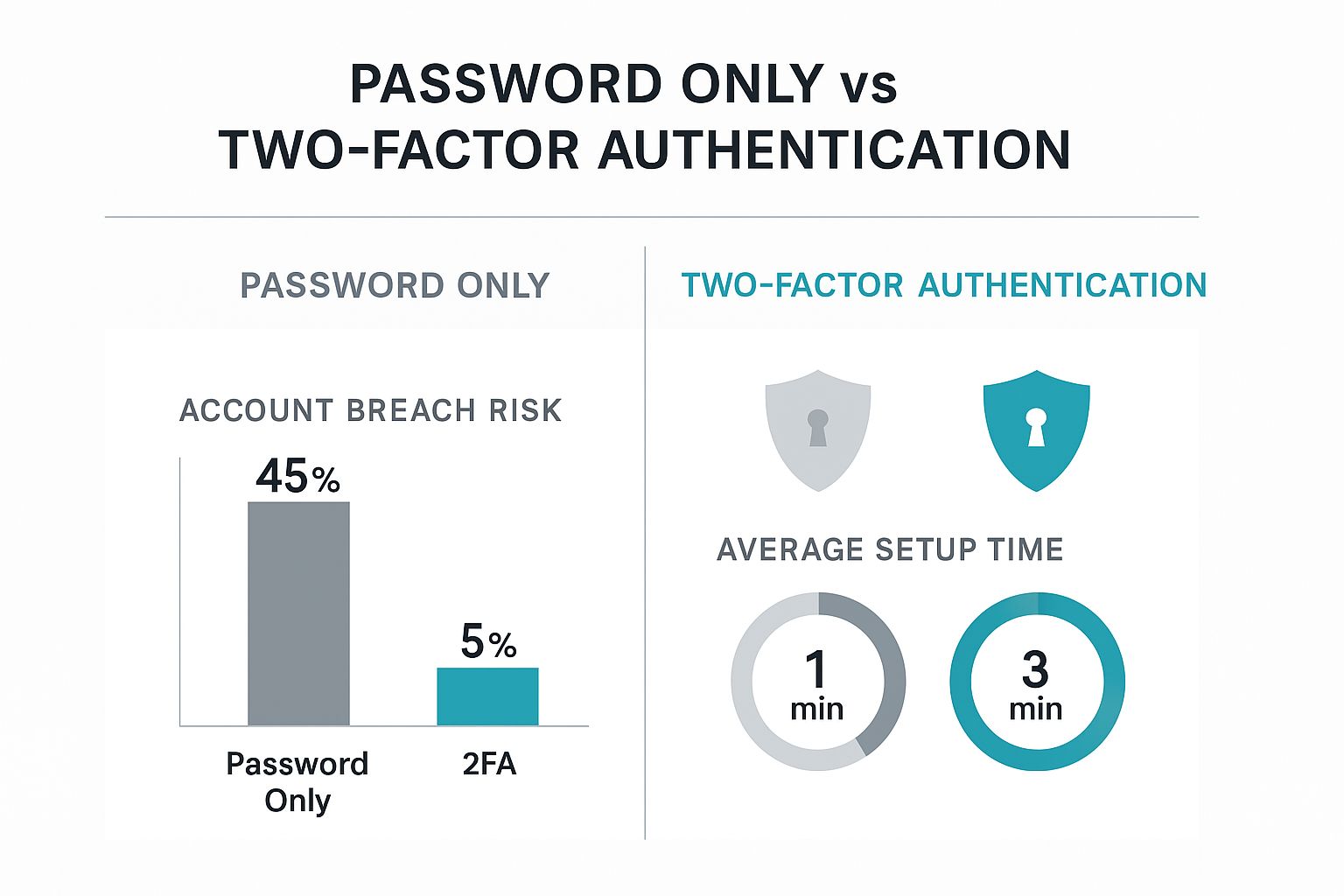
The image above illustrates a similar principle from digital security. Think of relying on luck as a simple password—it’s easily broken. A mobile safety step is like adding that second layer of Two-Factor Authentication (2FA). It’s a deliberate action that massively strengthens your protection.
Reinforcing the Need for a Mobile Safety Step
This new wave of AI enforcement sends a crystal-clear message: relying on luck to avoid a fine and points is no longer a strategy. The old excuses for having a “quick check” of your phone just don’t stand up against this kind of constant, automated vigilance.
This makes putting a personal mobile safety step in place more important than ever. It’s about taking control. By physically securing your phone out of sight and reach before you even start the engine, you create your own foolproof defence. It’s the one guaranteed way to ensure you won’t be caught by these new cameras, protecting your licence, your wallet, and everyone else on the road.
Practical Ways to Build a Distraction-Free Habit

We all know the dangers of distracted driving, but knowing isn’t always enough. The real challenge is beating the temptation to just have a quick look at your phone. This is where building a strong, almost automatic habit comes into play. A mobile safety step isn’t about relying on sheer willpower; it’s about creating a simple, repeatable routine that makes safe driving the easy, default option.
Think of it like a pilot running through their pre-flight checklist. It’s a non-negotiable sequence of small actions that guarantees safety before the journey even begins. By making these steps a fixed part of getting into your vehicle, you build a powerful mental barrier against distraction when you’re most likely to be rushed or preoccupied.
Your Pre-Drive Safety Checklist
For this to work, your mobile safety routine has to be practical and easy to follow every single time. The aim is simple: get everything sorted before you turn the key, so there’s absolutely no reason to touch your phone while you’re on the move.
Here’s a straightforward and effective routine you can adopt today:
- Set Your Destination First: If you use your phone for navigation, get the address keyed in and the route started while you’re still safely parked. It’s just as important to make sure the phone is in a secure cradle where it doesn’t block your view of the road.
- Activate ‘Do Not Disturb’ Mode: Most smartphones have a driving mode that silences notifications and can even send automatic replies to texts. Make a point of switching this on before you pull away. No pings, no temptation.
- Put It Out of Reach: This is the game-changer. The single most effective way to stop yourself from grabbing your phone is to physically remove it from your immediate area. Pop it in the glovebox, a bag on the back seat, or even in the boot. Out of sight, out of mind.
By making the deliberate choice to secure your phone before you drive, you’re taking active control of your environment. This turns a vague intention to be safe into a concrete, repeatable action.
Making the Habit Stick
At first, any new habit requires a bit of conscious effort. To help it become second nature, try linking your mobile safety step to something you already do without thinking, like putting on your seatbelt. Create a simple mental trigger: “Seatbelt on, phone away.” This little mantra reinforces the behaviour every single time you get in the car.
If you’re looking to implement these strategies in a business setting, it’s worth comparing different distracted driving solutions to see what fits your team’s needs. At the end of the day, the best system is simply the one you and your drivers will use consistently, without fail.
Why the Mobile Safety Step Is Your Best Protection
So far, we’ve looked at the hard facts surrounding distracted driving. We’ve seen the tough UK laws, the stiff penalties, and the truly sobering statistics. It all points to one undeniable truth: the mobile safety step isn’t just a helpful tip, it’s your most critical line of defence behind the wheel.
Think of this simple, conscious habit as your ultimate safeguard against a trio of devastating consequences—legal, financial, and personal. It protects you from hefty fines, six penalty points, and even losing your licence entirely. More than that, it’s the single most effective action you can take to ensure a brief distraction doesn’t turn into a lifetime of regret.
The risk of getting caught isn’t just a possibility anymore; it’s a probability. With new AI-powered enforcement cameras on the roads, the game has changed for good. Relying on sheer luck to avoid a ticket simply won’t work.
Your Final Check for Total Safety
Embracing the mobile safety step is all about taking back control. It’s a promise you make to yourself, to your passengers, and to everyone else on the road. It’s an acknowledgement that even though some hands-free tech is allowed, no phone call or text message is ever worth the gamble.
Of course, putting your phone away is the main focus here, but true safety comes from a wider perspective. Other tools can help in different situations. For instance, many drivers find that resources like Night Vision Glasses for Driving can make a real difference to their confidence and visibility on unlit roads.
Ultimately, the mobile safety step is about building a barrier between your focus and the digital world. It is the conscious decision to make driving your only priority from the moment you start the engine.
Before you set off on your next journey, make that commitment. Put your phone out of sight and out of mind. Clear your head and focus on the road. Your safety, and the safety of others, truly depends on it.
Frequently Asked Questions
Even when you know the rules, real-world driving situations can still be confusing. Let’s clear up some of the most common questions UK drivers have about using their phones behind the wheel. The goal here is to help you navigate the law with confidence and see why a consistent mobile safety step is so valuable.
Can I Use My Phone as a Sat Nav in a Cradle?
Yes, you can, but there are some very important strings attached. Your phone can be used for navigation, but only if it’s securely fixed in a cradle. Critically, this cradle must not block your view of the road or the traffic around you.
The most important rule? You absolutely must have your route programmed before you even start the engine.
Once you’re driving, any kind of physical interaction with the phone is off-limits. That means no tapping the screen to change the route, no zooming in on the map, and no swiping away notifications. This holds true even when you’re temporarily stopped in traffic. The law is crystal clear: once the journey starts, you cannot touch the device.
What if I Am Stopped in Traffic or at a Red Light?
This is a big one, and the answer is simple: it is still illegal to use a handheld mobile phone. Whether you’re in a queue of traffic or waiting for the lights to change, the law considers you to be ‘driving’ as long as you’re on a public road with the engine running.
You must be parked safely and legally, with the engine completely switched off, before you can lawfully pick up and use your phone. The new AI enforcement cameras are specifically designed to catch this offence, so the risk of getting caught has never been higher.
It’s a common misunderstanding, but the rule is absolute: engine on, phone down. That quick text or email check at a traffic light is all it takes to earn a hefty fine and points on your licence.
What Are the Penalties for a New Driver Caught Using a Phone?
For anyone who has passed their test within the last two years, the penalties are incredibly harsh. Getting caught using a handheld phone just once will land you with six penalty points.
A new driver’s licence is revoked as soon as they reach six points. This means a single mistake will cost you your licence entirely, forcing you to re-sit both the theory and practical driving tests all over again. It’s a stark reminder of why making the mobile safety step an unbreakable habit from day one is absolutely essential for every new driver.
At TEMA Solutions Limited, we believe safety and efficiency should walk hand in hand, both on the road and in the workshop. An organised, distraction-free environment is key to focused work, just like a clear pre-drive routine creates a safer journey. To see how we can help you build a safer, more productive workspace, explore our range of industrial storage and workbench solutions.


