


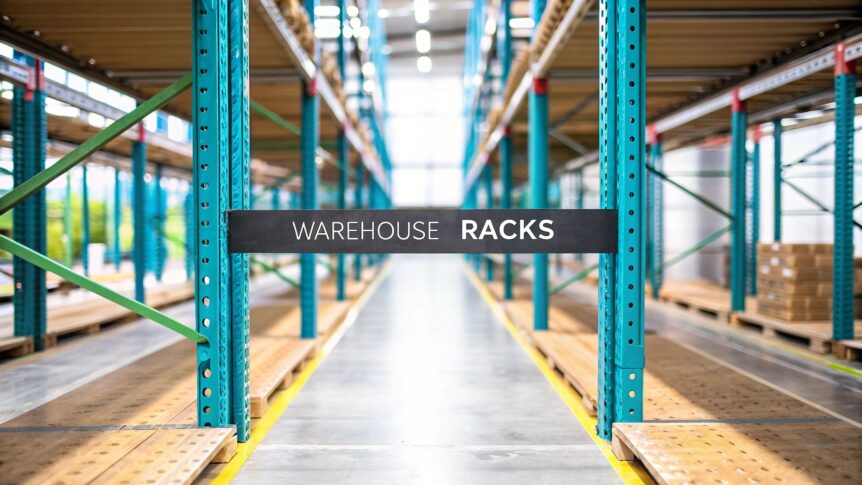
Finding the right warehouse racks for sale isn't just another purchase; it’s a decision that sits at the very heart of your warehouse's efficiency. Let's cut through the jargon and get straight to the point. Every warehouse manager is wrestling with the same core challenge: how do you pack more into your space without making it impossible to get to, all while keeping everyone safe? Get this right, and you can completely transform your workflow and protect your inventory.
Choosing Your Next Warehouse Racking System
Putting in a new racking system is a foundational move. It's not about just buying steel; it’s about engineering a solution that truly works for your specific products, your team's workflow, and your business's future. A well-chosen system can slash picking times, stop products from getting damaged, and magically find storage capacity you never knew you had.
On the flip side, the wrong choice is a recipe for disaster. It creates bottlenecks, introduces safety hazards, and bleeds money through hidden inefficiencies that will stunt your growth. Think of this guide as your practical roadmap, helping you move from the basics to making a smart, informed decision, with a focus on what really matters in the UK market.
The Core Challenge: Maximising Space and Access
Every warehouse lives in a constant tug-of-war between two opposing forces: storage density and accessibility. You can't really have the best of both.
- High-Density Systems: Think of systems like drive-in racking. They are fantastic for cramming in huge amounts of the same product. The trade-off? Getting to a specific pallet buried at the back means moving everything in front of it first. It's like a multi-storey car park where you have to move five cars to get yours out.
- High-Accessibility Systems: Selective racking is the classic example here. It’s set up like a library, where every single pallet has its own spot and can be accessed instantly. This convenience comes at a price, though—you need much wider aisles, which eats into your total storage space.
So, the first step is always to look at your inventory. Do you have a massive variety of different SKUs that need to be picked all the time? Or are you mostly storing pallets and pallets of the same few products? Your answer is the first big clue pointing you towards the right kind of racking.
It's a surprising fact, but studies show that order pickers can spend over 50% of their time just walking or driving around the warehouse. A smart racking layout that cuts down that travel time is one of the single biggest productivity boosts you can make.
Why a Strategic Approach Matters
If you stop thinking about "buying racks" and start thinking about "investing in a storage solution," you'll see things differently. This mindset forces you to look past the initial price tag and consider the total cost over the system's life. That includes installation, maintenance, and, crucially, how it affects your labour costs.
A system that costs 10% more upfront but makes your team 20% faster at picking orders will pay for itself in no time. Before you get lost in the details of specific types, it’s worth getting a bird's-eye view of what a modern storage racking system looks like. This big-picture understanding ensures the choice you make is one that will support your business and boost your bottom line for years to come.
Decoding the Types of Warehouse Racking
Choosing the right racking isn't just about finding something to hold your stock; it's about picking the perfect tool for your specific operation. You wouldn’t use a sledgehammer to tap in a nail, and you shouldn’t install a high-density system when you need immediate access to a wide range of different products. When you start looking at warehouse racks for sale, understanding how each system works in the real world is the first step toward making a smart investment.
Let's walk through the most common types of racking. Think of this as a guided tour of your potential storage solutions, where we'll look past the jargon and focus on what makes each one tick.
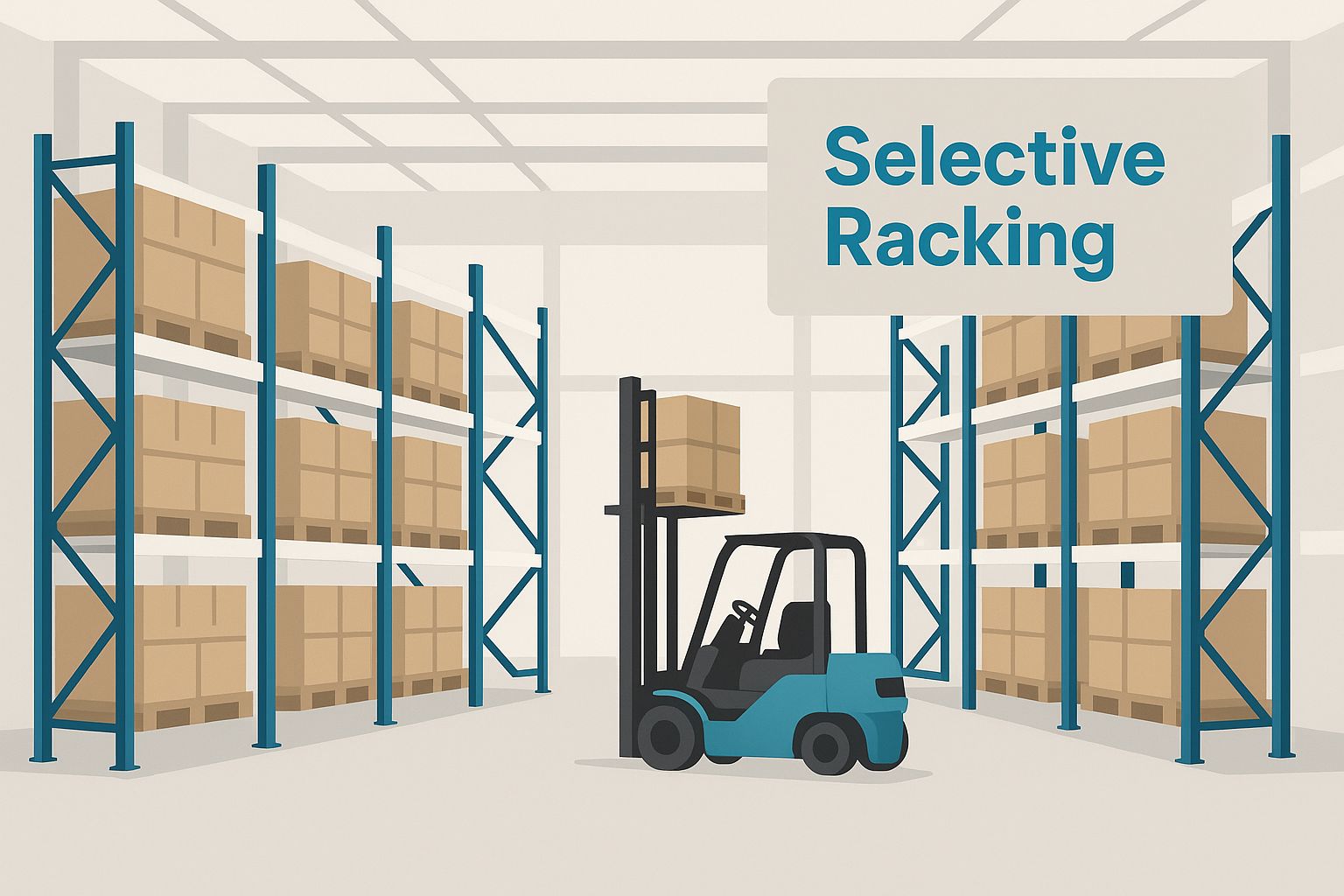
The image above shows a classic selective racking setup. Its main advantage is clear: a forklift can get to any pallet at any time, which is why it's such a common sight in warehouses everywhere.
Selective Pallet Racking: The All-Rounder
Selective racking is the most straightforward and popular system you'll find. The best way to picture it is as a giant set of industrial-strength library shelves. Every single pallet gets its own spot and can be picked up immediately without having to shuffle anything else around.
This direct access makes it a perfect fit for warehouses that handle a huge variety of different products (SKUs) but have relatively small quantities of each one.
- How It Works: It’s built from vertical upright frames and horizontal load beams, which create individual bays for each pallet. Forklifts simply drive down the aisles between the racks to access them.
- Best For: Fast-paced operations needing quick access to a wide product range. Think retail distribution centres, third-party logistics (3PL) providers, and general-purpose storage facilities.
- Key Consideration: The trade-off for all that accessibility is floor space. Because you need an aisle for every row of racking, it offers the lowest storage density.
Drive-In Racking: The Density Champion
If selective racking is a library, then drive-in racking is more like a multi-storey car park. Here, the forklift physically drives into the racking structure along a lane to place or retrieve a pallet. This brilliant design gets rid of most of the aisles, which dramatically increases how much you can store in the same footprint.
Of course, this density comes at a price: selectivity. Drive-in systems work on a Last-In, First-Out (LIFO) basis. The last pallet you load is the first one you can take out, making it a poor choice for perishable goods or any inventory with a use-by date.
In warehousing, the name of the game is using your vertical space to avoid the high cost of expanding outwards. This is particularly true in the UK, where e-commerce has put warehouse space at a premium. UK facilities rely on multi-level steel structures to handle heavy loads, making systems like selective, drive-in, and pallet flow racking essential for retail, manufacturing, and distribution.
Pallet Flow Racking: The FIFO Expert
When stock rotation is non-negotiable, pallet flow (or "live") racking is the answer. It’s engineered specifically for First-In, First-Out (FIFO) inventory management. Pallets sit on inclined rails fitted with rollers or wheels, causing them to slide forward automatically. You load from one end (the back) and retrieve from the other (the front).
This guarantees that the oldest stock is always used first, making it the go-to system for date-sensitive products like food, drinks, and pharmaceuticals.
Push Back Racking: A LIFO Compromise
Push back racking strikes a great balance between high density and decent selectivity. It’s a LIFO system, but with a twist. Pallets are placed on a series of nested carts that sit on inclined rails. When you load a new pallet, it pushes the cart behind it one position deeper into the rack.
This clever setup allows you to store multiple pallets deep (usually 2-6) while still being able to access a different SKU in each lane—a big advantage over the all-or-nothing lanes in a drive-in system. For a closer look at the mechanisms, exploring different options for metal racking storage can offer more insight.
Cantilever Racking: For Awkward Loads
So, what do you do with products that won't fit neatly on a standard pallet? That’s where cantilever racking comes in. It’s the perfect solution for storing long, bulky, or oddly shaped items like timber, steel pipes, PVC tubing, or even furniture.
It’s made of vertical columns with horizontal arms sticking out, creating a completely open-fronted shelf. With no front uprights getting in the way, it’s incredibly easy to load and unload oversized materials. It's a specialist system that solves a very common headache in the construction and manufacturing industries.
To help you visualise how these systems compare, here’s a quick overview of their core characteristics.
Warehouse Racking Systems At a Glance
| Racking Type | Storage Density | Inventory Access (Selectivity) | Stock Rotation | Best For |
|---|---|---|---|---|
| Selective | Low | High | FIFO / LIFO | Wide variety of products (high SKUs), fast turnover |
| Drive-In | Very High | Low | LIFO | Large volumes of identical products, cold storage |
| Pallet Flow | High | Medium | FIFO | Date-sensitive goods (food, pharma), high-volume items |
| Push Back | High | Medium | LIFO | Moderate SKU counts, bulk storage with some selectivity |
| Cantilever | Low | High | N/A | Long, bulky, or irregularly shaped items (timber, pipes) |
This table should give you a solid starting point for figuring out which racking philosophy best aligns with your inventory and operational flow.
Essential Specifications Before You Buy
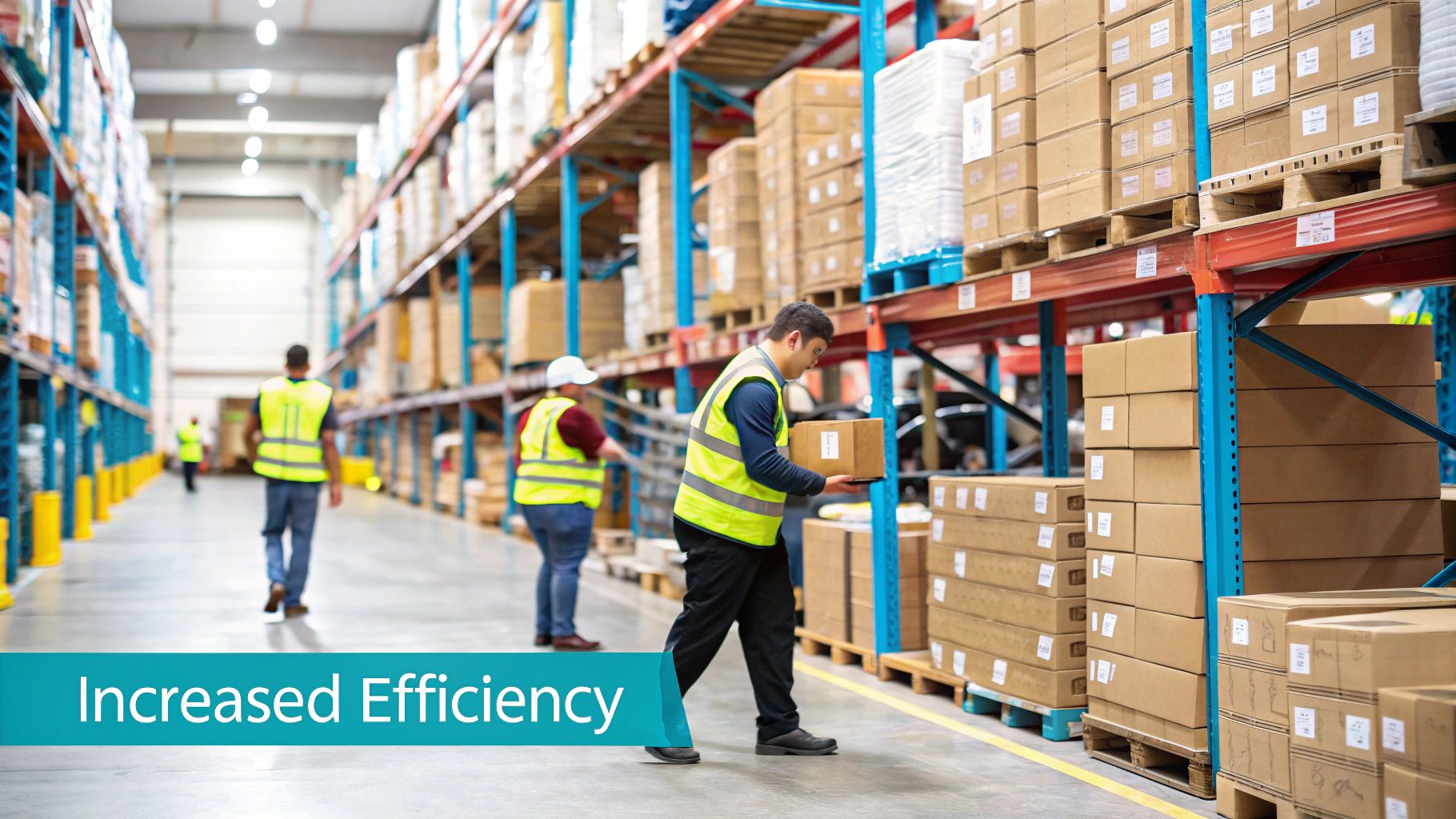
Once you've got a handle on the type of racking that fits your workflow, it's time to get into the nitty-gritty. Looking at warehouse racks for sale is about more than just a layout; it's about understanding the core specifications that define strength, safety, and how long the system will last. Getting these details right from the start is the difference between a reliable asset and a constant headache.
This is where you shift from the "what" to the "how." The goal here is to create a checklist of non-negotiable questions for any supplier. This ensures the system you invest in is not just efficient but also safe and compliant with crucial UK standards, like those from the Storage Equipment Manufacturers' Association (SEMA).
Calculating Your True Load Requirements
The first and most critical spec to nail down is load capacity. But it’s not as simple as knowing your average pallet weight. To guarantee a proper safety margin, you absolutely must calculate the maximum possible load a pair of beams will ever be asked to hold.
A classic mistake is forgetting about dynamic forces. When a forklift operator places a pallet onto a beam, the downward force is actually greater than the pallet's static weight. You have to account for this impact loading, along with the weight of the pallet itself and the potential for any accidental overloading.
To work out your required beam capacity, figure out the weight of your heaviest possible pallet and multiply it by the number of pallets you’ll store on each beam level. A good rule of thumb is to add a 10-15% safety margin on top of this figure to cover operational variables and prevent dangerous bending.
Let's walk through an example. Say you plan to store two pallets per beam level, and your heaviest pallet ever is 1,000 kg.
- Pallet Load: 2 pallets x 1,000 kg per pallet = 2,000 kg
- Safety Margin (at 15%): 2,000 kg x 0.15 = 300 kg
- Required Beam Capacity: 2,000 kg + 300 kg = 2,300 kg
With this number in hand, you can confidently tell a supplier exactly what you need. Remember, the upright frame capacity is a separate calculation based on the total load of all beam levels combined. A good supplier can help you determine this based on your vertical beam spacing.
Understanding Steel Types and Finishes
Not all steel is created equal, and your choice here directly impacts your racking's durability. When you're browsing warehouse racks for sale, you'll mainly run into two types of steel construction.
- Roll-Formed Steel: This is the industry standard for most pallet racking. It’s lighter, more cost-effective, and usually has a teardrop or clip-in connection system that makes it easier to install and adjust. It’s perfect for the vast majority of retail, e-commerce, and 3PL operations.
- Structural Steel: Think of this as the heavy-duty option. It’s a thicker, hot-rolled steel that is bolted together, offering far greater resistance to impact. This makes it ideal for tough environments like freezers, fast-paced distribution hubs, or anywhere with a high risk of forklift collisions. It costs more, but you're paying for maximum durability.
The finish applied to the steel is just as important, especially in the UK where dampness can be an issue over time. A powder-coated finish is standard for a reason. It creates a tough, plastic-like layer that’s much more resistant to chipping, scratching, and corrosion than regular paint. This protective skin is vital for maintaining the racking's structural integrity and stopping rust from weakening the steel.
Getting the Dimensions Right
Finally, you need to be precise with your measurements. We're talking about the width and depth of each bay, and the clear height between beam levels. These dimensions are dictated by your pallet sizes and the forklifts you use.
- Bay Width: Measure the width of your pallet, then add a minimum of 75mm of clearance on each side. This gives your forklift drivers enough wiggle room to place and retrieve pallets without clipping the uprights.
- Frame Depth: The depth of your upright frame should be about 150mm less than the depth of your pallet. This allows the pallet to sit securely on both the front and back beams with a slight overhang, which is standard practice.
- Beam Spacing: The vertical gap between beam levels needs to be big enough for your tallest pallet load, plus at least 100mm of lift-off clearance. This extra space is essential for the operator to lift the pallet cleanly off the beam before backing away.
Nailing these specifications from the outset ensures your system isn't just safe, but perfectly matched to your stock and your team's needs. It empowers you to compare quotes like-for-like and invest in a solution that’s built to perform for years to come.
A Realistic Look at Racking Costs
When you see a price tag on a set of warehouse racks for sale, it’s easy to think that's the final number. But in reality, that's just the beginning of the story. To get a true handle on the investment, you need to look at the total cost of ownership, which wraps in several other essential expenses that go far beyond the raw steel.
Thinking about the complete financial picture from the outset is what separates a smart investment from a costly mistake. It saves you from the classic trap of picking a system purely because it looks cheapest on paper. This foresight helps you accurately calculate your return on investment (ROI) and justify the spend with the real-world efficiency gains you’ll see down the line. It turns a simple purchase into a sound business decision.
Uncovering the Hidden Costs
The sticker price is just the starting point. A number of other significant costs pop up between getting the racking from the supplier and having it fully operational in your facility. If you haven't budgeted for them, they can derail your project fast.
Here are the 'hidden' costs you absolutely must plan for:
- Professional Installation: Trying to install racking yourself to save a few pounds might seem tempting, but it's a huge risk. Professionals know how to assemble the system safely, anchor it correctly, and ensure it meets all UK safety standards. Think of the installation cost as an investment in safety and peace of mind.
- Delivery and Freight: Pallet racking is big, heavy, and a real pain to move. Freight charges can be substantial, particularly for large orders or if your warehouse is in a remote location. Always get a specific shipping quote upfront so there are no surprises.
- Essential Safety Accessories: Things like column guards, end-of-aisle barriers, and safety netting aren't just nice-to-haves; they're vital. These pieces protect your racking from forklift bumps and your staff from falling stock. In many cases, they're required to be compliant with regulations.
- Floor Reinforcement: Your concrete floor has to withstand the immense pressure created by fully loaded racking uprights. You may need a structural engineer to assess the slab. In some cases, you might need to reinforce the floor or pour new footings, which can be a significant, unforeseen expense.
New vs Used Racking
The choice between new and used racking really boils down to cost versus certainty. Used racking can certainly save you money upfront, and for many standard setups, it's a perfectly good option. The catch? It comes with risks. You might not get proper load documentation, there could be unseen damage like metal fatigue, and it might not meet the latest safety standards. If you go down the used route, getting a thorough inspection by a qualified professional is non-negotiable.
New racking, on the other hand, comes with a manufacturer's warranty, guaranteed compliance with current safety specifications, and a complete, known history. That level of certainty is often worth the higher initial price, especially if your operation is complex or handles very heavy loads.
The growing need for smart storage solutions mirrors bigger shifts in the economy. The global warehouse racking market is tipped to grow from around $8.04 billion in 2025 to $11.13 billion by 2035. This surge, fuelled by e-commerce and manufacturing, highlights just how critical it is to invest in good, reliable racking to make the most of your space. You can dive deeper into these market trends and their impact on the UK logistics industry on futuremarketinsights.com. Understanding the bigger picture helps you make an investment that’s built for the future.
Mastering Racking Installation and Safety
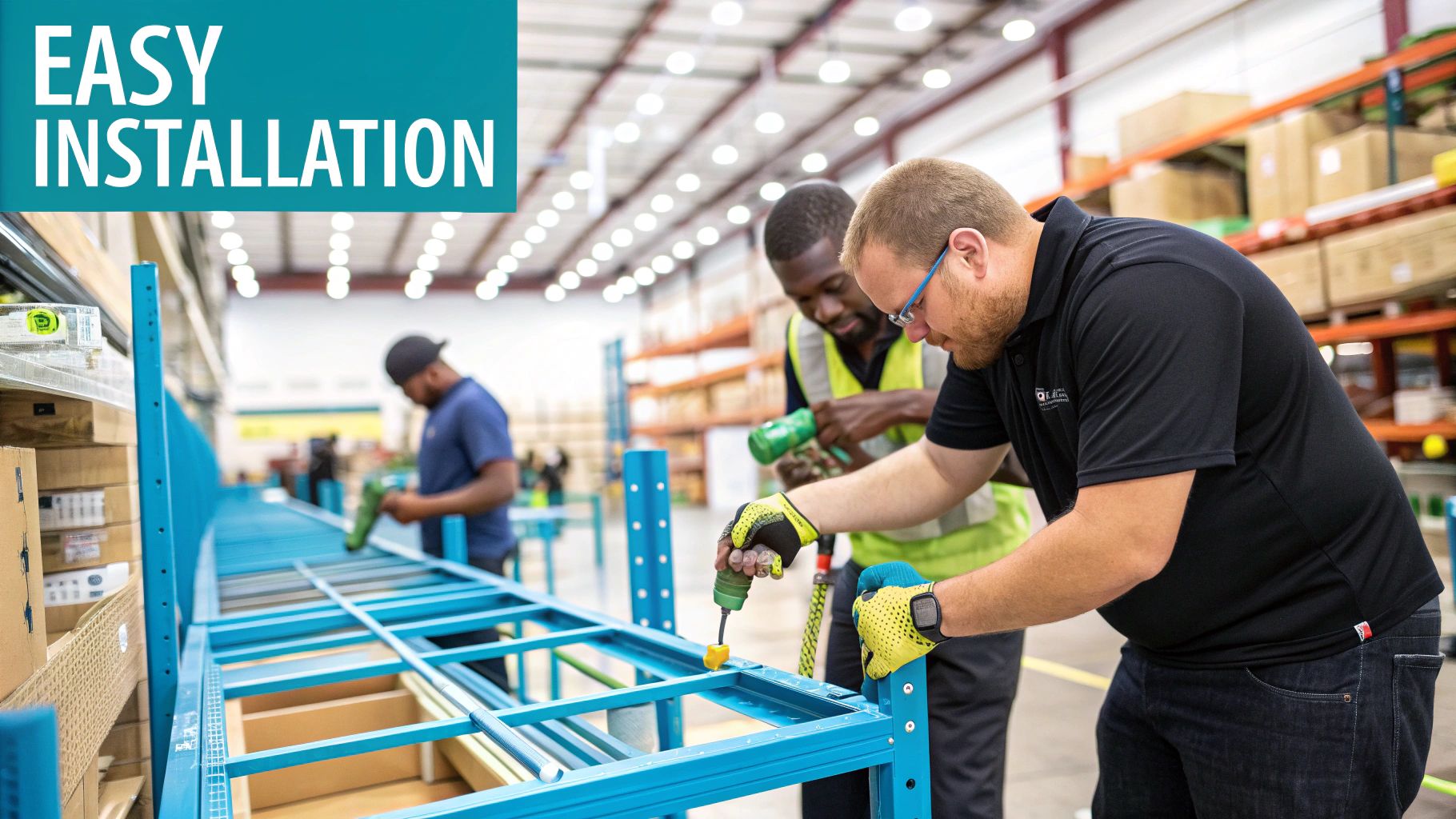
A top-quality racking system is only as strong as its assembly and upkeep. When you're looking at warehouse racks for sale, it’s tempting to try and save a few quid by installing it yourself, but that’s a huge mistake. A DIY approach invites serious trouble, from a catastrophic collapse to falling foul of UK safety laws. Professional installation isn't just a nice-to-have; it's essential for a safe, efficient, and legally compliant warehouse.
Think of the initial setup as the foundation for your entire warehouse's safety. When trained experts correctly assemble and anchor your racking, you can be confident it will handle the specified loads without buckling under pressure. Once it’s up, your focus needs to shift to keeping it safe for the long haul. This isn't a piece of kit you can just set up and forget about.
The Legal Duty of Regular Inspections
Staying vigilant is absolutely crucial. You have a legal responsibility to make sure your racking is safe to use, which means regular inspections are non-negotiable. These checks are all about spotting small problems before they become massive hazards.
A competent person needs to carry out these checks, keeping an eye out for obvious signs of damage or wear. Here’s what to look for:
- Damaged Uprights: Check for any dents, twists, or bends in the vertical frames. Pay close attention to the lower levels, as this is where forklift impacts happen most often.
- Deflected Beams: Look for any obvious sagging or bowing in the horizontal beams. A sagging beam is a sure sign it's been overloaded and its strength is compromised.
- Missing or Damaged Components: Make sure all safety clips, bolts, and floor anchors are in place and properly secured.
Beyond the structure itself, keeping the whole environment in good nick contributes to safety and the longevity of your racking. For example, using professional warehouse cleaning services can help keep your facility safe and extend your equipment's life. A clean, organised space means fewer trip hazards and makes it easier to spot potential rack damage.
Creating a Culture of Safety
A safe racking system isn't just about the steel; it's about your people and your procedures. The way you run your day-to-day operations plays a massive part in preventing accidents and getting the most out of your investment.
Crucial Insight: It is a legal requirement in the UK to display clear Safe Working Load (SWL) notices on your racking. These signs must show the maximum load for each beam and for the entire bay, serving as a constant safety reminder for staff.
Proper forklift operator training is another pillar of warehouse safety. Drivers who have been well-trained understand how to handle heavy loads at height, the need for careful manoeuvring, and how to avoid the kind of impacts that can weaken your racking. Investing in your team’s skills is a direct investment in protecting your people, your stock, and your racking.
For businesses handling particularly heavy goods, getting to grips with the specifics of different heavy duty racks for storage is vital to match the right gear to the job. When you combine professional installation, regular inspections, and a well-trained team, you build a warehouse that is genuinely safe and compliant.
What's Next? A Glimpse into the Future of Warehouse Storage
If you think the future is just about finding better warehouse racks for sale, it might be time to think again. The real shift is happening where storage and technology collide. For UK businesses that want to keep their edge, it’s no longer about simply holding stock; it's about building intelligent systems that actively drive the workflow forward.
The biggest leap we’re seeing is automation being built directly into the racking itself. Forget traditional layouts of aisles and shelves. The future is a single, cohesive, automated machine where the racking is a core component.
The Rise of Intelligent Racking
This next wave of storage is dominated by a single concept: Automated Storage and Retrieval Systems (ASRS). Picture a vast, incredibly dense block of racking where robotic shuttles and cranes glide silently within the structure, fetching and stowing goods with pinpoint accuracy. This isn't some far-off concept; it's already running in the most advanced distribution centres today.
With an ASRS, your racking stops being a passive bystander and becomes an active player in your daily operations.
- The Goods-to-Person Model: Instead of people walking miles up and down aisles, the system brings the exact tote or pallet they need directly to them at a fixed workstation. This simple change eliminates travel time, which can easily eat up over 50% of a picker's entire shift.
- Ultimate Storage Density: ASRS systems don't need wide aisles for forklifts or even people. This allows you to pack goods in with unbelievable density, squeezing every last drop of value from your building's footprint.
- Near-Perfect Accuracy: When robots are doing the work, human error all but disappears. This means inventory counts are spot on, and picking mistakes become a thing of the past.
We're witnessing a fundamental change in thinking. Racking is evolving from a set of passive shelves into a dynamic, robotic system. It’s a move from static storage to an automated logistics solution, where the structure and the machine are one and the same.
Learning from Niche Industries
You can also see hints of this evolution in highly specialised sectors, like data centres. The way they handle storage gives us a clear window into where racking design is headed. These facilities need racks that can not only bear the immense weight of modern servers but also integrate sophisticated cooling systems to manage the heat they generate. The engineering challenges here are pushing the boundaries of what's possible.
Consider this: the UK data centre rack market is valued at around $118.75 million in 2025 and is expected to more than double by 2030. This isn't just growth; it's a response to the demand for bigger, stronger racks that can support powerful AI servers and cooling hardware managing over 70 kW of power. You can read more about these advanced data centre rack trends in the UK on mordorintelligence.com.
It’s only a matter of time before these innovations in load capacity and integrated technology find their way into mainstream warehouse racking.
Your Warehouse Racking Questions Answered
Even when you think you’re ready to buy, a few final questions can pop up. It’s completely normal. This section is here to give you straightforward, practical answers to those common queries that often stand between you and a confident decision.
Think of it as the final check before you commit. We're going to tackle the real-world dilemmas that warehouse managers face, making sure you have all the information you need.
Should I Buy New or Used Warehouse Racking?
This is a classic question, and honestly, it boils down to balancing immediate cost against long-term peace of mind. Buying new gives you complete certainty. It comes straight from the factory with a full manufacturer's warranty, it’s guaranteed to meet the latest UK safety standards, and you get clear documentation on its load capacity. You know its entire history because its history starts with you.
Used racking, on the other hand, can be much easier on the wallet, which is a big draw for businesses working with a tight budget. But it doesn't come without risks. You could be dealing with hidden damage like metal fatigue from years of use, missing load notices, or a system that no longer complies with current regulations.
If you do go down the used route, getting a thorough inspection from a SEMA Approved Rack Inspector (SARI) isn't just a good idea—it's absolutely essential. Without that expert sign-off, you're taking a significant gamble with both safety and your legal compliance.
What Is a Rack Protection Survey and Do I Need One?
A Rack Protection Survey is essentially a professional risk assessment for your racking. A qualified inspector will walk through your warehouse, watch how your operation flows, and pinpoint the high-risk spots where your racking is most likely to get hit by a forklift. Based on their findings, they'll recommend specific protective gear.
For any new installation, you should seriously consider getting one. The survey gives you a clear, actionable plan for installing things like:
- Column Guards: These are tough shields that wrap around the base of your upright posts to take the brunt of a collision.
- End-of-Aisle Barriers: Sturdy steel barriers placed at the ends of your racking rows, which are the most vulnerable points.
- Safety Netting: This is fitted to the back of racks to stop boxes or loose items from accidentally falling into walkways or work areas.
Getting this survey done from the outset helps protect your investment and, more importantly, keeps your team safer.
How Do I Know What Load Capacity I Need?
Figuring out the right load capacity is one of the most critical steps, and it’s something you have to get right to prevent a dangerous collapse. The calculation itself is simple, but you must be precise. First, work out the absolute maximum weight of a single, fully-loaded pallet you intend to store. Don't use an average; you need the heaviest possible weight.
Once you have that number, multiply it by how many pallets will sit on a single beam level. For example, if your heaviest pallet is 1,000 kg and you plan to store two side-by-side, you need a minimum beam capacity of 2,000 kg. Always give this figure to your supplier. They will then engineer a system with the correct safety margins, ensuring the beams and frames can handle that specified load without any issues.
Ready to find a storage solution built for performance and durability? The team at TEMA Solutions Limited specialises in providing high-quality industrial storage systems designed to maximise your operational efficiency.
Explore our industry-trusted solutions today at https://tema-solutions.co.uk.


