


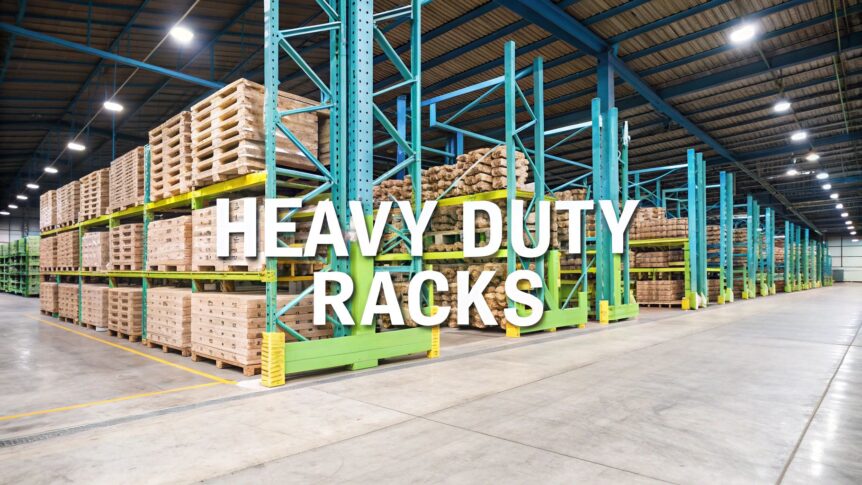
Heavy duty racks for storage are so much more than simple metal shelving. They’re actually sophisticated, engineered systems built to do three things exceptionally well: maximise your space, smooth out your operations, and keep your people safe.
Think of them as the very skeleton of your warehouse. They provide the crucial structural support that holds your entire inventory management process together.
Why Heavy Duty Racks Are Essential for Modern Warehouses
Could you build a skyscraper without its steel frame? Of course not. It wouldn’t get very far off the ground. In much the same way, a modern warehouse or industrial facility simply can’t function efficiently—or safely—without a solid racking system. These structures are the backbone of logistics, turning empty, unused vertical space into a highly organised and accessible storage goldmine.
When you install the right system, the impact on your business’s operational flow can be dramatic. You’ll see faster picking times, much clearer inventory organisation, and a serious drop in workplace accidents. A thoughtfully designed layout creates a clear path for both goods and people to move, which is a fundamental part of optimizing warehouse operations.
Boosting Efficiency and Safety
At its core, the main job of heavy duty racks for storage is to hold immense weight without breaking a sweat. This is what prevents catastrophic failures that could destroy inventory, damage expensive equipment, and, most importantly, cause serious injuries. A properly installed system creates a predictable and secure environment where every single item has its own designated, stable home.
A well-structured racking system isn’t just a business cost—it’s a direct investment in productivity and safety. It supports every single movement inside your facility, from goods-in to final dispatch, making sure each step is as efficient as it can possibly be.
Below is a quick look at the main advantages you can expect.
Key Benefits of Heavy Duty Racking at a Glance
| Benefit | Impact on Your Operations |
|---|---|
| Maximised Space | Go vertical to store more goods in your existing footprint, putting off costly expansions. |
| Better Inventory Control | An organised system makes stock-takes faster and far more accurate, leading to fewer errors. |
| Safer Environment | Sturdy, well-maintained racks create a visible commitment to safety for your team. |
| Increased Productivity | Faster access to goods means quicker picking, packing, and shipping cycles for customers. |
This powerful combination of benefits is why the sector is growing so rapidly. The global market for heavy duty storage racks was valued at an impressive USD 5.95 billion in 2024 and is expected to climb to USD 10.73 billion by 2033. This trend is certainly reflected right here in the UK’s own warehousing industry, showing just how indispensable these systems have become. You can read more about these market projections and their impact.
Finding the Right Type of Heavy Duty Rack for Your Inventory
Picking the right heavy-duty rack isn’t just about finding the strongest one. It’s about making a smart match between the system and the reality of your inventory. You wouldn’t use a Ferrari to haul bricks, and the same logic applies here; there’s no single racking type that works for every product. Each system is engineered to solve a specific storage puzzle, striking a careful balance between density, accessibility, and product flow.
The first step is to get clear on how you actually need to access your goods. Do you need to grab any pallet, at any time, without a fuss? Or are you storing huge volumes of the exact same item? Your answer is the compass that will point you directly to the ideal solution.
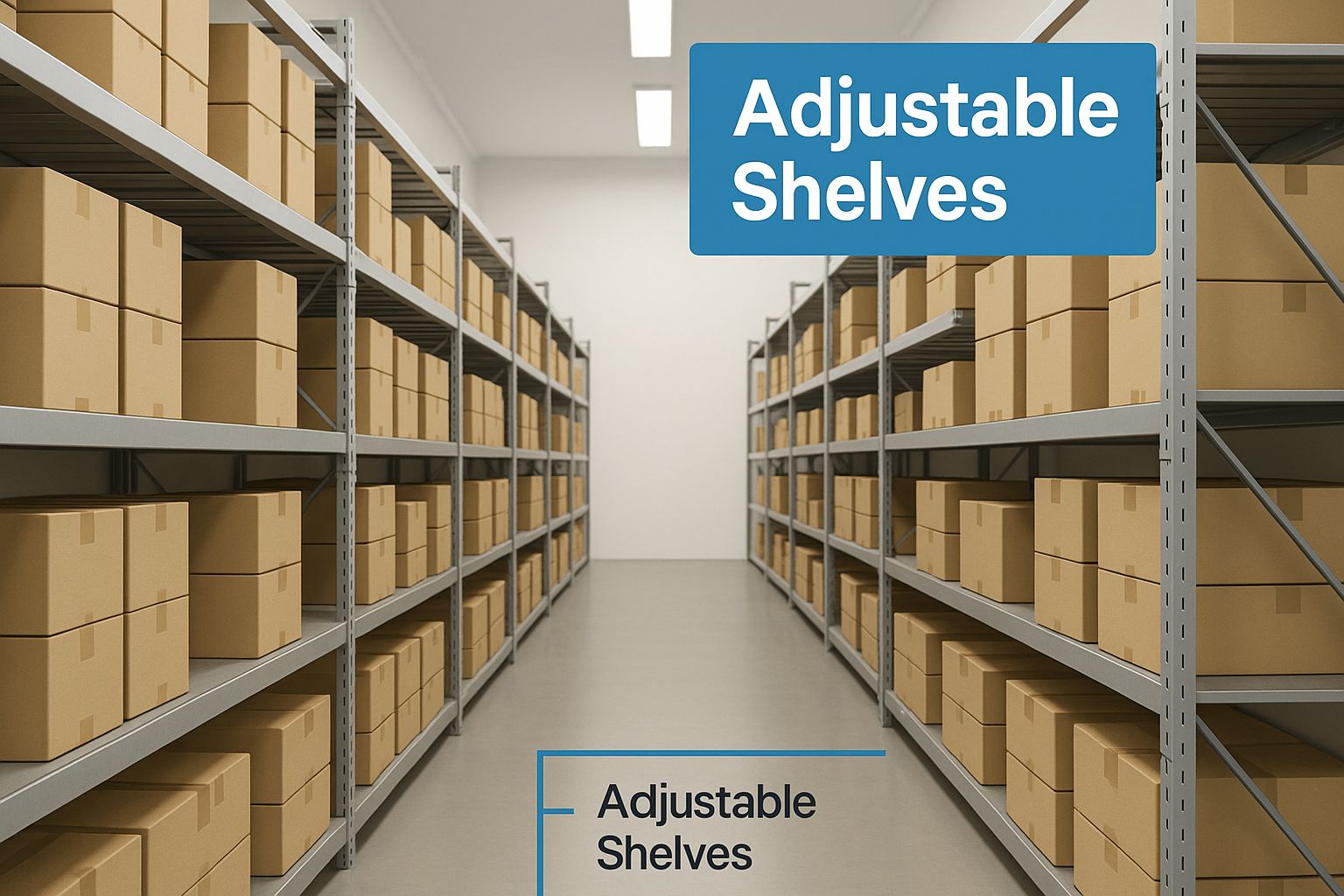
As you can see, adjustable shelves are a core feature of many heavy-duty systems. This flexibility is built right in, ensuring your storage can adapt as your product lines evolve over time.
The All-Rounder: Selective Pallet Racking
Think of Selective Pallet Racking as the reliable workhorse of the warehouse world. It’s easily the most common type of heavy duty racks for storage, and for one very good reason: it offers 100% selectivity. In simple terms, this means you can access any pallet you want, whenever you want, without having to shift other stock out of the way.
The design is brilliantly straightforward—upright frames and horizontal beams create simple, individual bays. This setup is perfect for operations that handle a high number of different products (or SKUs) but have lower volumes of each one.
- Pros: Unbeatable access to every single pallet, cost-effective to install, and incredibly versatile for businesses with changing inventory.
- Cons: It’s the least dense option. You sacrifice a lot of floor space to aisles, more so than with any other system.
Because of this, it’s the go-to choice for retail distribution centres, general warehousing, and any business where getting to varied goods quickly is the top priority.
High-Density Solutions: Drive-In and Push-Back Racking
When your main goal is to cram as much product as possible into a finite space, you need a high-density system. Drive-In Racking, for instance, works a bit like a multi-storey car park for your pallets. A forklift literally drives into the deep racking structure to place or retrieve pallets, which sit on guide rails. This is a brilliant solution for storing large quantities of identical, non-perishable goods where the “first in, last out” principle works.
By putting storage capacity ahead of individual pallet access, drive-in systems can boost your storage density by up to 75% compared to standard selective racking.
If that feels a bit too restrictive, Push-Back Racking offers a clever compromise. Here, pallets are loaded onto a series of nested carts that sit on gently inclined rails. When you load a new pallet, it simply pushes the pallet behind it back one spot. This gives you much higher density than selective racking but far better selectivity than a drive-in system, as each lane can hold a different SKU.
Specialised Systems: Cantilever Racking
But what about all the stuff that just won’t fit neatly on a standard pallet? For those long, bulky, or awkwardly shaped items—think timber, PVC pipes, steel bars, or even furniture—Cantilever Racking is really the only practical choice.
Instead of having restrictive vertical uprights at the front, it uses a strong central column with arms extending outwards to cradle the load. This open-faced design provides completely clear, unobstructed access for handling cumbersome goods. Exploring various warehouse storage solutions is key to understanding how these specialised systems can integrate into a wider, more effective operational strategy.
How to Select the Perfect Racking System for Your Business
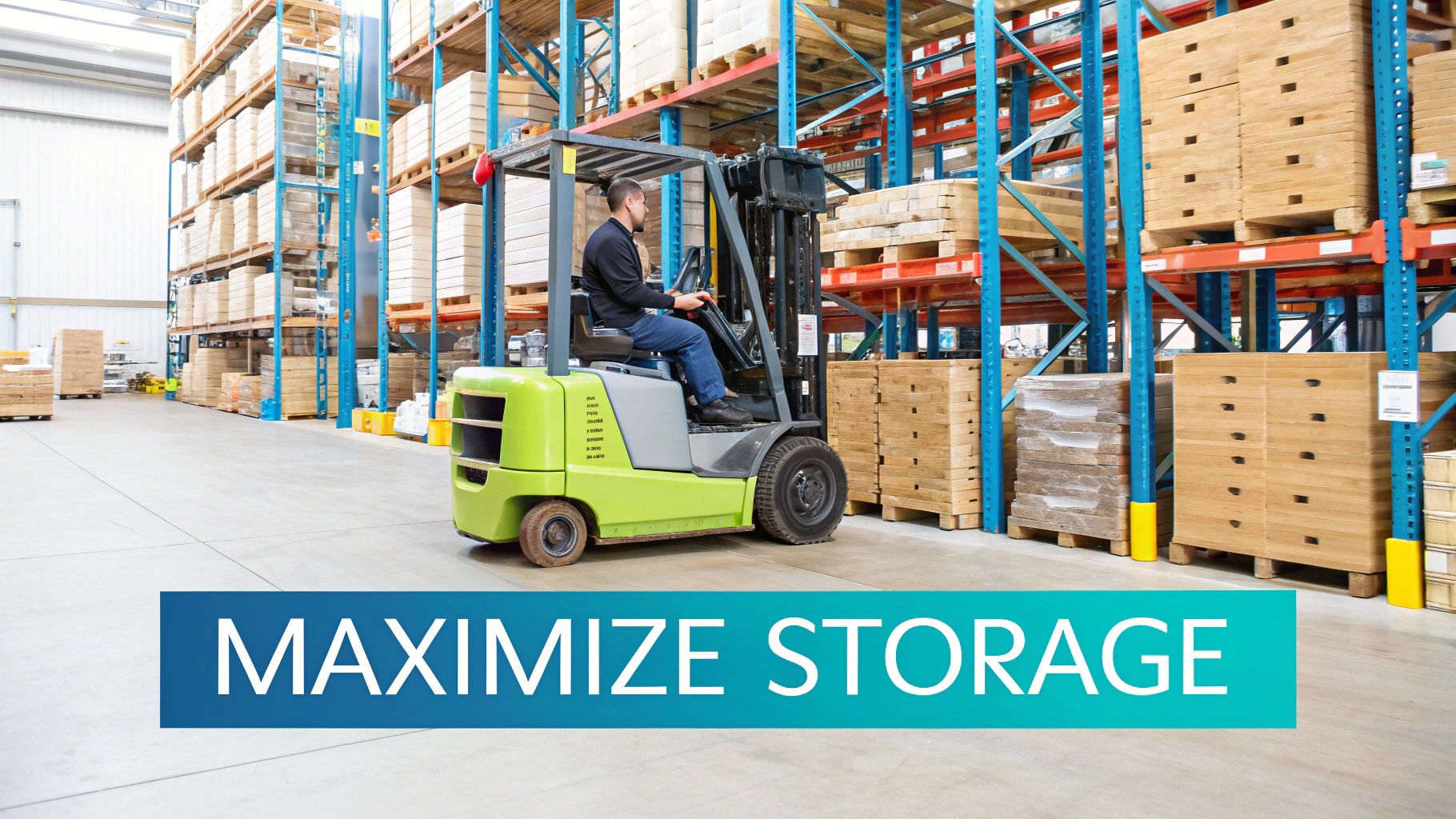
Choosing the right heavy duty racks for storage is one of those critical decisions that can quietly make or break your warehouse’s efficiency. It’s not just about buying strong shelves; it’s about investing in a system that fits your operation like a glove. The right choice will streamline your workflow, while the wrong one can create daily headaches and bottlenecks.
Before you start flipping through catalogues or talking to suppliers, the most important work happens right inside your own four walls. It all begins with a brutally honest look at what you actually need. This initial groundwork is what separates a smart, long-term investment from a costly mistake.
Defining Your Storage Requirements
First things first: what are you storing? You need to know the average and, crucially, the maximum weight of your pallets or individual items. This figure is the foundation for determining the required load capacity of the racking beams and uprights—a non-negotiable factor for safety and performance.
Next, it’s time to measure up. Get the precise dimensions of your warehouse, looking at both the available floor space and the clear vertical height you can work with. One of the biggest wins with professional racking is maximising your ‘cube’—the total usable volume from floor to ceiling.
A classic mistake I see all the time is forgetting about the equipment. Your racking system has to play nicely with your forklifts. You must account for their turning circles and the minimum aisle width they need to operate safely and efficiently.
Finally, consider how your inventory moves. Are you dealing with perishable goods that demand a First-In, First-Out (FIFO) system? Or can you work with a Last-In, First-Out (LIFO) approach for items that don’t expire? The answer to this one question can instantly point you towards certain types of racking and away from others.
Comparing Racking Systems for Different Needs
To make things clearer, let’s compare some common racking types. This table breaks down which system works best for different inventory and access needs, helping you see at a glance which direction to go in.
| Racking Type | Best For (Inventory Type) | Density | Selectivity (Accessibility) |
|---|---|---|---|
| Selective Racking | Varied, fast-moving stock; FIFO | Low | High |
| Drive-In Racking | Uniform, bulk products; LIFO | High | Low |
| Pallet Flow Racking | High-volume, perishable goods; FIFO | High | Medium |
| Push-Back Racking | Multiple SKUs, moderate turnover; LIFO | Medium-High | Medium |
This table is a great starting point, but remember that a racking specialist can help you explore hybrid solutions or more specialised systems if your needs are unique.
A Practical Checklist for Selection
To arm yourself for conversations with suppliers, run through this checklist. Having these answers ready will ensure you’re asking the right questions and getting a quote for a system that truly serves your business.
- Product Profile: What are the dimensions, weight, and fragility of your goods?
- Warehouse Footprint: What is your total floor space and, just as importantly, your clear ceiling height?
- Inventory Management: Do you absolutely need FIFO, or is LIFO acceptable?
- Handling Equipment: What type of forklifts or other machinery do your teams use?
- Future-Proofing: Where do you see your storage needs in the next 3 to 5 years?
That last point is key. Don’t just plan for today. A system that feels spacious now could be cramped in a few years. Factoring in future growth means you won’t have to rip everything out and start over when you expand.
This is a significant capital investment, so exploring your financing options is also a smart move. Securing competitive Equipment Loan Rates can make a big difference to your budget. While the upfront cost is substantial, a well-chosen racking system pays for itself many times over through better productivity and safer, more organised operations.
Understanding Key Materials and Components
The real strength and lifespan of a heavy-duty storage rack boil down to what it’s made of. Getting to grips with the core materials and components is a bit like learning the fundamentals of engineering—it helps you read a supplier’s quote with confidence and truly understand the quality you’re paying for. These choices directly impact everything from load capacity to how well the system stands up to daily abuse.
Steel is the heart of almost every racking system, but it’s not all the same. It typically comes in two main forms.
First, you have roll-formed steel, which is by far the most common. It’s made by bending flat sheets of steel into the required shapes. This process makes it relatively lightweight, versatile, and more affordable. For most general warehousing needs where you need flexibility without breaking the bank, this is the go-to option.
On the other end of the spectrum is structural steel. This is hot-rolled into its final shape, creating much thicker, heavier, and more robust components. Think of it as the system’s bodyguard, built for the most demanding environments where heavy-duty forklift traffic is constant. While it costs more, the superior impact resistance can be a lifesaver in operations prone to accidental bumps and collisions.
The Building Blocks of a Racking System
Every racking bay, no matter how complex, is assembled from a few essential parts. These are the non-negotiable elements that work in harmony to create a safe, stable structure.
- Uprights (or Frames): These are the vertical pillars that form the rack’s backbone. Their height, depth, and the thickness of the steel dictate the entire bay’s stability and how much weight it can ultimately support.
- Beams: These are the horizontal bars that connect the uprights. They create the shelf levels where you place your pallets or goods. The length and profile of a beam determine the safe working load for that specific level.
The connection point between the beam and the upright is a critical safety feature. Most modern systems use a teardrop design with safety clips that lock the beam in place, preventing accidental dislodgement from a forklift impact.
Decking and Finishes That Matter
Once you have the basic frame, you need a surface to place your inventory on. A very popular and practical choice is wire mesh decking. It’s great for safety, as it stops loose items from falling through the rack and also allows light and sprinkler water to penetrate, which is a big plus for fire safety regulations.
If you’d like a deeper dive into its uses, have a look at our guide to wire racks and shelving. For smaller, non-palletised items, solid steel or timber decking can provide a continuous flat surface.
Finally, the finish on the steel is what protects your investment from the elements. A powder-coated finish is the industry standard for a good reason. It provides a tough, durable layer that resists corrosion and chipping far better than a simple coat of paint. As you weigh your options, understanding the underlying construction material costs will help you budget effectively. This way, you’re not just buying a rack; you’re investing in a durable, long-term asset for your business.
How Racking Systems Evolve for High-Tech Demands
When you think of heavy duty racks for storage, images of warehouses stacked high with pallets probably come to mind. But the core ideas—strength, stability, and smart use of space—have found a surprising new home: the digital world. The very principles that keep a warehouse organised are now propping up the data centres that run our connected economy.
Instead of holding boxes of goods, these racks are now responsible for safeguarding mission-critical servers, intricate networking gear, and the cooling systems that keep it all from overheating.
In this high-tech setting, the rack isn’t just a rack anymore. It’s a highly specialised piece of engineering. Forget about storing different pallet sizes; here, everything is built around a global standard: the 19-inch rack format. This simple but brilliant standardisation means equipment from virtually any manufacturer will fit perfectly, creating a universally organised and efficient ecosystem.
Think of a data centre rack as a vertical filing cabinet for technology. Every piece of equipment has its own designated slot, measured in “U” units (where 1U equals 1.75 inches), which allows for meticulous planning and getting the most out of every square foot.
This standardised approach is the very bedrock of modern data centre design, ensuring not an inch of valuable space goes to waste.
The Drive for Vertical Density
As our hunger for computing power grows, so does the pressure to cram more and more equipment into each cabinet. This has sparked a real focus on vertical density, pushing rack heights to new levels. Standard sizes like 42U and 48U have become the workhorses of the industry, letting facility managers stack servers higher without expanding their building’s footprint.
The United Kingdom’s booming tech sector is a perfect case study. The UK’s data centre rack market is set to be worth a staggering USD 230.9 million by 2030. While the 42U format still dominates with a 56.6% market share, the taller 48U racks are catching up fast, growing at an impressive 15.3% annually. This surge is fuelled by the immense power demands of new AI clusters, which need all the vertical real estate they can get. You can discover more about these data centre market insights to see the trends for yourself.
It’s a fantastic example of how fundamental storage concepts are being reimagined to solve highly technical, modern problems.
Key Features of Data Centre Racks
Naturally, these aren’t your average warehouse racks. They come packed with features designed specifically for the sensitive environment of a data centre:
- Integrated Cable Management: Forget a spaghetti junction of wires. These racks have built-in channels, rings, and trays to neatly route hundreds of power and data cables. This keeps things tidy and, more importantly, prevents tangled cables from blocking airflow and causing components to overheat.
- Enhanced Cooling Support: Heat is the enemy in a data centre. Many racks are designed with perforated doors and panels to maximise airflow, a crucial feature for preventing equipment failure.
- Security Features: With valuable hardware and sensitive data at stake, security is paramount. Lockable doors and side panels come as standard, providing a necessary layer of physical protection.
From warehouse workhorses to the silent sentinels of the digital age, heavy duty racks have shown a remarkable ability to adapt, proving their value far beyond the world of traditional logistics.
Maintaining Safety and UK Compliance Standards
When your business depends on storing thousands of pounds of inventory high above the ground, safety isn’t just a good idea—it’s everything. A top-quality set of heavy duty racks for storage is only ever as safe as the culture you build around it. Simply installing your racking and walking away is a recipe for disaster, leading to damaged stock, accidents, and serious legal trouble.
Think of your racking system less like static furniture and more like a critical piece of machinery. It needs regular care and attention to do its job safely day in, and day out. While professional installation is the first step, the real responsibility begins the moment you start loading those shelves. In the UK, this duty of care is clearly laid out in both legal requirements and industry standards.
The biggest threat to your racking isn’t usually a single, catastrophic overload. It’s the slow, creeping damage from repeated forklift impacts. A seemingly minor knock to an upright frame can, over time, dangerously weaken the whole bay and create a silent risk.
Adhering to SEMA Guidelines and Legal Duties
Here in the UK, the Storage Equipment Manufacturers’ Association (SEMA) sets the benchmark for rack safety and inspection. Although SEMA’s guidelines aren’t law in themselves, they are widely recognised as the best practice for fulfilling your legal duties under the Health and Safety at Work Act 1974. Following them is the most straightforward way to show you’re taking your responsibilities seriously.
This means putting a layered inspection process in place:
- Immediate Reporting: Everyone on your team should be trained to report any collision or damage to the racking system the moment it happens.
- Regular Visual Checks: A competent person from your staff should be doing weekly visual inspections, looking for obvious problems like bent beams, damaged uprights, or missing safety clips.
- Expert Annual Inspection: You are required to have a formal inspection at least once every 12 months. This must be done by a technically competent expert, such as a SEMA Approved Rack Inspector (SARI).
These inspections are far more than a box-ticking exercise; they are a vital health check for one of your warehouse’s most valuable assets. If you’d like to dive deeper into these safety protocols, our complete warehouse storage solutions guide offers even more practical information.
A cornerstone of this compliance is the use of clear load notices. These signs must be prominently displayed on every racking run, clearly stating the maximum safe working load for each beam and the entire bay. They are the single most important instruction for your team on how to use the system safely. Operating without them is a major safety breach.
Right, so we’ve covered the different types of heavy duty racking and how to pick the right system for your needs. Still, a few practical questions almost always pop up. Let’s tackle some of the most common ones I hear from businesses just like yours.
How Often Should I Be Inspecting My Racking?
Think of it as having two layers of checks. First, your own team should be doing quick, weekly visual inspections. This is about spotting the obvious stuff – a dented upright, a beam that looks slightly out of place, or anything that just doesn’t look right.
Then, you have the formal inspection. UK regulations are clear on this: you need a thorough inspection by a technically competent expert, like a SEMA Approved Racking Inspector, at least once every 12 months. This is a non-negotiable part of keeping your team safe and your operations compliant.
What’s the Most Common Reason Racking Fails?
It’s usually not what people expect. Overloading is a risk, of course, but the biggest culprit is the slow, steady accumulation of minor damage. I’m talking about the constant, low-level bumps and scrapes from forklifts and other handling equipment.
A single knock might seem trivial, but over months and years, that repeated damage weakens the steel and can seriously compromise the entire structure’s integrity. It’s death by a thousand cuts, which is exactly why things like upright protectors are such a smart, cost-effective investment.
The strength of your racking system is only as good as its weakest point. Consistent, minor damage from daily operations poses a greater long-term risk than a single, major event, making vigilance and protection essential.
Can I Just Modify or Repair My Own Racking?
In a word: no. Please don’t ever try to weld, cut, or modify racking components yourself. It might seem like a quick fix, but it’s incredibly dangerous.
Any repairs must be handled by qualified professionals who use the correct, manufacturer-approved parts. A DIY job will almost certainly void your warranty, put you on the wrong side of safety regulations, and, worst of all, create a hidden hazard that could have catastrophic consequences for your staff.
Just How Important Are Racking Systems to the UK Economy?
They’re more crucial than you might think, particularly for the backbone of our digital world. The UK’s data centre storage market, which is entirely reliant on highly specialised heavy duty racks, is a perfect example. It’s forecast to rocket from USD 4,396.91 million in 2023 to a staggering USD 8,679.67 million by 2032.
You can discover more insights about the UK data centre market on credenceresearch.com. This incredible growth really highlights how these fundamental storage solutions are the unsung heroes, not just in warehouses but in the high-tech environments that power our modern economy.
Ready to create a safer, more organised, and highly efficient workspace? TEMA Solutions Limited offers industry-leading heavy duty racking and storage systems built for performance. Explore our solutions at tema-solutions.shop and build a workplace that works for you.


