


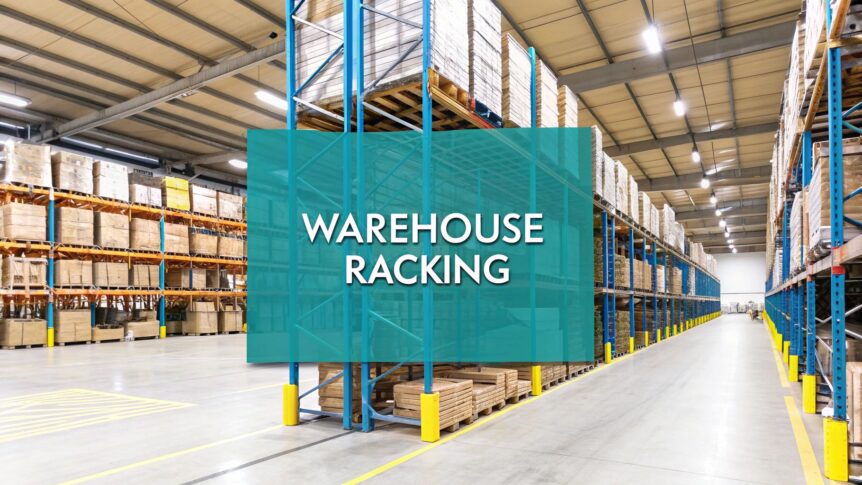
At its most basic, metal racking storage is a system of industrial-strength shelving built to make the most of vertical space in places like warehouses, factories, and distribution centres. It’s all about turning wide-open floor areas into highly organised and accessible storage. Think of it as the skeleton that holds up the entire body of modern commerce.
Why Metal Racking Is the Backbone of UK Logistics
Picture a busy library, but without any shelves. Books would be piled everywhere, making it chaotic and nearly impossible to find what you need. Metal racking does the same job for a warehouse, just on a much bigger, industrial scale. It’s the true backbone of the UK’s logistics network, converting empty air into a structured, valuable asset.
By putting these systems in place, a business can instantly boost its storage capacity without the massive cost and disruption of expanding its physical footprint. In a market where commercial property prices are high, that’s a serious competitive edge. Using vertical space smartly means you can hold more stock, smooth out your day-to-day operations, and respond faster to market changes.
The Impact on Speed and Efficiency
But the benefits go way beyond just cramming more stuff in. A well-designed racking system has a direct and immediate impact on how fast and efficiently your whole operation runs.
- Faster Pick Times: When stock is logically organised, your team can find and retrieve items much more quickly.
- Improved Inventory Management: Clear visibility and structure lead to fewer picking mistakes and make stocktaking far less of a headache.
- A Safer Working Environment: Storing heavy or awkward items securely on robust racking dramatically cuts down on workplace hazards. For lighter, non-palletised goods, you can learn more about specific https://tema-solutions.co.uk/wire-racks-shelving/.
This isn’t just about being tidy. It’s a strategic approach to creating a fluid, productive environment where goods move seamlessly from the delivery bay to the despatch lorry. It’s a foundational piece for any business serious about operational excellence.
While racking is key for organisation, it also holds incredibly valuable inventory. That makes it crucial to integrate comprehensive industrial security solutions across the entire facility.
The explosive growth in e-commerce, which now makes up over 30% of all UK retail sales, has only cranked up the pressure for these kinds of optimised systems. This trend is fuelling major investment in high-density racking, a fact backed up by market analysis that predicts significant growth in the warehouse racking sector for years to come.
Finding the Right Racking for Your Inventory
Choosing the right type of metal racking isn’t a decision to be taken lightly. Think of it like buying a car; you wouldn’t pick a two-seater sports car for a construction job. Each racking system is specifically engineered for a certain purpose, designed to handle the unique weight, size, and turnover rate of your inventory.
Getting this choice wrong can lead to all sorts of problems – from wasted space and clunky workflows to serious safety hazards. The real goal here is to find that perfect match between your products and your storage structure, making sure every square metre of your facility is pulling its weight.
The infographic below gives a great visual overview of the main racking categories to help you see the options at a glance.
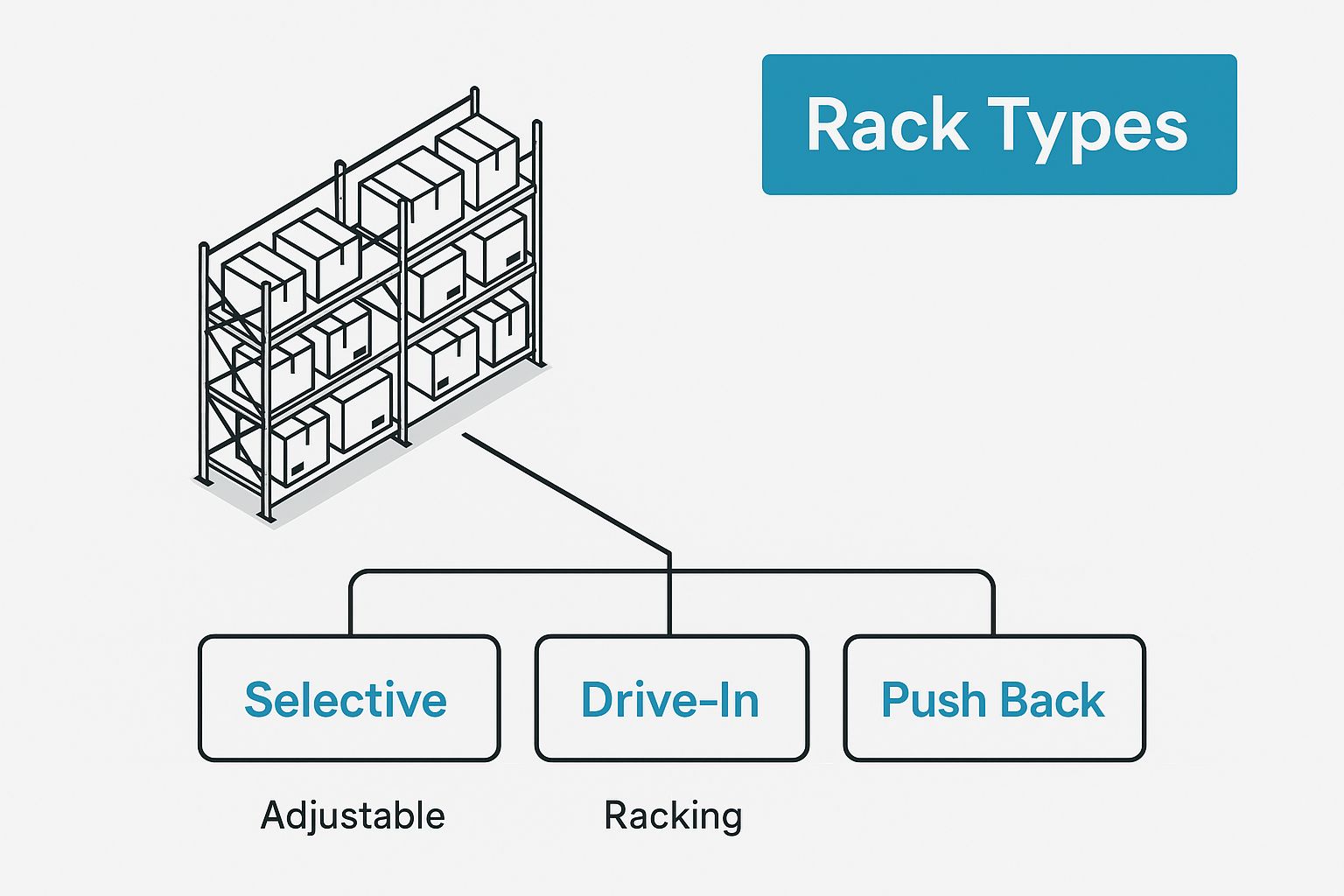
As you can see, the fundamental trade-off in any warehouse is between selectivity (easy access to everything) and density (packing more in). Let’s break down what that means for your operation.
The Versatile Workhorse: Selective Pallet Racking
If you were to picture a standard warehouse rack, you’d probably be thinking of selective pallet racking. It’s the most common and straightforward system out there for a reason. It gives you direct, unimpeded access to every single pallet you store.
This makes it the go-to solution for businesses that handle a huge variety of products (high SKU counts) and need to be able to grab any item at any time. Its simplicity is its strength, but the trade-off is the space you sacrifice for aisles. A lot of your floor plan will be dedicated to access, not storage.
The High-Density Specialist: Drive-In Racking
When your focus shifts to cramming in as much stock as possible, and you’re dealing with large quantities of the same product, drive-in and drive-through racking is a game-changer. Think of it as a multi-storey car park but for pallets. Forklifts literally drive into the racking structure itself to place or pick up a load.
By dramatically reducing the number of aisles needed, you can achieve incredible storage density. This makes it perfect for bulk goods or seasonal items. The catch? It works on a “first-in, last-out” (FILO) basis, so it’s not suitable for products with an expiry date. You can explore a complete warehouse storage solutions guide to learn more about striking the right balance.
By minimising aisle space, drive-in systems can increase storage capacity by up to 75% compared to standard selective racking. This makes it a powerful option for cold storage or facilities where space is at an absolute premium.
Storing Long and Awkward Items: Cantilever Racking
So, what do you do with items that just won’t sit nicely on a standard pallet? For inventory like timber, steel pipes, plastic extrusions, or even furniture, cantilever racking is the purpose-built solution.
This design features a sturdy central column with arms extending outwards, creating long, open shelves with no front uprights to get in the way. It allows for easy access to bulky or irregularly shaped goods, simplifying handling and preventing the kind of damage that can happen when trying to squeeze them into the wrong system.
Optimising for Fast-Moving Goods: Carton Flow Racking
For operations centred on high-volume, hand-picked orders, carton flow racking is an incredibly efficient, dynamic solution. It uses shelves tilted at a slight angle and fitted with rollers, so as you pick a box from the front, the one behind it automatically slides forward to take its place.
You load the system from the back and pick from the front, which guarantees perfect “first-in, first-out” (FIFO) stock rotation. This is the ideal setup for distribution centres dealing with fast-moving consumer goods, components, or pharmaceuticals, as it massively boosts picking speed and accuracy.
Understanding Racking Materials and Construction
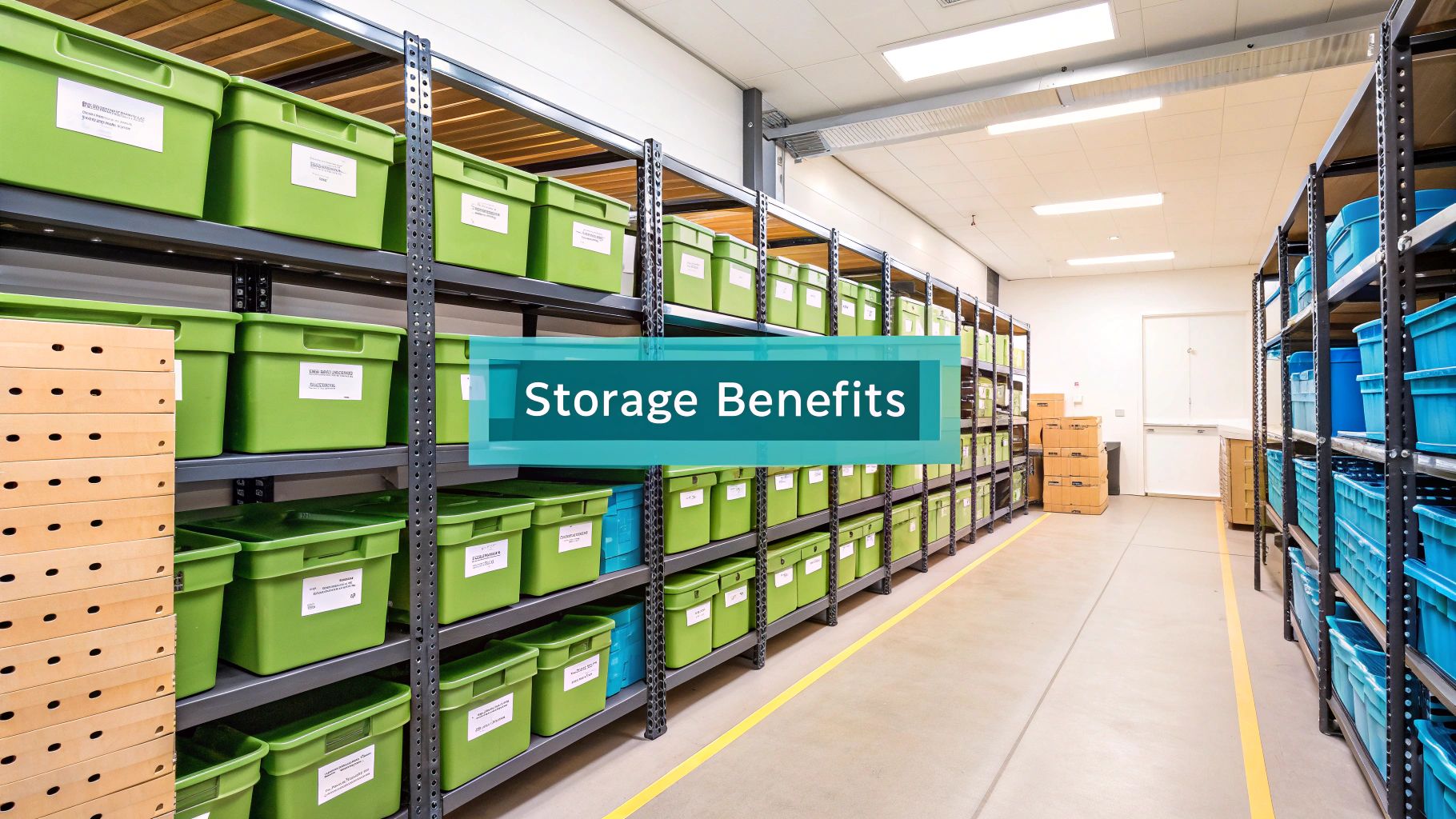
The physical makeup of your metal racking storage isn’t just a minor technical detail; it’s the very foundation of its safety, lifespan, and overall value. Getting the material and construction right from the start is absolutely crucial if you want a system that can handle the daily grind of a busy warehouse. The two main players you’ll be choosing between are roll-formed steel and structural steel.
Think of it this way: you wouldn’t use a family car chassis to build a lorry, would you? Both are made of steel and are fit for purpose, but they’re engineered for completely different loads and stresses. The same exact logic applies to your racking.
The Flexible Choice: Roll-Formed Steel
Most of the time, when you see pallet racking, you’re looking at roll-formed steel. It’s the go-to material for standard uprights and beams. The manufacturing process involves feeding a flat sheet of steel through a series of rollers that carefully bend it into the required profile. This method is highly efficient, which keeps costs down and results in components that are relatively lightweight.
Because it’s lighter, it’s easier to ship, handle, and install. For most standard warehouse setups—where loads are consistent and forklift drivers are careful—roll-formed steel hits that sweet spot between strength and cost-effectiveness. The clip-in beam connections are another big plus, making it incredibly simple to adjust shelf heights on the fly.
The Heavy-Duty Contender: Structural Steel
On the other end of the spectrum, you have structural steel. This is a completely different beast. It’s made from hot-rolled C-channels which are then bolted together to form the uprights and beams. This process creates components that are much thicker, denser, and far tougher than their roll-formed cousins.
This sheer mass gives structural steel a massive advantage in resisting impact damage. In a bustling warehouse, a bump from a forklift isn’t a matter of ‘if’, but ‘when’. That’s why specifying structural steel for vulnerable areas, like the end of aisles or in high-traffic zones, isn’t just a good idea—it’s a critical safety measure.
Essential Protective Finishes
The final piece of the puzzle is the protective finish. This is the coating that shields your steel from rust, scrapes, and general wear and tear, protecting your investment for the long haul.
Here’s what you’ll typically find:
- Powder Coating: This is the industry standard for indoor racking. A dry powder is applied to the steel using an electrostatic charge and then baked on. The result is a tough, durable finish that looks a bit like paint but is much harder. It comes in all sorts of colours, which is handy for safety coding—think orange beams and blue uprights.
- Galvanising: If your racking is going to live outdoors, in a cold store, or in a food processing area that gets washed down, you need a galvanised finish. The steel is dipped in molten zinc, creating a tough coating that offers superior protection against moisture and rust.
Nailing the right combination of steel type and finish means your metal racking won’t just hold your products; it will hold up to whatever your operation throws at it for years to come.
Getting Load Capacity Right to Keep Your Warehouse Safe
Overloading your metal racking storage isn’t just a minor slip-up; it’s a direct path to catastrophic failure. Getting your head around load capacity isn’t just about following the rules—it’s a fundamental part of your legal and moral duty to keep people safe. When you get this right, you prevent devastating accidents, protect your team, and keep your valuable inventory secure.
It all boils down to two key ideas: beam capacity and upright capacity. Imagine a simple bridge. The road surface that spans the gap can only hold a certain amount of traffic—that’s your beam. But the support pillars holding up the entire road have their own limit, which depends on how much weight is pressing down from above. That’s your upright.
For your racking, the beam capacity is the absolute maximum weight a single pair of beams can hold. The upright capacity is the total weight the entire frame structure can support, which is determined by how many beam levels you have and how far apart they are. For the whole bay to be stable, you absolutely must stay within both of these limits.
A Quick Guide to Calculating What You Need
Working out your required capacity is probably less intimidating than you think. It starts with a simple look at your pallets. Let’s walk through a straightforward example.
- Find Your Heaviest Pallet: First, figure out the maximum weight of the heaviest single pallet you’ll ever need to store. For this example, let’s say it’s 1,000 kg.
- Count Pallets Per Level: Next, decide how many pallets will sit side-by-side on one beam level. A common setup is two pallets per level.
- Calculate Your Beam Capacity: Now, just multiply the heaviest pallet’s weight by the number of pallets you’ll store on that level. In our case, that’s 1,000 kg × 2 pallets = 2,000 kg. This tells you that you need a pair of beams rated to hold at least 2,000 kg.
It is absolutely crucial to use the maximum possible weight for this calculation, never the average. A system built for average loads is a system just waiting to fail. Always refer to the official load notices from the manufacturer, which must be clearly displayed on your racking as required by UK health and safety law.
Must-Have Safety Accessories and Practices
The racking structure itself is only part of the story. A few key accessories and daily habits are non-negotiable for running a safe operation. Think of these not as optional extras, but as essential safety equipment.
- Locking Pins: These small metal clips are vital. They lock beams into the upright frame, preventing a forklift from accidentally lifting and dislodging a loaded beam.
- Column Guards: These are brightly coloured steel shields bolted to the floor at the base of your uprights. They act as a crucial buffer, absorbing impacts from forklifts and protecting the frame’s integrity.
- Safety Netting: Fitted to the back of single-sided racking, this simple netting stops boxes or loose items from being pushed off and falling into walkways or work areas.
Beyond the racking’s physical strength, a safe warehouse also relies on strong operational measures, like enhancing security enforcement at your facility. Even in highly specialised fields, like the UK data centre rack market, structural integrity and security are paramount. That sector is expected to nearly double to USD 230.9 million by 2030, a boom driven by the demand for incredibly robust racking to hold high-density digital equipment. You can find more on this trend from the UK data centre rack market report by Mordor Intelligence.
A Practical Checklist for Buying Metal Racking
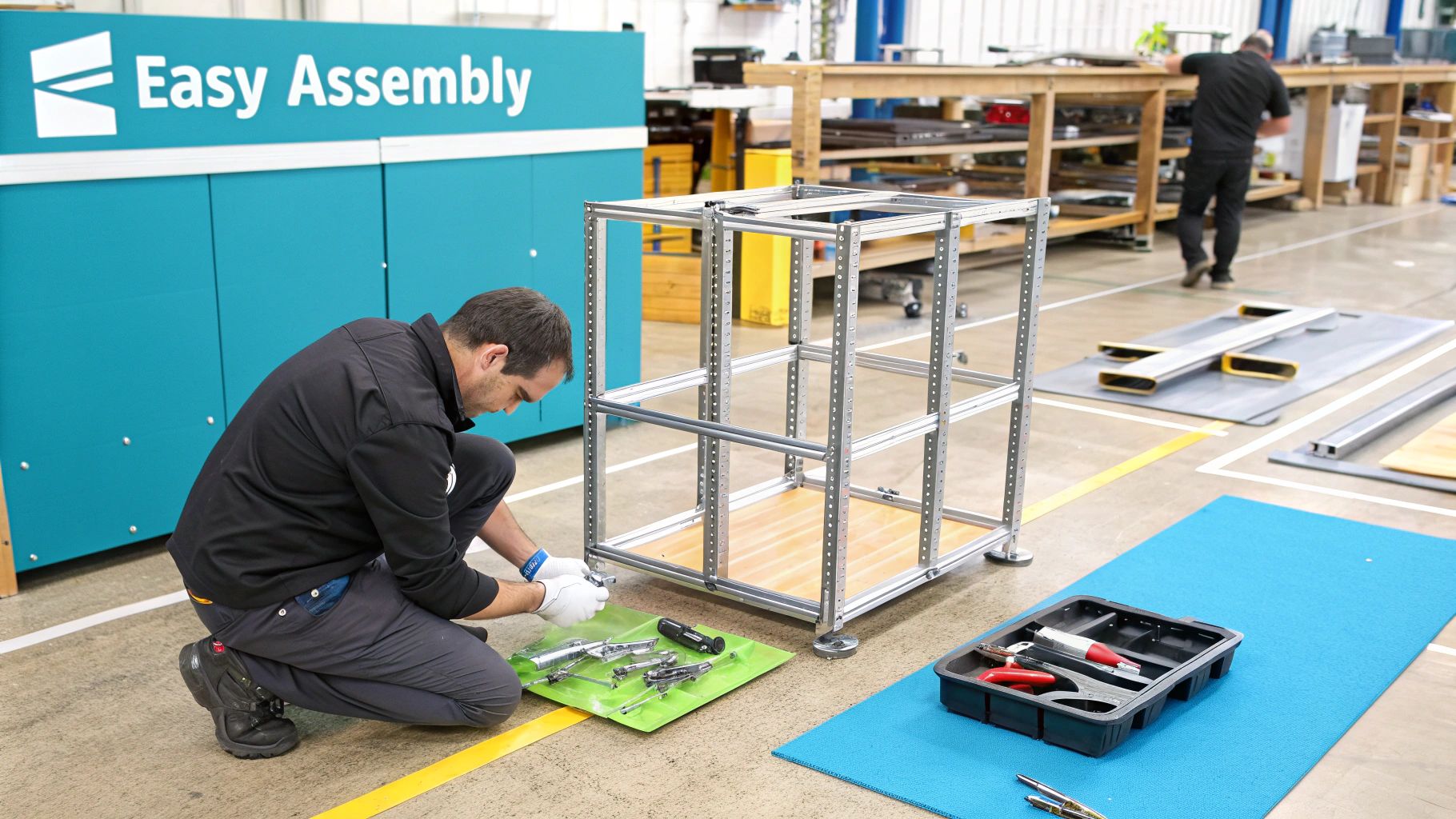
Choosing new metal racking storage is one of those big-ticket decisions that can genuinely define how well your whole operation runs. To get it right, you need to look past the price tag and really dig into what your business needs. This checklist will walk you through the most important things to think about before you sign on the dotted line.
Think of it like drawing up the blueprint before laying the foundation for a house. A bit of careful planning now will save you from major headaches and costly fixes down the road, ensuring the system you end up with is a perfect fit.
Assess Your Physical Space
Before you start browsing catalogues, the first job is to get intimately familiar with the space you have—your warehouse. Every building has its own personality, with quirks and limitations that will dictate what kind of racking is even possible.
- Ceiling Height: What’s your clear vertical space? You need to measure from the floor to the lowest-hanging obstacle, whether that’s a sprinkler head, a light fixture, or a bit of ductwork. This number sets the absolute limit for how high you can build.
- Floor Integrity: A fully loaded rack puts an incredible amount of focused pressure on the floor. Is your concrete slab up to the task? You might need a structural engineer to assess its load-bearing capacity to avoid any nasty surprises.
- Obstructions: Get a tape measure out and map the precise location of every column, pillar, doorway, and fire exit. Your racking layout has to work around these immovable objects, not fight them.
Analyse Your Inventory and Workflow
With a solid understanding of your building’s limits, it’s time to turn your attention inwards. You need a crystal-clear picture of what you’re storing and, just as importantly, how it needs to move. The type of product you handle is the single biggest influence on your choice of racking.
Think about the size, weight, and shape of your goods. Are they uniform boxes or awkward, bulky items? Then, consider your stock turnover. Do you need immediate access to every single pallet (a First-In, First-Out or FIFO system), or are you storing bulk products for longer periods where the last one in can be the first one out (FILO)? Your racking system must support your daily operational rhythm.
You can get a better sense of how different systems match up with various operational needs by exploring different warehouse storage solutions.
Choose a Reputable UK Supplier
This isn’t a step you can afford to skip. Partnering with a credible, experienced supplier is absolutely non-negotiable. A great partner does far more than just sell you racking; they bring design expertise to the table, ensure everything is compliant with safety standards, and manage a professional installation.
A key thing to look for is a supplier who openly states they follow the SEMA (Storage Equipment Manufacturers’ Association) codes of practice. This is your guarantee that the design, the materials, and the installation will meet the UK’s highest safety benchmarks—something the HSE takes very seriously.
When planned properly, a new racking system can be a game-changer, slashing order picking times and making your labour force far more effective. These efficiencies lead directly to cost savings, which is vital for the UK’s 1,400+ warehousing businesses trying to stay competitive. With e-commerce now making up over 30% of all retail sales, having the right racking isn’t just an advantage; it’s essential for survival. For more data, you can see how optimised racking impacts the UK logistics market from Grand View Research.
Answering Your Top Metal Racking Questions
When you’re looking to invest in something as fundamental as a metal racking storage system, it’s only natural to have a few questions. Getting straight, practical answers is key to making sure your warehouse is safe, efficient, and fully compliant.
We’ve put together this quick guide to tackle the most common queries we hear from warehouse managers and first-time buyers across the UK. Think of it as a no-nonsense rundown to help you manage your storage with total confidence.
How Often Must Racking Be Inspected in the UK?
The rules in the UK are crystal clear on this. Under the Provision and Use of Work Equipment Regulations (PUWER) 1998, you’re required to have a “technically competent person” carry out a formal inspection of your racking at least once every 12 months.
But that’s not the whole story. Your own internal teams should be doing regular visual checks—we recommend weekly—to catch any obvious damage like dents or bent beams. If you spot anything, the procedure is simple: log the issue, immediately unload the affected bay, and get a qualified technician in to sort it out.
Pallet Racking vs Industrial Shelving
This is a frequent point of confusion, but the distinction really boils down to scale and how you handle the goods. It’s a bit like comparing a heavy goods lorry to a small delivery van; both move things, but they’re built for entirely different jobs.
- Pallet Racking: This is your heavy-lifter. Built from large, robust components, it’s engineered specifically to hold fully loaded pallets that are moved around exclusively with machinery like forklift trucks.
- Industrial Shelving: This is for smaller, lighter items that don’t live on a pallet. It’s perfect for things that are picked and put away by hand—think archive boxes, spare parts, tools, or any loose stock that doesn’t need a forklift.
Can I Mix Components from Different Racking Brands?
This is an easy one: a firm no. Mixing and matching components from different manufacturers is a dangerous game that safety bodies and industry experts will always warn you against.
A racking system is a precisely engineered structure where every part is designed to lock together and distribute weight in a specific way. The grade of steel, the profile dimensions, even the locking mechanisms are unique to each brand. If you start combining parts, you create a structure that’s unpredictable and unstable. It instantly voids your warranty and, more importantly, puts your team at serious risk. For any repairs or extensions, always stick with genuine parts from the original manufacturer.
“A key industry standard, the SEMA (Storage Equipment Manufacturers’ Association) code of practice, is the benchmark for racking safety in the UK. Adhering to this code, which includes not mixing components, is vital for compliance with Health & Safety Executive (HSE) regulations.”
Choosing a supplier who lives and breathes these guidelines is the best way to ensure your metal racking storage is installed correctly and is fit for purpose. This isn’t just about following best practice; it’s about fulfilling your legal duty to provide a safe workplace.
For expert guidance on selecting, installing, and maintaining a compliant metal racking system, trust the specialists at TEMA Solutions Limited. We provide robust, industry-leading storage solutions that are built to last. Explore our offerings at https://tema-solutions.shop


