


If you’ve ever gone home from work with a nagging backache or sore shoulders, you know firsthand the problem with old-school, static workbenches. Let’s be honest, the one-size-fits-all approach just doesn’t cut it in a modern workshop. It leads to discomfort, yes, but it also tanks your output.
These problems aren’t random; they’re a direct result of poor ergonomics, where your equipment is fighting against you, not working with you.
Moving Beyond the Static Workbench
For years, the standard workbench has been little more than a slab of material on legs, all at one fixed height. This design forces you to adapt to the bench, instead of the other way around. It doesn’t matter if you’re tall and find yourself hunching over, or shorter and constantly reaching up—the end result is always physical strain and a less-than-efficient workday.
This fundamental mismatch between a person and their workspace is a huge contributor to musculoskeletal issues. We’re not just talking about a bit of soreness at the end of the day. This is about the slow, cumulative damage that can build up into chronic pain and serious, long-term injuries.
The Real Cost of Poor Ergonomics
When your workbench is set at the wrong height, it creates a ripple effect of problems that hit both your team’s well-being and your bottom line.
- Reduced Efficiency: It’s simple, really. When you’re uncomfortable, you work slower and with less precision. Constantly having to readjust your position or strain to get a good view of your work wastes time and opens the door to mistakes.
- Increased Fatigue: Holding an awkward posture, even for a short time, burns a surprising amount of energy. This leads to both physical and mental fatigue setting in much faster, draining focus and killing productivity as the shift wears on.
- Higher Risk of Injury: That persistent strain on the neck, shoulders, and back isn’t just uncomfortable; it can develop into serious musculoskeletal disorders (MSDs), which are a leading reason people miss work.
The biggest flaw with static workbenches is their complete lack of adaptability. They assume every person is the same height and every task requires the same posture, which simply isn’t how safe, effective work gets done.
This is where adjustable height workbenches come in. They aren’t just a nice-to-have feature; they are a fundamental tool for building a safer, more dynamic, and ultimately more productive workshop. Giving people the power to change their work surface height in seconds means they can find that perfect, neutral posture that feels natural.
It’s a simple concept, but the impact is massive. A task that needs a bit of leverage can be done with the bench lowered, while fine-detail assembly is often easier with the surface raised. By matching the bench to the person and the job at hand, you eliminate chronic strain and unlock a whole new level of performance.
The Real Benefits of an Ergonomic Workbench
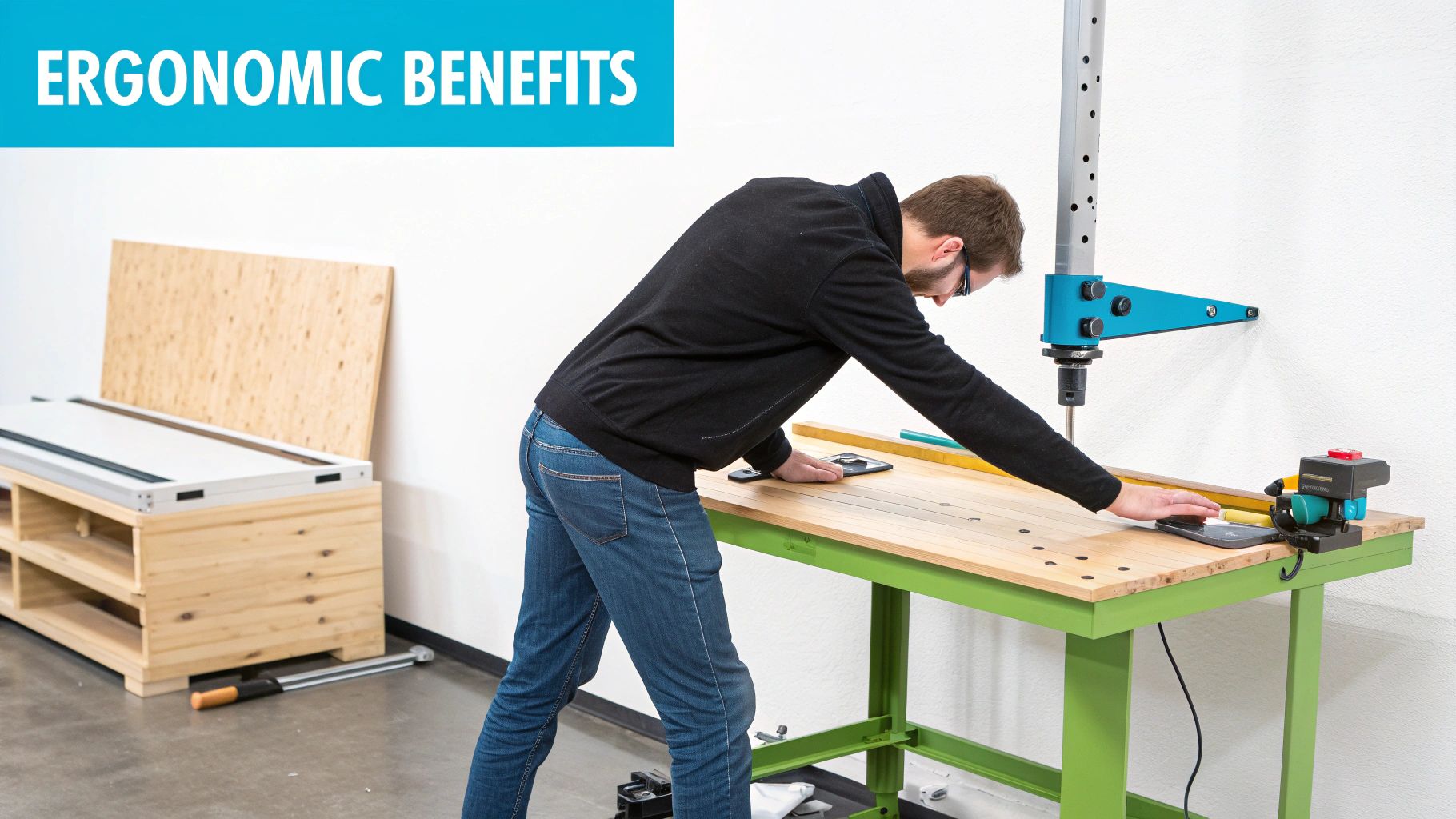
It’s easy to dismiss an adjustable workbench as just being ‘better for your back’, but the real benefits go much deeper than that. Think of it this way: you wouldn’t wear a pair of shoes that are three sizes too big or too small. The same logic applies to a workspace. An adjustable height workbench allows each person to find their perfect fit, and that makes all the difference.
The secret lies in achieving what’s called a neutral posture. This is your body’s most efficient and relaxed position, where your spine keeps its natural S-curve, minimising stress on your muscles and joints. A good adjustable bench lets you set the height so your elbows naturally rest at a comfortable 90-degree angle, whether you’re sitting or standing.
This simple customisation eliminates the constant hunching over or awkward reaching that a fixed-height bench forces on you. The result? A massive reduction in physical strain across your neck, shoulders, back, and even your wrists.
From Employee Well-Being to Business Performance
These ergonomic improvements aren’t just about feeling good; they have a direct and measurable impact on business performance. When your team isn’t battling fatigue and physical discomfort, they can concentrate better, work more accurately, and maintain their energy levels for the whole shift.
This is a huge deal, especially here in the UK. Work-related musculoskeletal disorders (MSDs) are a serious problem, accounting for roughly 33% of all workplace injuries. That figure represents a massive cost to businesses in the form of sick days, compensation claims, and lost productivity.
By giving workers the ability to adapt their station to their own body, adjustable workbenches are a direct solution. They help build safer working habits and cut down on the risk of these costly injuries.
The true value of an ergonomic workbench is its power to turn employee well-being into a measurable operational advantage. It’s an investment that pays you back in safety, productivity, and morale.
What’s more, outfitting your facility with this kind of equipment helps you meet UK health and safety regulations, which require employers to provide a safe working environment. Taking a proactive approach to ergonomics shows a genuine commitment to your team’s welfare and protects your business from potential legal issues.
The Tangible Returns on Investment
Putting your money into ergonomic equipment like an adjustable height workbench isn’t an expense—it’s an investment that delivers a clear return.
Here’s what you can expect:
- Fewer Lost Workdays: When you reduce the risk of strains and injuries, you’ll naturally see a drop in absenteeism from back pain and other MSDs.
- Improved Quality and Accuracy: A comfortable worker is a focused one. Proper ergonomics lead to fewer mistakes, less wasted material, and a higher standard of work.
- Enhanced Team Morale: When you provide tools that show you care about your team’s health, you build loyalty and create a more positive, productive work culture.
Ultimately, an ergonomic workspace isn’t a cost centre; it’s a performance multiplier. By investing in your people, you’re directly fuelling the efficiency and success of your entire operation.
Choosing Your Workbench Adjustment Style
Not all adjustable height workbenches are created equal. The mechanism that actually changes the height is a massive factor, influencing its speed, ease of use, and where it will fit best in your workspace. It’s a bit like choosing between a manual and an automatic car; both will get you there, but the driving experience is completely different, and each suits a different purpose.
To make the right call, you need to think honestly about your daily routine. Will you be adjusting the height once a day, or multiple times an hour? Is the bench a personal station or will it be shared by several people across different shifts? The answers will guide you straight to the perfect adjustment style for your workshop.
Manual Crank Workbenches
Manual crank systems are the dependable workhorses of the adjustable bench world. As the name implies, you turn a hand crank to raise or lower the surface. It’s a simple, tough mechanism that doesn’t need plugging in, which gives you complete freedom on where you place it.
This style is a great match for places where you aren’t adjusting the height all that often. Think of a hobbyist’s garage, a small repair shop, or a dedicated station for one person who might only switch between sitting and standing a couple of times a day.
- Cost-Effective: Their mechanical simplicity makes them a more budget-friendly choice, which is ideal for smaller operations or anyone just starting to invest in better ergonomics.
- Reliable: With fewer moving parts and no complex electronics, there’s less to go wrong. This makes them incredibly durable, even in tough industrial environments.
- No Power Needed: You can position them anywhere in your workshop without having to worry about finding a nearby plug socket.
While they are incredibly sturdy, keep in mind that the adjustment process is slower and takes a bit of physical effort. This could become a real drawback in a busy environment where every second counts.
Electric Motorised Workbenches
For workshops where speed and convenience are paramount, electric models are the hands-down winner. A simple push of a button activates a motorised lift, which smoothly and quickly raises or lowers the bench. This is an absolute game-changer in fast-paced settings like assembly lines or packing stations where several operators might use the same bench.
An electric system removes any physical effort from making an ergonomic adjustment. This ease of use encourages workers to change their posture more frequently—a crucial factor in reducing fatigue and preventing strain injuries over a long day.
The real win with an electric workbench isn’t just the speed; it’s the removal of hassle. When adjusting the height is effortless, people are far more likely to do it, which fosters better ergonomic habits and a healthier, more productive team.
Many electric workbenches also come with programmable memory settings. This brilliant feature lets different users save their ideal sitting and standing heights, allowing for an instant, personalised setup at the start of a shift. It’s especially valuable in multi-shift operations, guaranteeing ergonomic consistency for every single worker.
To help you decide, let’s break down the key differences between the common adjustment types. The table below compares the features and typical uses for manual, electric, and heavy-duty industrial systems.
Comparison of Adjustable Workbench Mechanisms
| Feature | Manual (Crank/Pin) | Electric (Motorised) | Heavy-Duty Industrial |
|---|---|---|---|
| Adjustment Speed | Slow, requires physical effort | Fast, push-button operation | Varies; often slow and deliberate |
| Ease of Use | Moderate; can be cumbersome | Excellent; effortless | Good; designed for stability over speed |
| Load Capacity | Good; typically 250-500 kg | Very Good; typically 300-750 kg | Exceptional; 1,000 kg+ |
| Power Required | No | Yes (standard plug socket) | Often Yes (may require specialised power) |
| Best For | Single users, infrequent adjustments, budget-conscious setups | Multi-user environments, frequent adjustments, assembly/packing | Heavy manufacturing, fabrication, workshops with extreme loads |
| Cost | £ | ££ | £££ |
This comparison makes it clear that while a manual crank is a solid, budget-friendly choice, an electric motor offers superior speed and convenience. For the most demanding jobs, however, a purpose-built heavy-duty system is in a league of its own.
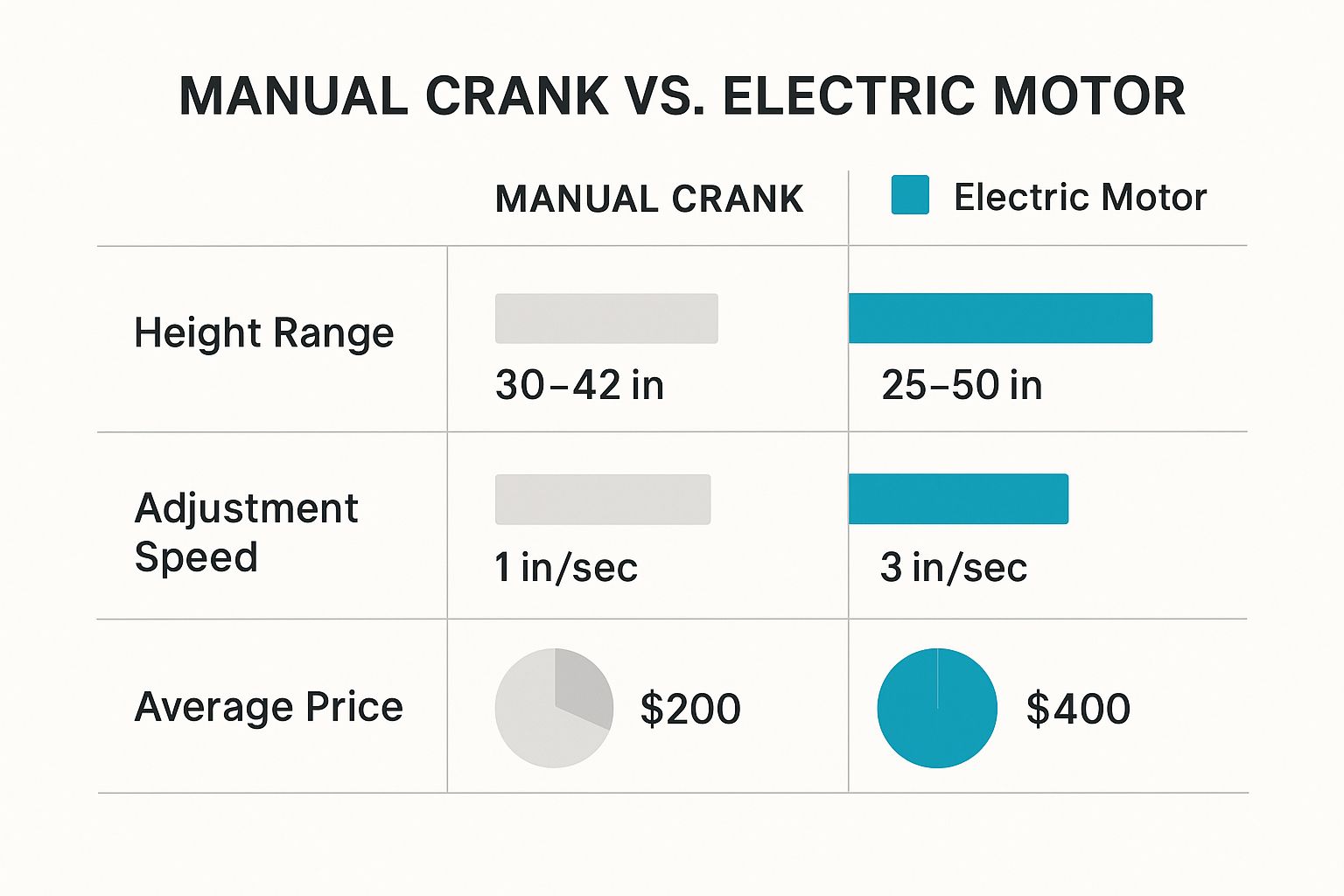
Ultimately, your decision should balance your team’s operational needs against your budget. By weighing the speed and convenience of an electric model against the simplicity of a manual one, you can find the most practical and effective solution that truly supports your workers.
How to Select the Perfect Adjustable Workbench
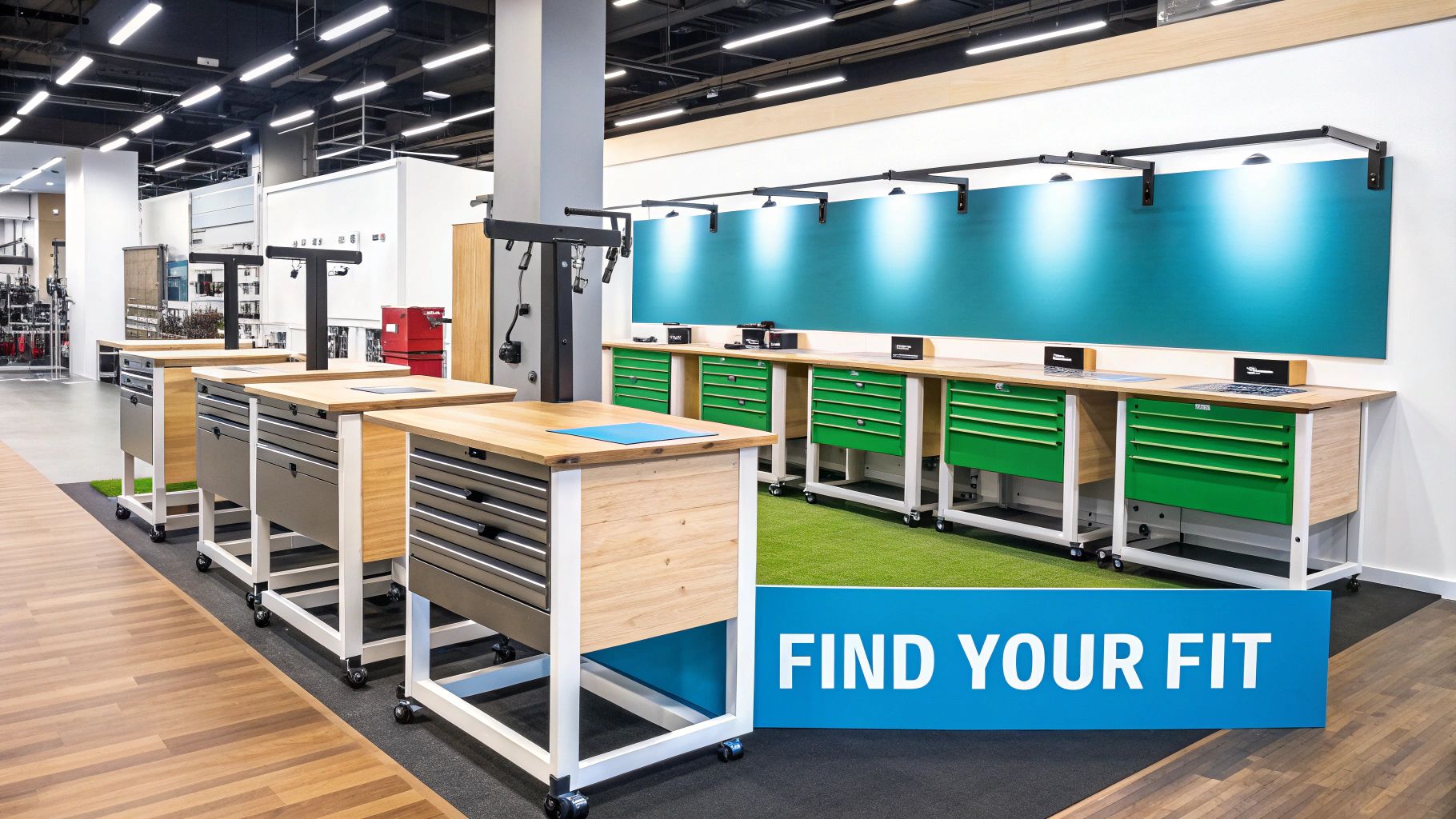
Choosing the right adjustable workbench isn’t just about picking a size from a catalogue. It’s a practical decision that hinges on matching the equipment to your specific workflow. To get it right, you need to look past the marketing and get to grips with the technical details that will define its performance day in and day out. Think of this as your blueprint for choosing a bench that truly works for you.
One of the first things you’ll see is the load capacity, which is usually listed as the Uniformly Distributed Load (UDL). This isn’t just a random number; it’s a direct measure of the bench’s strength and stability. It tells you exactly how much weight the workbench can safely handle when that weight is spread evenly across the top.
A standard bench might offer a UDL of 250-500 kg, which is more than enough for light assembly, packing, or general-purpose tasks. But if you’re in heavy engineering or fabrication, clamping components in a vice, or dropping heavy parts onto the surface, you’ll want a heavy-duty model rated for 1,000 kg or more. Always build in a buffer—choose a capacity that easily exceeds the heaviest job you can imagine to guarantee a solid, safe foundation for your work.
Matching the Work Surface to the Task
The worktop is every bit as important as the frame holding it up. The right surface can make you more efficient, protect delicate components, and survive years of hard use. Different jobs demand different materials, so it’s crucial to get this part right.
Here’s a quick rundown of the most common worktop materials and what they’re good for:
- MDF (Medium-Density Fibreboard): A great all-rounder for general tasks, assembly, and craftwork. It’s budget-friendly and gives you a smooth, dependable surface to work on.
- Solid Wood (e.g., Beech): Perfect for woodworking or mechanical jobs where you’re hammering, clamping, or mounting heavy equipment like vices. Its natural resilience and strength have made it a workshop classic for a reason.
- Steel: The undisputed champion for heavy fabrication, welding, and any job where extreme durability is the top priority. It’s tough as nails, easy to clean, and stands up to heat and serious impacts.
- Laminate: A versatile choice that comes in standard or chemical-resistant versions. Standard laminate is great for clean assembly and inspection, while specialised types are a must for labs or anywhere spills are a constant risk.
- ESD (Electrostatic Dissipative) Laminate: Absolutely essential for anyone working with electronics. This surface safely grounds static electricity, protecting sensitive components from getting fried.
Think of the work surface as the direct interface between you and your work. Choosing the right one is fundamental. An electronics technician needs an ESD-safe surface with integrated power, while a metal fabricator requires a heavy-gauge steel top that can withstand intense punishment.
Considering Size and Essential Accessories
Finally, think about the workbench’s physical footprint and how it will fit into your workspace. Get your tape measure out and be realistic about the space you have, making sure to leave plenty of room to move around the bench safely. The depth of the worktop matters too; a deeper surface gives you more real estate for tools and materials, preventing a cramped and cluttered setup.
Don’t overlook the accessories that can elevate a good bench to a great one. Things like integrated power strips, overhead lighting, shelving, and lockable drawers can make a huge difference to your organisation and efficiency. If your workshop layout changes often, you might also consider a workbench with wheels for total flexibility. Choosing a bench with the right combination of features from the start ensures it will be a perfect fit for the way you work.
Integrating Workbenches into a Modern UK Workplace
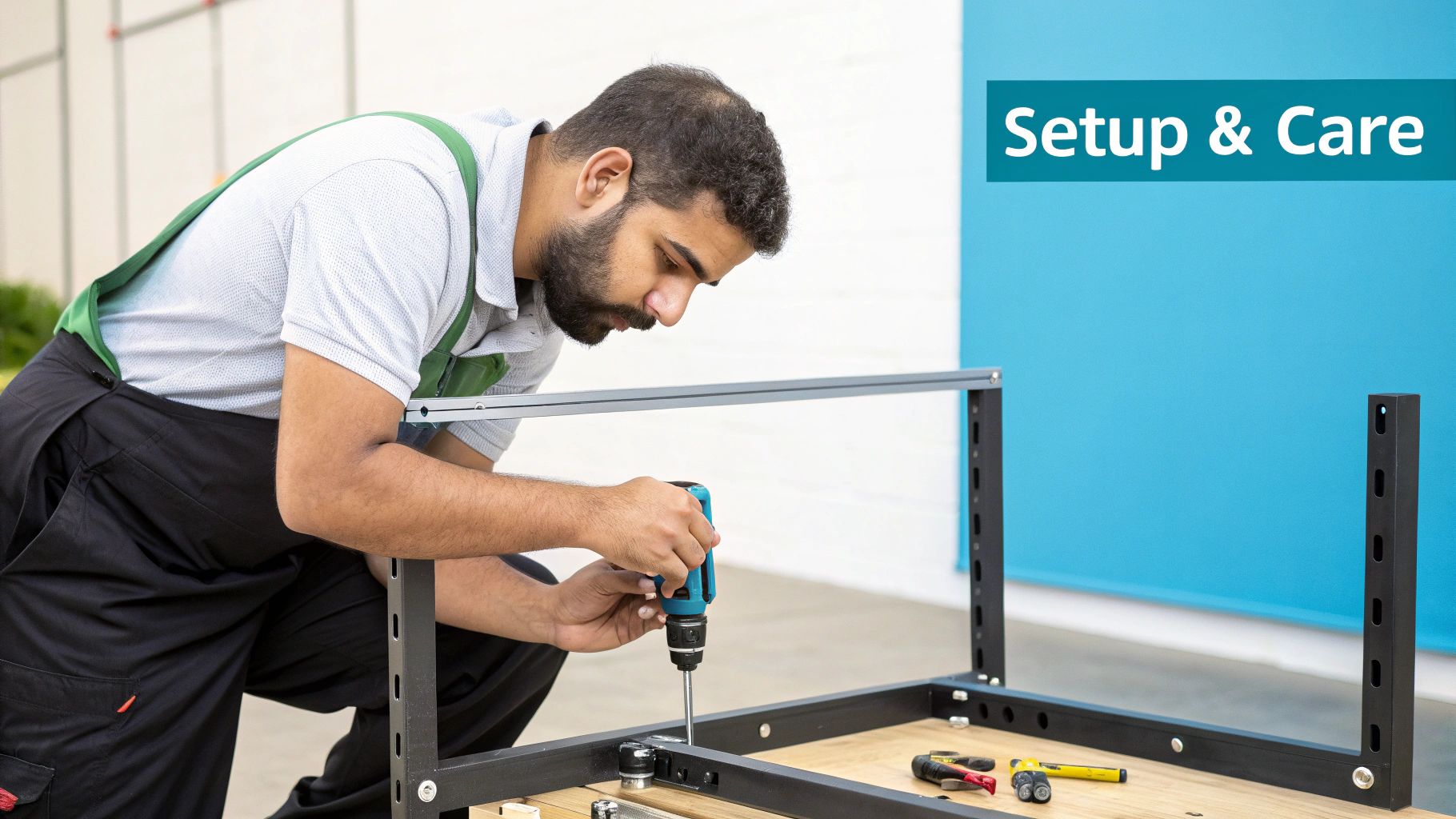
In a modern UK workshop, an adjustable workbench is much more than just a place to put your tools. Think of it as a strategic asset, a key piece of the puzzle for achieving real operational excellence. These benches are fundamental to modern manufacturing ideas like lean and agile, where being able to adapt on the fly isn’t just nice to have—it’s essential.
Picture a busy factory running multiple shifts. Different operators, often of different heights and builds, will use the same workstation throughout the day and night. A standard, fixed-height bench turns ergonomics into a game of chance. Adjustable height workbenches change all that, giving every worker the power to set up a comfortable and safe station in moments. This simple change is a game-changer for maintaining focus and productivity across every single shift.
Future-Proofing Your Operations
Bringing in ergonomic equipment isn’t just a short-term fix; it’s a savvy, forward-thinking investment that pays dividends for years. When you’re planning to introduce these systems, you need to think about the unique demands of your environment, whether it’s a bustling logistics hub or a high-precision specialized manufacturing workshop.
This isn’t only about boosting efficiency numbers. It has a direct, positive impact on team morale and helps you keep good people. When you provide tools that show you care about your team’s health and well-being, it sends a clear message that they are valued. This helps build a far more positive and committed culture. Kitting out your workspace with quality https://tema-solutions.co.uk/work-storage-benches/ is a massive step towards creating a resilient, people-first operation.
“Adopting adjustable workbenches isn’t just an equipment upgrade. It’s a strategic decision to future-proof your facility, align with UK health and safety standards, and build a workplace that attracts and retains top talent.”
This shift towards better ergonomics is backed by some serious market momentum. In 2023, the global market for height-adjustable furniture was valued at around US$5.5 billion, with the UK and Europe being significant players. This market is set to expand even further, driven by a growing understanding of ergonomic benefits and the need for more flexible, adaptable working environments.
This growth points to a clear change in industry thinking. Facility managers and business owners now realise that investing in ergonomics is vital for long-term, sustainable growth. It ensures their workplaces are not just productive today, but are also ready for whatever challenges tomorrow brings.
Of course, here is the rewritten section with a more natural, human-expert tone.
Your Top Questions About Adjustable Workbenches Answered
Making a significant change to your workshop, like bringing in an adjustable height workbench, always comes with questions. It’s a big step up from a basic, static bench, so it’s smart to get into the nuts and bolts before you commit. We’ve heard plenty of queries over the years, so we’ve put together some straight-talking answers to the most common ones.
Think of this as clearing the air on any final doubts you might have. We’ll cover everything from raw strength to setup and long-term value, helping you feel confident you’re choosing the right gear for your space.
How Much Weight Can an Adjustable Workbench Actually Hold?
This is probably the first thing everyone asks, and for good reason. The answer really comes down to what the bench was built for. You wouldn’t use a hobbyist’s bench for heavy engineering, so you’ll find a massive difference in load capacity from one model to the next.
- Standard-Duty Benches: Most standard benches will happily take on 200 kg to 300 kg. This is plenty for things like assembling electronics, general repairs, or running a busy packing station.
- Heavy-Duty Benches: When you get into serious industrial work, you need a bench that can take a real beating. The heavy-duty models are monsters, with reinforced frames capable of holding anywhere from 800 kg up to over 1,000 kg. They’re designed for fabrication, heavy maintenance, and engineering workshops where you’re dealing with serious mass.
The key is to always look for the Uniformly Distributed Load (UDL) rating. Make sure you pick a bench that can handle more than the heaviest thing you’ll ever put on it. A little bit of overkill here is a good thing.
Are Electric Workbenches a Pain to Install and Maintain?
Honestly, no. It’s a common worry, but most electric workbenches are surprisingly simple to put together. The manufacturers know you don’t want a complicated project. Often, the leg and motor system arrives pre-assembled, so all you’re left with is bolting on the worktop and plugging it into a standard socket.
People often assume that anything with a motor is going to be high-maintenance. The reality is these benches are built for tough industrial life, with robust parts that need very little attention.
As for looking after them, it’s pretty straightforward. Just keep the lifting columns free of workshop dust and grit, and give the electrical connections a quick check now and then to make sure everything’s still tight. They are built for reliability, not to add another job to your maintenance list.
Is an Adjustable Workbench Worth It for a Hobbyist?
Without a doubt. While you’ll spend more upfront compared to a fixed bench, the payoff for a serious hobbyist is huge. Just think about all the different things you do in your workshop. Some tasks need brute force and leverage, where you want the bench low. Others involve fiddly, detailed work where having everything up close at a higher level is a game-changer.
An adjustable bench lets you set the perfect height for every single project. It’s not just about stopping that nagging back and neck ache after a long session; it’s about improving the quality of your work and actually enjoying your time more. It’s a real investment in your health and your hobby.
What’s a Good Height Adjustment Range to Look For?
The whole point of an adjustable bench is its versatility, so you want the widest height range you can get. A good one should let you work comfortably whether you’re sitting on a stool or standing tall.
Look for a range that starts around 650mm on the low end (perfect for most seated tasks) and goes up to 1100mm or even higher. This kind of range means just about anyone, no matter their height, can find their ergonomic sweet spot. That’s what makes these benches such a fundamental part of any modern, flexible workshop.
At TEMA Solutions Limited, we specialise in providing high-quality, durable adjustable height workbenches that are built to enhance productivity and ergonomic safety. Explore our industry-leading solutions and find the perfect fit for your workshop at https://tema-solutions.co.uk.


