


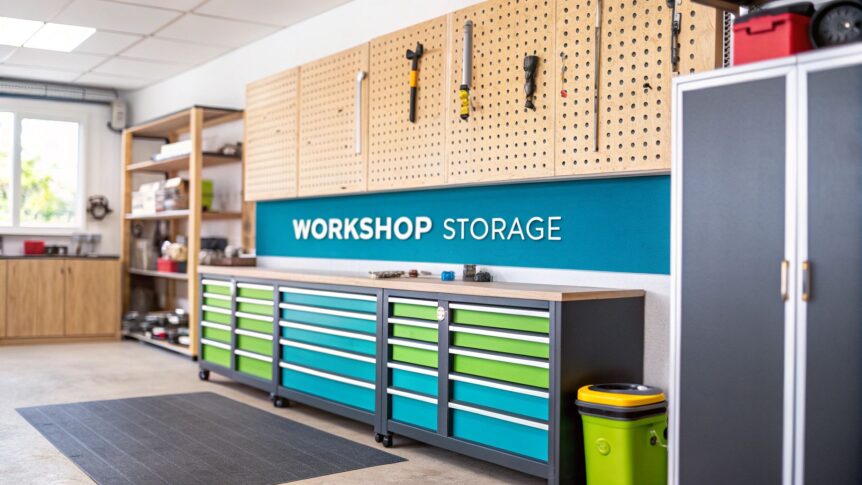
A cluttered workshop doesn't just look messy—it stifles creativity, wastes time, and can even be a serious safety hazard. The best storage ideas for a workshop aren't about just tidying up; they’re about transforming chaos into clarity. The real goal is to make your tools accessible, your supplies visible, and your layout flexible enough to handle any project you throw at it.
Forget generic tips. Let's build a system that actually works for you.
Transform Your Workshop from Chaos to Clarity
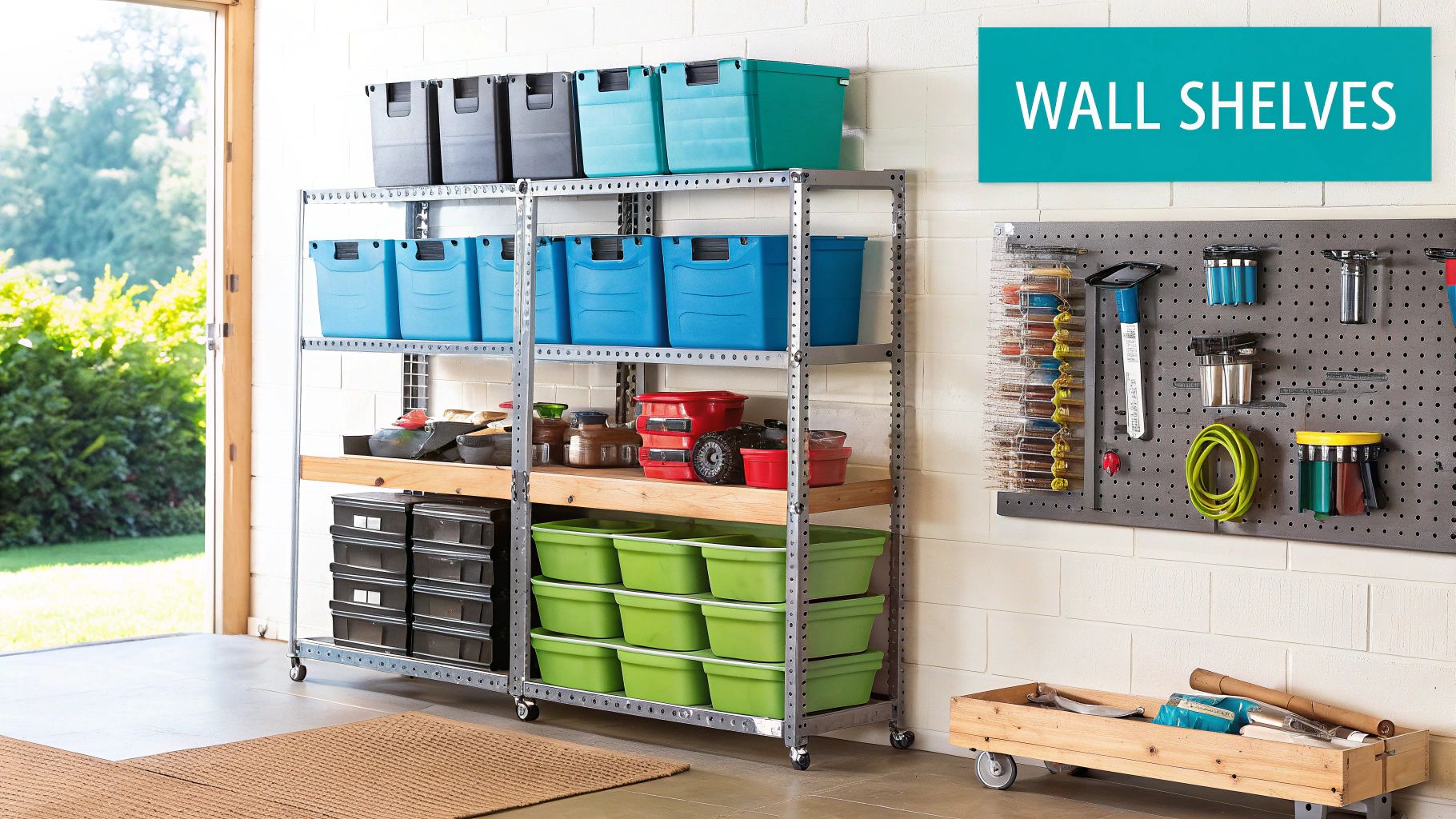
A disorganised workspace is more than just an eyesore; it's a direct roadblock to getting things done. Every minute spent rummaging for a specific spanner or the right size of screw is a minute you're not spending creating, repairing, or building. This guide is your roadmap to reclaiming that lost time and turning your workshop from a source of constant frustration into a powerhouse of productivity.
The principles we're about to cover are simple but incredibly powerful. They go far beyond just buying more storage bins and push you to think strategically about how you arrange your space to support your actual workflow.
The Foundation of an Organised Space
Before you rush out and buy a single cabinet, you need to start with a shift in mindset. A truly effective workshop isn't just tidy—it's intelligently designed. This means every single item has a logical home, and the entire layout is planned to support the way you naturally move and work.
Many of the most practical strategies for organizing your garage can be adapted for a workshop, as the core challenges of limited space and lots of gear are remarkably similar.
The journey begins with a crucial first step: decluttering. You can't organise what you don't need. Be ruthless. Get rid of broken tools, unnecessary duplicates, and those leftover materials you know, deep down, you'll never actually use.
A perfectly organised workshop isn't a fantasy—it's an achievable reality. The secret is to stop thinking about "tidying up" and start thinking about creating a system that prevents mess from building up in the first place.
This system is built on a few core ideas we'll dive into:
- Vertical Storage: Using your wall space is a game-changer. It gets tools and supplies off your valuable benchtops and into plain sight.
- Mobile Workstations: Why walk back and forth to your tools? Use carts and rolling cabinets to bring your entire toolkit right to the project.
- Modular Systems: Your needs will change over time. Choose flexible storage solutions that can grow and adapt with you.
By embracing these simple but effective concepts, you'll quickly realise that a clean, hyper-efficient workshop is well within your grasp.
Core Principles for Effective Workshop Storage
To get started, it helps to understand the foundational concepts that underpin any great workshop layout. The table below summarises the key principles we'll be building on. Think of this as your quick-start guide to making immediate, impactful changes.
| Principle | Primary Benefit | Ideal Application |
|---|---|---|
| Zone-Based Layout | Reduces wasted movement by grouping related tools and materials together. | Creating distinct areas for woodworking, metalworking, and electronics repair. |
| Point-of-Use Storage | Keeps the most frequently used items within arm's reach of their work area. | Mounting screwdrivers and pliers on a rack directly above your main workbench. |
| Visibility and Access | Makes finding items faster and easier, reducing search time and frustration. | Using clear-front bins for fasteners or pegboards for hand tools. |
| Mobility and Flexibility | Allows the workshop layout to adapt to different project sizes and types. | Using rolling tool chests and mobile workbenches that can be reconfigured. |
| Vertical Space | Maximises storage capacity without sacrificing precious floor space. | Wall-mounted shelving, magnetic tool bars, and tall cabinet units. |
Getting these core ideas right is the first step. When you start thinking in terms of zones, accessibility, and mobility, you're no longer just storing things—you're designing a high-performance workspace.
The Three Pillars of Workshop Organisation
Before you rush out and buy a single storage bin, it's worth taking a moment to think about the philosophy behind a truly functional workshop. I’ve seen countless great storage ideas fail, not because the products were poor, but because they were put in place without a clear strategy. The most satisfying and successful workshop transformations are always built on three foundational pillars: Accessibility, Visibility, and Flexibility.
If you can get these three concepts locked in your mind, you'll be able to make smarter, more effective storage decisions that serve you for years to come. Think of them as your guiding principles, helping you move beyond quick fixes to create a system that genuinely works.
Master Accessibility First
At its heart, accessibility is about keeping your most-used tools within arm's reach. It's simple, really. A professional chef wouldn’t keep their favourite knife in a locked cupboard across the kitchen; it’s right there, ready to go. Your workshop should run on the same principle of 'mise en place'—everything in its place for immediate use.
This means your primary hand tools, measuring tapes, and daily drivers should never be buried in a deep drawer or stuck in a box on a high shelf. Get them out where you can grab them. Store them on a pegboard, a magnetic strip above your workbench, or in the top drawers of a rolling tool cabinet. When you optimise for ease of access, you stop wasting time and energy just getting ready to work.
Prioritise Visibility for Efficiency
The second pillar, visibility, is all about being able to see what you have at a glance. How much time have you wasted rummaging through opaque tubs or identical cardboard boxes, trying to find that one specific thing? When you can’t see your inventory, you not only lose time searching, but you also risk buying duplicates of items you already own.
An organised workshop isn’t just about neatness; it's about creating a visual inventory system. When you can see everything you own, you make better decisions, waste less time, and save money.
This is where clear containers for screws, nails, and other small consumables become your best friend. For frequently accessed supplies, open shelving is almost always better than closed cabinets. The goal is to make finding any item as simple as scanning the room.
The diagram below shows how even a single area, like a workbench, benefits massively from organised visibility.
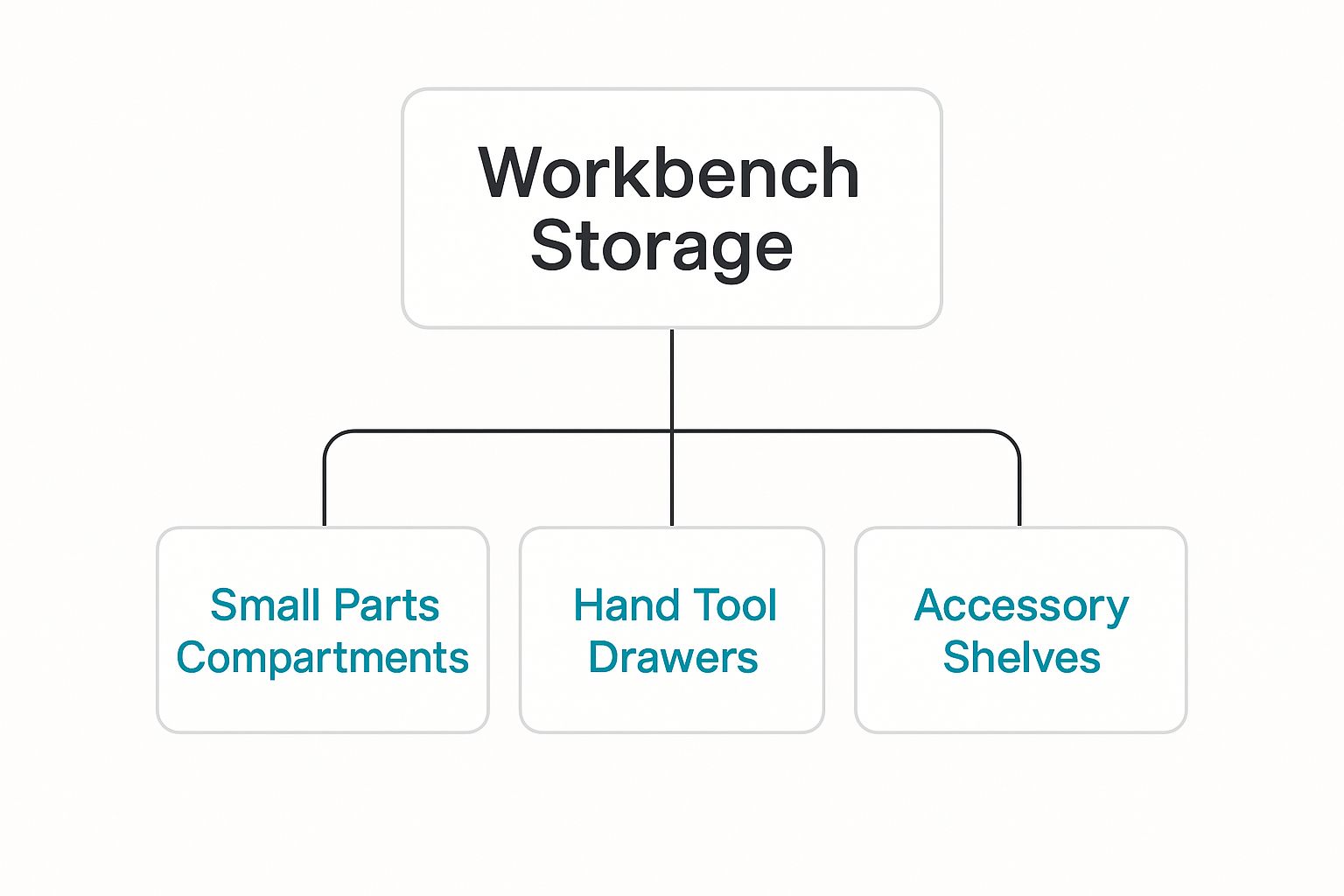
This structure shows how breaking down storage into logical, visible categories—like compartments, drawers, and shelves—creates a system that’s intuitive and incredibly efficient to use.
Build in Flexibility for the Future
Finally, a great workshop has to be flexible. Your projects, tools, and skills will change over time, and your storage system must be able to adapt without needing a complete overhaul. Rigidity is the enemy of a long-term, functional space.
This is where modular and mobile solutions really prove their worth.
- Mobile Tool Carts: These let you bring a whole set of specialised tools directly to your project, whether you're working on a vehicle or a large assembly on the other side of the room.
- Modular Cabinets: Systems like those from TEMA Solutions can be reconfigured or added to as your collection of tools and parts inevitably grows.
- Adjustable Shelving: This allows you to easily change shelf heights to accommodate new pieces of equipment or bulk material purchases.
By choosing storage that can be moved, rearranged, and expanded, you are essentially future-proofing your workshop. It’s the best way to ensure your space stays efficient and supports your work, no matter what new hobby or project you decide to take on next.
Choosing the Right Storage Hardware
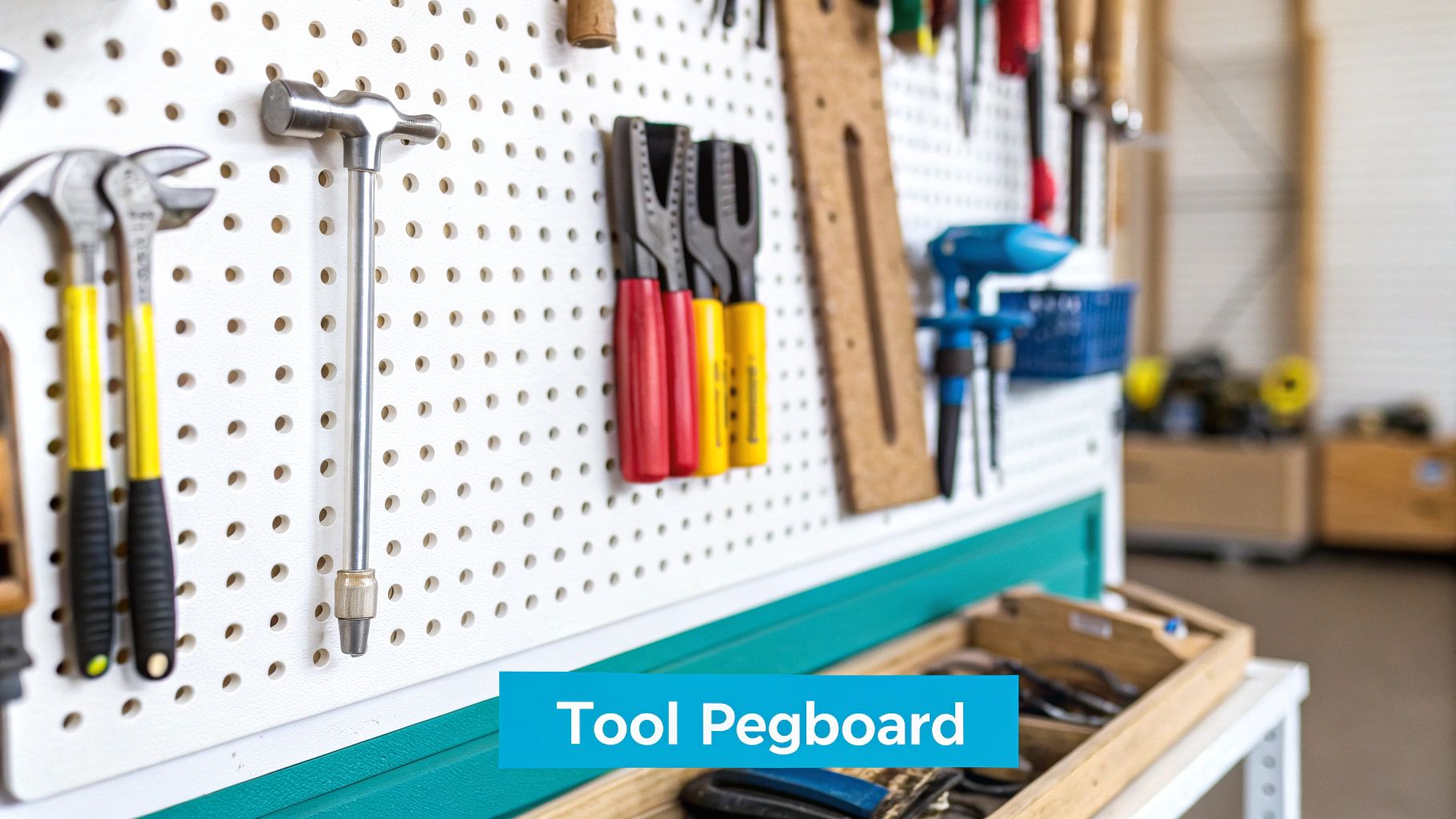
So, you’ve got a solid plan built around access, visibility, and flexibility. Now for the fun part: picking the physical kit that will bring your workshop to life. This is where your vision becomes a reality, selecting the true workhorses of workshop organisation—cabinets, shelving, and wall-mounted systems. Each one has a specific job to do in creating an efficient, clutter-free space.
And it’s a big market. The garage storage cabinet sector in the UK and Europe alone is expected to reach about $2.5 billion by 2025. This isn't just a number; it shows a real shift as more of us get serious about DIY and want our workshops and garages to be proper, functional spaces. This demand is fuelling the need for tough, effective solutions like steel and plastic cabinets.
Cabinets: The Foundation of Secure Storage
Think of cabinets as the backbone of any serious workshop. They provide secure, dust-free homes for valuable power tools, delicate equipment, and all those bulky items you don't want lying around. The first big decision you’ll face is steel versus plastic.
-
Steel Cabinets: These are the professional's choice, hands down. They offer top-notch security with robust locks and simply can't be beaten on durability. A quality, powder-coated steel unit from a brand like Thurmetall or LISTA will fend off dents, scratches, and chemicals for years. It's a genuine long-term investment.
-
Plastic Cabinets: A great option if you're working with a tighter budget. While they don't offer the same security or ruggedness as steel, modern plastic cabinets are lightweight, rust-proof, and a breeze to clean. They're perfect for stashing consumables and less valuable tools.
A good cabinet system does more than just keep things tidy. Its real value lies in protecting your investments. It shields expensive tools from dust, moisture, and theft, making sure they’re in perfect working order when you need them.
Shelving: The Key to Visibility and Access
While cabinets are for hiding things away, shelving is all about putting them on display. This is absolutely critical for items you need to see and grab in a hurry, like organisers brimming with screws or your most-used material stock.
Heavy-duty freestanding units are brilliant for taking serious weight, making them ideal for bulky machinery or supplies. For something more adaptable, adjustable wall-mounted tracks give you customisable storage that can change as your projects do. It's worth exploring different https://tema-solutions.co.uk/wire-racks-shelving/ to see what might best suit your space. For bigger setups, you could even look into racking and shelving rental options to maximise your vertical space without the upfront cost.
Wall Organisers: Turning Air into Assets
Finally, don't ever underestimate your walls. They represent prime real estate for some of the smartest storage ideas in any workshop. Systems like pegboards and French cleats can transform an empty vertical surface into an incredibly efficient storage zone.
-
Pegboards: The classic, affordable choice. With a near-endless variety of hooks and hangers available, a pegboard gives you a customisable home for every hand tool, keeping them perfectly visible and always within reach.
-
French Cleats: A more robust and versatile system. It uses interlocking angled cleats that allow you to hang heavy items like cabinets or custom-built tool holders securely. The best part? You can rearrange everything without drilling a single new hole.
Clever Solutions for Maximum Space
A truly organised workshop isn't just about being tidy—it's about turning your space into a powerhouse of efficiency where every single inch is working for you. To get there, we need to think beyond the obvious and start looking at those often-forgotten areas. This means thinking vertically, getting mobile, and setting up dedicated zones for your most common jobs.
Most of us have a habit of thinking about storage purely in terms of floor space. The real game-changer, however, is often right above your head. High shelving, installed close to the ceiling, is perfect for stashing away things you don't need day-to-day, like seasonal gear or bulk materials. By shifting these items up and out of the way, you reclaim prime real estate down below for your everyday work.
Harnessing Dynamic and Underutilised Spaces
Another brilliant tactic is to make your storage mobile. Why have everything bolted to the floor? A rolling tool cart, for example, lets you create a completely fluid layout. You can bring an entire toolkit right to the project you're working on, which slashes the time you'd otherwise spend walking back and forth to grab things.
This idea of mobility is what creates a truly flexible workspace. It lets you reconfigure your shop on the fly, which can make even a small area feel much larger and more capable. Start thinking of your workshop less as a static room and more as a modular environment that adapts to whatever you're building today.
The goal is to make every square foot work for you. By using vertical space for long-term storage and mobile units for daily tasks, you create a workshop that is both spacious and incredibly efficient.
The demand for these kinds of solutions is really taking off. The UK market for garage organisation, which heavily overlaps with workshops, was valued at over USD 2 billion back in 2022. It's now projected to climb to a staggering USD 3.5 billion by 2030. Garage cabinets accounted for nearly 43% of that market, which just goes to show how vital they are for smart space management. You can dive deeper into these figures by exploring the market research on Grand View Research.
Defining Your Workflow with Zoning
One of the most powerful strategies you can adopt is 'zoning'. This is simply about creating dedicated areas for specific tasks—an assembly bench over here, a finishing station over there, and maybe a metalworking corner in the back. The right storage is what makes these zones click. Your finishing station, for instance, should have all your sanders, stains, and varnishes organised neatly within arm's reach.
This approach brings a natural, logical order to your entire workflow. To keep all the small bits and pieces like screws, fasteners, and fixings under control within each zone, you need a system that gives you both organisation and instant visibility. Think about how much smoother your projects would be with purpose-built divider storage boxes designed for exactly this kind of detailed organisation. By setting up your workshop in logical zones, you build an intuitive and productive space where you can just get on with the job.
When To Use Off-Site Workshop Storage
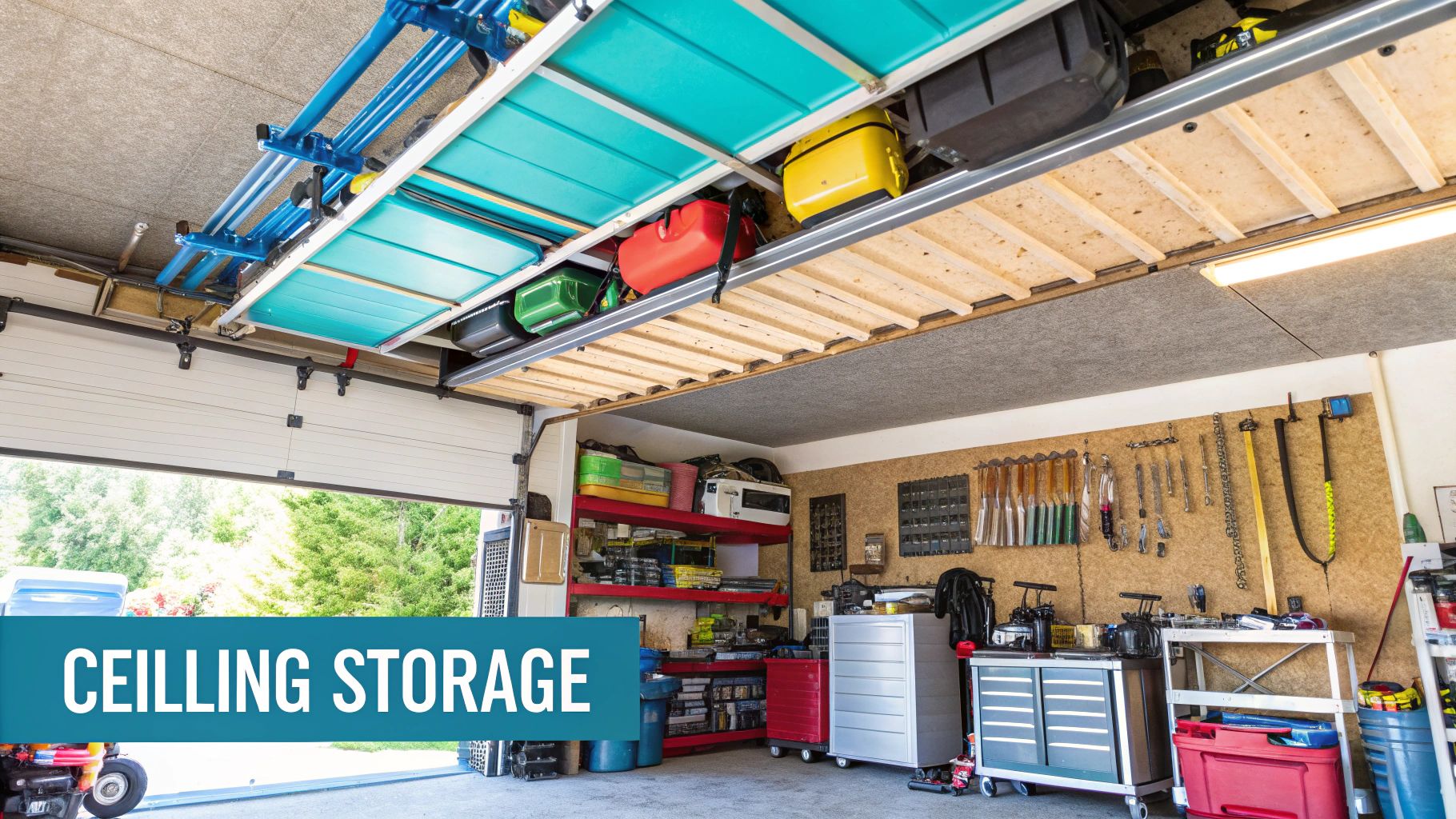
Even the most meticulously organised workshop eventually hits a wall—quite literally. You've installed shelving up to the ceiling and tucked things into every conceivable corner, but you're still tripping over stuff. When you’ve run out of space, it’s time to think beyond your four walls.
Using an external self-storage unit isn't about admitting defeat; it's a smart, strategic move that helps your business grow. Think of it as a managed extension of your workspace. It’s one of the most practical solutions for a workshop that’s bursting at the seams, letting you free up precious floor space for the work that actually makes you money. Off-loading certain items improves safety, cuts down on clutter, and helps you create a much more focused and efficient environment.
It seems a lot of people are catching on. The UK self-storage industry has grown significantly, adding 7.2% more floor space in the last year alone. That brings the total to a staggering 64.3 million square feet. This boom really highlights how many small businesses and serious hobbyists are using off-site units to manage their stock and reclaim their primary workspace.
What Belongs in Off-Site Storage?
The real trick is being selective about what you move. You don't want to find yourself driving across town just to grab a screwdriver. The goal is to store items that are important, but not needed for your day-to-day operations.
Here are a few classic examples:
- Bulk Raw Materials: Those stacks of timber, sheets of metal, or huge boxes of components take up an enormous amount of room. Store the surplus off-site and just bring what you need for the week into the workshop. The difference it makes is huge.
- Seasonal Equipment: Things like tools for large outdoor projects or specialised gear you only use a few months of the year are perfect candidates. Why let them clog up your workshop when they're not in use?
- Finished Projects: If you make products to sell, a storage unit can be your clean, secure stockroom. It keeps your finished goods safe from workshop dust and accidental knocks while they're waiting to be sold or delivered.
- Archived Tooling and Jigs: Custom jigs and tools you rarely use can be kept safe and sound, ready for that one specific job that comes up every so often. They don’t need to be taking up prime real estate in your main work area.
For especially large, valuable, or sensitive machinery, you might even consider dedicated equipment storage facilities, which often offer better climate control and security.
Think of off-site storage as your workshop's archive and warehouse. It’s not for your favourite hammer; it's for the twenty sheets of plywood you bought on sale.
This clear separation helps you keep your main workshop lean, agile, and purely focused on productivity. All the while, your long-term assets are kept secure and organised elsewhere. When you combine this approach with clever on-site solutions, like the ones in our guide to https://tema-solutions.co.uk/tool-cabinets-on-wheels-the-ultimate-mobile-workshop-solution/, you create a truly complete and efficient system.
Workshop Storage Questions Answered
Even the most carefully laid-out plans can hit a snag once you start putting them into practice. Questions always come up, and getting the right answers is what turns a good idea on paper into a system that actually works for you, day in and day out.
This section tackles those common queries head-on. Think of it as a troubleshooting guide to help you build a truly efficient workshop, getting it right the first time.
What Is the Best Way to Store Small Parts?
For all those tiny but essential items—screws, nails, washers, and other fasteners—there's really only one rule: you must be able to see what you have. The goal is to completely eliminate the dreaded "mystery tin" that stops a project dead in its tracks while you hunt for the right fixing.
Compartmentalised storage is your best friend here. Systems with clear, pull-out drawers are fantastic because you can see everything at a glance. Wall-mounted bin racks are another brilliant solution, getting all those small bits off your workbench but keeping them visible and within easy reach. The key is to group like with like and take away all the guesswork.
- Group logically: Keep all your wood screws together, all your machine screws in another spot, and so on.
- Label everything: Even with clear containers, a simple label on each drawer or bin is the final piece of the puzzle. It saves an unbelievable amount of time.
- Get creative: Don't underestimate simple solutions. A row of clean, labelled jam jars can be a surprisingly effective and low-cost way to get organised.
How Can I Organise My Workshop on a Tight Budget?
A great workshop is built on smart thinking, not just on spending a lot of money. You can get incredible results by focusing on clever, often DIY, solutions. The very first step is completely free: declutter ruthlessly. Be honest with yourself and sell, donate, or recycle anything you haven't used in years.
Once you’ve cleared some space, it’s time for some ingenuity. A French cleat system, which you can build from a single sheet of plywood, offers incredibly flexible and customisable wall storage for a tiny investment. You can construct sturdy shelves from reclaimed timber. And of course, the humble pegboard is still a classic for a reason—it’s a cost-effective way to get hand tools organised and accessible. It’s all about applying the principles of good storage with the materials you have to hand.
Should I Use Mobile or Stationary Storage?
Honestly, the best workshops nearly always have a mix of both. It's not a case of one being better than the other; they just do different jobs. A hybrid approach gives you the best of both worlds.
Stationary Storage: This is the foundation of your workshop. Think heavy-duty shelving and large wall-mounted cabinets. This is where you store things you use less often, bulk materials, and heavy power tools that don't need to move.
Mobile Storage: This is what gives you flexibility. Rolling tool chests, workbenches on castors, and mobile carts are absolute game-changers. They let you bring your tools and supplies right to where you're working, which is a massive boost to efficiency.
If you have a smaller workshop, prioritising mobile units is often the smartest move. It gives you the power to completely reconfigure your space for different tasks, making a small room feel much bigger and more versatile.
What Is the Biggest Workshop Storage Mistake?
Without a doubt, the most common mistake is buying storage before you know what you need to store. It’s so tempting to see a cluttered bench and rush out to buy a set of drawers or a cabinet, hoping it will solve the problem. But all you end up doing is tidying away junk you don’t even need.
The process has to start with an inventory. Pull everything out, be critical about what you keep, and group the keepers by how you use them. Only then will you have a clear picture of the type and size of storage you actually need. A very close second is ignoring your walls. That vertical space, right up to the ceiling, is the most valuable and underused real estate in your entire workshop.
At TEMA Solutions Limited, we specialise in providing the high-quality, durable storage hardware needed to bring these ideas to life. From robust steel cabinets to customisable workbenches, our solutions are designed to make your workshop safer, more organised, and more productive. Explore our full range of professional-grade storage.


