


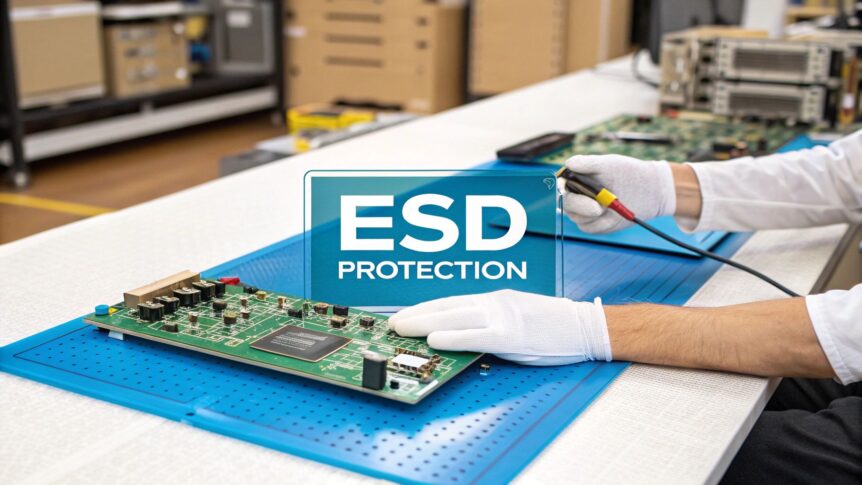
Ever felt that little zap of static shock after walking across a carpet and touching a doorknob? That’s electrostatic discharge, or ESD, in action. ESD protection is all about preventing that same sudden zap of electricity from frying the delicate electronic components we rely on every day.
The Invisible Danger to Your Electronics

Think of an ESD event as a microscopic lightning strike targeting your most sensitive electronics. It’s the same basic principle as shuffling your feet on the rug, but for a tiny computer chip, that discharge can be catastrophic, destroying the intricate pathways that make it work.
This static charge builds up on almost everything—people, tools, and even work surfaces—through simple friction. This process, called tribocharging, is happening all the time. When a charged object gets too close to an electronic component, the built-up energy can suddenly leap across the gap.
Why This Unseen Force Is a Critical Threat
The real danger with ESD is that you often can't see or feel it. A discharge strong enough to permanently damage a microchip can be far too small for a person to notice. This makes it a silent, persistent threat in any environment where electronics are built, repaired, or handled.
The economic impact is staggering.
International estimates suggest that worldwide, up to 25% of all electronic component failures are caused by ESD events. This highlights the critical need for proactive protection.
This isn't just a global issue; it's a major concern right here for the UK’s technology and manufacturing sectors. Even highly regulated fields like military aviation have strict protocols for handling ESD-sensitive devices to avoid catastrophic failures in mission-critical systems.
While ESD focuses on static electricity, a comprehensive strategy for protecting your equipment also means understanding essential computer hardware security to guard against other threats.
The Three Pillars of ESD Control
To get a handle on an invisible threat like electrostatic discharge, you need a solid, multi-layered strategy. Real ESD protection isn't about a single magic bullet; it’s a complete system built on three core principles working together. Once you grasp these pillars, you'll see how every bit of protective gear plays its part in creating a safe environment for delicate electronics.
These fundamental principles are grounding, shielding, and neutralisation. Each one tackles the static electricity problem from a different angle to form a complete defence.
The following infographic gives a great visual of how these pillars function in a protected workspace.

This image shows a technician shielded by a Faraday cage, illustrating how different layers of protection combine to create a safe zone for sensitive components.
Grounding: The Safe Drainage Path
Grounding is the absolute cornerstone of ESD control. Think of it like a lightning rod on a building—it offers a safe, controlled path for dangerous electrical energy to flow away from something valuable and dissipate harmlessly into the earth.
In an ESD-safe area, we connect people, work surfaces, and tools to a common ground point. This ensures any static charge that builds up has an immediate and safe escape route, stopping it from ever reaching a level where it could zap a sensitive component. Wrist straps and grounded mats are perfect, everyday examples of this principle in action.
Shielding: An Invisibility Cloak for Components
While grounding drains static away, shielding stops it from ever getting near the component in the first place. This is done by creating what’s known as a Faraday cage around the sensitive item.
A Faraday cage is an enclosure made of conductive material that blocks external electric fields. For ESD protection, this means anti-static bags or containers that act as a barrier, effectively making the components inside invisible to nearby static charges.
This pillar is absolutely critical when electronics are being moved or stored, as grounding isn't always practical in those situations. The shield intercepts any discharge and keeps the inside of the package electrically neutral.
Neutralisation: Taming Stubborn Charges
Finally, the third pillar deals with charges on materials that can't be grounded, like plastics and other insulators. Neutralisation uses tools like ionisers to release a balanced stream of positive and negative ions into the air. These ions land on charged surfaces and neutralise the static, stopping it from building up at the source.
Building Your ESD Protected Fortress
An ESD Protected Area (EPA) isn't just a random collection of equipment; it's a carefully planned environment designed to keep dangerous electrostatic discharge at bay. Think of it as creating layers of defence, where every single element works together to build a complete system.
The goal is simple: create a safe zone where any static charge is neutralised and channelled to the ground before it can ever reach and destroy a sensitive electronic component.
The Foundation of Safety
Everything starts from the ground up—literally. The first line of defence is specialised ESD-safe flooring or floor matting. This material is designed to be dissipative, which means it safely and slowly drains static charges away from people and equipment. Without it, just walking across the floor could build up a charge big enough to cause damage.
Next up is the workbench itself. An ESD-safe workbench features a static-dissipative surface that’s directly connected to a common earth ground point. This creates a completely neutral surface, allowing you to handle sensitive components without the risk of a sudden, damaging spark.
An EPA is a bit like an ecosystem. Every part is connected, and a single weak link—like an ungrounded mat or a regular office chair—can break the entire chain of protection.
Connecting People to the System
Even with the right floors and benches, the biggest source of static is often the person doing the work. This is why personal grounding equipment is absolutely essential.
- Wrist Straps: These are the most common and effective grounding tools. A technician wears the strap, which is connected by a cord to the common ground point, keeping them at the same electrical potential as the entire workspace.
- ESD Footwear/Heel Straps: When people need to move around the EPA, special footwear or heel grounders are used. They work in tandem with the ESD flooring to provide a continuous path to ground.
- ESD Smocks: Everyday clothing, especially synthetic fabrics like polyester, can generate a surprising amount of static. ESD-safe garments are made with conductive fibres that create a shield, preventing these charges from zapping any components.
To give you a clearer picture, here’s a breakdown of the core equipment needed to set up a safe handling environment for sensitive electronics.
Essential Components of an ESD Protected Area
| Component | Primary Function | How It Works |
|---|---|---|
| ESD Workbench | Provides a static-safe work surface. | Features a dissipative top layer connected to a common earth ground, preventing charge build-up on the surface. |
| Wrist Strap | Grounds the technician handling components. | Creates a direct path from the person's skin to the ground, equalising their electrical potential with the work area. |
| ESD Flooring/Matting | Drains static from people and mobile equipment. | Dissipates static charges generated by walking or rolling carts, channeling them safely to the ground. |
| ESD Smock/Clothing | Shields components from static on clothing. | Made with conductive threads that form a "Faraday cage" effect, containing electrostatic fields from the wearer's clothes. |
| Common Ground Point | Centralises the grounding system. | A single, verified connection to the building's earth ground where all ESD equipment is connected. |
Each of these components plays a critical role in maintaining the integrity of the EPA.
Finally, setting up your fortress is only half the battle; maintaining it is just as crucial. Regular cleaning is vital to ensure the dissipative properties of your surfaces aren't compromised by dirt and grime. You can learn more about the best practices for maintaining your specialised workspace to guarantee your EPA remains effective for the long haul.
Your Essential ESD Protection Toolkit
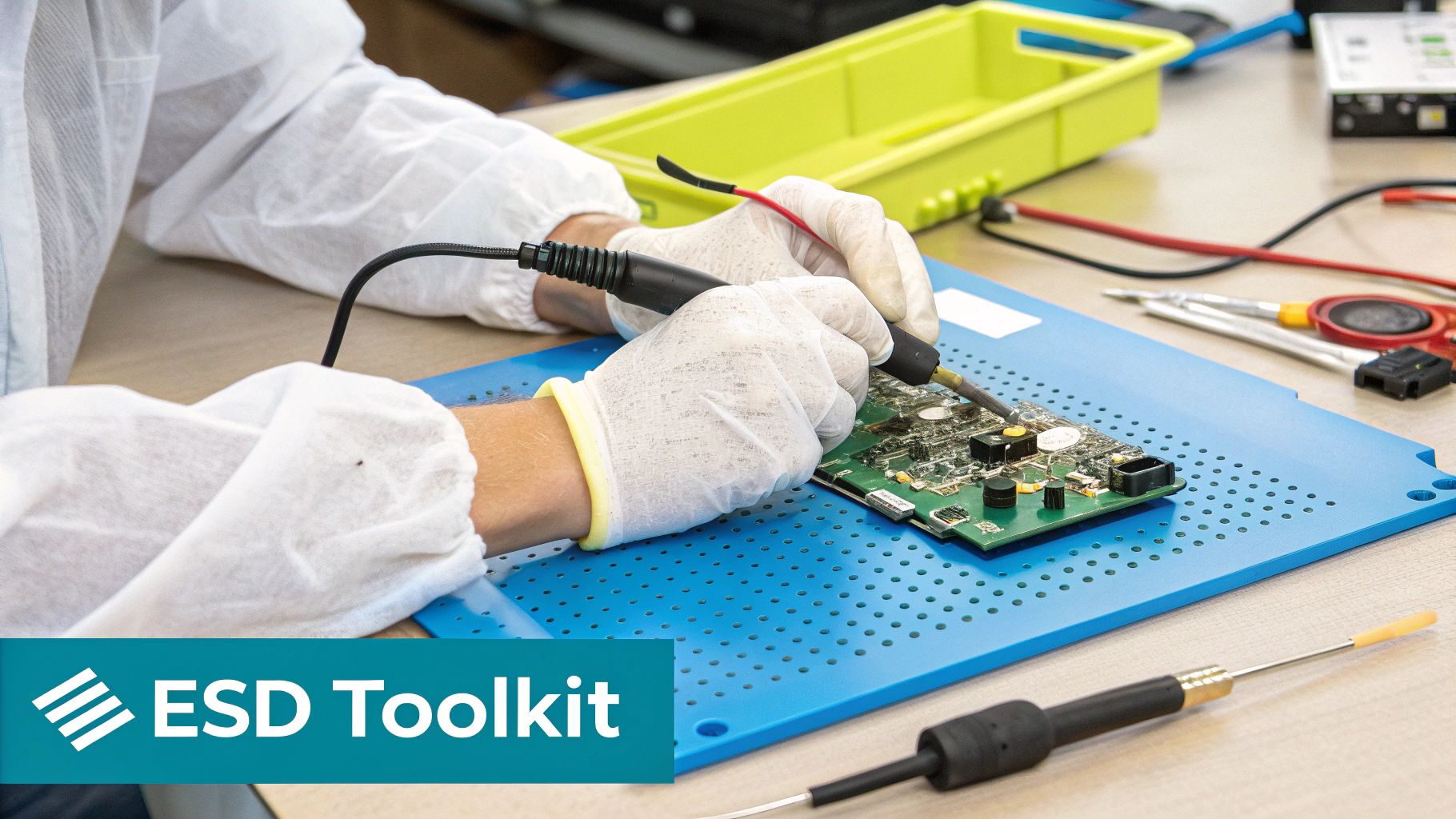
While a fully kitted-out EPA sets the stage for safety, the real, hands-on work with sensitive electronics comes down to a core set of personal and portable tools. These items are your first and most important line of defence, making sure every single interaction—from assembly to transport—is safe from electrostatic discharge.
The most basic, non-negotiable piece of gear is the personal grounding strap. A wrist strap, for instance, creates a direct and secure link between a technician and an earth ground point. It works by constantly siphoning off any static charge your body generates, stopping it from ever building up to dangerous levels. It's like a personal lightning rod, keeping you electrically neutral and safe.
Clothing and Containment
Beyond direct grounding, the very clothes on your back can be a major source of static. Everyday fabrics, particularly synthetics, can build up a surprising amount of charge from simple movement. That’s where ESD-safe garments make a real difference.
- ESD Smocks and Lab Coats: These aren't just standard workwear. They are made with special conductive fibres woven right into the fabric, creating a shielding effect that contains the electrostatic fields generated by the clothing underneath.
- ESD Footwear: When you need to move around the workspace, special shoes or heel grounders connect you to the ESD flooring. This maintains a continuous path to ground, even as you walk.
This personal gear is often paired with a whole range of ESD workspace and storage solutions to keep the entire environment secure.
Finally, protecting components doesn't end at the workbench. The moment electronics are moved or shipped, they enter an uncontrolled environment where shielding becomes absolutely critical. This is the job of ESD-safe packaging, like anti-static bags and containers, which create a protective bubble around the device.
This packaging essentially acts as a Faraday cage. It blocks external electric fields and stops any static charge from ever reaching the sensitive contents inside. It's the final, crucial step for complete ESD protection.
The need for these solutions is massive. In the UK, major aerospace and automotive companies rely on them daily, because even a single ESD event could cause catastrophic product failures. This is a global trend, with the ESD packaging market projected to hit USD 8.53 billion by 2032. As you can dig into further, Europe is also spearheading a move towards more sustainable ESD packaging options. You can read the full research on the growing electrostatic discharge packaging market.
Bringing Your ESD Control Plan to Life
Having the right gear is a fantastic starting point, but an effective ESD control programme is really built on people and procedures. After all, the best tools in the world are useless if your team doesn't know how to use them properly, which makes solid training the cornerstone of your entire strategy.
A good plan bridges the gap between theory and day-to-day practice. It all starts with creating clear, consistent handling procedures for every single ESD-sensitive device. Everyone needs to know the correct protocol for entering an EPA, grounding themselves, and managing components without creating a static risk. This isn’t a one-off memo; it’s a continuous commitment.
Keeping Your Defences Strong
Think of ESD protection as a living system, not a one-time setup. Your protective measures can degrade over time through simple wear and tear or improper use. That's why routine checks and regular audits are absolutely essential.
Putting a maintenance schedule in place is the only way to guarantee the long-term integrity of your EPA. Key activities should include:
- Daily Checks: Before starting any work, technicians must test their personal grounding equipment, like wrist straps and footwear. Make it part of the daily routine.
- Monthly Audits: Systematically go through all elements of the EPA. Check your workbench surfaces, flooring, and ionisers to make sure they are still performing to the correct standard.
- Annual Reviews: Step back and look at the bigger picture. Re-evaluate your entire ESD control plan to account for new equipment, updated processes, or changes in industry standards.
An ESD control plan isn't just about preventing device damage. It's a vital part of your quality control and a pillar of operational excellence. A well-run programme directly cuts down on product failures, reduces rework costs, and boosts the reliability of everything you produce.
Following these steps helps build a culture of awareness where every person understands the part they play. This proactive mindset is a key component of maintaining overall workplace safety compliance and protecting your valuable assets from an invisible threat.
Where ESD Protection is Absolutely Mission-Critical
An ESD failure isn't just a minor glitch. In certain industries, it’s a high-stakes event that can lead to catastrophic failure. For these sectors, robust ESD protection isn't just a good idea—it’s a fundamental requirement for safety, reliability, and the success of the entire mission.
Think about the aerospace and defence industries. You simply can't have a guidance system or communications array fail mid-flight. The intricate electronics packed into satellites, aircraft, and military gear have to work perfectly under intense conditions. That’s why comprehensive ESD control is baked into the manufacturing process from the very beginning.
High-Stakes Commercial Applications
The modern car has basically become a powerful computer on wheels. Sensitive microchips and sensors manage everything from airbags and anti-lock brakes to engine timing and the satnav. An ESD zap during assembly can create a hidden defect that doesn't show up for months, leading to dangerous situations on the road and incredibly expensive recalls.
It’s a similar story in the medical device field, where there's absolutely no room for error. The reliability of pacemakers, MRI scanners, or patient monitoring systems can be the difference between life and death.
Effective ESD protection ensures that these life-saving devices function exactly as intended, free from the silent threat of electrostatic damage that could compromise their performance when it matters most.
The market data backs this up. Global demand for ESD protection devices is expected to climb from USD 2.7 billion to USD 4.3 billion by 2033, a surge driven largely by these high-tech industries. With silicon-based components accounting for over 68% of the market, the need to protect electronics in everything from our phones to factory equipment is undeniable. You can dive deeper into the growth of the ESD protection market to see the key drivers.
At TEMA Solutions Limited, we build the specialised ESD-safe workstations and storage solutions these critical industries rely on to guarantee quality and reliability every single day. https://tema-solutions.co.uk


