


Effective garage storage isn't just about tidying up. It’s the backbone of a high-performing workshop – a complete system of cabinets, shelving, and workbenches that turns a chaotic space into a powerhouse of productivity and safety. In a professional automotive or manufacturing setting, it’s a strategic investment that frees up floor space and gives every single component a home.
From Clutter to Control with Professional Garage Storage
Let's face it, a disorganised workshop costs you more than just a few minutes hunting for a tool. It chips away at your safety, your efficiency, and ultimately, your bottom line. When tools go missing, components get damaged, and trip hazards are everywhere, the problem is bigger than frustration. It's an operational bottleneck that stalls growth.
This is a familiar struggle. A recent study found that nearly six million of the UK's 11 million garages are so cluttered you can't even park a car in them. While that’s about home garages, the problem is magnified in a professional environment. As RAC.co.uk highlighted in their analysis of these trends, this level of disorganisation in a business isn't a minor headache—it's a critical failure.
The Strategic Value of an Organised Workspace
This is where strategic garage storage comes in. It’s not just furniture; think of it as a high-performance system engineered to bring order to the chaos. The goal is to create an environment where every movement is purposeful and every tool is right where you need it, when you need it.
A well-designed system of heavy-duty cabinets, industrial shelving, and purpose-built workbenches delivers on several fronts:
- Maximises Your Space: By going vertical with smart shelving and using modular units, you can claw back a surprising amount of valuable floor space.
- Sharpens Your Workflow: Creating specific zones for disassembly, repair, and finishing means less walking around and no more wasted steps.
- Boosts Safety and Compliance: Properly storing heavy parts, hazardous chemicals, and sensitive equipment is fundamental to preventing accidents and damage.
- Improves Professionalism and Morale: A clean, organised workshop doesn't just look good for clients; it creates a far better and more productive environment for the team.
A professional garage storage system is the foundation upon which operational excellence is built. It’s what separates a workshop that just gets by from one that truly excels, turning bottlenecks into smooth processes and driving real productivity gains.
This guide is designed to help you make the right choices to reclaim your workspace. By getting to grips with the core principles of effective storage, you can choose the components that fit your exact needs. To get started, you might find some great ideas in our guide on storage ideas for a workshop. We’ll explore how a tailored system from a specialist provider can pay for itself many times over through sheer performance.
Choosing Your Workshop's Building Blocks
A high-performance workshop isn't just about the skills of the people in it; it’s about how every single component works together. Think of your storage system in the same way. It's not just a place to put things, but a collection of essential building blocks, each with a specific job to create a safer, more efficient space. Getting to grips with these core components is the first real step in designing a workshop that actually helps you get the job done.
The bedrock of any serious setup is heavy-duty garage cabinets. These aren't your average cupboards; they're secure vaults for your most valuable tools and equipment. They shield precision instruments from dust and damp while giving you control over who can access what, keeping your inventory locked down. A well-planned cabinet system means less time spent hunting for a tool and more time spent actually working.
The industry certainly recognises their value. The UK garage organisation market hit a massive £2,042.1 million in 2022, and cabinets alone accounted for the largest slice of that pie at 42.93%. With the market expected to climb to £3,513.1 million by 2030, it's clear that businesses see professional storage as a critical investment, not an expense.
The Core Components of Professional Garage Storage
Beyond cabinets, a complete system brings together several key elements to tackle the varied demands of a professional workshop. Each piece is designed to solve a different storage problem or smooth out a kink in your workflow.
-
Industrial Shelving: This is the real workhorse, built for your heavy and bulky items. Unlike flimsy domestic shelving, industrial-grade units are engineered to hold serious weight, making them perfect for stashing spare parts, raw materials, and hefty equipment.
-
Integrated Workbenches: A workbench is more than just a table; it's the heart of your workspace where assembly, repairs, and diagnostics happen. Professional benches often come integrated with storage, power outlets, and task lighting, creating a self-sufficient and highly productive station.
-
Specialised Units: For workshops that handle sensitive electronics, Electrostatic Discharge (ESD) workbenches are absolutely essential. They’re built to safely ground static electricity, protecting delicate components from the kind of invisible damage that can cause catastrophic failures down the line.
This flowchart shows exactly how a workshop evolves from chaos to control when a proper system is put in place.
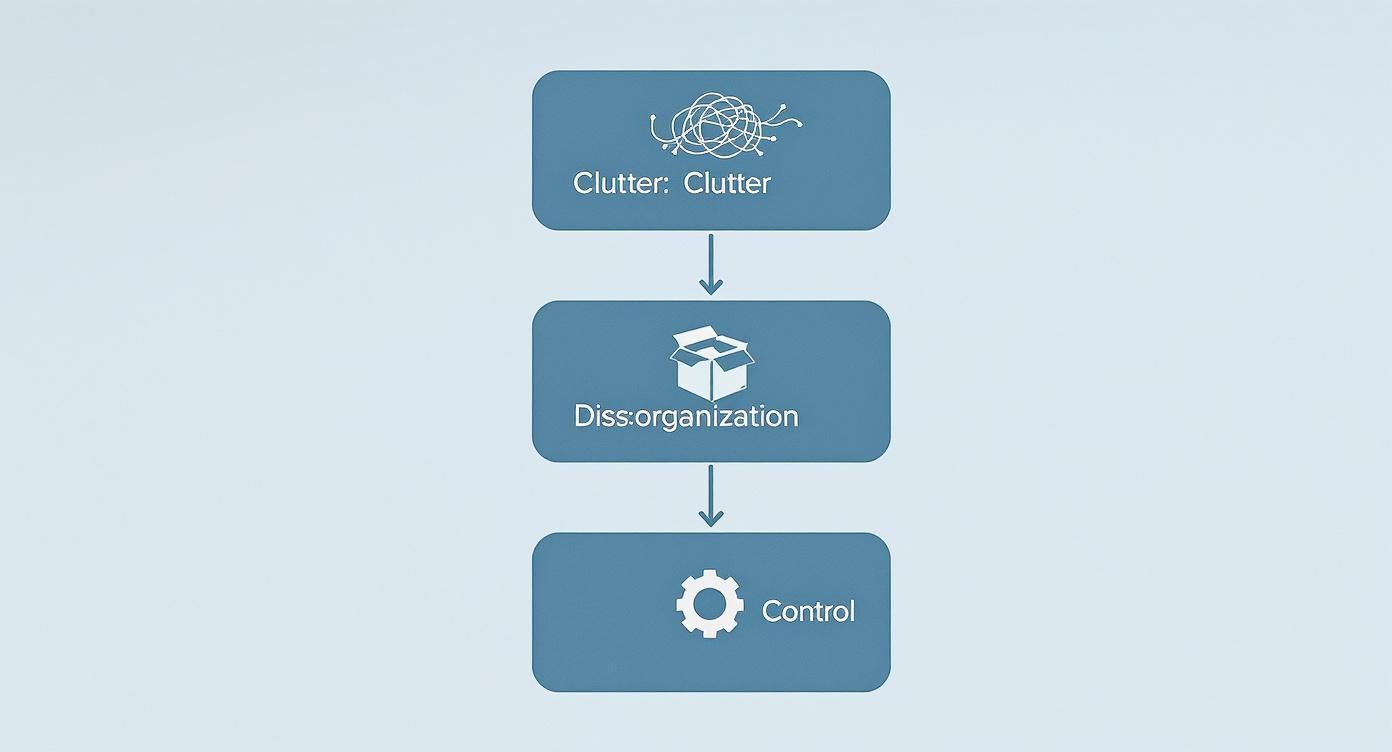
It’s a perfect visual of how implementing a structured system directly transforms a cluttered, disorganised space into a highly functional and controlled professional environment.
To make it easier to see how these pieces fit together, here's a quick comparison of the main components.
Comparing Professional Garage Storage Components
| Storage Type | Primary Use Case | Typical Materials | Load Capacity Range | Key Features |
|---|---|---|---|---|
| Heavy-Duty Cabinets | Secure storage for tools, parts, and sensitive equipment. | Powder-coated steel, stainless steel | 50-150 kg per drawer/shelf | Lockable doors, configurable drawers, dust/moisture protection. |
| Industrial Shelving | Storing bulky items, raw materials, and heavy stock. | Galvanised or painted steel, reinforced beams | 200-1000 kg+ per shelf | Open-frame design, adjustable shelf heights, high vertical storage. |
| Integrated Workbenches | Primary workstation for assembly, repair, and detailed tasks. | Steel frame, hardwood/laminate/steel tops | 300-1500 kg+ total | Built-in storage, power outlets, task lighting, customisable surfaces. |
| ESD Units | Handling and assembling sensitive electronic components. | Steel with dissipative surfaces, grounding points | 250-750 kg total | Static dissipative worktop, grounding wrist strap connections, conductive parts. |
Choosing the right combination is what makes a workshop truly effective. It's about matching the equipment to the specific tasks you perform every day.
Matching Materials and Configurations to Your Work
The material your storage is made from is just as crucial as its design. For the vast majority of professional workshops, industrial-grade steel is the go-to choice. It's strong, durable, and gets the job done without breaking the bank. Most units are powder-coated, which gives them a tough finish that resists scratches, chemicals, and rust.
If you’re working in an environment that demands serious corrosion resistance or needs to be kept spotlessly clean—like in food processing or certain labs—then stainless steel is the better pick. It costs more, but its ability to stand up to rust and harsh cleaning chemicals is second to none.
Choosing the right storage is about anticipating your needs. A mechanic's workshop requires robust drawer cabinets for hand tools and sockets, while a fabrication shop needs heavy-duty open shelving for raw materials. The configuration must serve the workflow.
When you're pulling together the basic components for your workshop, it pays to explore options like various mounting rails and storage accessories that give you more flexibility. These add-ons let you tweak your setup to perfectly match your needs, making sure every tool has its own home.
The right drawer setup, for instance, is absolutely vital for quick access. You can learn more about optimising your tool storage by exploring our range of high-quality metal cabinets with drawers built for professional environments. With these fundamentals covered, you’ll be ready to move on to planning your workshop layout.
Designing Your Ideal Workshop Layout
Think of your workshop's layout as its central nervous system. A well-designed one makes everything work together seamlessly, turning a simple collection of storage units into a high-performance workspace. You wouldn't build a house without a solid blueprint, and the same principle applies here. This isn't about just finding a spot for everything; it's a strategic process of mapping out the entire space to make it safer, more ergonomic, and ultimately, more productive.
The whole point is to cut out wasted steps and make sure every task flows logically into the next. Get it right, and you’ll feel the difference every single day.
It all starts with the humble tape measure. Before you even think about ordering cabinets or workbenches, you need to know exactly what you’re working with. That means measuring not just the main walls, but every single obstacle that could get in your way.
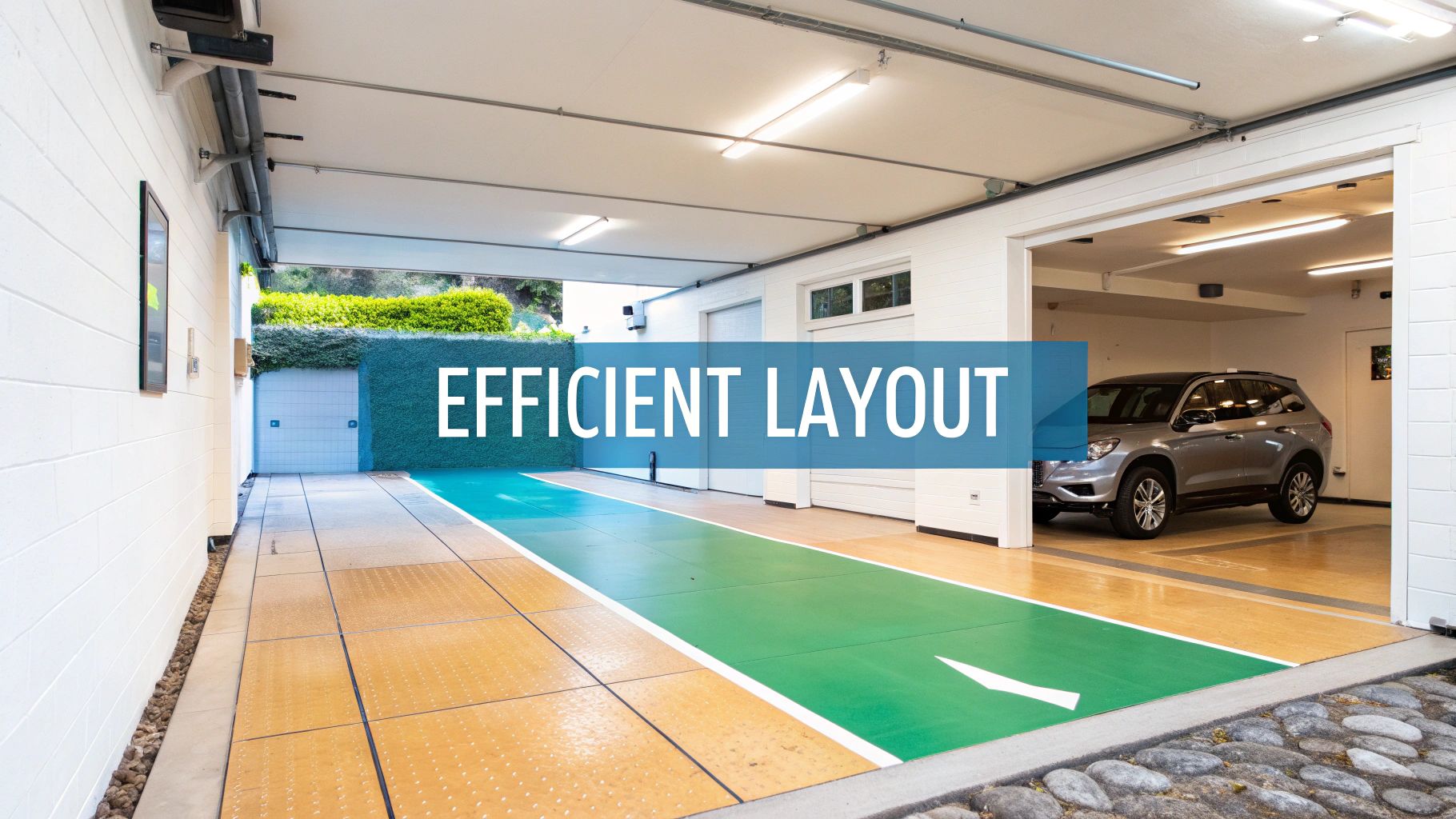
Mapping Your Physical Space
First things first, get a floor plan down on paper. A rough sketch is a good starting point, but for real accuracy, you might want to use some of the free room planning software available online. The key is to be meticulous with your measurements.
- Document Wall Dimensions: Measure the length of every single wall, corner to corner. Don't estimate.
- Locate Doors and Windows: Mark where all doors and windows are, noting their size and which way they swing open. Remember to measure their height from the floor – a low window can stop you from placing a tall cabinet or workbench against that wall.
- Identify Utility Access: Pinpoint the location of every power socket, light switch, water pipe, and drain. It’s far cheaper to plan around these now than to pay an electrician or plumber to move them later.
- Note Structural Features: Don’t forget to include things like support pillars, low-hanging beams, sloped ceilings, or anything else that’s a permanent part of the structure.
With this map in hand, you’ve got a proper canvas to work from. This isn't just a pointless exercise; this accurate blueprint is the foundation for figuring out how you'll actually use the space.
Analysing Your Workflow and Creating Zones
Now for the smart part: workflow analysis. This is really just a fancy way of saying you need to think about how you move around during a typical project. Picture it from start to finish. Where do parts and materials come in? Where do you do the messy disassembly work? What’s the most logical path to the repair bench, and then on to the finishing station?
By tracing these steps, you can create dedicated work zones. This simple idea is incredibly powerful. It stops you from constantly walking back and forth and prevents cross-contamination – think keeping grinding dust well away from a sensitive electronics bench.
A well-zoned workshop guides you. Instead of constantly fighting the layout, the space itself helps you work more efficiently, which reduces physical strain and mental fatigue over a long shift.
Let's make this practical. For an automotive workshop, you might set up zones like these:
- Receiving and Disassembly Zone: Right by the main garage door makes the most sense. You'll want heavy-duty shelving here for incoming parts and a tough workbench for the initial teardown.
- Repair and Machining Zone: This is the heart of your workshop. It’s where your main workbenches, tool cabinets, and specialist gear like lathes or presses should live. Good lighting is non-negotiable in this area.
- Assembly and Finishing Zone: This needs to be a clean space for putting things back together. If you handle delicate electronics, this is where you’d put an ESD-safe workbench.
- Parts and Tool Storage Zone: A central spot for the tools and components you use most often. A good system here means you can grab what you need and put it back without a second thought.
Finally, don't forget the invisible footprint of your biggest equipment. You have to plan for proper clearance around vehicle lifts, engine hoists, and other heavy machinery. It's not just about having enough room for the equipment itself, but for a technician to move around it safely. Thinking about these safety perimeters is what elevates a basic sketch into a professional, functional, and safe workshop design.
Understanding Load Capacity and Material Strength
In a professional workshop, the strength of your storage isn't just a nice feature—it's the bedrock of safety and efficiency. It’s easy to get sidetracked by looks or a low price tag, but that’s a rookie mistake. To get it right, you need to understand what actually makes industrial-grade storage tough enough for the daily grind.
Think of it like this: your shelving unit is a bridge. You wouldn't try to drive a fully-loaded lorry over a quaint little footbridge, would you? The same logic applies right here in your workshop. Piling heavy engine blocks or dense manufacturing parts onto consumer-grade shelves is just asking for a catastrophic failure. It’s a huge risk to your equipment and, far more importantly, a serious safety hazard for your team.
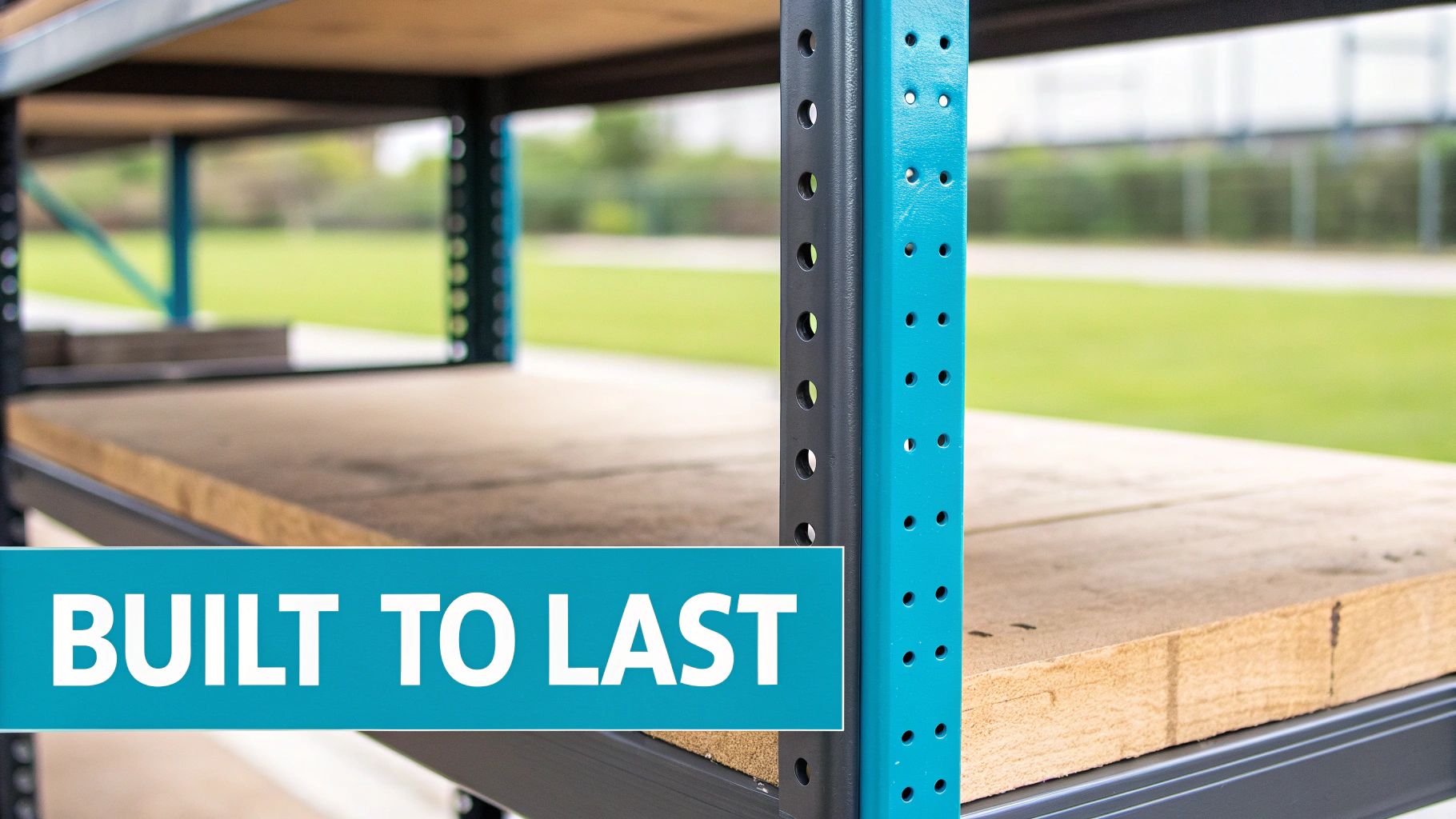
This is why getting to grips with load capacity is about more than just reading a number on a sticker. It's about protecting the structural integrity of your entire operation. Professional-grade materials aren't a luxury; they're a critical investment.
Decoding Load Ratings and Material Science
When you see a weight rating on a shelf or cabinet, that number typically refers to its Uniformly Distributed Load (UDL). Grasping this concept is vital. It represents the maximum weight the surface can hold, but only when that weight is spread out evenly across it—picture laying a large, flat sheet of steel on the shelf.
What it does not mean is that the shelf can take that same weight concentrated in one small area. For instance, a shelf rated for 400 kg UDL could easily buckle if you place a 400 kg engine block right in the centre. That focused force creates a single, intense point of stress that the structure simply wasn't designed for.
Always think about how you'll be storing items. If your workshop handles heavy, compact objects, you either need a solution with a specific point load capacity or a strategy to distribute that weight effectively to prevent failure.
This principle goes all the way down to the materials themselves. Not all steel is created equal. Professional storage systems are built from high-gauge steel, which is thicker and far more resistant to bending and impacts. This is usually finished with a powder coating, which does more than just add a bit of colour. It forms a tough, protective skin that fights off scratches, chemical spills, and the rust that can silently weaken a structure over time.
Welded vs Bolted Construction: What’s the Difference?
How a storage unit is put together is just as important as what it's made of. You'll generally come across two main methods, and each has its place in a professional setting.
-
Welded Construction: Here, the joints are permanently fused together. The result is an incredibly rigid and robust frame that arrives ready to go. Welded units are the go-to choice for environments where absolute durability is the top priority, as there are no bolts to work loose from vibrations or constant heavy use.
-
Bolted Construction: These systems need to be assembled on site. While they might not have the out-of-the-box rigidity of a welded unit, high-quality bolted systems are engineered with reinforced joints and high-tensile bolts to provide fantastic stability. Their biggest advantage is their modular nature, making them easier to transport and customise.
For almost any high-demand workshop, a fully welded cabinet or a properly engineered, heavy-duty bolted shelving system will run circles around the flimsy alternatives sold for domestic garages. With workshop space at a premium—the UK now has around 2,050 self-storage facilities offering 52 million square feet of space partly because on-site storage is so tight—making every inch count with reliable equipment is crucial.
And for those jobs that demand zero flex, like precision assembly or mounting a heavy vice, a rock-solid workbench is essential. A heavy-duty workshop bench built with a fully welded frame gives you a foundation that won't wobble under pressure, ensuring the quality of your work and the safety of your technicians.
Getting the Most Out of Your Investment for Years to Come
Buying a professional garage storage system is a serious investment, but its real worth is proven over years of dependable service. To make sure your cabinets, shelving, and workbenches pay you back, you need a smart plan for installation and long-term care. This is about more than just keeping things looking tidy; it’s about maintaining structural integrity and safety for the long haul.
The first big decision is how to get your new gear set up. While going the DIY route might look like a way to save a few quid initially, it’s a risky move for complex, heavy-duty systems. Professional installation is your guarantee that every unit is perfectly level on sloped concrete floors, securely anchored, and put together exactly as the manufacturer intended.
Professional Installation vs. DIY: A Worthy Expense
Deciding between professional and DIY installation really comes down to weighing up cost against precision and safety. A pro team has seen it all before—they know how to handle common workshop problems like uneven floors or walls that aren't quite true. They get the job done quickly, reducing your workshop’s downtime and making sure the system is safe and ready to go from day one.
Think of professional installation as a final quality check. An expert can spot potential problems with placement or anchoring that a DIY installer might overlook, preventing equipment failure or a serious safety incident down the line.
For any professional workshop, the precision you get from an expert installer is priceless. They ensure drawers glide without a hitch, doors hang perfectly, and load capacities are never compromised by shoddy assembly. That initial spend on their expertise pays for itself by stopping the kind of premature wear that can slash the lifespan of your equipment.
A Simple Maintenance Schedule That Works
Once everything is installed, a consistent maintenance routine is your ticket to longevity. You service the machinery in your workshop, right? Well, your storage equipment needs the same kind of regular attention to stay in top form. A little proactive care stops small issues from spiralling into expensive headaches.
Here’s a practical checklist to get you started:
- Monthly Once-Over: Have a quick walk around and look for any signs of damage—dents or scratches that have chipped the powder coat, for example. Check for loose bolts on shelving units and make sure all cabinets are still level and solid.
- Quarterly Clean-Down: Give all surfaces a proper wipe. For powder-coated steel, a cloth with a bit of mild detergent and water is all you need. Steer clear of harsh, abrasive cleaners that can strip the finish, as that’s your main line of defence against rust.
- Six-Month Lubrication: Apply a quality lubricant to all drawer slides, hinges, and locks. This keeps everything moving smoothly, reduces wear on the moving parts, and stops them from seizing up.
- Annual Weight Check: Take a look at how you’re storing your heaviest items. You want to make sure the weight is spread as evenly as possible and that you aren't constantly overloading any single shelf or drawer beyond its UDL rating.
Your Warranty is Your Safety Net
Finally, don’t underestimate the manufacturer’s warranty. It’s a direct reflection of how much they believe in their own product’s quality and durability. For instance, reputable brands like Thurmetall back their units with a five-year warranty, while LISTA offers a ten-year guarantee.
These warranties are more than just a piece of paper; they're a promise of performance. They tell you that the manufacturer has used top-notch materials and construction methods built to handle the tough environment of a professional workshop. Taking a moment to understand what’s covered is a final, crucial step in protecting your investment.
Why Custom Storage is a Game-Changer for Your Workshop
Off-the-shelf storage solutions are built for the average garage, not a high-performance professional workshop. Let's be honest, that one-size-fits-all approach rarely works when you're dealing with the realities of a working environment. Awkward pillars, low-set windows, sloped floors, or the unique footprint of your specialist equipment can make standard units a real headache.
That's when a bespoke system stops being a luxury and becomes a powerful operational tool.
It’s like trying to fit a square peg in a round hole. Many workshop owners start out with a random mix of leftover cabinets and second-hand benches. Before you know it, the setup is actively fighting against you, causing wasted time, constant frustration, and a general state of chaos.
A custom-designed system completely flips that script. It’s engineered around your specific challenges, turning those awkward nooks and crannies into highly functional, valuable assets.
Making Your Storage Work for You, Not Against You
The real magic of a custom approach is its ability to solve the problems that standard products simply can't touch. It's about creating an environment that feels like a natural extension of how you work, rather than an obstacle course you have to navigate every single day.
A bespoke solution can tackle things like:
- Spatial Headaches: A good provider can build cabinets that wrap perfectly around a structural column or design a workbench that slots neatly under a low window. Suddenly, that "dead space" is reclaimed and put to work.
- Workflow Logic: If your typical job involves moving from disassembly to a cleaning station and then to a parts rack, a custom layout can arrange these elements in a logical, ergonomic line. Think of all the wasted steps that eliminates.
- Industry-Specific Needs: An aerospace workshop requires secure, FOD-aware storage for calibrated instruments. An automotive bodyshop needs units that can stand up to paint and solvents. A custom plan ensures your storage is built for the job it needs to do.
A custom garage storage system isn't just about fitting into your space. It's about fitting into your business, actively supporting your processes, and making your entire operation run smoother.
This tailored approach pays for itself. Yes, the initial outlay is often higher than buying off-the-shelf, but the long-term gains in efficiency, safety, and productivity quickly start to balance the books.
Calculating the Real Return on Your Investment
The ROI of a custom system goes far beyond just having a tidier workshop. It hits your bottom line through real, measurable improvements in how your day-to-day operations run. When every tool, part, and component has a designated, logical home, your team spends less time searching and more time doing what they do best.
Think about the financial impact:
- More Billable Hours: Cutting down the time technicians spend looking for tools can reclaim dozens of valuable hours every single month. That's a direct increase in billable work without having to hire more staff.
- Fewer Accidents & Less Damage: Purpose-built, secure storage minimises the risk of accidents from trip hazards or falling items. It also protects your expensive equipment from damage, saving a fortune in replacement costs.
- A More Professional Image: A clean, organised, and professional-looking workshop isn't just nice to have—it builds client trust and confidence. That confidence leads to repeat business and better referrals.
Finding a partner like TEMA Solutions, who can engineer a system around your precise needs, is the key. We don't just sell boxes; we provide engineered solutions that become a core part of your success. By working with you to understand your workflow, we deliver a system that doesn't just store your tools—it helps you build your business.
Your Questions Answered: Professional Garage Storage FAQ
When you're ready to invest in a serious upgrade for your workshop, you’re bound to have some questions. It’s a big decision, and getting the right answers is the key to making a smart investment that pays off for years to come. Here, we'll tackle some of the most common queries we hear from workshop professionals.
Key Considerations Before You Buy
One of the first things people ask is, "Do I really need professional installation?" For the kind of lightweight shelving you might buy for your home, DIY is fine. But when we're talking about heavy-duty industrial systems, it's a completely different ball game. Professional fitters know how to get everything perfectly level on uneven concrete floors and, most importantly, how to anchor it securely. This isn't just about stability; it's about safety and ensuring the unit can actually handle its advertised load capacity.
Material choice is another hot topic. For most automotive and manufacturing settings, you can't go wrong with powder-coated steel. It’s the workhorse of the industry—strong, durable, and resistant to the daily barrage of scratches and chemical spills. That said, if your work involves a lot of moisture or corrosive agents, it’s worth spending a bit more on stainless steel. It’s an investment that will save you from rust and hygiene headaches down the line.
Here are a couple of other questions that come up time and again:
- What exactly is a Uniformly Distributed Load (UDL)?
Think of UDL as the total weight a shelf can handle, but only if that weight is spread out evenly across its entire surface. It's a critical detail because it’s not the same as a point load. Dropping a heavy engine block right in the middle of a shelf could cause it to fail, even if the block’s weight is well below the UDL rating. - Should I go for welded or bolted storage?
Welded units are the titans of rigidity. They arrive fully assembled and are built like tanks, making them perfect for permanent, heavy-duty applications. Bolted systems, on the other hand, offer more flexibility. They're easier to get into tight spaces and allow for some on-site customisation, and a well-engineered bolted unit is still incredibly sturdy once put together.
If I can leave you with one piece of advice, it's this: make sure your storage choice matches your real-world workflow. A system that looks fantastic but gets in your way is a wasted investment. Measure everything twice, think about your heaviest tools and most-used parts, and always plan with a little room for future growth.
Finally, workshop managers often wonder if a custom solution is worth the extra expense. If you're dealing with an awkward space, a specific workflow, or unique equipment, the answer is a resounding yes. A bespoke garage storage system can turn a problematic layout into your workshop's greatest strength, delivering a serious return on investment through better efficiency and improved safety.
Ready to stop fighting the clutter and start building a workshop that works as hard as you do? The team at TEMA Solutions are experts in designing and building high-performance storage that’s made to last. Take a look at our range of durable cabinets, workbenches, and shelving to see what’s possible. Find your perfect fit at https://tema-solutions.co.uk.


