


A cluttered workshop isn’t just a mess; it’s a productivity killer. When tools go missing and your work surface disappears under a pile of materials, projects grind to a halt and frustration takes over. This is where workbenches with storage come in, turning a chaotic space into a streamlined hub where efficiency is the default.
Why Your Workshop Needs Integrated Storage
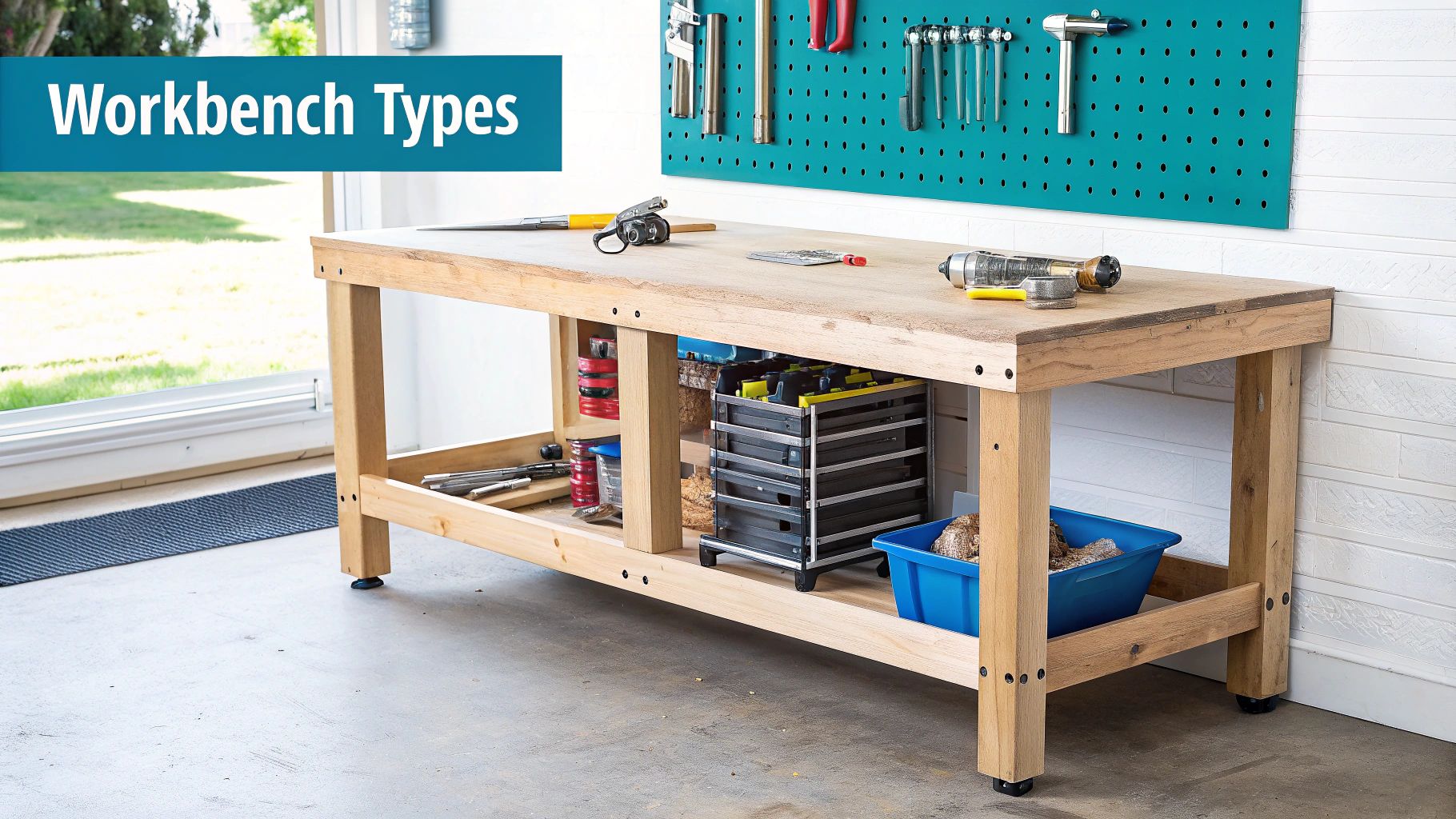
Picture a professional chef’s kitchen. Every knife, pan, and ingredient has its own spot, which is essential for working smoothly under pressure. An integrated workbench brings that same “mise en place” philosophy—everything in its place—into your workshop, garage, or industrial space. It’s one piece of furniture doing two crucial jobs: giving you a tough work surface and keeping your tools organised.
This combination is a real game-changer. It fundamentally resets the relationship between you, your tools, and your workspace. You end up with an environment where you can actually focus on the job, not on a constant search for the right piece of kit.
The Core Benefits of Combined Systems
The most obvious win is space efficiency. Let’s be honest, in many UK homes and businesses, especially in smaller garages or workshops, floor space is gold dust. A workbench with built-in storage merges two bulky items—a work surface and a tool cabinet—into a single, compact unit. This immediately frees up valuable room for bigger equipment or just for moving around more safely.
But it’s not just about physical space; it’s about reducing mental clutter too. A tidy, organised area is proven to lower stress and sharpen your focus. When your workspace is in order, your mind is free to get stuck into the creative or technical parts of your project.
A well-organised workstation is more than a convenience; it is a competitive advantage. It streamlines workflows, enhances worker health and safety, and boosts productivity by ensuring tools and supplies are always where they need to be.
This level of organisation also saves a surprising amount of time. Instead of wasting minutes searching for that one specific screwdriver or drill bit, you know exactly which drawer to pull open. Over the life of a project, those saved moments quickly add up to hours of productive work time. This isn’t just a nice-to-have for hobbyists; it’s a serious consideration in the professional world.
It’s no surprise that the global market for workbenches was valued at USD 1.2 billion in 2023, with projections hitting USD 2.1 billion by 2032. That growth is being driven by more industrial activity and a massive increase in home-based workshops, both of which need efficient, well-designed solutions. Here in the UK, we’re seeing the same pattern with the rise of SMEs in tech and manufacturing, where an organised workstation is vital for precision and output. You can explore more about global workbench market trends and what’s behind them.
Finding the Right Workbench Type for Your Projects
Choosing the right workbench is a bit like a chef picking the right knife; what you’re working on dictates the best tool for the job. The projects you tackle, the space you have, and your personal workflow all play a huge part in deciding which type of bench will turn your workshop into a hub of efficiency, not a place of constant frustration.
Let’s dive into the main categories of work benches with storage to help you find that perfect match. Each one is built with a specific purpose in mind, offering its own unique blend of materials, toughness, and storage setup. Getting to grips with these differences is the first real step towards buying a piece of kit that will serve you well for years.
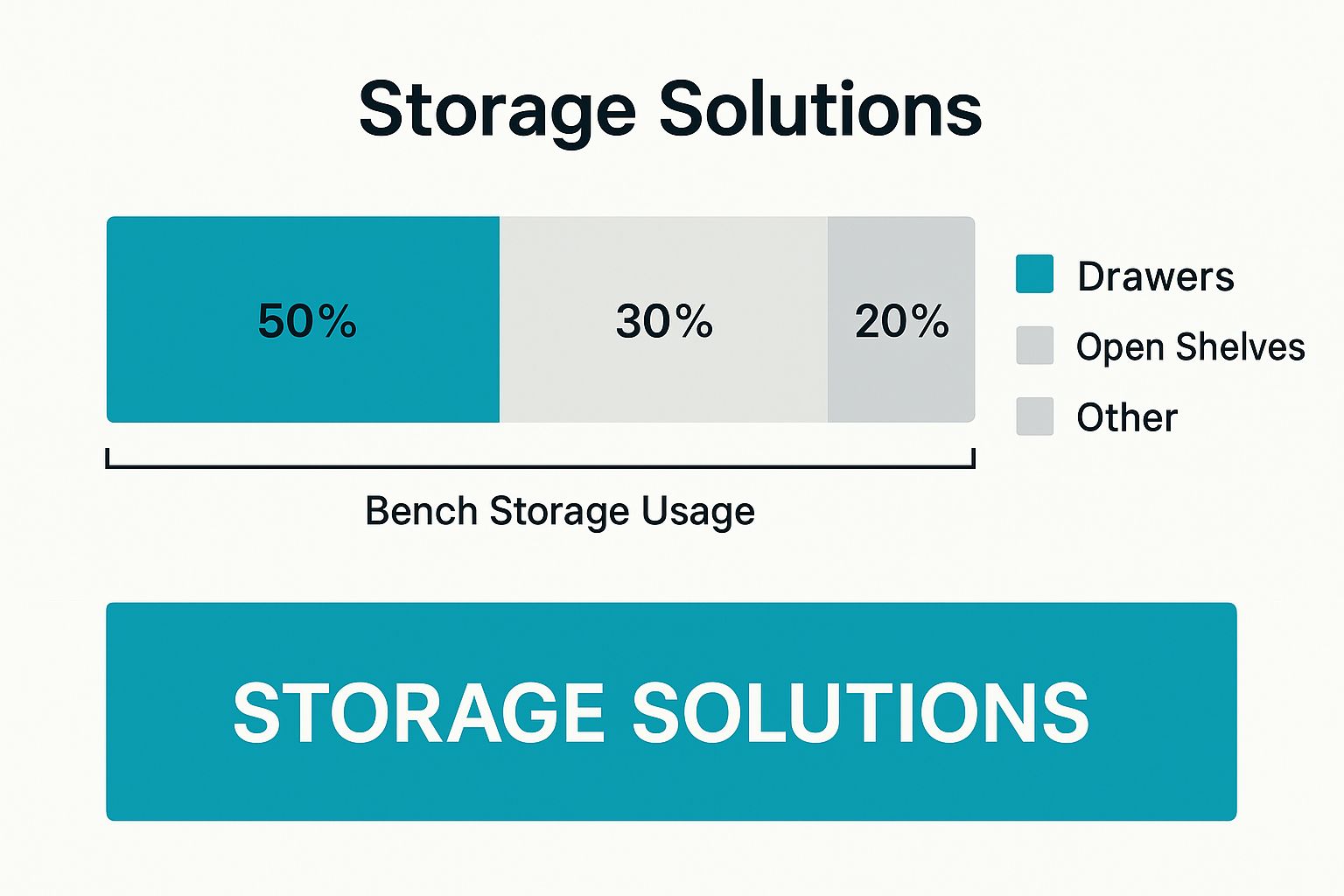
As you can see, having drawers and shelves built right into the bench is fundamental for keeping your workspace organised and functional.
Classic Wooden Workbenches
For anyone who loves woodworking or is a keen DIYer, the traditional wooden workbench is a timeless classic. There’s a good reason for that. Its solid wood top is gentle enough not to mar delicate pieces, but it’s still more than sturdy enough for heavy-duty sawing, sanding, and assembling.
Storage on these benches tends to be straightforward and practical. You’ll usually find classic wooden drawers, which are ideal for keeping hand tools like chisels, planes, and measuring tapes neatly organised. Often, there’s a large, open shelf at the bottom—a handy spot for stashing bulkier items or your current work-in-progress.
Heavy-Duty Steel Workbenches
Now, when your work involves grease, chemicals, or heavy machinery, a steel workbench is the clear winner. It’s the go-to choice for mechanics, metalworkers, and engineers because these units are built to take a serious beating. The powder-coated steel frame and worktop will shrug off rust, impacts, and stains without any fuss.
The storage is just as tough. You can typically expect:
- Deep drawers on ball-bearing slides: These are built to hold heavy power tools and socket sets without ever buckling under the weight.
- Locking cabinets: Absolutely essential for keeping valuable equipment secure, especially in a shared or commercial workshop.
- Integrated backboards or pegboards: This gives you instant, at-a-glance access to your most-used tools, right where you need them.
The core principle is simple: fit the work to the worker. A heavy-duty steel workbench with secure, organised storage allows mechanics and fabricators to minimise movement and keep their focus entirely on the precision task at hand, boosting both safety and output.
These features make steel workbenches an absolute powerhouse of efficiency, particularly in demanding industrial or automotive settings.
Mobile and Rolling Workbenches
But what if your workshop is a shared space, or you need to reconfigure it on the fly? This is where a mobile workbench on heavy-duty castors really shines. These clever units let you bring your entire work surface and toolset directly to the project, whether that’s a car in the garage or a large assembly on the factory floor.
Don’t think that being mobile means sacrificing storage. Modern rolling workbenches are surprisingly well-equipped, often featuring a compact but efficient layout of drawers and a small cabinet. They’re essentially a complete workstation on wheels. Just make sure you look for models with locking castors to ensure everything stays put once you’re in position and ready to work.
Comparing Common Workbench and Storage Options
To make the choice a bit clearer, we’ve put together a quick comparison. Think about your typical projects, how much space you’ve got, and what you need to store to find the best fit for your workshop.
| Workbench Type | Best For | Common Storage Features | Typical Price Range (UK) |
|---|---|---|---|
| Classic Wooden | Woodworking, general DIY, hobby crafts | Wooden drawers, large open lower shelf | £150 – £600 |
| Heavy-Duty Steel | Mechanics, metalworking, engineering, industrial use | Deep steel drawers, locking cabinets, integrated pegboards | £300 – £1,500+ |
| Mobile / Rolling | Dynamic workshops, shared spaces, on-site repairs | Compact drawers and cabinets, tool trays, locking castors | £200 – £800 |
Ultimately, the right bench isn’t just a surface—it’s the foundation of your entire workspace. Matching the type to your needs ensures you have a reliable partner for every project you take on.
Getting Down to the Details: What Really Makes a Great Workbench?
Once you’ve got a handle on the general type of workbench you need, it’s time to zoom in on the features. This is where you separate a good workbench from a great one – the kind that feels like an extension of your hands and lasts for years. Think of it like buying a new car; you know you want an SUV, but now you’re looking at the engine, the feel of the steering, and the little comforts that make driving it a pleasure.
These details aren’t just fancy extras. They’re the nuts and bolts of what makes a workbench practical, durable, and secure. From the feel of the surface under your hands to the satisfying slide of a well-made drawer, every element plays a part in your daily work.
Your Worktop: The Foundation of Every Project
The work surface is where the magic happens, so getting the material right is probably the most important decision you’ll make. Each option has its own personality, suited to different kinds of jobs.
Solid Wood: The classic choice, and for good reason. A solid wood top is a woodworker’s best friend. It has a bit of give, so it won’t damage delicate projects, and it’s tough enough to handle heavy clamping. Best of all, if it gets beaten up, you can just sand it down and refinish it, ready for another decade of use.
MDF (Medium-Density Fibreboard): A really popular, wallet-friendly option. MDF gives you a perfectly smooth and flat surface, which is ideal for general-purpose DIY, assembling flat-pack furniture, or tinkering with electronics. It’s not as tough as solid wood, but if it gets wrecked, it’s cheap and easy to replace.
Stainless Steel: If you’re a mechanic, engineer, or anyone working with oils, chemicals, or heat, stainless steel is the undisputed king. It’s non-porous, a breeze to clean, and stands up to almost any abuse you can throw at it. For a messy or heavy-duty environment, it’s the most durable choice by a country mile.
Choosing the right surface is about protecting your work and your workbench. It’s the foundation you’ll be relying on for every task.
The Mechanics of Good Storage
The drawers and cupboards on your workbench are only as good as the hardware that holds them together. Cheap out on this, and you’ll spend years fighting with sticking drawers and shelves that sag under the weight of your tools. Good-quality mechanics, on the other hand, just work, day in and day out.
One of the first things to look for is ball-bearing drawer slides. Unlike the basic slides that just rely on friction, ball bearings let the drawers glide open smoothly and silently, even when they’re packed with your heaviest spanners. It sounds like a small thing, but it makes a world of difference when you’re in the middle of a job.
A central locking system is another must-have, especially if you share your workshop or store valuable tools. The ability to lock every drawer and cabinet with a single turn of a key is a huge plus. It offers peace of mind and keeps your expensive gear safe and sound.
This focus on smart organisation isn’t just a workshop trend. As our homes and workspaces get smaller, we’re all looking for better storage solutions. You can see it in the UK’s self-storage industry, which was valued at around USD 1.3 billion in 2024 and is set to keep growing. It just goes to show how much we value having a place for everything. If you’re interested, you can learn more about UK self-storage market growth projections and see how it reflects this wider need for better organisation.
Clever Extras for the Modern Workshop
Beyond the basics, many modern workbenches come with thoughtful features that can seriously upgrade your workflow and comfort. They’re designed to solve those little annoyances that can pull you out of the zone.
A truly effective workspace anticipates your needs before you even realise you have them. Integrated power and lighting aren’t luxuries; they’re essential tools that stop you from breaking your flow and help you focus on the task at hand.
Keep an eye out for these game-changing enhancements:
Integrated Power Strips: We’ve all been there – hunting for a free socket or tripping over a tangle of extension leads. A built-in power strip puts multiple outlets right where you need them. It’s perfect for keeping batteries on charge or running tools without the clutter.
Built-in Lighting: You can’t do good work if you can’t see properly. An integrated overhead LED light is a brilliant feature, bathing your entire worktop in clear, shadow-free light. It makes a massive difference for fiddly jobs like soldering or fine assembly and really helps reduce eye strain.
Adjustable Height Legs: This one is all about ergonomics. A workbench that you can set to the perfect height for your body, whether you’re sitting or standing, is a lifesaver. It might seem like a simple feature, but preventing back pain and fatigue during a long day in the workshop is priceless for your long-term health.
Smart Strategies for Organising Your Workbench
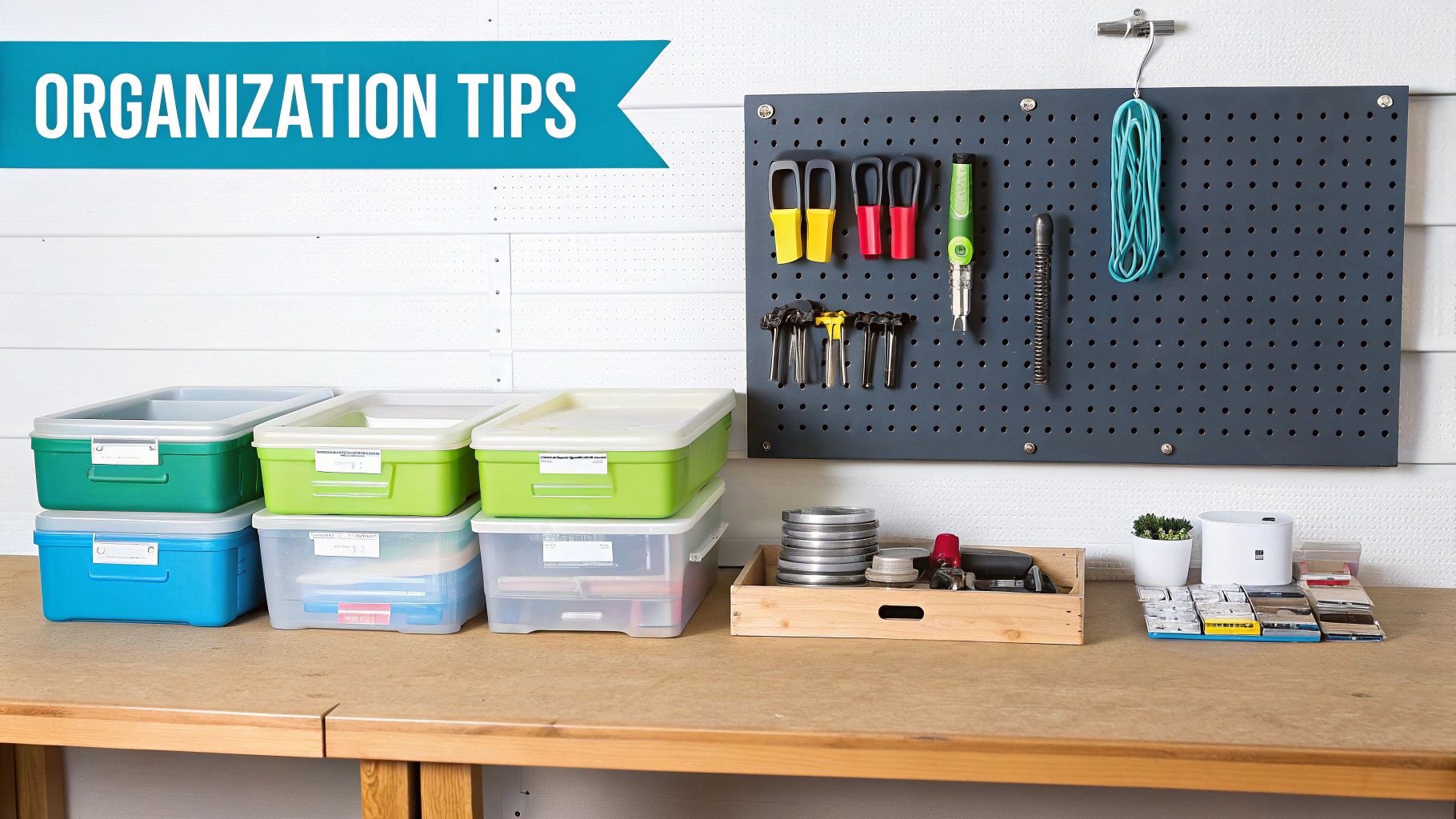
A brand-new workbench with its rows of empty drawers is a thing of beauty. But without a solid plan, that pristine potential can quickly descend into a jumbled mess of tools, leading to endless frustration. The secret to real efficiency isn’t just having storage; it’s about having a smart strategy for how you use it.
Think about a professional chef’s station just before a busy service. They call it ‘mise en place’—a French term meaning ‘everything in its place’. Every vegetable is chopped, every pan is at hand, and every utensil is within easy reach. This level of preparation allows them to cook with incredible focus and precision. Applying that same philosophy to your work benches with storage can completely transform your workflow from chaotic to controlled.
The aim is simple: to make finding any tool an instant, almost thoughtless, action. This frees up your mental bandwidth to focus entirely on the project in front of you, which boosts both your speed and the quality of your work.
Creating Your Workflow Zones
The most effective way to organise your storage is by creating logical zones. It’s a straightforward concept: group your tools and supplies based on how, where, and how often you use them. This simple system stops you from rummaging through every single drawer just to find one specific Allen key.
First, define your primary work zone. This is the area directly in front of you, within immediate arm’s reach. Anything you use constantly—your go-to screwdriver, a tape measure, a Stanley knife—needs to live here. A magnetic tool bar mounted on the backboard or the top drawer of your bench is perfect for this.
From there, dedicate specific drawers or cabinets to particular types of tasks. Think of them as project-specific kits that you can grab in a second.
- Electrical Drawer: This is home to your wire strippers, soldering iron, multimeter, and heat-shrink tubing. Everything for an electrical job, all in one spot.
- Finishing Drawer: Keep your sandpapers, wood stains, brushes, and protective gloves together so you’re always ready for the final touches.
- Drilling & Driving Drawer: Organise all your drill bits, driver bits, and chuck keys so they’re neat and ready to go.
This method means you only need to open one drawer for any given stage of a project, which dramatically speeds things up. If you’re looking for more in-depth guidance on this, we’ve put together a post covering top storage ideas for workshop organisation efficiency right here on our blog.
Mastering the Art of Internal Organisation
Once you’ve mapped out your zones, the next step is to get organised inside the drawers and cabinets. Just tossing tools into a drawer is a recipe for chaos. The right accessories are crucial for stopping everything from sliding into a tangled heap every time you open it.
An organised workbench isn’t just about tidiness; it’s a system designed to reduce wasted motion and cognitive load. Every second saved not searching for a tool is a second spent making progress.
Consider adding these simple but incredibly effective items:
- Foam Inserts: Custom-cut foam organisers are a real game-changer. They create a specific ‘shadow’ for each tool, making it glaringly obvious if something is missing while also protecting your expensive kit from getting knocked about.
- Small Bin Trays: These are perfect for all those tiny items like screws, nuts, bolts, and washers. Using labelled or even colour-coded bins makes finding the right fastener instant.
- Drawer Dividers: Adjustable dividers let you create custom-sized compartments for larger hand tools like spanners, pliers, and hammers, keeping them neat and orderly.
Many of the principles we use in a workshop are actually universal. The core ideas of zoning and easy access can be applied to any space where efficiency is key. For example, you can see similar concepts in action when looking at kitchen storage ideas to maximise space, where every utensil and ingredient has its own designated home.
By putting these strategies into practice, you’ll turn your workbench from a simple storage unit into a high-performance workstation. It becomes a system where every tool has a home, allowing your focus to remain squarely on your craft.
How to Spot a Workbench Built to Last
A quality workbench isn’t just another piece of kit; it’s a long-term investment. Think of it as a reliable partner that needs to stand up to years, maybe even decades, of serious work. To find a good one, you have to look past the price tag and get a feel for its real build quality. It’s a bit like inspecting a house’s foundations – the true strength is often hidden in the details.
Once you know what to look for, you can easily tell the difference between a workbench that will last and one that will let you down. It’s all about checking the frame, the fixings, and the finish. These are the things that separate a temporary fix from a permanent, trusted fixture in your workshop.
The Bones of the Bench: Construction Quality
The frame is the skeleton of your workbench, and it absolutely has to be strong. For steel benches, the gauge of the steel is your first port of call. It’s a bit counter-intuitive, but a lower gauge number actually means thicker, stronger steel, which gives you far better rigidity and resistance to knocks and bumps. If you can, go for a bench with fully welded joints. They’re massively stronger than bolted connections, which have a nasty habit of working themselves loose over time.
With wooden benches, it’s all about the joinery. Look for classic signs of craftsmanship like dovetail or mortise-and-tenon joints. These will hold solid under serious pressure, unlike simple butt joints that are just screwed together. The quality of the nuts, bolts, and screws also tells a big part of the story. High-grade steel hardware is essential to make sure everything stays clamped down tight through years of vibration and heavy loads.
Getting to Grips with Load Capacity Ratings
Every workbench has its breaking point, and manufacturers state this with a load capacity rating. But here’s the key: it’s not just one single number. You need to check the capacity for the worktop and for each individual drawer. A work surface that can hold a ton is fantastic, but it’s no use if the drawers underneath collapse the second you fill them with power tools.
A workbench’s durability is a system, not a single feature. The load capacity of the surface, drawers, and frame must work together to handle the demands of your projects safely and reliably.
Always look for clear, tested ratings and think about the heaviest jobs you’re likely to tackle. If you’re wrestling with engine blocks or heavy machinery, a work surface rated for 1,000 kg or more is a sensible target. For drawers, ball-bearing slides are a must-have. They not only give you that smooth opening action but also support much heavier loads, often upwards of 40-50 kg per drawer. You can discover more about our durable work storage benches and check their specific load capacities on our product pages.
Why a Durable Finish Matters
A tough finish does more than just look good; it’s the workbench’s first line of defence against the daily grind of a workshop. With steel benches, a quality powder-coated finish is the gold standard. This process bakes on a hard, resilient layer that stands up to scratches, chemical spills, and most importantly, rust.
On wooden benches, you want to see a thick, hardy varnish or oil finish that has properly soaked into the grain, not just sitting on the surface. This seals the timber against moisture and makes cleaning up spills much easier. This mindset should apply to your whole workspace. To create a workshop that truly stands the test of time, you might also consider investing in some heavy-duty floor protection.
This drive for smarter, more durable storage is part of a bigger picture in the UK. The self-storage industry saw its available space grow by 7.2% last year, hitting over 64 million square feet. It shows a real demand for better storage, especially when you realise the UK has just 0.8 square feet of storage per person, compared to 9.5 in the US. This opens up a huge opportunity for integrated solutions like the quality workbenches we’ve been talking about.
Your Final Checklist Before You Buy
Alright, you’ve done the homework. You now know what separates a truly great workbench from just another flat surface. To make sure you get this right, I’ve put together a final checklist. Think of it as your last-minute reality check before you commit.
Running through these quick questions will give you the confidence that you’re buying the right bench – one that will become the real workhorse of your garage or workshop.
Defining Your Needs and Space
First things first, let’s nail down the practicalities. It’s easy to get excited about features, but even the world’s best workbench is useless if it doesn’t fit your space or the jobs you need it for.
- Have you got your tape measure out? Seriously, measure the height, width, and depth of where it’s going to live. Don’t forget to leave room to actually move around it and fully open drawers and cupboards.
- What are you actually making? List the top three projects you’ll be tackling. This tells you exactly what kind of worktop you need and how much weight it has to handle.
- What’s your budget, really? Be honest with yourself about what you can spend. And remember to check for any hidden delivery charges or essential accessories you’ll need to buy separately.
Must-Have Features and Logistics
With the basics sorted, it’s time to sweat the small stuff. These are the details that turn a good purchase into a great one and save you from any nasty surprises down the line.
Your final decision should balance what you need today with what you’ll need tomorrow. A workbench isn’t just a purchase; it’s an investment in your productivity, your safety, and the quality of your work.
Here’s what to confirm before you click “buy”:
- Worktop Material: Does the surface match your work? Whether it’s solid wood for joinery, steel for fabrication, or MDF for general tasks, make sure it’s the right fit.
- Storage Capacity: Are the drawers and cupboards big enough for your most-used tools? More importantly, can they handle the weight?
- Build Quality: Have a close look at the construction. Are the steel frames properly welded? Is the joinery on the wooden parts solid? These are tell-tale signs of quality.
- Assembly: Does it arrive built, or is it a flat-pack marathon? If it’s the latter, be realistic about whether you have the time and patience to put it together.
- Warranty and Support: What’s the guarantee like? A solid warranty on the frame, worktop, and moving parts like drawer runners offers genuine peace of mind.
Got a Few More Questions?
Choosing the right workbench is a big decision, so it’s natural to have a few final things to clear up. Let’s tackle some of the most common questions we hear – getting these answers sorted will help you make a choice you’re happy with for years to come.
What’s the Best Worktop for General DIY Stuff?
For most jobs around the house or in a home workshop, you can’t go wrong with either solid wood or a good quality MDF (Medium-Density Fibreboard). Solid wood is the classic choice for a reason: it’s incredibly tough, you can sand it down and refinish it if it gets a bit battered, and it won’t scratch up delicate materials.
On the other hand, MDF gives you a perfectly flat and smooth surface that’s a bit kinder on the wallet. It’s brilliant for anything that needs precision, like electronics, model-making, or general assembly. Both are fantastic all-rounders.
How Much Weight Can a Decent Heavy-Duty Workbench Actually Hold?
This is a big one, and it really varies. As a rule of thumb, a proper heavy-duty workbench should be able to handle a load of at least 500 kg to 1,000 kg on the worktop itself. That’s more than enough muscle for engine parts, welding projects, and other serious bits of kit.
But don’t just look at the top surface. Check the drawer capacity, too. On a well-built bench, each drawer should be rated for somewhere between 40 kg and 75 kg. This means you can load them up with spanners, power tools, and socket sets without worrying about them buckling. Always double-check the manufacturer’s specs before you buy.
A workbench’s real strength isn’t just one number. The surface has to hold the project, and the storage has to hold the tools. Make sure both ratings are up to scratch for your work to stay safe and reliable.
Are Flat-Pack Benches as Solid as the Pre-Built Ones?
A well-designed flat-pack workbench can absolutely be as sturdy as a pre-assembled one, but it all comes down to how you put it together. The secret is in the quality of the materials and the connections. You want to see thick-gauge steel, chunky bolts, and instructions that actually make sense.
Of course, pre-assembled units with welded frames give you that solid-as-a-rock feeling right away. But a top-notch flat-pack from a good brand is engineered for rigidity and will be just as strong once you’ve tightened up that last bolt.
How Do I Keep My Tools Safe in a Shared Workshop?
When you’re sharing a space, security is everything. The single most important feature to look for in work benches with storage is a central locking system. It’s simple but effective: one turn of a key locks every single drawer and cabinet.
It gives you total peace of mind and is the easiest way to protect your investment. For an extra layer of security, go for a bench built from heavy-gauge steel – its sheer toughness is often enough to put off any opportunists.
Ready to build a workspace that’s organised, efficient, and tough enough for the real world? TEMA Solutions Limited has a massive selection of industry-leading workbenches and storage designed for demanding professional environments. Take a look at our collection and find the perfect backbone for your workshop at https://tema-solutions.co.uk.


